How the Landlord-Tenant Relationship Is Documented

Documenting the landlord-tenant relationship is defined as the practice of creating, organizing, and retaining written records that establish the rights and obligations of both parties throughout a tenancy. A signed lease agreement is the foundation of every tenancy, but the full record extends far beyond that single document. Landlords who maintain timestamped maintenance logs, signed inspection reports, and consistent communication trails hold a decisive legal advantage when disputes arise. The TPLS framework (Timestamped, Photographic, Linked, Signed) sets the standard for court-admissible records that can withstand scrutiny in eviction court or a security deposit hearing.
What documents form the foundation of landlord-tenant records?
The written lease agreement is the most legally critical document in any tenancy. Leases exceeding one year must be in writing and signed by both parties to be legally enforceable in most jurisdictions. That requirement alone makes a signed, dated lease the non-negotiable starting point for every landlord-tenant relationship.
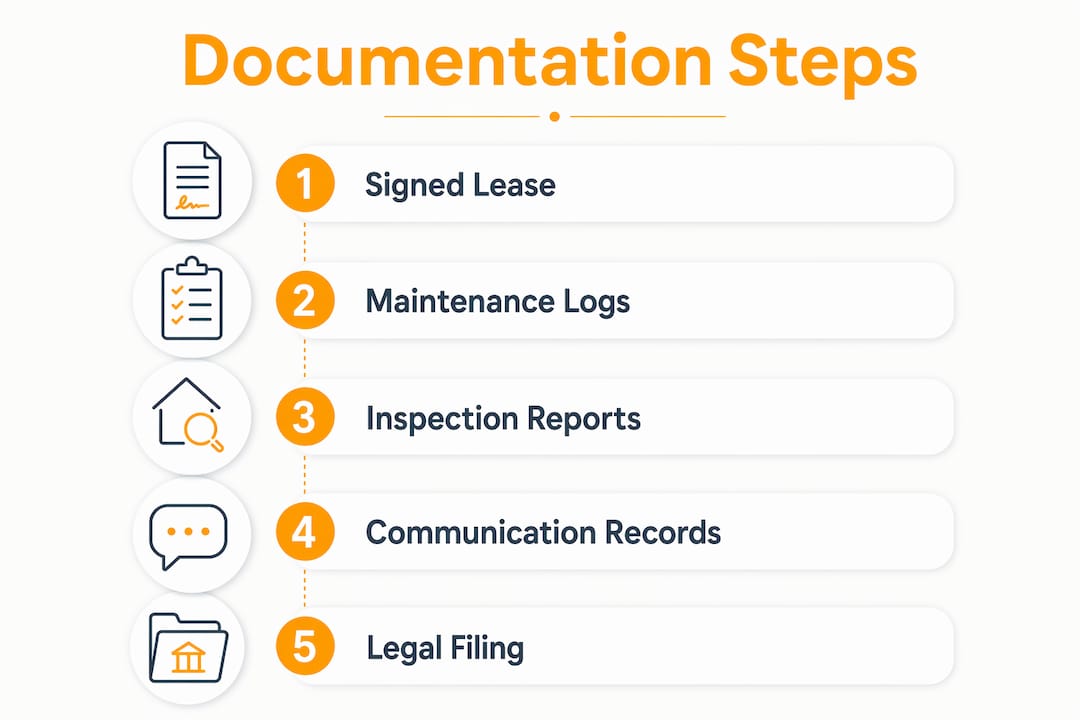
Beyond the lease, a complete documentation set includes four categories of records:
- Written lease agreement. The lease defines rent amount, due dates, maintenance responsibilities, and grounds for termination. A lease without signatures or a clear effective date is difficult to enforce.
- Move-in and move-out inspection reports. The move-in baseline record, signed, photographed, and dated before the tenant takes possession, is the single most critical document for resolving deposit disputes. Without it, a dispute becomes the tenant’s word against yours.
- Rental applications and screening records. These establish when the relationship began and document the criteria used to approve the tenant. They also provide a defense against fair housing complaints.
- Communication records. Every notice, repair request, and written acknowledgment belongs in the file. Emails, text messages, and certified mail receipts all qualify. The goal is a chronological record of every substantive exchange.
A centralized system for storing these records improves both legal leverage and day-to-day efficiency. Scattered files across email inboxes, paper folders, and phone texts create gaps that are hard to close when a dispute surfaces.
How to document maintenance requests and repairs

Proper maintenance documentation is the most overlooked part of landlord compliance, and the most costly to ignore. A habitability counterclaim triggered by poor maintenance records can escalate case costs from a straightforward $500–$2,000 dispute to over $9,900. That single fact explains why landlords document repair requests with the same rigor they apply to rent collection.
Follow these steps for every maintenance interaction:
- Log the request immediately. Record the date, time, tenant name, unit number, and the tenant’s exact description of the problem. Do not paraphrase. Exact wording matters if the issue later becomes a habitability claim.
- Confirm verbal requests in writing within 24 hours. Follow up all verbal conversations on maintenance matters with a written summary sent to the tenant by email or text. This creates a paper trail even when the tenant calls rather than writes.
- Schedule and document the repair. Record the scheduled date, the vendor or contractor assigned, and the estimated completion date. Attach the vendor invoice once work is complete.
- Photograph before and after. Photos with embedded timestamps show the condition that prompted the repair and confirm the completed fix. Store photos linked directly to the maintenance request record.
- Get a signature or written acknowledgment. Ask the tenant to confirm the repair was completed satisfactorily. A short email reply works. A signed completion form is better.
- Retain the full file. Keep the original request, all communications, the vendor invoice, photos, and the completion acknowledgment together as a single linked record.
Pro Tip: A maintenance request filed within 30 days before or after an eviction notice can trigger a retaliatory eviction claim. A timestamped maintenance file showing prompt response is the only reliable counter to that defense. Build the file in real time, not after the notice is served.
Documentation gaps are the most preventable cause of eviction failure. Consistent, prompt maintenance response documentation is the foundation of any habitability defense.
What role do inspections and communication trails play?
Regular inspections create contemporaneous evidence of unit conditions. Routine unit inspections every 6–12 months with written notes and photos are among the most effective practices for countering habitability claims. They show that you monitored the property, identified issues, and acted on them.
Every inspection should include the following elements:
- Written notice to the tenant before entry, consistent with your state’s required notice period (typically 24–48 hours).
- A completed inspection checklist covering every room, appliance, and system. Use a standardized form so records are consistent across tenancies.
- Timestamped photographs of every area inspected, including any damage or wear noted.
- Tenant signature or written acknowledgment of the inspection findings. If the tenant refuses to sign, note the refusal in writing with the date and time.
- Documentation of any tenant refusal to allow the inspection. This record protects you if the tenant later claims you failed to maintain the property.
The communication trail works alongside inspections to show landlord responsiveness. The table below outlines the key communication types and their documentation purpose.
| Communication type | Documentation purpose |
|---|---|
| Written lease notices | Establishes formal notification of obligations or violations |
| Repair request acknowledgments | Confirms landlord received and acted on tenant concerns |
| Lease violation notices | Cites specific lease clause and provides proof of service |
| Move-in and move-out reports | Creates baseline and exit condition record for deposit disputes |
| Inspection notifications | Demonstrates lawful entry and tenant awareness |
Verified lease violation notices with clear lease clause citations and proof of service strengthen enforcement efforts and reduce disputes. A notice without a cited clause or delivery confirmation is far harder to defend in court.
How to organize and maintain documentation for legal defense
Most landlord-tenant conflicts are decided on the quality of evidence, not the volume. Records must be specific, linked, and signed to prevail. A folder full of undated photos and unsigned notes rarely wins a case.
The TPLS framework provides a clear standard for every record you create:
- Timestamped. Every document carries an original creation date and time, ideally with metadata that cannot be altered after the fact.
- Photographic. Visual evidence accompanies written records wherever property condition is relevant.
- Linked. Related records reference each other. A repair request links to the vendor invoice, which links to the completion photo, which links to the tenant acknowledgment.
- Signed. Every substantive document carries a signature or written acknowledgment from the relevant party.
Missing two or more TPLS elements reduces the evidentiary value of a record significantly. Courts prefer real-time, daily logs over reconstructed timelines created after a dispute begins.
Pro Tip: Cross-reference your records from the start. Link the lease to any violation notices, link violation notices to repair logs, and link repair logs to inspection reports. A judge reviewing your file should be able to follow the full history of any issue without asking for additional documents.
Retention periods vary by state, but a practical rule is to keep all tenancy records for at least three years after the tenancy ends. Some states require longer periods for security deposit records or habitability claims. Check your state’s statute of limitations for landlord-tenant disputes and set your retention policy accordingly.
Landlordforms supports this workflow by generating timestamped landlord documents including lease agreements, inspection checklists, and violation notices, all formatted for legal compliance and organized in one place.
Key takeaways
Proper landlord-tenant documentation requires a signed lease, real-time maintenance logs, periodic inspections, and a complete communication trail organized under the TPLS framework to be defensible in court.
| Point | Details |
|---|---|
| Signed lease is non-negotiable | Leases over one year must be written and signed to be legally enforceable. |
| Move-in baseline prevents deposit disputes | A signed, photographed, dated move-in report is the strongest record for deposit resolution. |
| Maintenance logs reduce eviction risk | Prompt, timestamped maintenance records counter habitability claims and retaliatory eviction defenses. |
| TPLS framework sets the evidence standard | Records must be Timestamped, Photographic, Linked, and Signed to hold up in court. |
| Real-time records outperform reconstructed ones | Courts discount timelines and logs created after a dispute begins. |
What landlords consistently get wrong about documentation
Most landlords I have seen in trouble did not fail because they were bad property managers. They failed because they documented inconsistently. They kept great records for the first six months of a tenancy and then stopped. By month 18, when a dispute surfaced, their file had a strong beginning and almost nothing after that.
The move-in baseline is the record landlords most often get right. The ongoing communication trail is where things fall apart. A verbal agreement to allow a pet, a phone call about a leaking faucet, a conversation about a lease renewal, none of these exist legally unless you follow them up in writing. I have watched landlords lose deposit disputes over a single undocumented verbal conversation that the tenant remembered differently.
The other mistake I see regularly is treating documentation as a reactive task. Landlords start building files only after a problem appears. By then, reconstructed records carry far less weight than contemporaneous ones. A judge notices when every document in a file was created on the same day, two weeks after the eviction notice was served.
The landlords who avoid costly legal challenges treat documentation as a daily habit, not a crisis response. They use a move-in checklist on day one, log every maintenance call the same day it comes in, and send a written summary after every substantive conversation. That discipline is what separates a defensible file from an expensive lesson.
— Igor
Landlordforms makes complete documentation faster
Building a complete, legally sound documentation file does not require hours of manual work. Landlordforms is built for landlords managing 1 to 150 units and automates the creation of the documents that matter most.
The platform generates lease agreements, eviction notices, lease violation notices, and inspection checklists in a few clicks. The rent ledger template provides a timestamped payment record that holds up in court. Photo documentation for inspections is built into the workflow, so your records meet the TPLS standard without extra effort. Landlordforms saves landlords up to eight hours a week by replacing manual entry with accurate, professional documents generated from a single platform.
FAQ
What is the most important document in a landlord-tenant relationship?
The signed lease agreement is the most legally critical document. It defines rent, responsibilities, and grounds for termination, and leases over one year must be in writing to be enforceable.
How does documentation reduce eviction risk?
Timestamped maintenance logs and inspection records counter habitability counterclaims, which can escalate a simple eviction case from under $2,000 to over $9,900 in costs.
Why do judges review landlord documentation so closely?
Judges evaluate the quality and timing of records to determine credibility. Real-time, linked, and signed records carry far more weight than documents reconstructed after a dispute begins.
What is the TPLS standard for landlord records?
TPLS stands for Timestamped, Photographic, Linked, and Signed. A record missing two or more of these elements has significantly reduced evidentiary value in court.
How long should landlords keep tenant records?
A practical minimum is three years after the tenancy ends, though some states require longer retention periods for deposit records and habitability claims. Check your state’s statute of limitations to set the right policy.