The Role of Tenant Screening Documents in 2026

TL;DR:
- Tenant screening documents form the legal infrastructure for defensible rental decisions and protect landlords from legal risks.
- Using multiple verified sources and proper procedures ensures compliance with FCRA and Fair Housing Act requirements.
Tenant screening documents are the verifiable foundation landlords use to make legally defensible rental decisions while reducing financial risk. The role of tenant screening documents goes far beyond collecting paperwork. These records, governed by the Fair Credit Reporting Act (FCRA) and the Fair Housing Act (FHA), determine whether a landlord can defend a denial, prove consistent criteria, or survive a discrimination claim. Landlords who treat screening documents as a legal infrastructure rather than a formality protect their properties, their income, and their legal standing from the first application forward.
What are the essential tenant screening documents?
Tenant screening documents are the specific records landlords collect to evaluate a rental applicant’s financial reliability, rental history, and legal background. Each document type answers a different question about risk.
The five core documents in any screening file are:
- Credit report: Shows payment history, outstanding debt, and credit score. Lenders and landlords use the standard threshold of three times the monthly rent as the minimum qualifying income benchmark.
- Criminal background check: Identifies felony and misdemeanor convictions relevant to property safety. Landlords must apply this criterion consistently to avoid FHA violations.
- Eviction history report: Pulls from dedicated eviction databases. 28% of eviction filings never appear on standard credit reports. That gap means a credit-only search can miss a serial non-payer entirely.
- Income verification: Pay stubs, W-2s, or employer letters confirm an applicant can afford the rent. Manual document review detects only 40–50% of falsified submissions.
- Rental references: Written or verbal confirmation from prior landlords about payment behavior, property care, and lease compliance.
No single document gives the full picture. A ResidentScore, a scoring model built specifically for rental risk, predicts eviction risk 15% better than a standard FICO score. That improvement comes from weighting rental-specific behaviors that general credit models ignore.
| Document | What it verifies |
|---|---|
| Credit report | Debt load, payment history, credit score |
| Criminal background check | Felony and misdemeanor convictions |
| Eviction history report | Prior eviction filings from court databases |
| Income verification | Ability to meet the 3x monthly rent threshold |
| Rental references | Landlord-reported behavior and lease compliance |

Pro Tip: Always order a dedicated eviction database search separately from the credit report. Bundling them into one report does not guarantee eviction court records are included.
How do tenant screening documents support legal compliance?
Tenant screening documents are the primary defense a landlord has against FCRA violations, FHA disparate treatment claims, and adverse action disputes. Getting the paperwork right is not optional.
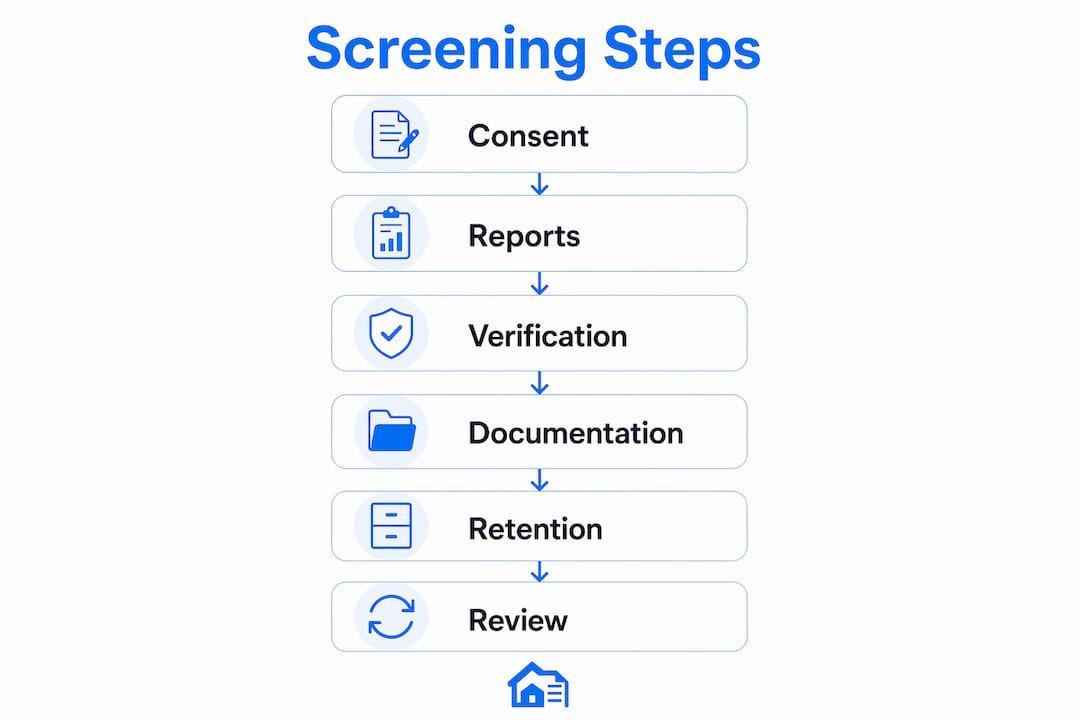
The FCRA requires a standalone written consent form before you pull any consumer report on an applicant. Bundling FCRA consent inside the rental application is a direct violation of federal law. The disclosure must be a separate document, signed by the applicant, before any screening begins. Many landlords skip this step and face penalties that far exceed the cost of a single bad tenant.
Consistent documentation also neutralizes FHA risk. Documented screening criteria provide a critical defense against Fair Housing Act claims because they prove every applicant was evaluated against the same written standard. Without that paper trail, a denial can look like discrimination even when it was not.
Record retention is the third pillar. Landlords must retain complete applicant files for at least four years to comply with FCRA requirements and defend against discrimination claims. That file must include the screening criteria in effect at the time, the signed consent form, the reports ordered, and the written decision.
Pro Tip: Create a dated decision memo for every applicant, approved or denied. One paragraph explaining which criteria the applicant met or failed gives you a documented, consistent record that holds up in court.
Key compliance obligations at a glance:
- Obtain standalone written FCRA consent before ordering any report
- Apply the same written criteria to every applicant for the same unit
- Issue an adverse action notice when denying based on a consumer report
- Retain the full applicant file for a minimum of four years
- Challenge inaccurate report data before taking adverse action under FCRA §1681e(b)
What are common challenges landlords face with screening documents?
The biggest mistakes in the tenant screening process are not dramatic. They are quiet procedural failures that create serious legal and financial exposure over time.
Relying on credit reports alone is the most common error. Because 28% of eviction filings are invisible on credit searches, a landlord who skips a dedicated eviction database check can approve a tenant with three prior evictions and no credit blemishes. That applicant looks perfect on paper until month two.
Falsified income documents are a larger problem than most landlords expect. 84.3% of landlords reported encountering falsified income documentation in 2024. Pay stubs are easy to alter with basic software. Manual review catches less than half of fraudulent submissions. Payroll database verification, which pulls directly from employer payroll systems, closes that gap significantly.
Improper consent forms create FCRA liability before screening even begins. A consent clause buried in the rental application does not satisfy the standalone disclosure requirement. The penalty for noncompliance is not theoretical. Applicants can and do file FCRA claims against landlords who skip this step.
Inconsistent criteria application is the fastest path to an FHA complaint. Legal liability stems more from inconsistent application of screening criteria than from the criteria themselves. Approving one applicant with a prior eviction while denying another with the same history creates a documented pattern of disparate treatment.
Incomplete tenant files can be used as evidence in Fair Housing litigation regardless of landlord intent. A missing consent form or an undocumented denial decision does not just create a gap in your records. It creates an argument for the other side.
Pro Tip: Use a screening checklist for every applicant. Check off each document as it is received and verified. A completed checklist in the file proves process, not just outcome.
How can landlords build effective screening document workflows?
A repeatable, documented workflow is what separates landlords who survive legal challenges from those who do not. The goal is a process that runs the same way every time, for every applicant.
Step 1: Standardize your application and consent forms. Use the same rental application for every unit. Keep the FCRA consent form as a separate, standalone document. Never modify the consent language without reviewing it against current FCRA requirements.
Step 2: Order a combined screening report from multiple sources. A single-source report misses too much. Order a credit report, a dedicated eviction database search, and a criminal background check separately or through a service that pulls from all three. The eviction database gap alone justifies the extra step.
Step 3: Verify income through payroll databases, not documents alone. Payroll database verification detects 85–95% of income fraud compared to 40–50% for manual document review. The cost of one bad tenant far exceeds the cost of a payroll verification service.
Step 4: Document your decision in writing. Write a brief decision memo for every applicant. Note which criteria they met, which they did not, and the outcome. Date it and keep it in the file.
Step 5: Store all files securely for at least four years. Digital storage with access controls works well for most landlords. Physical files need a locked cabinet. Either way, the file must be complete and retrievable on short notice.
Step 6: Review and update your criteria annually. Screening standards shift with local law changes, court rulings, and updated FHA guidance. A criteria document that was compliant in 2023 may not be compliant in 2026.
Tools like Landlordforms save up to eight hours a week by automating document creation and organizing tenant information in one place. That time savings matters most when you are managing multiple applications at once and need every file to be complete and consistent. You can also use a move-in checklist template to extend your documentation workflow from screening through tenancy.
Key Takeaways
Screening documents are the legal infrastructure of tenant selection, and every gap in that file is a liability waiting to surface.
| Point | Details |
|---|---|
| Use multiple document sources | Credit reports miss 28% of eviction filings; always order a dedicated eviction database search. |
| Standalone FCRA consent is required | Bundling consent in the rental application violates federal law and creates penalty exposure. |
| Retain files for at least four years | Complete applicant files with signed consent, reports, and decision memos satisfy FCRA retention rules. |
| Verify income with payroll databases | Payroll verification catches 85–95% of fraud; manual document review catches less than half. |
| Apply criteria consistently | Inconsistent application of screening standards creates FHA disparate treatment risk regardless of intent. |
Why I think most landlords underestimate their screening paperwork
Most landlords I have spoken with treat tenant screening as a background check and a gut check. They pull a credit report, look at the score, and make a call. That approach works until it does not, and when it fails, the paperwork gap is what turns a bad tenant situation into a legal one.
The insight that changed how I think about this: gut instinct is a poor predictor of tenant success. Documented criteria are not bureaucracy. They are the only thing standing between a landlord and a Fair Housing complaint that has no factual rebuttal. A landlord who cannot produce a signed consent form, a written denial reason, and a consistent criteria document is not just disorganized. That landlord is exposed.
The misconception I see most often is that screening documents protect landlords from bad tenants. They do that, but their bigger function is protecting landlords from legal claims by any tenant, good or bad, who believes the process was unfair. A complete, consistent file is the answer to that claim before it is ever filed.
My honest recommendation: treat your screening file like a legal record from day one. Build the workflow once, use it every time, and update it every year. The landlords who do this rarely end up in housing court defending a process they cannot document.
— Igor
Landlordforms templates for compliant tenant screening
Landlordforms is built for landlords managing 1 to 150 units who need accurate documents without the manual effort. The platform automates the creation of screening-related forms, consent documents, and tenant records, reducing human error and cutting paperwork time significantly.

Every screening workflow needs reliable templates as its foundation. Landlordforms provides free landlord document templates including PDF generators that produce consistent, professional forms for every stage of the tenant screening process. From consent forms to decision records, the documents are ready when you need them, formatted correctly, and stored in one place. For landlords who want to extend that organization into tenancy, the eviction notice template is also available at no cost.
FAQ
What documents are needed for tenant screening?
The core documents for tenant screening are a credit report, a criminal background check, a dedicated eviction history report, income verification, and rental references. Each document verifies a different risk factor that a single report cannot cover alone.
How long must landlords keep tenant screening documents?
Landlords must retain complete applicant files, including signed consent forms, screening reports, and decision documentation, for at least four years to comply with FCRA requirements and defend against discrimination claims.
What is the FCRA consent requirement for tenant screening?
The FCRA requires a separate, standalone written disclosure and consent form before a landlord orders any consumer report on an applicant. Embedding consent language inside the rental application violates federal law.
Why is income verification so important in the screening process?
84.3% of landlords reported encountering falsified income documents in 2024. Payroll database verification detects 85–95% of income fraud, making it far more reliable than reviewing pay stubs or employer letters alone.
How do screening documents protect landlords from Fair Housing Act claims?
Documented, consistently applied screening criteria prove that every applicant was evaluated against the same written standard. Incomplete or inconsistent files can be used as evidence of disparate treatment in Fair Housing litigation, regardless of the landlord’s intent.