30 Day Notice for Tenant: Rules That Keep It Legal

A 30-day notice is a written, dated statement that ends a periodic tenancy, most often a month-to-month rental, and it only works if it’s served with exact language and proof of delivery. If you’re a landlord, the immediate move is to prepare a notice that names every tenant, states the exact property address, spells out a specific calendar termination date, and gets served by a method you can prove in court. If you’re a tenant, confirm that termination date now, save whatever the landlord handed you or mailed you, and keep proof of when you received it.
That single document doesn’t end a tenancy by itself. It starts a clock, and what happens when that clock runs out depends on whether the tenant leaves or stays.
Before you serve or accept anything, run through this:
- Is the exact move-out date written as a calendar date, not “within 30 days”?
- Are all tenants on the lease named individually?
- Does the notice match the property address on the lease, including unit number?
- Is it signed and dated by the person giving it?
- Do you have a method of delivery you can document (certified mail receipt, signed acknowledgment, process server affidavit)?
A 30-day notice is a written letter from tenant to landlord or landlord to tenant expressing intent to terminate or change a periodic tenancy, and its required contents vary by state, according to Cornell’s Legal Information Institute.
Pro Tip: Check that your termination date lines up with your rent cycle before you serve anything. Many states require the notice to end on or before the next rent due date, not exactly 30 days from delivery, and getting this wrong can force an extra month of rent or a dismissed case.
A valid notice is necessary but not sufficient for eviction. If the tenant doesn’t leave by the stated date, the landlord’s next step is a separate court filing, an unlawful detainer or eviction action, not just showing up with a moving truck.
Key Takeaways
A 30-day notice ends a periodic tenancy only when it states an exact termination date, names every tenant, and is served with documented proof, otherwise courts routinely dismiss the eviction case that follows.
| Point | Details |
|---|---|
| Use an exact date | Write a specific calendar termination date, never vague phrasing like “within 30 days.” |
| Count from the day after service | The 30-day clock usually starts the day after delivery, not the delivery day itself. |
| Match your rent cycle | Many states require the termination date to align with the next rent due date. |
| Notice is not eviction | If the tenant stays past the deadline, the landlord must still file an unlawful detainer in court. |
| Document everything | Keep signed proof of service and dated move-out photos to support deposit or court disputes. |
| Use a state-aware template | Landlordforms generates 30-day notices with built-in proof-of-service forms to reduce dismissal risk. |
Table of Contents
- What Is a 30-Day Notice and When Do You Use One?
- What Has to Be in a Valid 30-Day Notice?
- How Do You Count 30 Days and Serve the Notice?
- Landlord and Tenant 30-Day Notice Examples
- What Happens After the 30 Days End?
- How Should a Tenant Respond to a 30-Day Notice?
- Common Mistakes That Get 30-Day Notices Thrown Out
- Do Notice Periods Vary by State?
- Why Getting the Notice Right Actually Matters
- How Landlordforms Makes 30-Day Notices Simple
- Where to Verify Local Notice Rules
- Sources
- FAQ
What Is a 30-Day Notice and When Do You Use One?
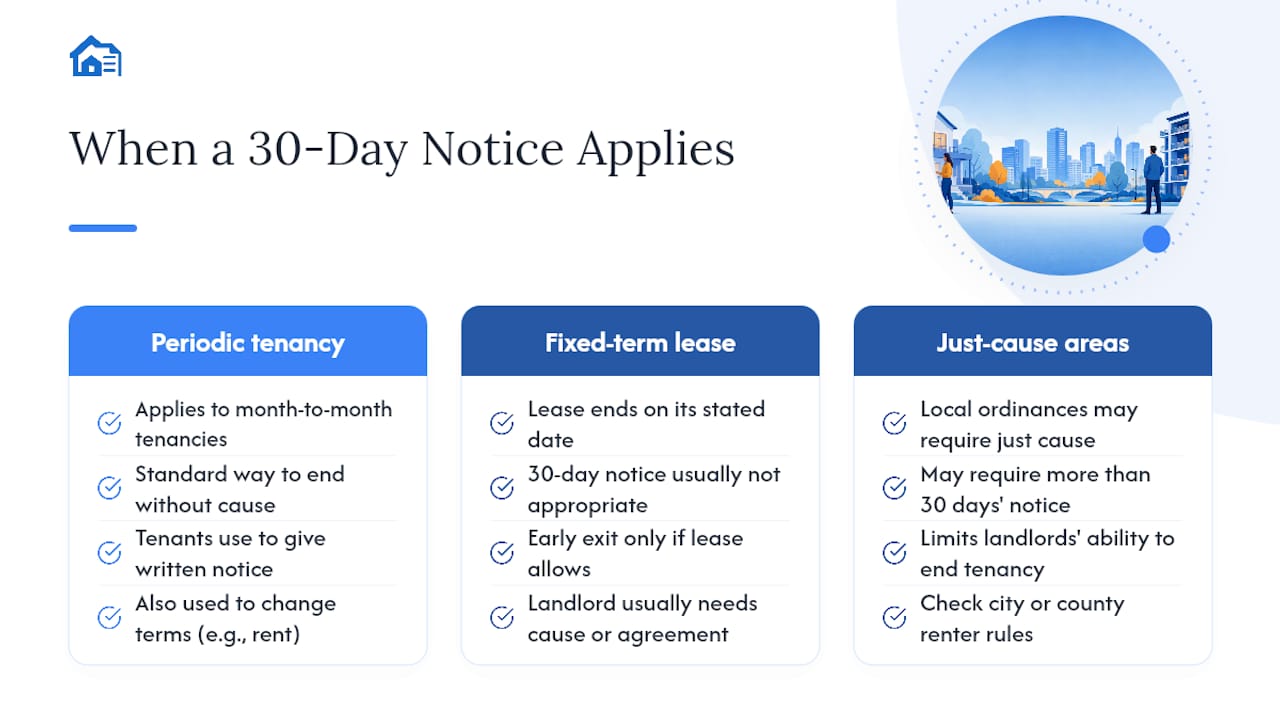
A 30-day notice applies almost exclusively to periodic tenancies, meaning month-to-month arrangements or tenancies at will where there’s no fixed end date on the lease. It’s the standard mechanism for ending that kind of arrangement without cause in most states, and it’s also the tool tenants use to tell a landlord they’re leaving.
Fixed-term leases work differently. If a tenant signed a 12-month lease, that lease typically ends on its own stated date, and a 30-day notice isn’t the right tool unless the lease itself allows early termination with notice, or both parties agree to end it early. Landlords who want a tenant out before a fixed term expires generally need cause, a lease violation, or a mutual agreement, not a simple 30-day notice. If you’re dealing with that situation, a lease termination letter built for early-exit clauses is the more appropriate document.
On the landlord side, common uses include ending a month-to-month tenancy with no stated reason (in states that allow no-fault nonrenewal), or changing the terms of an existing tenancy, like raising rent or adding a new rule, since many states require the same 30-day written notice to modify terms as they do to end the tenancy outright. On the tenant side, it’s usually as simple as: “I’m moving out at the end of next month, and here’s my written notice.”
Not every jurisdiction lets landlords end a tenancy for no reason at all. A growing number of cities and some states have adopted just-cause eviction rules, which require landlords to state a legally recognized reason (nonpayment, lease violation, owner move-in) even for month-to-month tenants, and some of those same jurisdictions extend the notice period well beyond 30 days for longer-term tenants. Always check whether your city or county has its own renter protection ordinance layered on top of state law.
What Has to Be in a Valid 30-Day Notice?
Courts look for specific fields, and skipping one is the single most common reason a notice gets challenged. At minimum, a legally sufficient notice includes:
- The date the notice itself is written and issued.
- Full legal names of both the landlord (or property manager) and every tenant on the lease.
- The complete rental address, including apartment or unit number.
- A clear, unambiguous statement that the tenancy is being terminated (not “reviewed,” not “considered ending,” but terminated).
- An exact calendar date by which the tenant must vacate.
- The landlord’s signature and contact information for follow-up.
The termination date is where most notices fall apart. Language like “your tenancy will end within 30 days of this notice” sounds fine to a non-lawyer, but it’s vague enough that a judge can throw it out. Courts want a specific date. “Your tenancy will terminate on March 15, 2026” leaves no room for argument about when the clock started or when it ended.
Vague phrasing such as “within 30 days” instead of a fixed calendar date is one of the most common reasons eviction filings get invalidated, according to Cornell’s Legal Information Institute.
Beyond the mandatory basics, a well-drafted notice usually includes a few optional items that head off disputes later. A request for the tenant’s forwarding address makes returning the security deposit easier and faster. Instructions for key return, whether to drop keys at a leasing office or mail them, prevent the “I didn’t know where to leave them” excuse. Some landlords also note that a move-out inspection will be scheduled, which sets expectations before anyone starts patching nail holes. Local ordinances or the lease itself may require additional disclosures beyond what state law alone demands, so always cross-check the lease language against your state’s notice statute.
How Do You Count 30 Days and Serve the Notice?
The day the notice is delivered almost never counts as day one. In most states, the clock starts the day after service, so if a landlord hands a tenant a notice on June 1, day one is June 2, and the 30th day lands on July 1, not June 30. Landlords who count the delivery date itself as day one routinely end up a day short, and that single-day miscalculation is enough for a judge to dismiss the case.
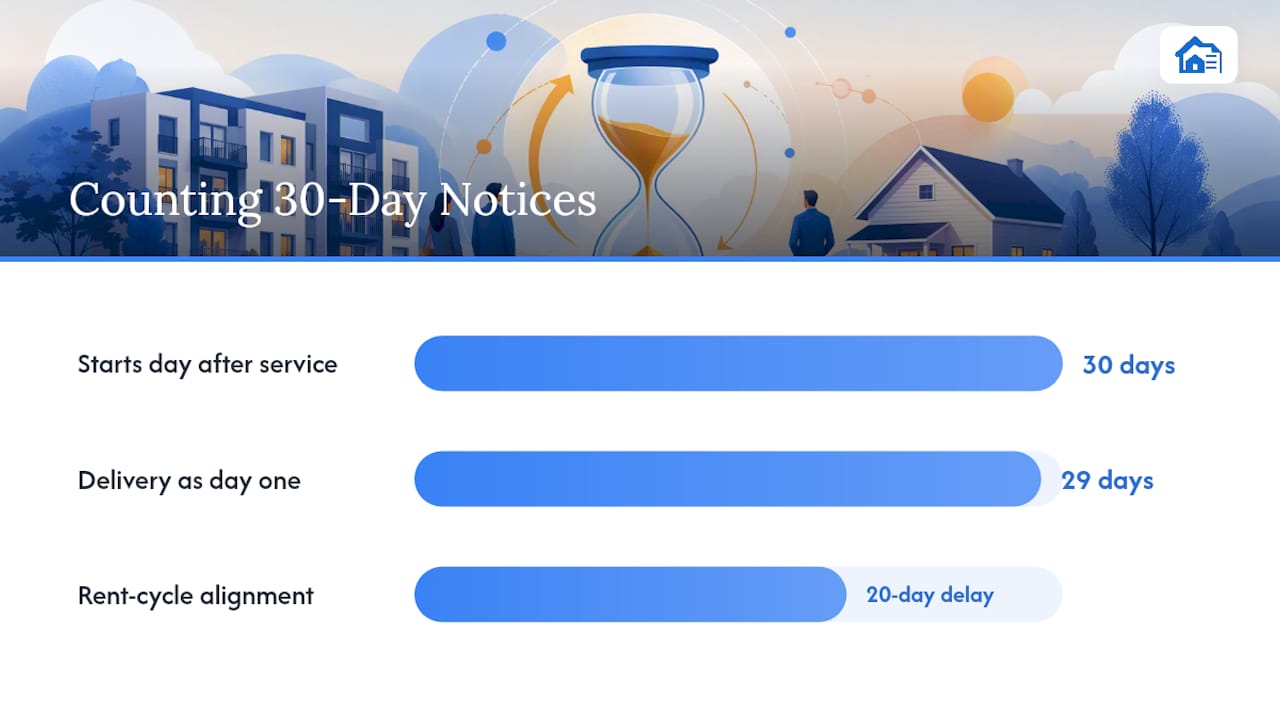
Rent-cycle alignment complicates things further. A lot of states require the termination date to fall on or before the next rent due date rather than simply 30 calendar days out. Say rent is due on the 1st of every month, and a landlord serves notice on June 10. Thirty calendar days would land around July 10, but if the tenant’s rent cycle runs monthly, that notice might not actually end the tenancy until July 31 instead, because it has to align with the rental period. That mismatch can leave a tenant owing an extra month’s rent, or a landlord waiting an extra 20 days to reclaim the unit. Neither side wants that surprise.
Service method matters just as much as the math. Commonly accepted delivery methods include:
- Personal service, handing the notice directly to the tenant.
- Substituted service, leaving it with another adult resident when the tenant isn’t available, sometimes with a follow-up mailing required.
- Posting and mailing, taping the notice to the door and mailing a copy, allowed in some states as a last resort.
- Certified mail with return receipt, which creates a paper trail showing exactly when the tenant (or someone at the address) signed for it.
Whatever method you use for service, fill out a sworn affidavit or declaration of service immediately afterward, while the details are fresh. Note the date, time, method, and who received it. That single piece of paper is often the difference between a case that proceeds and one that gets tossed for lack of proof.
Landlord and Tenant 30-Day Notice Examples
Here’s a stripped-down landlord notice, condensed to its essential elements:
“Dear [Tenant Name], this letter serves as notice that your month-to-month tenancy at [Full Address, Unit #] will terminate on [Exact Date]. You are required to vacate the premises and return all keys by that date. Please provide a forwarding address for return of your security deposit. Signed, [Landlord Name], [Date], [Contact Info].”
And a tenant version:
“Dear [Landlord Name], this letter serves as my written notice that I will be vacating [Full Address, Unit #] on [Exact Date], and terminating my month-to-month tenancy as of that date. My forwarding address for return of my security deposit will be [Address]. Signed, [Tenant Name], [Date].”
The table below breaks down what each field is doing legally, so you’re not just filling in blanks without knowing why they matter.
| Field | Legal Purpose |
|---|---|
| Exact termination date | Prevents ambiguity that courts use to dismiss vague notices |
| Full property address with unit | Confirms which specific rental unit is affected |
| All tenant names listed | Ensures every leaseholder is legally bound by the notice |
| Signature and date of notice | Establishes when the notice was created and by whom |
| Forwarding address (tenant) | Speeds security deposit return and satisfies state deposit laws |
To compute the actual termination date, start with your service date, add one day (since day one starts the day after delivery), count forward 30 days, then check whether that date lands on or before your next rent due date. If it doesn’t, you may need to extend to the following rent due date instead. Skip the manual math and use a free 30-day notice template that calculates this for you and adjusts for state-specific language automatically. Keep in mind that some states require phrasing that differs from these generic examples, so always verify against your state’s own statute or official court form before serving.
What Happens After the 30 Days End?
Once the termination date passes, the paths for landlord and tenant split sharply depending on whether the tenant actually left.
For tenants who are vacating on schedule, the obligations are mostly practical: pay rent through the termination date (even a partial period, unless the landlord agreed otherwise in writing), remove all belongings, and return keys as instructed. Landlords, meanwhile, need to schedule a move-out inspection and start the clock on their state’s security deposit return deadline, which is a separate legal requirement from the notice itself and varies by state, often ranging from 14 to 30 days after move-out.
For tenants who stay past the termination date without a new agreement, the notice alone does not remove them. A 30-day notice is not an eviction; it is the prerequisite that must occur before an eviction proceeding can be filed. If the tenant remains, the landlord’s next legitimate step is filing an unlawful detainer or eviction case in court, and only a judge, not the landlord, can order removal. State court self-help resources walk through exactly what that filing requires and how the process unfolds from there.
Pro Tip: Take dated photos of the unit’s condition right after move-out, before you touch anything. If a security deposit dispute ends up in small claims court, that timestamped documentation is worth more than any verbal description of “it was already like that.”
How Should a Tenant Respond to a 30-Day Notice?
Getting a notice doesn’t mean you have to just accept it silently. Start with the basics: confirm the date the notice was actually delivered and the exact termination date it states, then hold onto the physical notice and any proof of how it was delivered, certified mail receipts, photos of a posted notice, whatever exists.
Next, check your lease and your state’s landlord notice requirements. Some leases specify longer notice periods than state law requires, and some states mandate longer windows for tenants who’ve lived somewhere for years. If the notice gives you less time than the law requires, that’s a defect worth raising.
From there, you generally have three paths:
- Accept and plan your move. Confirm the date, start looking for a new place, and give your own written notice of your forwarding address for the deposit.
- Negotiate. Landlords sometimes agree to an earlier move-out date with prorated rent, especially if they already have a new tenant lined up. Get any agreement in writing.
- Contest it. If you believe the notice was retaliatory (served right after you requested a repair or reported a code violation), discriminatory, improperly served, or defective in its wording or timing, you may have a defense.
If you’re leaving early and negotiating a partial final month, a rent proration calculator makes it easy to confirm the exact amount owed before you sign anything.
Tenants weighing a legal challenge should reach out to a local legal aid organization or tenant rights clinic, many operate on a sliding scale or free basis, and an attorney consultation is worth the cost when retaliation or discrimination is a real possibility. LA County’s consumer affairs office is a useful example of the kind of practical, jurisdiction-specific guidance available through local government resources.
Common Mistakes That Get 30-Day Notices Thrown Out
Judges see the same handful of errors over and over, and any one of them can sink an otherwise legitimate eviction filing.
- Vague termination date. Phrases like “within 30 days” or “by the end of next month” instead of a fixed calendar date.
- Counting the service day as day one. This shorts the tenant a full day and invalidates the timeline.
- Ignoring rent-cycle alignment. Serving mid-cycle without adjusting the termination date to the next rent due date where required.
- Missing signatures. An unsigned notice looks unofficial and can be challenged as invalid.
- Failing to name every tenant on the lease. Leaving one leaseholder off the notice can void it as to that person.
- Improper service. Taping a notice to a door in a state that requires certified mail, or skipping the required follow-up mailing after substituted service.
- Missing local disclosures. Some cities require specific language about tenant rights or relocation assistance that state law alone doesn’t cover.
Fixing most of these means starting over: correcting the date, redoing service properly, and, in most cases, restarting the entire notice period from the new service date. A corrected notice doesn’t retroactively fix a defective one; it resets the clock. The two costliest mistakes by far are missing proof of service and using the wrong notice period, both because they’re the first things a judge checks, and both because there’s no fixing them after the fact once you’re already in a hearing. When in doubt on a high-value or high-conflict tenancy, a quick consult with a landlord-tenant attorney costs far less than a dismissed case and a restarted clock.
Do Notice Periods Vary by State?
Thirty days is the common baseline for month-to-month tenancies across much of the country, but it’s far from universal. Some states step up to 60 or even 90 days once a tenant has lived in the unit past a certain length of time, often one year. Others layer just-cause requirements on top of the standard notice period, meaning a landlord needs both the correct notice length and a legally recognized reason.
Federal rules can also intervene. Properties tied to certain federally backed mortgages or subsidized housing programs may fall under additional notice requirements, including provisions tracing back to pandemic-era protections under 15 U.S.C. § 9058, which can extend timelines or add disclosure requirements depending on the property’s financing.
Given how much variation exists, the most reliable move is checking your specific state’s landlord-tenant statute directly, along with any city or county rental ordinance, before relying on a generic notice period. Colorado’s own official court form is a good example of how a state spells out exact wording and date-calculation rules that a generic template might miss. When searching, look for terms like “[your state] landlord tenant act notice to terminate tenancy” and prioritize .gov domains and official court self-help pages over blog posts or commercial summaries, which sometimes repeat outdated or state-mismatched information.
If your situation calls for a longer window than 30 days, whether because of local law or tenancy length, a 60-day notice template is built for exactly that scenario rather than trying to stretch a 30-day form to fit.
Why Getting the Notice Right Actually Matters
Courts don’t treat a defective notice as a technicality to overlook. When the timing, service method, or wording is off, judges frequently dismiss the eviction filing outright, according to LegalClarity’s breakdown of eviction notice requirements, and dismissal doesn’t just delay the case, it resets the entire notice period back to zero.
That reset carries real financial weight. A dismissed filing means the landlord has to serve a brand-new notice, wait out the full notice period again, and refile with the court, often paying filing fees a second time. In the meantime, rent may go uncollected, the unit stays occupied by a tenant the landlord was trying to remove, and legal costs stack up on both sides. What would have been a 30 or 60-day process can stretch into several months over a mistake that would have taken five extra minutes to fix upfront.
The fix is almost always cheaper than the mistake: confirm your state’s specific notice period and required language, generate a proof of service the moment you deliver the notice, and if the situation involves a long-term tenant, a subsidized property, or any hint of a retaliation claim, get a quick legal review before you file anything in court.
A note on getting this right the first time
Automating notice generation isn’t just about saving time, it closes the exact gaps that cause dismissals: a missed signature line, an uncounted day, a termination date that doesn’t match the rent cycle. Landlordforms builds state-aware templates specifically to catch those errors before a notice ever gets served, because the cost of a five-minute fix upfront is nothing compared to a dismissed case and a restarted 30-day clock.
Following a consistent checklist, exact date, correct service method, signed proof, cuts out the guesswork that turns a routine notice into a contested court case.
How Landlordforms Makes 30-Day Notices Simple
There are other ways to handle this: draft a notice from scratch using a generic online sample, copy language from a friend’s old lease, or hire an attorney for a routine nonrenewal that doesn’t really need one. Each of those works, but each also carries the exact risks this article just walked through, vague dates, wrong service methods, missing signatures, none of which a plain text template catches for you.
Landlordforms builds notices the way courts actually check them: state-aware fields that adjust required language automatically, a PDF generator that produces a clean, signature-ready document in minutes, and a built-in proof-of-service form so you’re not scrambling to write an affidavit from memory after the fact.

That automation matters because the errors that get eviction filings dismissed, wrong dates, missed names, improper counting, are exactly the kind of thing software catches and a rushed manual draft misses. Landlordforms also stores your documents and delivery records in one place, so if a dispute lands in court months later, you’re not digging through email for a certified mail receipt.
None of this replaces checking your own state and local rules first; laws change, and Landlordforms encourages every landlord to confirm current requirements before serving a notice. But once you know what your jurisdiction requires, generating a compliant notice takes minutes instead of hours. Start with the free 30-day notice template and have a ready-to-serve document before your next rent cycle deadline.
Where to Verify Local Notice Rules
Generic guides are useful for understanding the framework, but the specific number of days, required wording, and service rules for your situation come from your own state’s statute and court system. The Legal Information Institute at Cornell offers a solid plain-language overview of how 30-day notices work across jurisdictions, while official state court sites, like the Massachusetts eviction process guide, walk through the exact filing steps after a notice expires.
| Source Type | What It Provides | Example |
|---|---|---|
| Legal reference site | Plain-language explanation of notice law and terminology | Cornell Legal Information Institute |
| Official court form | Exact required wording and date-calculation rules | Colorado JDF 99B |
| State/county government page | Step-by-step eviction filing procedure | Mass.gov eviction resource |
| Local consumer affairs office | Practical move-out and deposit guidance | LA County DCBA |
Federal overlays occasionally apply too. Properties with certain federally backed financing may carry extra notice obligations tied to pandemic-era statutes still referenced in current law, so if your rental has any government-backed mortgage component, it’s worth a quick check before assuming state rules are the only ones in play. When in doubt, favor .gov sources and official court self-help centers over commercial blog summaries, since state law changes and a general guide can lag behind an actual statutory update.
This article provides general information, not legal advice. Confirm current notice requirements with your state statute, local court, or a licensed attorney before serving or responding to a notice.
This article is general information, not a substitute for advice from a qualified lawyer. Consult a qualified legal professional about your own circumstances before acting on anything here.
Sources
- 30-day notice | Wex | US Law | LII / Legal Information Institute
- JDF 99B (Colorado Judicial) — Notice of non‑renewal or termination
- How to Write a 30-Day Notice to Vacate Your Apartment - LegalClarity
- Mass
FAQ
What’s the difference between a 30-day notice and an eviction?
A 30-day notice is a written warning that ends a tenancy on a specific date; eviction is the separate court process a landlord files if the tenant doesn’t leave after that date passes. One is a document you serve, the other is a lawsuit a judge decides.
Can a 30-day notice be handwritten?
Yes, most states accept a handwritten notice as long as it includes all required elements: exact termination date, tenant and landlord names, property address, and a signature. Legibility and proof of delivery matter more than whether it was typed or written by hand.
What is the 30-day eviction notice requirement in Oklahoma?
Oklahoma generally requires a minimum 30-day written notice to terminate a month-to-month tenancy, with the notice needing to specify a clear termination date and be properly served on the tenant. Always confirm current requirements against Oklahoma’s own landlord-tenant statute, since notice periods and just-cause rules can change.
Does a landlord have to give 30 days notice in Ohio?
Ohio law typically requires 30 days’ written notice to end a month-to-month tenancy, though the exact notice period and required language can shift depending on local ordinances in certain cities. Check Ohio’s current landlord-tenant statute or a local court self-help page before serving notice.
Can a landlord serve a 30-day notice by text message or email?
Most states don’t accept text or email as a standalone valid service method unless the lease specifically authorizes electronic notice in writing. Personal delivery, certified mail with return receipt, or posting and mailing remain the service methods courts recognize most consistently.