Avoid Eviction Dismissals: U.S. 3 Day Notice Rules for Small Landlords

A 3-day notice is a landlord’s formal written demand that a tenant pay overdue rent, fix a lease violation, or move out within three days, and it’s typically the required first step before any eviction lawsuit can even be filed. If you’re a landlord, verify your state’s exact statute and prepare a notice with airtight proof of service, following applicable legal requirements. If you’re a tenant, check the notice for errors and pin down your real deadline before doing anything else.
TL;DR:
- Using the wrong type of 3-day notice, such as mixing pay-or-quit with unconditional quit, can result in immediate dismissal of the eviction case.
- Proper service methods like personal delivery, substitute service, or posting and mailing are essential; mailing alone is generally insufficient and can invalidate the notice.
- The countdown begins the day after service, with extensions for weekends and holidays, or in some states, counting only business days, affecting the deadline enforcement.
- California, Florida, Texas, and Ohio each have specific notice content and service requirements that must be strictly followed to maintain legal validity.
- Federal housing programs or properties with federal backing often require a minimum 30-day notice, overriding the standard three days mandated by state laws.
Table of Contents
- What Are the 3-Day Notice Rules and Which Type Applies to You
- How to Serve a 3-Day Notice So It Holds Up in Court
- Counting the Three Days Without Getting It Wrong
- State-by-State Differences: California, Florida, Texas, and Ohio
- Common Defects That Void a 3-Day Notice
- If You Get a 3-Day Notice: What to Do Right Now
- When Federal Rules Override the 3-Day Timeline
- A Pre-Serve Checklist That Prevents Most Legal Mistakes
- Why Documentation Beats Good Intentions
- Serve Notices Correctly Without Second-Guessing Every Form
- Where to Verify These Rules Yourself
- Sources
- FAQ
What Are the 3-Day Notice Rules and Which Type Applies to You
Not every 3-day notice works the same way, and using the wrong one is one of the fastest ways a landlord loses an eviction case before it starts.
- Pay or quit notice. This is the most common version. It demands a specific dollar amount owed in rent and gives the tenant three days to pay in full or vacate. Most states allow the tenant to “cure” by paying, which kills the eviction.
- Cure or perform notice. Used for lease violations that aren’t about rent, like an unauthorized pet or unapproved subletting. It must describe the specific violation and the exact steps needed to fix it.
- Unconditional quit notice. Reserved for serious issues, such as repeated violations, illegal activity, or property damage. There’s no chance to cure. The tenant must leave.
The most common drafting mistake is mixing these up, listing a curable violation on an unconditional quit notice, or demanding rent plus late fees on a pay-or-quit notice when the lease doesn’t classify late fees as rent. According to Cornell Law School’s Legal Information Institute, proper content and proper service both matter just as much as picking the right notice type.
How to Serve a 3-Day Notice So It Holds Up in Court
Service method is where landlords lose cases they should win on paper. Slipping a notice under a door or leaving it with no follow-up mailing usually isn’t valid service, according to instructional packets from courts like Michigan’s state court system.
Most states recognize three acceptable methods:
- Personal service. Hand the notice directly to the tenant. This is the gold standard and rarely challenged in court.
- Substitute service. Give it to another adult at the residence or workplace, then mail a copy. Some states require a waiting period before this method becomes valid.
- Posting and mailing. Post the notice on the door and mail a copy, used only when personal and substitute service aren’t possible.
Mailing alone almost never satisfies the requirement on its own, per the three-day notice entry from Cornell Law. Electronic service, through email or a tenant portal, only counts where the lease or state law specifically allows it and the tenant has consented in writing.
Every notice needs a completed certificate of service noting who served it, the date and time, the method used, and the address. Keep dated photos of the posted notice and mailing receipts as backup.
Pro Tip: Photograph the notice taped to the door with a timestamp visible, then keep the certified mail receipt stapled to your file copy. Judges want to see a paper trail, not your word for it.
Counting the Three Days Without Getting It Wrong
The countdown almost always starts the day after service, not the day you hand it over. Serve a notice on Monday, and day one is Tuesday.
- Weekends and holidays typically extend the deadline if day three lands on one of them, pushing it to the next business day.
- Some states, including Florida, count in business days for the entire three-day window on nonpayment notices, excluding weekends and holidays from the count entirely, according to guidance on Florida eviction timelines.
- Court forms like the Santa Clara County 3-day notice template spell out this “day after service” rule and the weekend extension explicitly.
Miscounting is the single most common reason landlords file too early and get their case dismissed. If you serve on Thursday, don’t assume Sunday is day three. Count forward carefully, checking whether your state uses calendar days or business days, and when in doubt, add a day rather than shave one off.
State-by-State Differences: California, Florida, Texas, and Ohio
The three-day framework looks similar everywhere, but the details shift enough between states that copying a form from the wrong jurisdiction can sink an eviction filing.
- California requires notices to include the tenant’s name, the property address, and the exact amount due, with service completed through personal delivery, substitute service, or posting plus mailing, following the format used in official Santa Clara County court forms.
- Florida counts business days rather than calendar days for nonpayment notices, and accepting a partial payment after service can complicate or waive the notice entirely unless the landlord gets a signed acknowledgment that the balance is still owed, per Florida-specific guidance.
- Texas treats the notice to vacate as a required prerequisite before filing, but the post-filing response window and courtroom timeline differ from other states, according to Texas eviction process guides.
- Ohio applies the same core notice-then-file structure, though local court scheduling and required forms vary by county.
Local ordinances can add another layer. Seattle, for example, requires extra language on certain notices tied to nuisance or criminal activity, plus mandatory reporting to a city department, according to the city’s own landlord guidance on issuing notices. Always check your specific state statute and local court’s current form before serving anything.
Common Defects That Void a 3-Day Notice
A single mistake on the notice can hand the tenant a complete defense, according to LegalClarity’s breakdown of 3-day notice rules. Courts routinely dismiss eviction filings over errors landlords consider minor.
- Wrong tenant name, wrong property address, or a notice sent to the wrong unit in a multi-unit building.
- An incorrect dollar amount, especially one that bundles in late fees or other charges the lease doesn’t define as rent.
- Improper service, including mailing alone or posting without a follow-up mailed copy where the state requires both.
- A missing or incomplete certificate of service, leaving the landlord unable to prove when or how the notice was delivered.
- Accepting a partial rent payment after serving the notice without a signed agreement stating the notice remains in effect for the balance, which can waive the notice in several states.
If You Get a 3-Day Notice: What to Do Right Now
Getting served doesn’t mean you’re already losing. It means the clock started, and how you respond in the next 72 hours matters more than almost anything else in the process.
- Check for federal coverage first. If your building has a federally backed mortgage or is part of certain federal housing programs, a longer 30-day notice may be legally required instead of three days.
- Read the notice for errors. Wrong name, wrong amount, or wrong address can make it invalid.
- Pay in full before the deadline if you can, and get a receipt or bank confirmation as proof.
- If you plan to contest it, gather receipts, texts, and any record of the landlord accepting prior partial payments, then file your answer within your state’s response window once a case is filed.
- Look into local rental-assistance funds or legal-aid organizations, such as FloridaLawHelp’s eviction resources, which walk tenants through state-specific defenses and deadlines.
When Federal Rules Override the 3-Day Timeline
Some properties don’t get a 3-day notice at all. United States Code Title 15, Section 9058, part of the CARES Act, sets a 30-day minimum notice to vacate for dwellings with federally backed mortgages or participation in certain federal housing programs.
- HUD-assisted housing carries its own 30-day notice requirement under Federal Register rules, with informational content that differs from a standard state notice.
- A short state-mandated 3-day notice cannot substitute for this 30-day floor when a property qualifies.
- Check your mortgage documents or ask your property manager whether the building participates in a federal program before assuming the shorter timeline applies.
A Pre-Serve Checklist That Prevents Most Legal Mistakes
Before a notice ever reaches a tenant’s door, run through this list:
- Confirm the current version of your state’s notice statute and required form language.
- Verify the exact amount owed, excluding any charges the lease doesn’t define as rent.
- Confirm the property isn’t subject to the federal 30-day floor.
- Choose a service method your state actually recognizes as valid.
- Keep dated photos, mailing receipts, and a signed certificate of service on file.
State-specific templates that auto-populate tenant names, amounts, and deadlines cut down on the typos and missed fields that sink so many filings. A 3-day notice to pay or quit template built for your state removes the guesswork around required language entirely.
Pro Tip: Store every notice, receipt, and photo in one place tied to the tenant’s file. When a case ends up in court months later, scrambling through email threads to reconstruct a timeline is how landlords lose winnable cases.
Why Documentation Beats Good Intentions
Landlords managing a handful of units to well over a hundred all make the same mistake: they treat the notice as a formality instead of the piece of evidence it actually is. My take is simple. Count conservatively, document obsessively, and train whoever serves notices on your behalf to follow the same steps every time. Save a lawyer for contested cases or anything involving federal coverage questions, not for routine pay-or-quit notices where a documented, state-compliant process will carry you through.
— Igor
Serve Notices Correctly Without Second-Guessing Every Form
Landlordforms turns the checklist above into a few clicks instead of a legal research project. Rather than piecing together state statutes and hoping your certificate of service holds up, you generate a state-specific 3-day notice to pay or quit that auto-fills tenant names, addresses, and the exact amount owed straight from your existing records.
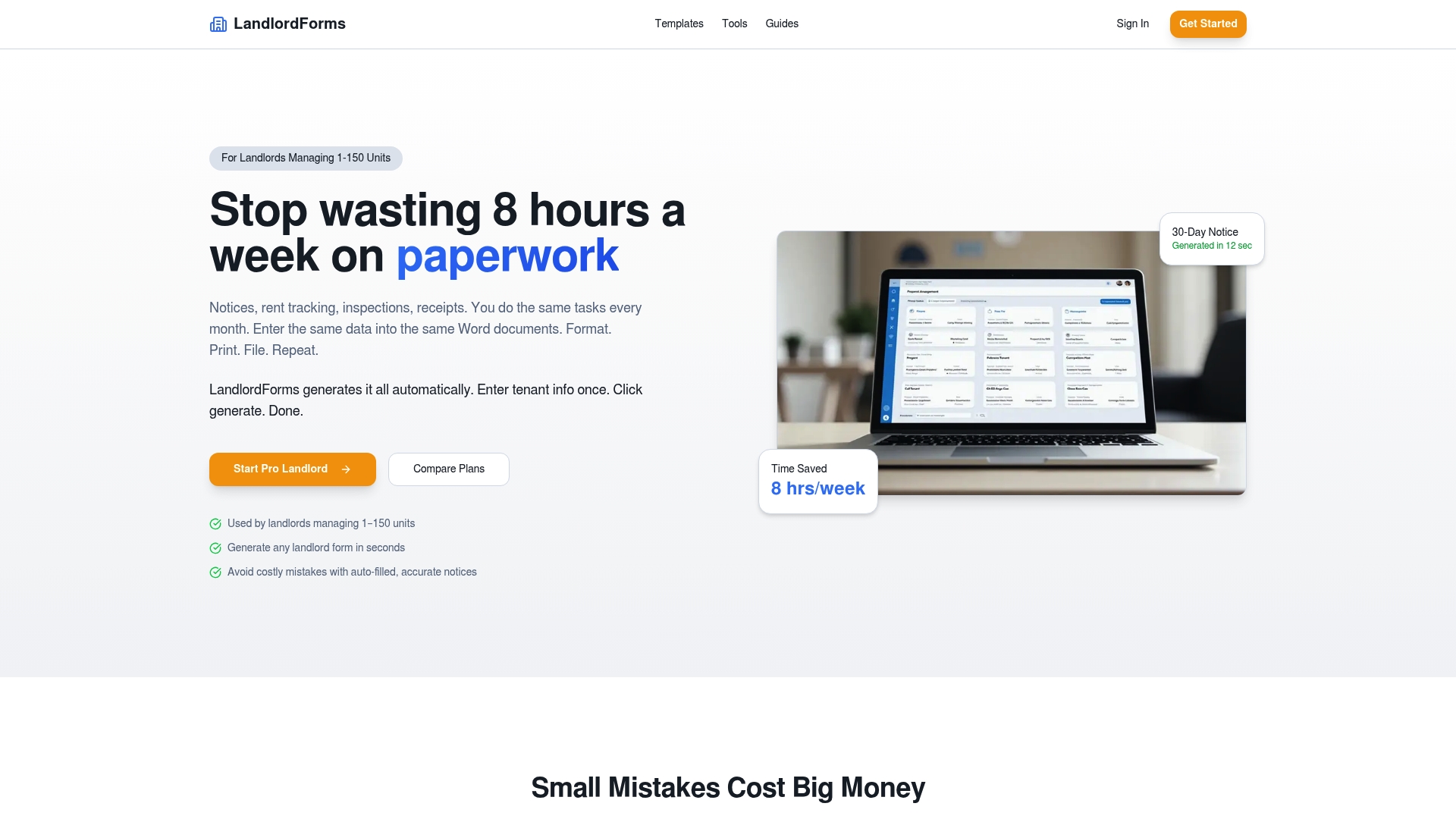
The platform also generates a certificate of service automatically and keeps tenant payment history tied to each notice, so if a case ends up in court, you’re not digging through email for proof. Pair it with a rent ledger to track exactly what’s owed before you ever serve a notice, and you’ve got a documented paper trail instead of a guess. Start a free trial and generate your first state-specific notice today.
Where to Verify These Rules Yourself
- United States Code Title 15, Section 9058 — the federal statute setting the 30-day minimum notice for covered dwellings.
- Cornell Law School’s Legal Information Institute — plain-language legal definition and service requirements.
- Santa Clara County 3-day notice form — a real court-approved form showing required content.
- Seattle’s landlord notice guidance — an example of local rules layered on top of state law.
- FloridaLawHelp’s eviction resources — tenant-facing legal aid for those who’ve been served.
This article is general information, not a substitute for advice from a qualified lawyer. Consult a qualified legal professional about your own circumstances before acting on anything here.
Sources
- United States Code Title 15 Section 9058
- three-day notice | Wex | US Law | LII
- 3 Day Notice (Santa Clara Courts)
- Issuing notices - Renting in Seattle
FAQ
What Voids a 3-Day Notice in California?
A California 3-day notice becomes invalid if it lists the wrong tenant name, the wrong amount owed, or lacks proper service, since courts there require personal delivery, substitute service, or posting plus mailing exactly as described on official court forms.
Can a Landlord in Florida Evict You in 3 Days?
No. A 3-day notice in Florida only starts the clock, and it’s usually counted in business days, excluding weekends and holidays; the actual eviction still requires filing a lawsuit and going through the court process, per Florida notice guidance.
Can a Landlord Evict You in 3 Days in Ohio?
No. Ohio landlords must serve a 3-day notice first, but that only satisfies the pre-filing requirement. Actually removing a tenant still requires filing in court and going through the standard eviction timeline.
Can You Be Evicted in 3 Days in Texas?
No. Texas requires a notice to vacate before any eviction filing, but the notice period itself doesn’t equal the total time to eviction, since the lawsuit and response window add additional time, according to Texas eviction process guides.
What Happens if a Landlord Accepts Partial Rent After Serving a Notice?
Accepting partial rent without a signed written agreement stating the notice remains in effect for the remaining balance can waive the eviction notice entirely in several states, including Florida.
Does a 3-Day Notice Always Apply, or Can Federal Rules Require More Time?
Properties with federally backed mortgages or certain federal housing program participation require a 30-day minimum notice under CARES Act rules, which overrides a shorter state 3-day notice for those units.