U.S. Landlords: When 30 Day Lease Notices Fail State Statutes

Notice periods come from two places: your state’s landlord-tenant statute and the signed lease itself, and whichever imposes the stricter requirement usually wins. A typical month-to-month tenancy needs a notice period that varies by state; some states require about three weeks’ notice, others around 30 days, while some have longer requirements. Before you write anything, check your lease’s termination clause, pull up your state’s statute or official court form, and plan how you will document delivery.
TL;DR:
- Notice periods for month-to-month leases typically range from 20 to 60 days, depending on state laws and local ordinances, with some states requiring as little as 20 days.
- Serving proper notice requires adherence to specific methods, such as personal delivery, certified mail, or posting and mailing, with requirements varying by jurisdiction.
- Exit notices must include the tenant’s full name, property address, clear move-out date, reason for termination if applicable, and signatures, ideally using official forms for enforceability.
- Shorter notice periods are permissible only for urgent issues like criminal conduct or unpaid rent, often with no cure options, while nonfault terminations generally allow more time.
- Utilizing state-specific templates that incorporate local rules and maintaining a documented service trail significantly reduce the risk of notice invalidation in court.
Table of Contents
- Lease Termination Notice Rules Vary by State: Here’s How They’re Organized
- The Main Types of Termination Notices and Their Typical Timelines
- How to Count Notice Days and Serve a Lease Termination Correctly
- What a Valid Termination Notice Must Include
- Federal and Local Rules That Can Override Standard Notice Periods
- After the Notice Is Served: What Comes Next for Both Sides
- Avoid These Common Notice Mistakes
- A Practical Take on Serving Notices That Actually Hold Up
- Skip the Guesswork With State-Aware Notice Templates
- Where to Verify State-Specific Notice Rules
- Sources
- FAQ
Lease Termination Notice Rules Vary by State: Here’s How They’re Organized
Every notice question starts with one distinction: are you ending a fixed-term lease or a periodic tenancy? A fixed-term lease (a one-year lease, for example) typically expires on its own end date, and many states require no notice at all unless the lease says otherwise. A month-to-month or week-to-week tenancy is different. It renews automatically until someone gives notice to stop it, and state law sets the minimum warning period.
Florida illustrates how flexible this gets. Under Florida Statute 83.575, a lease can include a clause requiring tenant notice before move-out, but that clause can’t demand less than 30 days or more than 60 days in the situations the statute covers. Colorado takes a more form-driven approach: the state’s official Notice to Terminate Tenancy (JDF 99B) form spells out specific move-out windows tied to the reason for termination, right down to checkboxes for how notice was served.
Here’s what to verify before drafting anything:
- Whether your tenancy is fixed-term or periodic, since that determines if notice is even required
- Whether your lease’s notice clause meets or exceeds your state’s statutory minimum (leases can extend notice periods, but rarely shorten them below the legal floor)
- Whether your city or county has its own separate ordinance layered on top of state law
- Where to find your state’s actual statute text or official court form, rather than relying on a generic template
Cornell Law School’s Wex overview of landlord-tenant law confirms the general rule across states: lease terms and statutes work together, and courts enforce whichever provision protects the tenant more.
The Main Types of Termination Notices and Their Typical Timelines
Not every notice is the same animal. The type of notice you serve depends on why the tenancy is ending, and each type carries its own clock.
- Nonrenewal or notice to vacate. Used to end a periodic tenancy with no fault alleged. This is the standard 30-day (or state-specific) notice discussed above, used simply because one party wants the tenancy to stop.
- Pay-or-quit notices. Triggered by unpaid rent. These carry the shortest windows in most states, often just three to five days, giving the tenant a narrow chance to pay before the landlord can pursue eviction.
- Cure-or-quit notices. Used for lease violations that aren’t about rent (unauthorized pets, noise complaints, unauthorized occupants). Colorado’s JDF 99B form specifies a cure window for repeat lease violations and a shorter notice period for substantial violations, with exact times detailed in the official form.
- Immediate or unconditional quit notices. Reserved for serious misconduct, such as criminal activity on the property or conduct that endangers others. States allow dramatically shorter windows here, sometimes with no cure option at all.
The pattern across all four: the more severe or urgent the reason, the shorter the notice period and the less likely a cure opportunity exists.
How to Count Notice Days and Serve a Lease Termination Correctly
Day counting trips up more landlords than any other part of this process. Most states start counting the day after the notice is delivered, not the day you hand it over or mail it. If your state uses a mailbox presumption, mailed notice is often considered delivered three to five days after postmark, which pushes your effective start date later than you might expect. Notice periods for month-to-month tenancies also frequently need to align with the rent period, meaning a 30-day notice given mid-month might actually need to run through the end of the following month.
Acceptable service methods differ by state, but most recognize:
- Personal delivery to the tenant
- Certified mail with return receipt
- Posting on the door combined with mailing (often required together, not as alternatives)
- Email, only where the lease or statute explicitly allows it
Seattle’s guidance is blunt on this last point: the city requires at least 20 days’ written notice for month-to-month tenants, and email typically doesn’t count as proper notice unless both parties agreed to it in advance.
Pro Tip: Keep your certified-mail receipt, a dated photo of any posted notice, and a signed affidavit of service in the same file. If the case ever reaches a hearing, that packet is the difference between a clean win and a continuance.
What a Valid Termination Notice Must Include
A notice that skips a required element can get thrown out regardless of how solid your underlying reason is. At minimum, include:
- Full legal name of every tenant on the lease
- Complete property address, including unit number
- A specific move-out date, not a vague timeframe
- The statutory or lease-based reason for termination, quoted where possible
- Cure instructions and deadline, if the violation is curable under your state’s rules
- Signature, printed name, and date of service
For serious or contested situations, an official state form beats a homemade letter. Colorado’s JDF 99B exists precisely because judges want to see the statutory basis, exact language, and service method laid out in one document. For routine nonrenewals, a lease termination letter template that already matches your state’s required wording removes the guesswork, and a dedicated lease renewal notice template handles the flip side when you’re the one choosing not to renew.
Federal and Local Rules That Can Override Standard Notice Periods
State statutes aren’t the final word. Several overlapping protections can extend timelines or restrict how you serve notice.
- Servicemembers have federal early-termination rights that require specific documentation, typically deployment or transfer orders, and landlords can’t penalize a qualifying termination.
- HUD’s Fair Housing Act overview flags that notices affecting protected classes, or units tied to federally backed mortgages, may carry additional procedural requirements.
- City and county ordinances sometimes require longer notice or relocation assistance than the state minimum, and these local rules are enforceable even when they conflict with the general state timeline.
- Many states, including Texas, grant early-termination rights to domestic violence survivors independent of what the lease says, according to the Texas State Law Library’s guidance on ending a lease.
After the Notice Is Served: What Comes Next for Both Sides
Serving notice isn’t the finish line. What happens next depends on whether the tenant complies, cures, or contests.
- Where a cure period applies, document exactly what the tenant fixed and when, since a disputed cure is a common point of conflict in court.
- Landlords generally have a duty to mitigate damages once a tenant vacates or is evicted, meaning you can’t let a unit sit empty and then bill the former tenant for the full lost rent.
- Security deposit accounting deadlines are state-specific, but most states require an itemized statement and refund within a set window, often 14 to 30 days after move-out.
- Before filing an unlawful detainer action, gather proof of valid notice, your service affidavit, the signed lease, and a current rent ledger showing the balance owed. A rent ledger template makes that last piece far easier to produce on short notice.
Avoid These Common Notice Mistakes
Most defective notices fail for the same handful of reasons, not because the underlying case was weak.
- Copying a generic online template instead of matching your state’s actual statute or official court form.
- Failing to document service, then having nothing to show a judge when the tenant disputes receiving notice.
- Assuming lease language can shorten a statutory minimum notice period, when most states don’t allow that.
- Overlooking a local ordinance that extends the state’s standard timeline.
- Using email for service when the lease never authorized it.
Pro Tip: Before you serve anything, read the notice provision in your lease side by side with your state statute. If they conflict, the one more favorable to the tenant typically controls, and knowing that in advance saves you a wasted filing.
A Practical Take on Serving Notices That Actually Hold Up
The notices that survive a court challenge are the ones that mirror the state’s own language, not a landlord’s paraphrase of it. Pulling directly from a statute or official form, and keeping a paper trail of service, does more to protect you than any clever wording ever will. When a tenant pushes back hard or the facts get messy, that’s the moment to bring in an attorney rather than gamble on a DIY filing.
— Igor
Skip the Guesswork With State-Aware Notice Templates
Drafting a notice from scratch means cross-checking your lease, your state statute, and often a city ordinance, every single time you need to end a tenancy. Landlordforms builds that cross-checking into the document itself: pick your state, generate a notice that already reflects the applicable timeline and wording, and get a clean PDF with built-in fields for signature and service date.

The platform covers the full range of situations this article walks through, from a routine 30-day notice to vacate to eviction-triggering notices, and it keeps a record of every document you generate so you’re not digging through email threads when a dispute lands in court. Pair any termination notice with a rent ledger to have your rent history and balance owed ready before you ever file. If you manage anywhere from one unit to 150, start building your next notice with Landlordforms and see how much faster state-compliant paperwork moves when the template already knows the rules.
Where to Verify State-Specific Notice Rules
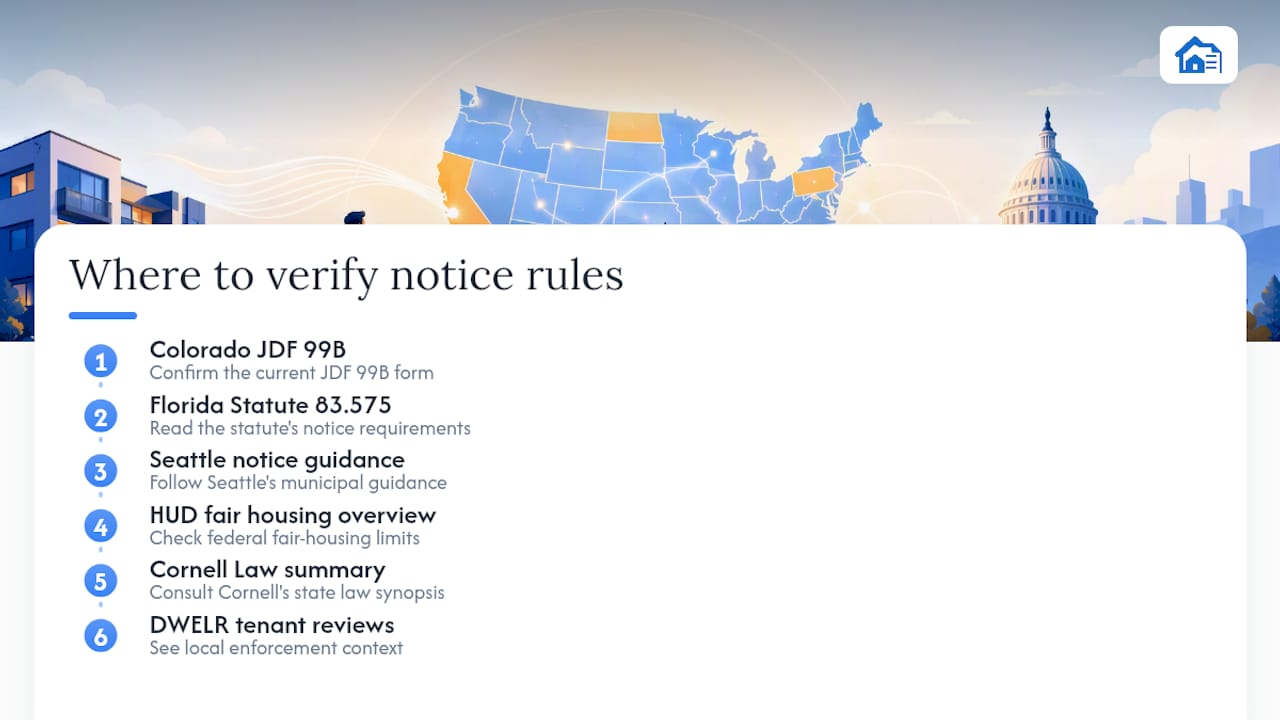
Always confirm your state’s current requirements before serving notice. Start with the Colorado JDF 99B form, Florida Statute 83.575, Seattle’s tenant notice guidance, HUD’s fair housing overview, and Cornell Law School’s landlord-tenant law summary. For a broader read on how local rental climates and tenant sentiment shape enforcement in practice, DWELR’s tenant review platform offers useful context.
Sources
- Notice to Terminate Tenancy (JDF 99B) — Colorado Judicial
- Chapter 83 Section 575 - 2024 Florida Statutes
- Giving notice to terminate your rental agreement — City of Seattle
- Fair Housing Act overview — HUD
- Landlord-tenant law — LII / Cornell Law School
FAQ
What legal notice is required to terminate a lease agreement?
The required notice comes from your state statute and your lease terms together, whichever is stricter. Most states require around 30 days for a month-to-month tenancy, though some, like Seattle, set a 20-day minimum, and others range up to 60 or more days depending on the circumstances.
Can a lease be terminated without any notice?
Generally no, unless the tenant engaged in serious misconduct, such as criminal activity or conduct that endangers the property, in which case some states allow shorter or immediate quit notices with little to no cure period. Fixed-term leases that simply expire on their end date typically require no additional notice unless the lease specifies otherwise.
How much notice must a landlord give to end a tenancy?
It depends on the tenancy type and the reason for termination. A no-fault nonrenewal usually needs 20 to 60 days depending on the state, while nonpayment or lease-violation notices can run as short as three to ten days, as Colorado’s JDF 99B form illustrates.
Can a landlord refuse to terminate a lease?
A landlord can’t simply ignore a tenant’s properly served notice to end a periodic tenancy, since the tenancy ends automatically once the statutory notice period runs. For a fixed-term lease, though, a landlord generally isn’t obligated to release a tenant early unless the lease allows it or a statutory exception, like a servicemember’s rights, applies.