When to Send an Abandoned Property Notice (and How to Do It Right)

You can only start an abandoned property notice when your state’s law says the facts support one, and you have to follow that statute’s required language, service method, and waiting period exactly. California’s Civil Code §1951.3, for instance, sets a 14 day rent trigger with strict 15 and 18 day service windows. Skip a step, and a tool built for this, like Landlordforms, or plain legal counsel becomes the safer path than guessing.
TL;DR:
- Landlords must strictly follow their state’s specific statutes for service methods, deadlines, and language to ensure abandonment notices are legally valid.
- Using approved forms, precise wording, and proof of mailing or posting significantly decreases the risk of notice rejection in court.
- Most states require documentation of abandonment triggers, such as unpaid rent for a set period and signs of tenant departure, before issuing formal notices.
- Property disposal timelines and procedures vary widely, with some states allowing immediate disposal after notice, others requiring holding periods of several weeks.
- Employing specialized management tools or templates can help maintain compliance, keep accurate records, and reduce the chance of procedural errors.
Table of Contents
- What Is an Abandoned Property Notice and When Do You Need One?
- How State Laws Handle Abandoned Property Differently
- A Step-by-Step Checklist for Serving a Valid Notice
- What Happens to Belongings After the Notice Period Ends
- The Mistakes That Get Abandonment Notices Thrown Out
- A Document-First Approach to Abandoned Units
- Let LandlordForms Handle the Paperwork You Can’t Afford to Get Wrong
- Sources
- FAQ
What Is an Abandoned Property Notice and When Do You Need One?
An abandoned property notice is a formal document telling a tenant, or anyone with an interest in the unit, that you believe the property has been vacated and that you intend to reclaim it and deal with any belongings left behind. It is not the same as an eviction notice. Eviction removes a tenant who is still living there; an abandonment notice addresses a unit you reasonably believe is already empty.
States set their own triggers, but most share a common pattern: rent has gone unpaid for a specific number of days, and you have some independent reason to believe the tenant has moved out for good, like stopped utilities, mail piling up, or a neighbor’s report. Rent arrears alone rarely justify treating a unit as abandoned. You need both pieces.
The notice itself has to contain specific elements or it is legally worthless:
- A clear statement that you believe the property has been abandoned
- The date by which the tenancy will terminate if the tenant does not respond
- Identification of the tenant and a description of the premises
- Exact statutory language telling the tenant how to stop the process, usually by paying rent owed or notifying you in writing of an intent to continue the tenancy
How you deliver the notice changes your deadline math. Personal delivery to the tenant starts the clock immediately. First class mail, which many statutes require or allow as an alternative, typically adds extra days to account for delivery time. If the tenant responds within the window, whether by paying, contacting you, or showing up, the abandonment process stops cold and you go back to treating the unit as occupied.
How State Laws Handle Abandoned Property Differently
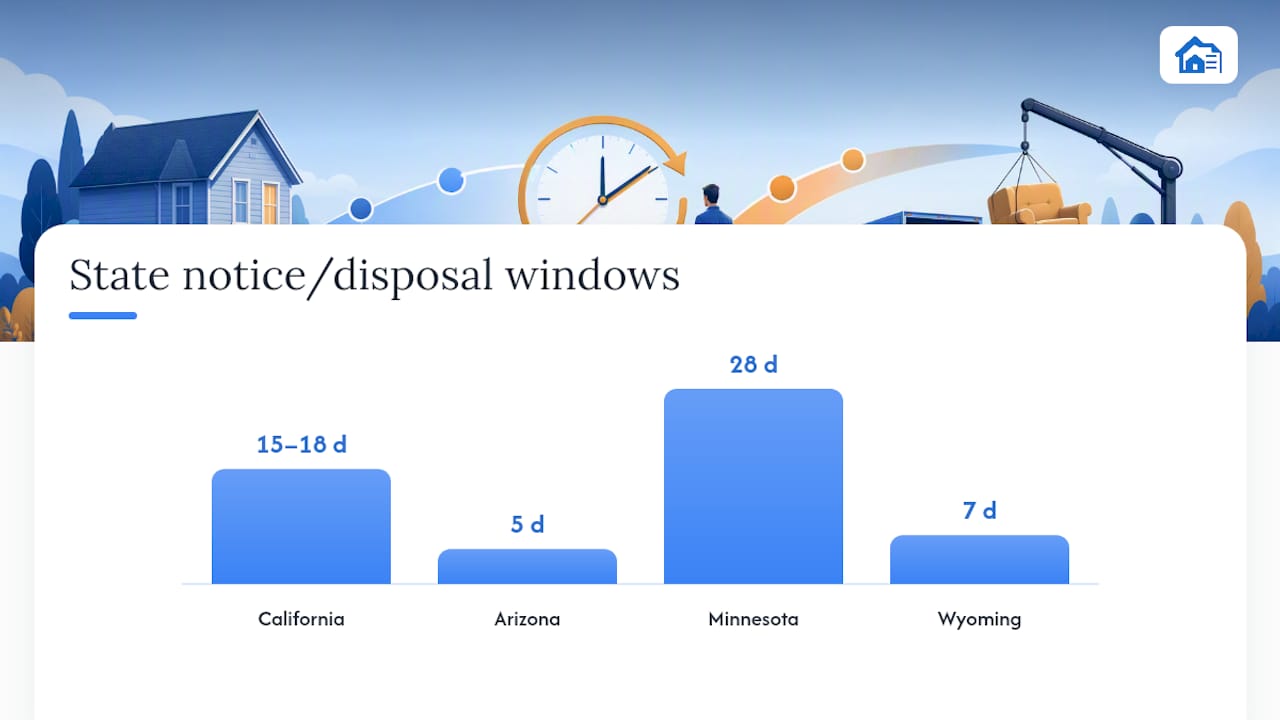
Every state builds its own version of this process, and the differences matter more than most landlords expect. The Texas State Law Library’s guide on tenant property makes the point plainly: there is no single national abandonment statute, and copying a form from another state can void your notice entirely.
Five states illustrate how wide the variation runs:
- California (Civil Code §1951.3): rent unpaid 14 days triggers eligibility, and the statute prescribes exact form language along with 15 day (personal delivery) or 18 day (mailed) response windows.
- Virginia (§55.1-1254): once you’ve completed the required notice steps, the code allows you to dispose of the property left behind, without a separate storage-and-auction phase in every case.
- Arizona (ARS 33-1370): requires posting the notice on the door or another visible spot and mailing it, with a five day posting period showing up in several fact patterns under the statute.
- Minnesota (Statute 504B.271): sets a 28 day clock after notice before you can dispose of remaining items, one of the longer windows among these examples.
- Wyoming: the courts publish a fillable Notice of Abandoned Property form with instructions describing a 7 day claim window in certain disposal scenarios, a useful real-world template if your state hasn’t standardized its own.
Notice the pattern: some states hand you a ready-made form with mandatory wording (California), some focus on disposal timing after notice (Virginia, Minnesota), and some emphasize physical posting as much as mailing (Arizona). Before you send anything, find your state’s specific statute or a court-published form rather than relying on a generic template.
A Step-by-Step Checklist for Serving a Valid Notice
Getting the paperwork right is only half the job. Getting the sequence right is what actually protects you if a tenant later challenges the process in court.
- Confirm the trigger. Document the signs of abandonment (disconnected utilities, accumulated mail, neighbor reports) alongside the rent-overdue period your state requires.
- Pull the exact statutory language. Use your state’s official form or statute text word for word. Do not paraphrase the “how to stop this” language.
- Fill in the termination date and service address. If your statute requires certified mail, list the address correctly and double check it matches your lease records.
- Pick a service method with built-in proof. A process server’s affidavit, a certificate of mailing from USPS, or a signed delivery receipt all hold up far better than “I mailed it” with no paper trail.
- Post physically if required and photograph it. Arizona and similar states expect the notice on the door; a dated photo removes any dispute about whether you actually posted it.
- Keep dated copies of everything. Notice text, mailing receipts, photos, all filed together with the tenant’s file.
- Do not re-enter or retake the unit before the deadline passes. Even one day early can undo the entire process.
- Stop immediately if the tenant responds. Preserve the communication, whether it’s a payment, a call, or a note taped to your door, and treat the tenancy as continuing.
Pro Tip: Send the notice by USPS certificate of mailing even when personal delivery is an option. It costs a couple of dollars and gives you a stamped, dated federal record of when the clock started, which matters enormously if a judge asks you to prove your timeline months later.
What Happens to Belongings After the Notice Period Ends

Once your statutory window closes without a response, you’re not automatically free to do whatever you want with what’s left behind. Most states still draw a line between items you can handle immediately and items that require a further storage or disposal process.
Hazardous or clearly perishable items, spoiled food, biohazards, items posing a safety risk, generally fall outside any storage requirement and can be discarded right away. Everything else usually falls under a reclaim window and a defined disposition method:
- Virginia permits disposal once you’ve completed the required notice steps under §55.1-1254, without necessarily requiring a separate auction phase.
- Minnesota gives tenants 28 days post-notice before disposal becomes an option under Statute 504B.271.
- Arizona ties its posting and mailing requirements under ARS 33-1370 to how and when you can move belongings.
- Wyoming’s court form describes a 7 day claim window in some scenarios before storage or sale proceeds.
Where a sale or auction is permitted, keep the receipts, the auction notice, and a clear chain-of-custody record showing what happened to each item and when. If you charge for storage or moving costs, calculate that figure before you release anything back to a returning tenant, and put the math in writing. A landlord who can’t show how they arrived at a storage bill is a landlord inviting a small-claims dispute.
The Mistakes That Get Abandonment Notices Thrown Out
The single most common failure practitioners see is a notice that skips the exact statutory warning language telling the tenant how to stop the process, including the certified-mail address for a response. Judges treat that omission as fatal, not a technicality.
Other frequent errors: using the wrong deadline (mixing up personal-delivery timing with mailed timing), choosing a service method the statute doesn’t actually authorize, and retaking the unit even a day before the deadline expires. Any one of these can turn a straightforward abandonment case into a wrongful-eviction claim.
Good recordkeeping is cheap insurance against all of it. Keep a USPS certificate of mailing for every notice you send, along with dated photos of anything posted physically, any process server’s signed affidavit, and contemporaneous notes on what you observed and when.
A certificate of mailing establishes a deposit date. That single date is often what decides the case if you ever have to prove in court that you served the notice within your statute’s mailing deadline.
Pro Tip: Build a simple folder system per unit, one for the notice, one for proof of service, one for photos, before you ever need it. Reconstructing a timeline after a tenant files a complaint is far harder than filing as you go. Tools like LegalClarity’s breakdown of California’s form walk through exactly which fields trip landlords up most often, and a notice to vacate template with the required warning language pre-built removes one more place for human error to creep in.
A Document-First Approach to Abandoned Units
My honest read on this: treat any ambiguous vacancy as still tenanted until you have paper proving otherwise. Landlords get burned not because they act in bad faith, but because they act on a hunch, a quiet unit, unanswered calls, and skip the documentation that would have protected them either way.
Favor service and storage methods that leave a verifiable trail over ones that feel faster. And when a statute reads unclear or the property value makes a mistake expensive, a short call to local counsel costs far less than defending a wrongful eviction claim later.
— Igor
Let LandlordForms Handle the Paperwork You Can’t Afford to Get Wrong
Every deadline and phrase covered above has to be right, every time, for every unit, and that’s exactly the kind of repetitive precision HomeRent’s property management tools are designed to support landlords with. It generates state-specific notice language automatically, tracks your service dates so you’re not counting days by hand, and stores your mailing receipts and posting photos in one place instead of scattered across email and phone camera rolls.

If you’re not ready to commit to a full workflow yet, start smaller: the free rent ledger template helps you document the unpaid-rent trigger that most abandonment statutes require, and the rent proration calculator handles the math when a tenancy ends mid-month. Both are free, and both feed directly into the kind of dated recordkeeping that protects you if a notice ever gets challenged. Try the templates, see how the timing tracking works for your next notice, and decide from there whether the full platform fits how you manage your units.
This article is general information, not a substitute for advice from a qualified lawyer. Consult a qualified legal professional about your own circumstances before acting on anything here.
Sources
- Tenant’s Property - Abandoned Property - Guides at Texas State Law Library
- § 55.1-1254. Disposal of property abandoned by tenants
- 33-1370 - Abandonment; notice; remedies; personal property
FAQ
How long before property is considered abandoned?
It depends entirely on your state. California’s §1951.3 uses a 14 day unpaid-rent trigger with 15 or 18 day response windows, while Minnesota allows disposal 28 days after notice under Statute 504B.271.
How long until property is considered abandoned in North Carolina?
North Carolina’s abandonment rules run separately from the states detailed in this guide, so check your county’s landlord-tenant statute or a state law library resource like the Texas State Law Library’s guide as a model for how to find your state’s exact version.
What are the laws regarding abandoned property in Florida?
Florida has its own statutory framework for abandoned tenant property that isn’t among the five state examples covered here; confirm current requirements directly with Florida’s landlord-tenant statutes before acting, since applying another state’s timeline or form would risk an invalid notice.
How long before property is considered abandoned in Tennessee?
Tennessee sets its own trigger and notice period separate from the CA, VA, AZ, MN, and WY examples in this guide, so verify the current statutory language and deadlines through your state’s official code before sending any notice.
What’s the fastest way to avoid a notice getting thrown out?
Use your state’s exact statutory language, especially the required “how to stop this” wording, and serve it with a method that creates proof, like a USPS certificate of mailing or a process server’s affidavit. Software like Landlordforms can generate the correct state-specific language and store that proof automatically.