60–70% Eviction Cost Rule: Cash for Keys Agreement for U.S. Landlords

A cash-for-keys agreement is a voluntary, written deal where a landlord pays a tenant or occupant to vacate a property by a set date, avoiding the time and cost of formal eviction. It makes financial sense when court delays would run longer than the payout, or when a tenant’s departure needs to happen fast and cleanly. The agreement only protects you if it’s in writing, ties payment to a verified move-out and clean condition, and includes a mutual release of claims.
TL;DR:
- Cash-for-keys offers faster possession and lower costs, but the agreement must be in writing, voluntary, and include clear conditions and releases.
- A defensible agreement requires detailed identification, a fixed move-out date, specific payment terms, and remedies for breach, supported by documented condition photos.
- Typical payouts range from a few hundred to several thousand dollars, often equivalent to one to three months’ rent, with structured payments tied to verified move-out.
- Legal compliance demands that the deal be voluntary, avoiding self-help eviction actions, and following local regulations such as disclosure and filing requirements.
- Proper documentation, including signed offers, walkthrough photos, receipts, and organized records, is essential to enforce the agreement and prevent disputes later.
Table of Contents
- What Is a Cash for Keys Agreement, and When Should You Use One?
- What Terms Belong in a Defensible Cash for Keys Letter?
- How Much Should You Offer, and How Do You Structure Payment?
- What Legal Rules Govern Cash for Keys Deals?
- How Do You Execute and Document a Cash for Keys Deal?
- Why Cash for Keys Works Better When It’s Boring
- Draft Your Agreement Without Starting From a Blank Page
- Where to Verify the Legal Details
- Sources
- FAQ
What Is a Cash for Keys Agreement, and When Should You Use One?
A cash-for-keys agreement is a negotiated exit: you pay a tenant, holdover occupant, or foreclosed homeowner a set amount to leave the property voluntarily by a specific date, instead of filing an eviction or unlawful detainer action. It shows up most often in three situations: a tenant who won’t leave after lease expiration, a homeowner staying past a foreclosure sale, or a new buyer who needs a rental unit vacated before closing.
The appeal is straightforward. Compared with formal eviction, a cash-for-keys deal typically means:
- Faster possession, often within days or weeks instead of months in court
- Lower total legal and filing costs, since you skip attorney fees and court dates
- Less risk of retaliatory damage from an occupant who feels cornered
- No public court record, which some owners prefer during a sale or refinance
The catch is that it’s entirely voluntary. An occupant can accept your money and still refuse to leave, or negotiate for more once they sense urgency. Some cities also regulate these deals directly. Los Angeles, for example, requires specific disclosures and a 30-day rescission period before a buyout becomes final.
What Terms Belong in a Defensible Cash for Keys Letter?
A cash-for-keys letter that skips key terms invites disputes later, sometimes in front of a judge who wasn’t part of the negotiation. According to contract guidance from LegalClarity, a defensible agreement needs these elements at minimum:
- Full identification of parties and premises. Name every adult occupant, not just the lease signer, and list the property address precisely.
- A firm move-out date and condition standard. Define “broom-clean” in the document itself: no trash, no personal property left behind, appliances and fixtures intact.
- Payment amount and structure. State whether the sum is cash, rent forgiveness, or a mix, and specify exactly when each portion is due.
- Mutual release of claims. Both sides waive future claims related to the tenancy, security deposit, or habitability disputes.
- Acknowledgment that departure is voluntary. This protects you if the occupant later claims coercion.
- Key return, inspection process, and breach remedies. Spell out what happens if the occupant misses the date or leaves the unit damaged.
Template language for offer letters and full agreements exists specifically to close these gaps. Talkov Law’s offer and agreement templates are one example of how these clauses get structured in practice.
Pro Tip: Attach a dated photo log to the signed agreement as an exhibit. If a dispute ever reaches small claims court, “the unit looked like this on the day we shook hands” carries more weight than a memory.
How Much Should You Offer, and How Do You Structure Payment?
Cash-for-keys payments commonly range from several hundred to several thousand dollars, with many offers landing around one to three months’ rent depending on market and urgency. A tenant in a rent-controlled unit paying well below market rate will usually ask for more, since staying costs them more in the long run. A month-to-month tenant with no lease protections typically settles for less.
Run the math before you name a figure:
- Add up projected eviction costs: court filing fees, attorney time, lost rent during the process, and likely property damage risk.
- Compare that total against a buyout offer plus a modest cushion.
- If the buyout costs less than 60 to 70 percent of the eviction total, it’s usually worth offering.
Payment structure matters as much as the amount. Landlords frequently split the payment, paying a portion at signing and the rest only after a verified, empty, clean turnover. That single tactic prevents the most common failure mode: an occupant who cashes the check and stays put anyway.
For execution, a joint inspection with photos, a meet-at-the-bank exchange for the final payment, and a small holdback tied to condition all reduce your exposure to a bad-faith exit.

What Legal Rules Govern Cash for Keys Deals?
Is a cash-for-keys agreement legal? Yes, but only when it’s genuinely voluntary and free of coercion. Landlords sometimes blur the line between negotiating an exit and forcing one, and that line has real legal consequences.
Self-help eviction, meaning changing locks, shutting off utilities, or removing a tenant’s belongings without a court order, is unlawful in nearly every state, regardless of whether cash was offered first. A buyout offer has to stand on its own as a choice, not a threat.
Local rules can add real friction. Los Angeles’s buyout ordinance under LARSO (LAMC § 151.31) requires:
- A written disclosure of tenant rights before any offer is made
- A mandatory 30-day rescission window after signing
- Filing the executed agreement with the LA Housing Department
Failure to follow these filing and disclosure steps can void the buyout entirely, according to guidance from Borna Houman Law. A landlord who skips the paperwork risks paying the tenant and still facing an eviction fight later.
Fair housing exposure is another blind spot. The Fair Housing Act prohibits targeting occupants for buyouts based on race, disability, family status, or other protected classes, and the DOJ’s Civil Rights Division actively investigates retaliation claims tied to these deals. Local housing codes, like New York City’s Housing Maintenance Code, can also affect habitability claims if a tenant argues the unit’s condition factored into their decision to leave. On the tax side, treatment differs for a tenant buyout versus a foreclosed homeowner’s payout, so loop in a CPA before you finalize numbers, especially if you’re allocating part of the payment as rent forgiveness rather than a lump sum.
How Do You Execute and Document a Cash for Keys Deal?
A clean execution sequence protects you if the deal falls apart or ends up disputed months later. Work through it in order:
- Send a written offer letter specifying the amount, move-out date, and condition expectations.
- Negotiate and finalize terms, then put everything into one signed agreement covering payment, release, and remedies.
- Schedule a joint walkthrough before move-out, photograph every room, and complete a move-out checklist together with the occupant.
- Exchange payment and keys simultaneously. A cashier’s check or a meet-at-the-bank transfer works better than cash handed over informally, and it leaves a paper trail.
- Get a signed receipt acknowledging the exchange and confirming the unit was returned in agreed condition.
- Retain every document. Keep the agreement, photos, and receipt on file, and file with your local housing authority if your jurisdiction requires it. If the occupant breaches the deal, this file becomes your eviction case.
Pro Tip: Schedule the final move-out date after any local rescission period expires. Funding a Los Angeles buyout before the 30-day window closes can leave you exposed if the tenant rescinds after you’ve already paid.
Why Cash for Keys Works Better When It’s Boring
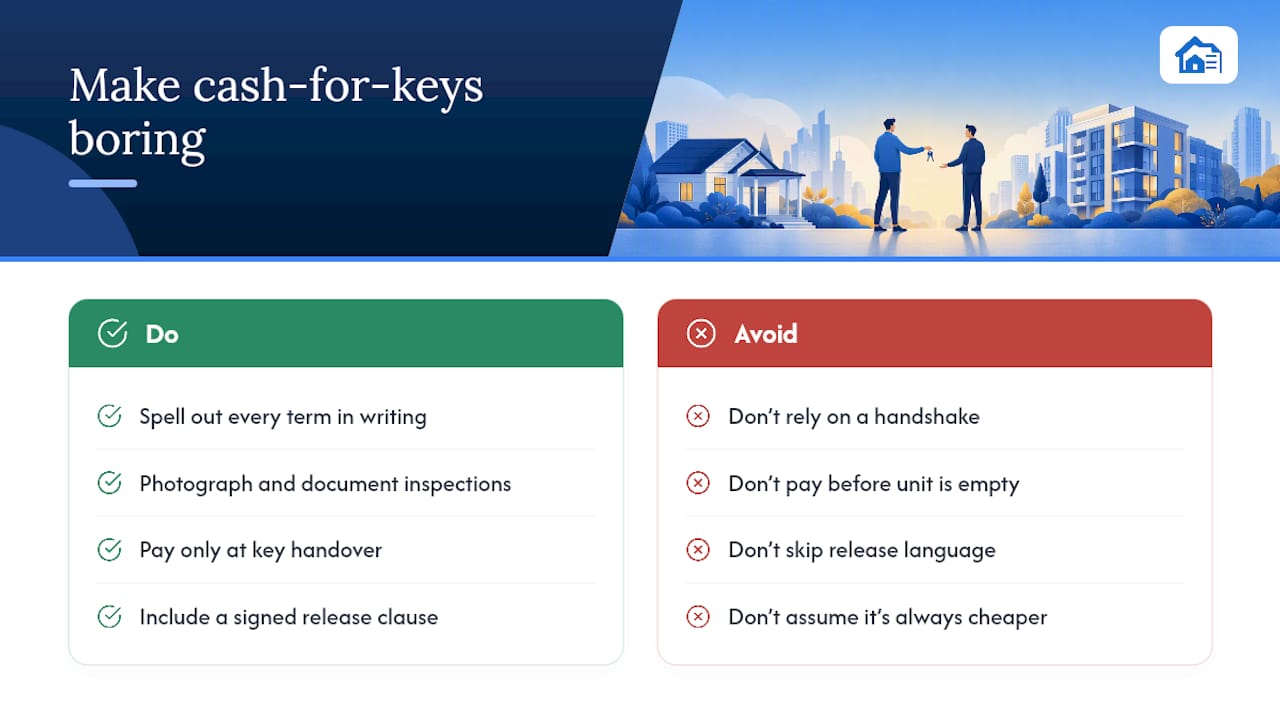
The best cash-for-keys deals are the ones nobody remembers as dramatic. They’re boring because every term was spelled out in advance, every inspection was photographed, and every dollar changed hands at the same moment the keys did. The failures I’ve seen traced back almost every time to landlords treating the agreement like a handshake instead of a contract, skipping the release language, or paying in full before confirming the unit was actually empty.
The other mistake worth naming: landlords assume cash-for-keys is always cheaper than eviction. It usually is, but not automatically. Run your own numbers on court costs and lost rent in your area before you name a figure, because a lowball offer that gets rejected just burns two weeks you didn’t have to lose. Treat the paperwork with the same seriousness you’d give a lease, and the process tends to go exactly as planned. Skip it, and you’ve just handed someone cash with no leverage left to recover it.
— Igor
Draft Your Agreement Without Starting From a Blank Page
Landlordforms turns the checklist above into documents you can actually use today, not a template you have to reverse-engineer from a legal blog. Instead of piecing together a move-out condition standard, a release clause, and a payment schedule from scratch, you generate them in a few clicks, with the same accuracy you’d want from a paid attorney draft.
Start with the move-in/move-out checklist template to document condition before you even make an offer, then use the rent ledger template to track any rent forgiveness or partial payments tied to the deal. Photo documentation and automated receipts mean you’re never scrambling to prove what happened if a tenant disputes the terms later. Try the rent ledger template now and have your next cash-for-keys deal fully documented before your first walkthrough.
Where to Verify the Legal Details
For the rules behind this guide, review HUD’s Fair Housing Act overview, the DOJ’s Civil Rights Division guidance, and, if you’re in California, the Los Angeles buyout ordinance breakdown. Landlords selling a rental with tenants still in place may also want to review this guide to selling with tenants in San Diego.
Sources
- Fair Housing Act overview — HUD
- Fair Housing Act — U.S. Department of Justice Civil Rights Division
- What is a cash-for-keys agreement and how does it work? — LegalClarity
- Credit
FAQ
Is a Cash for Keys Agreement Legally Binding?
Yes, once both parties sign it, it functions as an enforceable contract, provided it’s genuinely voluntary and includes clear terms on payment, move-out date, and release of claims.
Is Cash for Keys a Good Deal for Landlords?
It’s usually a good deal when the payout costs less than the projected legal fees, lost rent, and damage risk of a formal eviction, though the math changes based on local court timelines and tenant protections.
Is Cash for Keys Money Taxable?
Tax treatment depends on your situation. A landlord’s payment is generally a deductible business expense, while a tenant’s or homeowner’s income tax obligation on the payment varies, so confirm allocation with a CPA before finalizing the agreement.
Is Cash for Keys Better Than Eviction?
It’s often faster and cheaper than eviction when the occupant cooperates, but it carries the risk that they take the payment and still don’t leave, which is why splitting payment until verified move-out matters.