Eviction Process Documentation: A Landlord's Guide

TL;DR:
- Proper eviction documentation includes notices, court filings, proofs of service, and supporting evidence, all complying with state requirements. Mistakes in form selection, notice timing, or service method often lead to case dismissal or delays. Using state-specific forms and thoroughly organizing case files are essential for a successful eviction process.
Eviction process documentation is the complete set of legally required forms and records a landlord must prepare, serve, and file to lawfully remove a tenant. Courts treat eviction as a summary legal proceeding, meaning even minor procedural deviations cause dismissal regardless of how valid the underlying reason is. Defective notice is the single most common reason eviction cases fail. Understanding what documents you need, how to prepare them correctly, and how courts scrutinize them is the difference between a successful eviction and starting over from scratch.
What is eviction process documentation and why does it matter?
Eviction process documentation refers to the formal legal paperwork that governs every stage of removing a tenant. It includes notices, court complaints, summons, writs of possession, and proofs of service. Each document serves a specific legal function, and courts require all of them to be properly completed and filed before a judge will rule in your favor.
The stakes are high. Filing fees range from $50 to $400 depending on the jurisdiction, and that money is gone if your case gets dismissed on a paperwork defect. Beyond the filing cost, a dismissed case means restarting the notice period, which adds weeks or months to the process. Getting the documentation right the first time protects your investment and your time.
State statutes, local court rules, and law enforcement agencies all play a role in shaping what eviction paperwork must contain. Landlordforms provides state-specific templates that align with these requirements, reducing the risk of using a generic form that a court will reject outright.
What key documents are required in the eviction process?
Every eviction follows a document chain. Each form builds on the last, and a defect in any one of them can collapse the entire case.
The eviction notice is the first and most critical document. Three main types exist:
- Pay or quit notice: Demands the tenant pay overdue rent or vacate within a set period, typically 3 to 14 days depending on the state.
- Cure or quit notice: Requires the tenant to fix a lease violation or leave.
- Unconditional quit notice: Orders the tenant to vacate with no option to remedy, used for serious or repeated violations.
Every notice must include the tenant’s full legal name, the property address, the specific amount owed or the exact lease violation, and any required statutory disclosures. Missing any of these data points voids the notice entirely.
The eviction complaint is the document you file with the court to formally initiate the case. It must state the factual grounds for eviction, reference the lease, and attach supporting evidence. The complaint triggers the court’s involvement and sets the case timeline.
The summons is issued by the court clerk and served on the tenant. It notifies the tenant of the court date and the deadline to respond. Tenants typically have 5 to 30 days to respond to an eviction complaint. If they miss that deadline, the court issues a default judgment in your favor.
The writ of possession is issued after the judge rules for the landlord. It authorizes law enforcement to physically remove the tenant. Writs give tenants a final 24 to 72 hours to leave before officers enforce the order.
Proof of service accompanies every document served on the tenant. Courts require verified proof of service for each filing to confirm the tenant received proper legal notice.
Pro Tip: Use a free eviction notice template that matches your state’s requirements. A state-specific form eliminates the guesswork on required disclosures and formatting.
How must eviction paperwork be prepared, served, and maintained?
Preparation and service rules are where most landlords make costly errors. Courts do not grade on a curve. A technically correct eviction reason paired with defective paperwork results in dismissal every time.

Using state-mandated forms
Generic eviction forms lead to immediate case dismissal. California, for example, requires specific court forms like CS-010 that cannot be substituted with a generic template. Every state has its own requirements, and courts actively check for compliance before a case proceeds. Always verify which forms your jurisdiction requires before filing anything.
Calculating cure periods correctly
Off-by-one errors in cure period calculations are one of the most common notice defects. The mistake happens when a landlord counts the day of service as day one. Most states require that the cure period begin the day after service. This miscalculation regularly voids eviction notices and forces landlords to restart the entire process.
Serving documents properly
Proper service requires personal delivery, substituted service, or posting and mailing. Email and text message service are generally invalid unless state law explicitly permits them. After serving each document, complete a proof of service form immediately and keep a copy for your case file.
Organizing your case file
Complete eviction case files include the lease agreement, all notices with proofs of service, the formal complaint, and supporting evidence such as payment records and inspection photos. Failing to bring these documents to court often results in losing the case even when the eviction is legally justified. Treat your case file like a trial exhibit binder from day one.
Pro Tip: Track all rent payments with a rent ledger from the start of the tenancy. A clean payment history is your strongest evidence of nonpayment when you reach the courtroom.
Step-by-step overview of the eviction process
Each stage of an eviction requires specific documents. The table below maps the process from first notice to final enforcement.
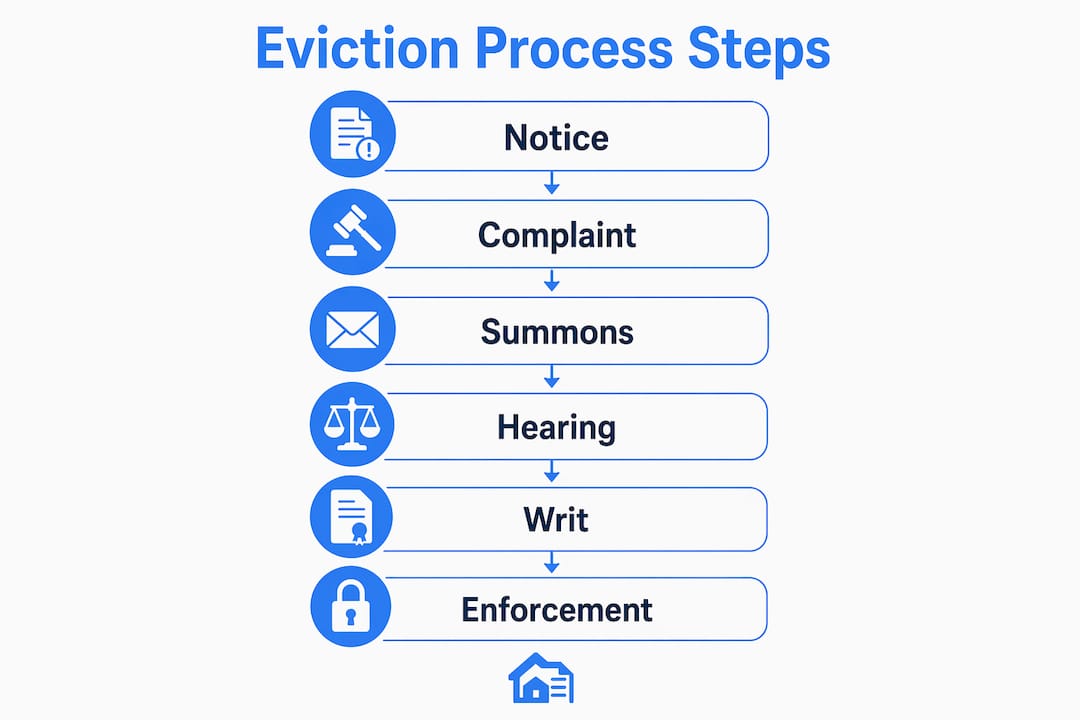
| Stage | Action | Key document |
|---|---|---|
| 1. Notice | Deliver written notice to tenant | Pay or quit, cure or quit, or unconditional quit notice |
| 2. Filing | Submit complaint and summons to court | Eviction complaint, court summons |
| 3. Service | Serve summons and complaint on tenant | Proof of service |
| 4. Hearing prep | Gather evidence for court date | Lease, payment records, photos, notices |
| 5. Judgment | Judge rules for possession | Court judgment for possession |
| 6. Writ | Court issues writ of possession | Writ of possession |
| 7. Enforcement | Law enforcement executes removal | Writ delivered to sheriff or marshal |
Here is how each stage plays out in practice:
- Send the notice. Deliver the correct notice type for the violation. Record the date, method of service, and the exact contents of the notice. A 3-day notice to pay or quit is the standard starting point for nonpayment cases in many states.
- File the complaint. Take the complaint, a copy of the lease, and your notice with proof of service to the court clerk. Pay the filing fee, which ranges from $50 to $400 depending on jurisdiction.
- Serve the summons. The court clerk issues the summons after you file. Serve it on the tenant using a legally approved method and complete a proof of service form immediately.
- Prepare for the hearing. Organize your full case file. Bring the lease, all notices, proofs of service, rent payment records, and any photos documenting the violation or property condition. Inspection records carry significant weight when the eviction involves property damage.
- Attend the hearing. Present your documents. If the tenant fails to appear, the court issues a default judgment. If they appear, the judge reviews both sides before ruling.
- Obtain the writ. After a judgment in your favor, request the writ of possession from the clerk. File it with the sheriff’s or marshal’s office.
- Enforce the writ. Only authorized law enforcement officers can execute physical removal. You cannot change locks or remove belongings yourself.
Common documentation mistakes landlords make
Most eviction failures trace back to a short list of preventable errors. Recognizing them before you file saves you weeks of delay.
- Using generic forms. State courts require state-specific forms. A generic notice or complaint downloaded from a non-authoritative source will likely be rejected at filing or dismissed at the hearing.
- Wrong notice deadlines. Counting the service date as day one of the cure period is the most common off-by-one error. Always start counting the day after service.
- Defective notice content. Missing the tenant’s legal name, the exact amount owed, or required statutory disclosures voids the notice. Courts check these details.
- Invalid service methods. Texting or emailing a notice does not constitute legal service in most states. Use personal delivery, substituted service, or posting and mailing, and document every step.
- Accepting rent during the cure period. Accepting any rent payment after serving a pay-or-quit notice can waive your right to proceed with the eviction. Consult your state’s rules before accepting partial payment.
- Attempting self-help eviction. Changing locks, shutting off utilities, or removing a tenant’s belongings without a court order is illegal in every state. Landlord lockouts and utility shutoffs expose you to civil liability.
Pro Tip: Before filing anything, check every document against your state’s eviction statute. A notice to vacate template built for your state removes most of the guesswork on required language and timing.
Key Takeaways
Proper eviction process documentation is the foundation of every successful eviction, and procedural errors in notices, service, or filings will defeat a case regardless of how valid the underlying reason is.
| Point | Details |
|---|---|
| Documentation chain matters | Every eviction requires notices, complaints, summons, writs, and proofs of service in sequence. |
| State forms are mandatory | Generic forms cause dismissal; always use state-prescribed templates for your jurisdiction. |
| Cure period math is critical | Start counting the cure period the day after service, not on the day of service. |
| Service method controls validity | Personal delivery or posting and mailing are required; email and text are generally invalid. |
| Case file wins hearings | Bring the lease, all notices, proofs of service, and payment records to every court appearance. |
The part landlords consistently underestimate
Most landlords I talk to think eviction is a straightforward process. Serve a notice, file some papers, show up to court, done. The reality is that eviction is one of the most procedurally rigid legal processes in American property law. Courts are not looking for the most sympathetic story. They are checking whether your paperwork meets the statutory standard.
The landlords who lose eviction cases are not usually the ones with weak facts. They are the ones who used the wrong form, miscounted the cure period by a single day, or served the notice by text message because it seemed faster. I have seen cases dismissed on a technicality that took less than five minutes to avoid if the landlord had simply verified the form against the state statute.
The other misconception I see constantly is that a judgment for possession means the eviction is over. It is not. The writ still needs to be filed with the sheriff, and the sheriff sets the enforcement timeline. Landlords who try to speed things up by changing locks or removing belongings after a judgment expose themselves to serious civil liability. The legal process has a defined endpoint, and you have to follow it all the way through.
My honest advice: treat every document in the eviction chain as if a judge will scrutinize it under a microscope. Because one will. Invest the time upfront to get the forms right, serve them correctly, and organize your case file before you ever walk into a courtroom. That discipline is what separates landlords who win from landlords who restart.
— Igor
Landlordforms has the templates you need
Getting eviction paperwork right starts with using the right forms. Landlordforms offers free, state-specific eviction document templates built to meet court requirements, including pay-or-quit notices, cure-or-quit notices, and notice-to-vacate forms. Each template is designed to include the required fields courts look for, reducing the risk of a defective notice dismissal.

Beyond notices, Landlordforms provides a free rent ledger download to track payment history accurately, plus a late fee calculator to document exactly what a tenant owes. These tools give you the organized, court-ready evidence base that judges expect when you walk into a hearing.
FAQ
What is eviction process documentation?
Eviction process documentation is the complete set of legally required notices, court filings, proofs of service, and supporting evidence a landlord must prepare and file to lawfully remove a tenant. Every document in the chain must meet state-specific standards or the case can be dismissed.
What is the most common reason eviction cases are dismissed?
Defective notice is the single most common reason eviction cases are dismissed. Common defects include wrong cure period calculations, missing required data fields, and use of generic forms instead of state-mandated templates.
How long does a tenant have to respond to an eviction complaint?
Tenants typically have 5 to 30 days to respond to an eviction complaint, depending on the jurisdiction. If the tenant fails to respond by the deadline, the court issues a default judgment in the landlord’s favor.
Can a landlord remove a tenant after winning in court?
No. Only authorized law enforcement officers can execute a writ of possession and physically remove a tenant. Landlords who attempt lockouts or utility shutoffs after a judgment face civil liability for illegal self-help eviction.
What documents should a landlord bring to an eviction hearing?
Landlords should bring the signed lease agreement, all served notices with completed proofs of service, the eviction complaint, and supporting evidence such as rent payment records and inspection photos. Failing to bring these documents to court often results in losing the case.