Louisiana Eviction Notice: Rules, Timelines, and Templates

In Louisiana, landlords generally must give tenants a written five-day notice to vacate before filing for eviction, under La. Code Civ. Proc. Art. 4701. That five-day clock starts the moment the notice is delivered, and it applies whether the problem is unpaid rent, a lease violation, or the end of a month-to-month tenancy, unless the lease itself waives the requirement in writing.
If you’re a landlord, the next move is simple: serve the notice correctly, keep proof of that service, and wait out the five days before filing anything in court. If you’re a tenant, read the notice carefully, note the exact deadline, and decide fast whether to pay, cure the issue, or start looking for legal help.
- Landlords: Serve a written notice with the correct deadline, keep proof of delivery, and don’t file the Rule for Possession until the five days pass.
- Tenants: Check the date the notice was delivered, calculate your deadline, and act (pay, fix the violation, or contact a legal-aid office) before that date passes.
One wrinkle worth knowing upfront: some leases include a clause waiving the statutory notice requirement entirely. But if a landlord later serves a document titled “Notice to Vacate” anyway, courts sometimes treat that as reinstating the requirement. Practitioners call this “waiving the waiver,” and it trips up more landlords than you’d expect.
Key Takeaways
A compliant Louisiana eviction always starts with a written five-day notice under Art. 4701, correct service, and documentation that can withstand a court challenge.
| Point | Details |
|---|---|
| Five-day notice is the baseline | Louisiana law requires written notice giving tenants at least five business days to vacate, unless the lease waives it. |
| Count business days carefully | Exclude weekends and legal holidays when calculating the notice deadline to avoid dismissal. |
| Don’t combine rent claims with possession | Seeking back rent in the same filing can convert the case into a slower ordinary action. |
| Service documentation matters | Keep signed receipts, affidavits, or photos proving how and when the notice was delivered. |
| Landlordforms simplifies compliance | Landlordforms generates state-specific notices and tracks rent ledgers so landlords have court-ready documentation. |
Table of Contents
- What Types of Eviction Notices Exist in Louisiana?
- How Do You Serve an Eviction Notice in Louisiana?
- What Is the Step-by-Step Eviction Process in Louisiana?
- How Long Does an Eviction Take in Louisiana, and What Does It Cost?
- What Can a Tenant Do After Getting an Eviction Notice?
- What Mistakes Delay or Derail a Louisiana Eviction?
- Where Can You Get a Compliant Louisiana Eviction Notice Template?
- How Do You Draft a Notice That Holds Up in Court?
- A Publisher’s Take on Where Landlords Actually Go Wrong
- Skip the Guesswork on Louisiana Notice Paperwork
- Where to Verify Louisiana Eviction Rules and Forms
- Sources
- FAQ
What Types of Eviction Notices Exist in Louisiana?
Louisiana doesn’t have one universal eviction notice. The correct notice depends on why you’re ending the tenancy, and using the wrong one can get your case tossed out before you ever see a judge.
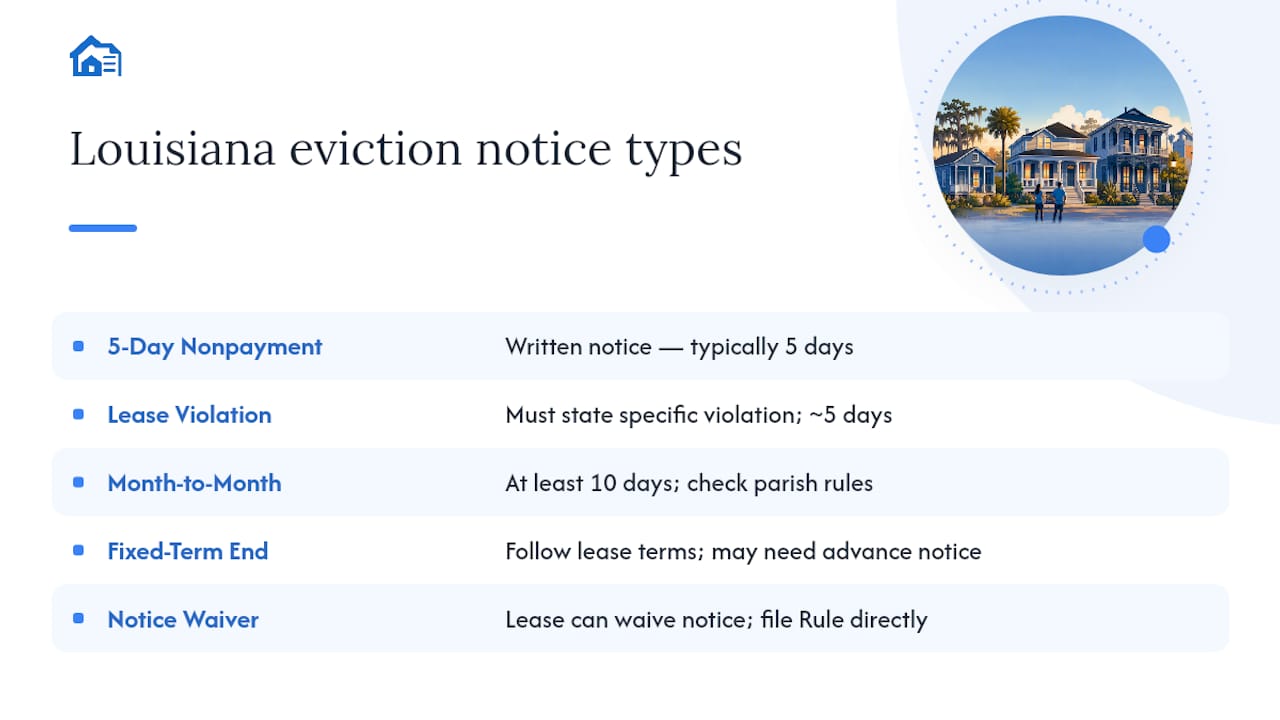
Five-day notice to vacate (nonpayment of rent). This is the most common notice landlords use. LouisianaLawHelp confirms that landlords must give tenants a written notice to vacate, typically allowing five days, before filing a Rule for Possession if the tenant hasn’t paid. A basic version reads something like: “You are hereby notified to vacate the premises at [address] within five days of this notice, due to nonpayment of rent.”
Notice for lease violations. If a tenant violates a lease term (unauthorized pets, unapproved occupants, property damage) that isn’t nonpayment, the same five-day framework under Art. 4701 typically applies unless the lease specifies otherwise. The notice should state the specific violation, not just “breach of lease,” since vague language gives tenants an easy defense.
Termination notices for month-to-month tenancies. Ending a periodic lease with no specific violation still requires written notice. Louisiana law and many local courts expect at least ten days for month-to-month arrangements, though the exact figure can shift depending on how the tenancy was structured, so check your parish’s court guidance before filing.
End-of-lease notices for fixed-term leases. When a fixed-term lease simply expires and the landlord doesn’t intend to renew, some leases require advance notice of non-renewal; others don’t. Read the lease terms first.
Here’s where it gets tricky. A lease can waive the statutory five-day notice in writing, letting a landlord file for eviction without any advance notice at all. That sounds like a shortcut, but it carries real risk.
Pro Tip: If your lease waives the notice requirement, never serve a document that says “Notice to Vacate” anyway out of habit. Courts have treated that as voluntarily reinstating the five-day clock, forcing landlords to restart a process they thought they’d already skipped. If you’ve waived notice, file directly for the Rule for Possession instead.
How Do You Serve an Eviction Notice in Louisiana?
Serving the notice correctly matters as much as writing it correctly. Louisiana courts will dismiss a case over defective service just as readily as over a missing statutory element.
- Personal service. Hand the notice directly to the tenant. This is the cleanest method and the hardest for a tenant to dispute later.
- Service at the residence. If the tenant isn’t available, leaving the notice with someone of suitable age at the residence, or posting it on the door, is often acceptable, particularly when the tenant’s whereabouts are unknown or the unit appears abandoned.
- Certified mail, where the lease allows it. Some leases specify mail as an acceptable method. Confirm your lease language before relying on this alone.
Counting the five days trips up more landlords than any other step. Baton Rouge’s official eviction guidance specifies the notice period runs five business days, excluding weekends and legal holidays. Say you serve notice on a Wednesday. Count Thursday, Friday, then skip the weekend, then Monday and Tuesday. You can typically file on Wednesday of the following week, not the following Monday as many landlords assume.
Keep documentation for everything:
- A signed delivery receipt or certified mail record
- A dated affidavit of service if you posted the notice
- Photos of the posted notice, timestamped if possible
- A copy of the notice itself, with the exact date it was served written on it
Never resort to self-help evictions. Changing locks, shutting off utilities, or removing a tenant’s belongings without a court order is illegal in Louisiana, even when the tenant is clearly behind on rent, and it can expose the landlord to damages that dwarf whatever rent was owed.
What Is the Step-by-Step Eviction Process in Louisiana?
Once the five-day notice period expires and the tenant hasn’t paid, cured, or left, the case moves to court. Nolo’s summary of Louisiana eviction procedure outlines a process that’s more streamlined than most civil litigation, but it still has real steps that can’t be skipped.
- File a Rule for Possession. This gets filed in the parish court that has jurisdiction over the property, often a justice of the peace court or city court, depending on the parish.
- Serve the Rule on the tenant. The court, typically through the sheriff or a constable, serves the tenant with notice of the hearing date.
- Attend the hearing. Both parties can appear. Bring the lease, your proof of service for the original notice, a rent ledger showing the balance owed, and copies of any written communication with the tenant.
- Receive judgment. If the landlord prevails and the tenant still doesn’t leave, the court issues a judgment for possession.
- Obtain and execute a Writ of Possession. This authorizes the sheriff to physically remove the tenant if they haven’t vacated voluntarily.
Filing checklist before you head to court:
- Copy of the signed lease
- Proof of service for the original five-day notice
- Current rent ledger or payment history
- Any written correspondence documenting the violation or nonpayment
- Filing fee (varies by parish court)
One decision point catches a lot of landlords off guard. If you try to recover past-due rent in the same action where you’re seeking possession, Baton Rouge’s guidance warns this can convert the case from a summary proceeding into an ordinary action. Ordinary actions come with heavier service requirements and a much longer timeline. Most landlords are better off pursuing possession first, then filing a separate suit for back rent if the tenant doesn’t pay voluntarily. For a deeper look at organizing the paperwork this process demands, see this guide to eviction process documentation.
How Long Does an Eviction Take in Louisiana, and What Does It Cost?
A straightforward, uncontested Louisiana eviction, one where the tenant doesn’t fight the case, often wraps up within a few weeks from the date the five-day notice is served. Contested cases, or ones where the tenant can’t be located for service, take longer.
| Stage | Typical Time Window |
|---|---|
| Notice to vacate period | 5 business days (statutory minimum) |
| Filing Rule for Possession to hearing date | Roughly 3 to 10 days, court dependent |
| Hearing to judgment | Often same day or within a few days |
| Writ of Possession issuance and execution | A few days to two weeks |
Costs vary by parish, and Baton Rouge’s civil court cost schedule gives a useful example of what filers can expect locally. Expect to budget for:
- Court filing fees for the Rule for Possession
- Service fees for the sheriff or constable to deliver court papers
- Additional fees if a Writ of Possession has to be executed
- Potential costs for a separate suit if pursuing back rent
Pro Tip: If your main goal is getting the unit back quickly, don’t bundle a rent claim into the possession action. Filing a separate small claims or ordinary suit for the money owed keeps the eviction moving on its faster track while you pursue the debt on a parallel path.
A default case where the tenant never responds moves fastest. A contested hearing, where the tenant shows up with a defense, adds days to weeks. And a case where the tenant can’t be found for service (an abandoned unit with unknown whereabouts) can stretch out further while the landlord establishes proper alternative service.
What Can a Tenant Do After Getting an Eviction Notice?
Getting a notice to vacate doesn’t mean the tenant has to leave immediately or has no options. Louisiana law gives tenants several paths, and choosing the right one within the notice window matters more than almost anything else in the process.
- Pay the rent owed, if the notice is for nonpayment. Many landlords will accept payment during the five-day window, though they aren’t legally required to once notice is served, so get any agreement in writing.
- Cure the violation, if the notice cites a specific lease breach that can be fixed, like removing an unauthorized pet or occupant.
- File an Answer if the landlord proceeds to court. Responding formally preserves the tenant’s right to raise defenses and avoids a default judgment.
- Raise defenses at the hearing, including improper service, an incorrect notice period, retaliatory eviction, or discrimination. HUD’s fair housing complaint process applies if the eviction appears tied to a protected class.
- Contact a legal-aid organization. LouisianaLawHelp is a free resource that walks tenants through their rights and connects them with local legal-aid offices.
Timing is everything here. Once a Rule for Possession is filed and a hearing date is set, missing that hearing or failing to file an Answer typically results in a default judgment against the tenant, closing off most avenues to appeal.
Pro Tip: If you’re a tenant unsure whether your landlord served the notice correctly, don’t assume the case is automatically invalid. Bring your copy of the notice and any proof of when you received it to the hearing. Procedural defects are a real defense, but a judge has to hear the argument first.
What Mistakes Delay or Derail a Louisiana Eviction?
Small errors cause more dismissed eviction cases than tenants disputing the underlying facts. Here’s what trips up each side most often.
Landlords should:
- Use the exact statutory notice period and count business days correctly, excluding weekends and holidays.
- Document every step of service with a signed receipt, affidavit, or photo.
- Get any partial-payment arrangement in writing before accepting money after serving notice, since accepting rent can sometimes be read as waiving the eviction.
Tenants should not:
- Ignore a Rule for Possession once served. Not responding almost guarantees a default judgment.
- Move out belongings or vacate informally without keeping proof of payment or communication, which can undercut a later dispute over deposits or damages.
A common real-world mistake: a landlord serves notice on a Friday and files the following Wednesday, miscounting the weekend as part of the five business days. The court dismisses the case, forcing the landlord to restart the entire notice period. The fix is straightforward. Mark the delivery date, count only business days, and confirm the filing date against a calendar before submitting anything to the court.
Where Can You Get a Compliant Louisiana Eviction Notice Template?
You don’t have to draft a notice from scratch, and honestly, you shouldn’t. A handful of reliable sources cover the statutory text, local filing rules, and ready-to-use templates.
- La. Code Civ. Proc. Art. 4701 on the Louisiana Legislature’s site gives you the actual statutory language, useful when you want to confirm the exact legal standard rather than rely on a paraphrase.
- LouisianaLawHelp offers plain-language explanations of tenant and landlord rights alongside the eviction process.
- Municipal pages, like Shreveport’s official eviction guidance and its sample petition for eviction, show exactly what local courts expect on filed paperwork.
- Landlordforms provides state-specific, fill-in-the-blank eviction notice templates built to match Art. 4701’s requirements, so landlords aren’t reconstructing legal language from memory.
Whichever source you use, a compliant notice needs these fields:
- Tenant’s full name and the property address
- A clear statement of the reason for eviction (nonpayment, lease violation, etc.)
- The exact deadline by which the tenant must vacate
- The date the notice was delivered
- The landlord’s signature
- Space to document the method and date of service, for your own records
A basic fill-in template reads: “To [Tenant Name], you are hereby notified that you must vacate the premises located at [Property Address] within five (5) days of the delivery of this notice, due to [reason]. This notice is delivered on [Date].” Customize the reason and date, but don’t strip out the statutory five-day language unless your lease has a valid written waiver.
How Do You Draft a Notice That Holds Up in Court?
A notice that looks right isn’t always one that holds up if a tenant challenges it. Small formatting choices make a real difference when a judge is deciding whether the notice met Art. 4701’s requirements.
Before you serve anything, run through this checklist:
- Confirm the delivery date is written on the notice itself, not just noted separately.
- Calculate the five-day deadline using business days, and write that exact date on the notice rather than a vague “within five days” phrase.
- Include a signature block for both the landlord and, if applicable, a witness to service.
- Attach or reference a return-of-service form documenting exactly how and when the notice reached the tenant.
- Keep the original notice and every proof-of-service document in your file, not just a digital copy.
A short compliant sample: “Notice to Vacate: You are hereby notified that pursuant to La. Code Civ. Proc. Art. 4701, you must vacate the premises at [address] no later than [specific date], due to [reason for eviction]. This notice was delivered on [delivery date] by [method of service].”
If your lease has a written waiver of the five-day notice, that changes the timing calculation entirely, but it doesn’t eliminate the need for careful documentation. Waived or not, courts still expect landlords to show exactly what happened and when, so serve every notice in a manner your local court accepts and keep the paper trail intact from day one.
A Publisher’s Take on Where Landlords Actually Go Wrong
Building compliant landlord forms for years surfaces the same handful of mistakes over and over. It’s rarely the big legal concepts that trip people up. It’s the small mechanical details: miscounting business days, forgetting to date the notice, or accepting a partial rent payment without writing down what that payment actually means for the eviction.
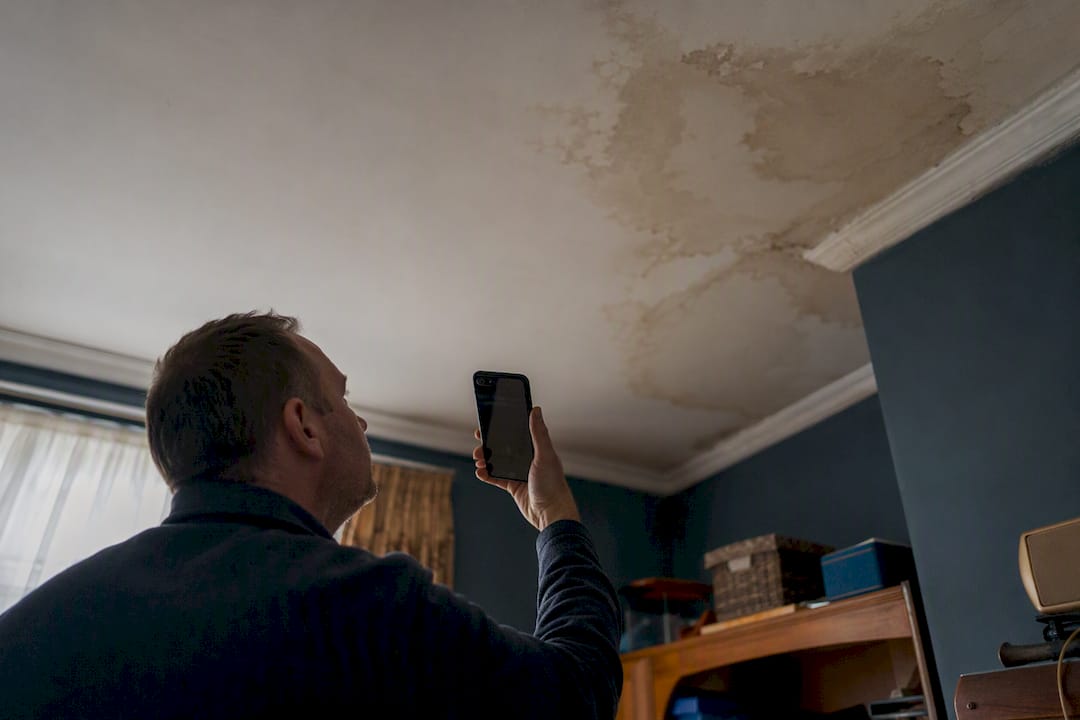
Two things consistently save landlords time and headaches. First, keep a running rent ledger from day one of every tenancy, not just after problems start. When you’re standing in front of a judge, a clean payment history is worth more than any amount of verbal explanation. Second, photograph everything related to service and condition, whether that’s a posted notice or a move-in inspection. Photo documentation resolves disputes before they escalate into contested hearings.
The pattern holds across nearly every dismissed case worth studying: the eviction wasn’t wrong on the merits, it was wrong on the paperwork.
Skip the Guesswork on Louisiana Notice Paperwork
Landlordforms builds state-specific eviction notices that already match Louisiana’s five-day requirement under Art. 4701, so you’re not second-guessing whether your notice language, dates, or deadlines will hold up in court.

Instead of retyping the same notice from a blank document every time a tenant falls behind, Landlordforms auto-fills tenant names, property addresses, and statutory deadlines, then exports a proof-of-service record you can bring straight to the hearing. The platform also tracks your rent ledger in real time, which matters more than most landlords realize once a case reaches court and a judge asks for a clear payment history. If you’re managing anywhere from a single unit to 150, that’s hours back every month you’d otherwise spend formatting notices and chasing paperwork. Start with a free rent ledger template to see how the documentation side works, or try the notice generator directly to build your next Louisiana eviction notice in minutes instead of starting from scratch.
Where to Verify Louisiana Eviction Rules and Forms
Read the statute directly at legis.la.gov before relying on any secondhand summary, since it’s the actual legal text courts apply. LouisianaLawHelp translates that statute into plain language for tenants and landlords navigating the process without an attorney.
For local filing specifics, Shreveport’s eviction guidance page shows exactly what that parish’s courts expect on submitted paperwork, including a sample petition. Municipal pages like this fill the gap that statewide statutes leave open: they explain local procedure, not just legal standards.
This article is general information, not a substitute for advice from a qualified lawyer. Consult a qualified legal professional about your own circumstances before acting on anything here.
Sources
- La. Code Civ. Proc. Art. 4701 — Louisiana State Legislature
- Louisianalawhelp
- Eviction procedure guidelines (Baton Rouge)
- Evictions | Shreveport, LA - Official Website
- The eviction process in Louisiana: Nolo
FAQ
How long does it take to evict a tenant in Louisiana?
An uncontested eviction typically takes two to four weeks from the date the five-day notice is served to the writ of possession being executed. Contested hearings or difficulty serving the tenant can extend that timeline significantly.
What is the difference between a notice to vacate and an eviction?
A notice to vacate is the written warning required before court action, giving the tenant at least five days to leave or fix the issue. An eviction is the court process that follows if the tenant doesn’t comply, ending in a judgment and possibly a Writ of Possession.
What is the eviction process in Louisiana?
The process runs from serving a written notice to vacate, to filing a Rule for Possession in the appropriate parish court, to a hearing, to a judgment, and finally to a Writ of Possession if the tenant still won’t leave.
How much does it cost to get someone evicted in Louisiana?
Costs include court filing fees for the Rule for Possession and service fees for the sheriff or constable, and they vary by parish; Baton Rouge’s civil court cost schedule offers one example of the range. Pursuing back rent in a separate suit adds its own filing costs.
Can a landlord skip the five-day notice requirement in Louisiana?
Only if the lease includes a written clause waiving that notice; otherwise Art. 4701 requires it. Serving a document labeled “Notice to Vacate” even under a waived lease can be treated by courts as reinstating the standard notice period.