Why Inspection Records Matter Legally for Landlords

TL;DR:
- Proper inspection records serve as essential legal proof that landlords met their safety and liability obligations. Missing or inconsistent documentation exposes landlords to fines, lawsuits, and claims of negligence, especially if hazards go unaddressed. Maintaining detailed, tamper-proof records linked to notices and photos helps defend against legal challenges and ensures compliance.
Inspection records are the primary legal evidence that property owners have met their compliance and liability obligations. Without them, a landlord who fixed every hazard and followed every rule has no proof it ever happened. The legal principle is blunt: if you did not record it, you did not do it. That standard applies in regulatory audits, tenant lawsuits, and court proceedings alike. Understanding why inspection records matter legally is the first step toward protecting your properties, your finances, and your reputation.
Why inspection records matter legally: the core standard
Inspection records serve as objective documentation of due diligence. Courts and regulators do not accept verbal assurances. They require a paper or digital trail showing what was inspected, when, by whom, and what action followed.

Federal agencies including OSHA and the EPA set baseline documentation requirements for property safety. Many state and local housing codes add their own layers, requiring landlords to record habitability checks, lead paint inspections, and fire safety reviews. These inspection documentation requirements are not suggestions. Failure to meet them exposes you to fines, license revocation, and civil liability.
The legal stakes are concrete. A 2014 regulatory case resulted in a $273,000 fine after a facility could not produce adequate inspection documentation. That penalty came not from the underlying hazard alone, but from the absence of records proving the hazard had been addressed. For landlords managing rental units, the same logic applies at every scale.
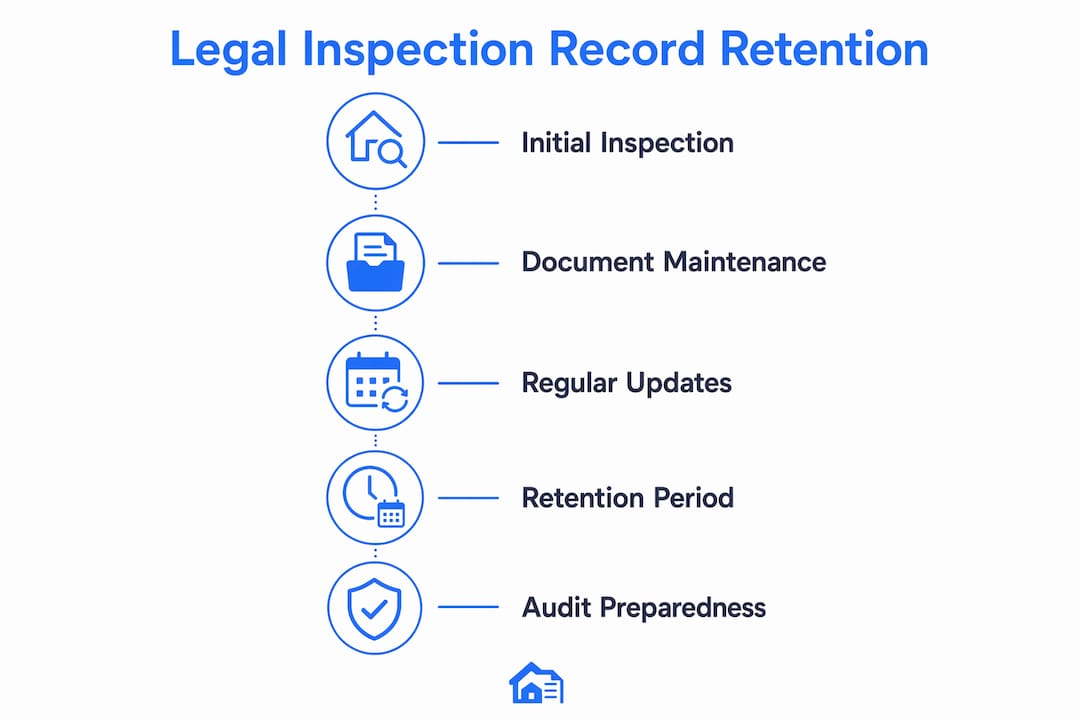
Retention periods vary by jurisdiction, but many require 5 years or more for a defensible audit trail. Some standards require records to be kept for the life of the asset. Landlords who purge files after a year are creating legal exposure they may not discover until a lawsuit arrives.
How inspection records protect landlords from liability
The most direct benefit of thorough inspection records is defense against negligence claims. When a tenant alleges that a hazard caused injury or property damage, your inspection log is the first document a court will request.
Incomplete or inconsistent records are among the most common factors cited in landlord liability arguments. A gap in your log, even a single missed quarterly check, signals to a judge or jury that oversight was lax. Consistent records tell the opposite story: a landlord who inspected systematically and acted on findings.
“The remediation trail, meaning records proving prompt correction of inspected hazards, is the most critical proof against claims of negligence or willful misconduct.” Safety Recordkeeping: The Operational Case for Getting It Right
Landlords often document the inspection itself but skip the follow-up. Courts interpret that gap as willful negligence when a noted hazard goes uncorrected. The fix is simple: every inspection entry needs a corresponding remediation note, even if the note says “no action required.”
Tenant rights add another legal dimension. In jurisdictions like New York City, documented justification for entry is legally required to avoid harassment claims. Recording the reason for each inspection, the notice provided, and the outcome protects you from a separate category of legal risk entirely.
Pro Tip: Link every inspection record to the corresponding tenant notice. A move-in checklist paired with a signed entry notice creates a two-document defense that is far harder to challenge than either record alone.
Common pitfalls in inspection recordkeeping to avoid
Most landlord recordkeeping failures fall into predictable patterns. Recognizing them is the fastest way to close your legal exposure.
-
Inconsistent documentation. Inspecting a unit in March and again in october but skipping the summer creates a gap that opposing counsel will highlight. Regulators expect a regular, predictable schedule.
-
No remediation evidence. Noting a leaking pipe in your log but having no follow-up record of the repair is worse than not noting it at all. It proves you knew about the problem and may not have fixed it.
-
Editable or unsecured formats. Word documents and spreadsheets stored on a personal laptop can be altered. Records that lack an immutable audit trail risk being labeled as tampered with during legal discovery, which destroys their value as evidence.
-
Premature deletion. Deleting records after one or two years violates many state retention requirements and leaves you without defense if a claim surfaces years later.
-
Missing inspector identification. A record that does not name who performed the inspection cannot be verified. Courts require a named, accountable inspector.
Pro Tip: Treat your inspection log the same way you treat a lease agreement. Store it in a system that timestamps every entry and prevents retroactive edits. Landlordforms supports photo documentation for inspections, which adds a visual layer that written notes alone cannot provide.
Best practices for maintaining legally defensible inspection records
A defensible inspection record does more than note what you saw. It establishes a complete, verifiable history of property management.
What every inspection record must include:
- The date, time, and location of the inspection
- The name and role of the person who conducted it
- A description of each area inspected, including common spaces and exterior areas
- Findings for each area, including “no issues found” where applicable
- Photo or video evidence attached to the relevant entry
- A remediation note for every finding, with a completion date
Documenting baseline inspections of all property areas, not just individual units, strengthens your legal defense by showing systemic maintenance. A landlord who can show consistent records for hallways, parking lots, and mechanical rooms demonstrates a property-wide standard of care.
Digital systems with immutable audit trails are the current best practice. Tamper-proof digital records remain defensible even after software changes or vendor transitions, because the underlying log cannot be altered retroactively. Paper records, by contrast, can be lost, damaged, or questioned.
The table below shows recommended retention periods by record type, based on common regulatory guidance.
| Record type | Recommended retention period |
|---|---|
| Move-in and move-out inspections | Minimum 3 years after tenancy ends |
| Routine habitability checks | 5 years or until next inspection |
| Lead paint and environmental inspections | Life of the property |
| Fire and safety system inspections | 5–7 years |
| Remediation and repair records | 5 years from completion date |
Coordinating inspection records with your broader documentation system matters too. A move-in checklist tied to a signed lease, combined with periodic inspection logs and a move-out report, creates an unbroken chain of evidence covering the full tenancy. That chain is what courts and auditors want to see.
The legal environment is also shifting. AI-assisted discovery tools are now used in litigation to identify gaps and inconsistencies in inspection records. What once required a paralegal to review manually can now be flagged automatically. Landlords who treat recordkeeping as optional are facing a litigation environment that is better equipped than ever to find the holes.
Key Takeaways
Inspection records are a landlord’s primary legal defense, and gaps in documentation create liability that no amount of verbal explanation can repair.
| Point | Details |
|---|---|
| Records equal proof | Courts treat undocumented inspections as inspections that never happened. |
| Retention periods matter | Most jurisdictions require 5 or more years; life-of-asset rules apply to environmental records. |
| Remediation trail is critical | Every noted hazard needs a follow-up record showing it was corrected. |
| Immutable formats win in court | Editable files risk being dismissed as tampered; use timestamped, tamper-proof systems. |
| Coordinate all documents | Linking inspection logs to leases, notices, and checklists creates a complete legal record. |
What I’ve learned from watching landlords lose cases they should have won
I’ve reviewed enough landlord-tenant disputes to spot the pattern immediately. The landlord did the work. They fixed the leak, replaced the smoke detector, and walked the property every quarter. But they kept notes in a spiral notebook that disappeared, or they stored photos in a phone that got wiped. When the lawsuit came, they had nothing.
The mindset shift that changes everything is treating inspection records as a legal asset, not a chore. Every entry you make is a future exhibit. Every photo you attach is testimony you won’t have to give in person. That reframe makes the paperwork feel less like overhead and more like insurance.
The AI discovery point is one I take seriously. Opposing counsel no longer needs to manually comb through your records looking for gaps. Automated tools do it in minutes. A missing inspection from 18 months ago, one you forgot about entirely, can become the centerpiece of a negligence argument. The records liability gap is real, and it is growing.
My practical advice: set a calendar reminder for every scheduled inspection, log it the same day, and attach at least one photo. Do not wait until the end of the month to catch up. Retroactive entries look retroactive, and courts notice.
— Igor
Landlordforms makes compliant recordkeeping straightforward
Property owners managing anywhere from one unit to 150 need a documentation system that keeps pace with legal requirements without adding hours to the week.

Landlordforms is built specifically for that scale. It supports photo documentation for inspections, generates professional forms including move-in and move-out checklists, and organizes tenant information in one place. Landlords report saving up to eight hours a week by replacing manual entry with automated document creation. The platform’s free document templates cover the full range of inspection and tenancy documentation, from baseline property checks to lease violation notices. For landlords who want a complete recordkeeping foundation, the move-in checklist template is a practical starting point that ties directly to the legal standards covered here.
FAQ
Why do inspection records matter legally for landlords?
Inspection records are the primary evidence that a landlord met their duty of care. Without them, courts and regulators treat the inspection as if it never occurred.
How long should landlords keep inspection records?
Most jurisdictions require a minimum of 3–5 years, with environmental and lead paint records kept for the life of the property. Check your state’s specific housing code for exact retention rules.
What happens if a landlord has incomplete inspection records?
Gaps or inconsistencies in inspection records are frequently cited in liability arguments and can result in regulatory fines, lost lawsuits, or both.
Do inspection records need to include photos?
Photos are not universally required by law, but they significantly strengthen a record’s legal defensibility. A timestamped photo attached to an inspection entry is far harder to dispute than a written note alone.
Can a landlord be penalized for inspecting too often?
Yes. Excessive or undocumented inspections can trigger tenant harassment claims. Documenting the reason for entry and the notice provided protects landlords from this specific legal risk.