Photo Documentation in Property Management: 2026 Guide

TL;DR:
- Photo documentation in property management involves capturing timestamped, geotagged images that objectively record property conditions throughout tenancy. It provides legally defensible evidence for disputes, with metadata like GPS and timestamps crucial for authenticity. Consistent workflow, proper techniques, and sharing records with tenants help prevent conflicts and support legal and insurance claims.
Photo documentation in property management is defined as the systematic capture of timestamped, geotagged visual records that objectively establish a property’s condition at every stage of a tenancy. Done correctly, it is the single most defensible asset a landlord or property manager can hold in a dispute. Without it, you are relying on memory and testimony against a tenant who has equal standing in any tribunal. This guide covers the legal standards, practical techniques, and workflow tools that make photo records work in your favor.
What is the role of photo documentation in property management?
Photo documentation serves as objective, court-ready evidence that replaces subjective testimony in deposit disputes, maintenance claims, and lease violation cases. Tribunal members in jurisdictions like Australia, including bodies such as QCAT and VCAT, prioritize timestamped photographic evidence over verbal accounts during bond hearings. That preference reflects a broader legal reality: photos with verified metadata are harder to dispute than any written statement.
The industry term for this practice is “condition documentation,” and it covers every visual record tied to a property’s physical state. The role of photo documentation in property management extends beyond dispute resolution. It supports insurance claims, habitability compliance, maintenance tracking, and lease renewal negotiations. Property managers who treat it as a core workflow, rather than an afterthought, consistently face fewer costly disputes.
How does photo documentation protect landlords legally?
The legal weight of a photo depends entirely on its metadata. GPS coordinates and timestamps embedded in the image file prove when and where a photo was taken. Strip that data, and a court or tribunal has no way to verify the photo’s authenticity or relevance.
Common metadata failures include:
- Emailing photos between devices, which strips EXIF data from the file
- Screenshotting images, which removes all original metadata
- Using cloud uploads that compress files and discard location data
- Saving photos to shared drives without preserving the original file
Experts recommend apps that burn the date, time, and property address directly into the image itself. This creates a human-readable record that survives file transfers and format changes. A photo with a visible timestamp and address in the frame is far more persuasive to a tribunal member than a file with invisible metadata that opposing counsel can challenge.
Pro Tip: Never email inspection photos as attachments. Transfer them using a dedicated property management app or a file-sharing service that preserves the original file, including all EXIF data.
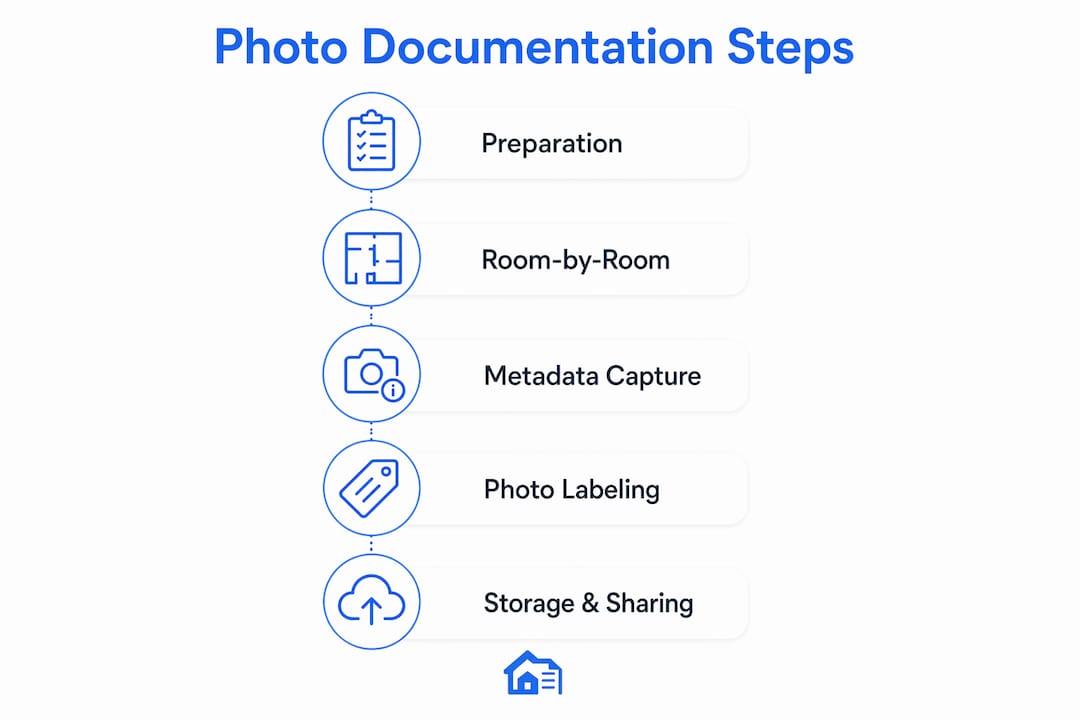
Professional inspection reports require clear property identifiers, a consistent room-by-room order, plain language notes, and photo references tied directly to checklist items. Sign-off by both parties at move-in and move-out strengthens the legal standing of every record in the file. A report that meets these standards is audit-ready from day one, which matters when litigation timelines compress and you need to produce evidence quickly.
What does a complete photo documentation process look like?
Effective condition documentation covers four distinct stages of a tenancy: move-in, routine inspections, maintenance events, and move-out. Each stage requires a different focus, but all four share the same technical standards for metadata and image quality.
A complete documentation workflow includes four integrated components. Missing any one of them creates a critical gap that can cost you an insurance claim or a tribunal ruling.
- Timestamped work orders. Every maintenance request and repair must be logged with a date, time, and description before work begins. This establishes a timeline that photos can then support.
- Before and after photos with metadata. Capture the condition before any repair or cleaning, and again after. Both sets must carry GPS and timestamp data.
- Immutable audit trails. Records must be stored in a system that logs who accessed or modified them. Editable spreadsheets do not qualify.
- Centralized, searchable storage. All photos, reports, and work orders must live in one place, organized by property, unit, and date.
The room-by-room approach is the industry standard for move-in and move-out documentation. A standardized checklist prevents missed items and creates a consistent sequence that makes move-in and move-out comparisons straightforward. Photograph each room in the same order, from the same angles, at every inspection. That consistency is what makes a side-by-side comparison credible to a tribunal.
| Tenancy Stage | Photo Focus | Key Metadata Requirement |
|---|---|---|
| Move-in | Walls, floors, fixtures, appliances | GPS, timestamp, address burn-in |
| Routine inspection | Wear and tear, maintenance issues | Timestamp, room label |
| Maintenance event | Before and after repair condition | Timestamp, work order reference |
| Move-out | Full room-by-room comparison to move-in | GPS, timestamp, address burn-in |
A typical professional inspection walkthrough lasts 2–4 hours and requires structured photo documentation linked to notes for legal defensibility. That time investment pays off when a deposit dispute would otherwise take days of tribunal preparation.
Which photo techniques produce legally defensible evidence?
The visual narrative approach is the most effective technique for property inspection photography. Starting with wide context shots before moving to medium-range and close-up images establishes exactly where damage is located and prevents misattribution. Insurers and tribunals consistently favor this progression because it removes ambiguity about which room or surface is being documented.
A defensible photo set for any single item of damage includes three shots:
- Wide shot: Shows the full room or area, placing the damage in context
- Medium shot: Shows the damaged item within its immediate surroundings
- Close-up shot: Shows the specific damage in detail, with enough resolution to read surface texture or depth
Pro Tip: Label each photo with the room name and item number from your checklist before uploading. “Kitchen-04-stovetop” is far more useful in a tribunal than “IMG_3847.”
Dedicated property management software that automatically tags photos with metadata and links them to specific rooms or checklist items eliminates filing errors and preserves EXIF data through the entire storage lifecycle. Entry-level field apps typically offer photo capture with basic timestamping. Enterprise-grade platforms add GPS burn-in, report generation, tenant sign-off workflows, and cloud storage with immutable audit logs. The right choice depends on your portfolio size and how frequently you face deposit disputes.
Landlordforms supports photo documentation for inspections directly within its platform, giving landlords managing 1 to 150 units a single place to store records alongside their legally required documents.
How does sharing photo records improve tenant relations?
Transparent photo documentation shifts the dynamic of a tenancy inspection from policing to accountability. Sharing move-in photos with tenants at the start of a lease establishes a common baseline that both parties have seen and accepted. That shared record removes the most common source of move-out conflict: disagreement about what the property looked like when the tenant arrived.
Practical steps for tenant-inclusive documentation include:
- Send the full move-in photo report to the tenant within 48 hours of key handover
- Ask the tenant to confirm receipt and flag any items they believe are missing or inaccurate
- Store their response alongside the original report as part of the tenancy file
- Share routine inspection summaries, not just findings, so tenants see the process as fair
Tenants and property owners are significantly less likely to dispute damage claims when records are objective and shared proactively. The emotional charge of a deposit deduction drops when a tenant can see a timestamped photo from move-in day sitting next to a timestamped photo from move-out day. The evidence speaks for itself, and the conversation shifts from accusation to fact.
Property managers who build this transparency into their standard workflow also report stronger tenant retention. Tenants who trust the documentation process are more likely to report maintenance issues early, which reduces long-term repair costs and protects the property’s condition over time.
Key Takeaways
Photo documentation is the most defensible asset a landlord holds in a deposit dispute, and its legal strength depends entirely on metadata preservation and consistent technique.
| Point | Details |
|---|---|
| Metadata is non-negotiable | GPS and timestamp data must be preserved in the original file or burned into the image to hold up in a tribunal. |
| Four-component workflow | Timestamped work orders, before/after photos, audit trails, and centralized storage must all be present. |
| Visual narrative technique | Shoot wide, medium, and close-up for every damage item to prevent misattribution in disputes. |
| Tenant transparency reduces conflict | Sharing move-in photos within 48 hours establishes a common baseline and lowers the risk of deposit disputes. |
| Consistency across inspections | Photographing rooms in the same order and from the same angles at every inspection makes comparisons credible. |
Why most landlords are one dispute away from regretting their photo habits
I have seen landlords lose deposit disputes they should have won. Not because the damage was not real, but because their photos were taken on a phone, emailed to themselves, and saved in a folder with no labels and no metadata. The tribunal looked at the images, could not verify when they were taken, and ruled in the tenant’s favor. That outcome was entirely preventable.
The documentation gap I see most often is not a lack of photos. It is a lack of system. Landlords take photos at move-in, but they store them in three different places, label them inconsistently, and never link them to a checklist. When a dispute arrives six months later, assembling a coherent evidence file takes hours and still looks disorganized.
Property managers often treat documentation as secondary. The reality is that documentation must be audit-ready from day one. The legal landscape in 2026 is moving toward stricter evidentiary standards, with tribunals increasingly expecting GPS-stamped, metadata-rich reports rather than a folder of phone photos. Landlords who standardize their photo protocols now will be ahead of that curve, not scrambling to catch up when a dispute lands.
Train anyone who conducts inspections on the wide-medium-close technique and the metadata requirements. Make the move-out documentation checklist a non-negotiable part of every tenancy end. Treat photo documentation as a business system, not a task you do when you remember to.
— Igor
Landlordforms tools that support your documentation workflow
Landlordforms is built for landlords managing 1 to 150 rental units, and its tools connect directly to the documentation workflows covered in this article.

The platform’s photo documentation feature for inspections keeps visual records alongside your tenancy files, so everything is in one place when you need it. Free templates like the move-in/move-out checklist give you a standardized room-by-room structure that supports consistent photo sequencing. For landlords who want to tighten their financial records alongside their inspection records, the rent ledger template tracks payments in the same organized format. Landlordforms also offers a rent proration calculator for move-in and move-out dates, keeping your financial and condition records aligned from day one.
FAQ
What is photo documentation in property management?
Photo documentation in property management is the systematic capture of timestamped, geotagged images that record a property’s condition at move-in, during inspections, after maintenance, and at move-out. These records serve as objective evidence in deposit disputes and legal proceedings.
Why does photo metadata matter for landlords?
Photos without preserved metadata are difficult to authenticate in court or at a tribunal. GPS coordinates and timestamps prove when and where a photo was taken, making the evidence far harder to challenge.
How many photos should a landlord take at move-in?
There is no fixed number, but the standard practice is to photograph every room from multiple angles, including wide, medium, and close-up shots of any existing damage. A thorough move-in set typically runs 50–100 photos for a standard unit.
How does photo documentation reduce deposit disputes?
Sharing move-in photos with tenants at the start of a lease establishes a shared baseline that both parties have acknowledged. When move-out photos show clear changes from that baseline, disputes are far less likely because the evidence is objective and mutually accepted.
What is the best way to store inspection photos?
Store photos in a dedicated property management platform that preserves EXIF data and links images to specific checklist items and rooms. Avoid emailing photos as attachments, which strips metadata and weakens their legal standing.