Reconcile Security Deposits Defensibly in 11 Steps for U.S. Landlords

Reconcile security deposits by documenting move-in condition, running the ledger math against your trust account, and issuing a refund or itemized deduction statement inside your state’s deadline. That means comparing dated move-in and move-out records, calculating prorated charges by remaining useful life, and confirming your tenant ledgers match both your general ledger liability and your bank balance. Skip any of those three checks and a deduction that felt obvious to you can collapse the moment a tenant disputes it.
TL;DR:
- Proper reconciliation starts with documented move-in conditions, a tenant sub-ledger, trust account records, move-out inspections, and vendor invoices.
- Security deposits are liabilities until applied, requiring three-way reconciliation to match tenant ledgers, general ledger, and bank balances before refunds or deductions.
- Deductions for damage must be calculated using useful-life pro-rata formulas, supported by recorded install dates, move-in photos, and current market estimates.
- Most states impose deadlines of 14 to 30 days for refunding deposits or providing itemized deductions, with specific rules varying by jurisdiction.
- Using automated tools that centralize data and document workflows can streamline reconciliation and minimize record-keeping errors.
Table of Contents
- What Goes Into Security Deposit Reconciliation?
- How Do You Record Security Deposits in Accounting?
- How Do You Calculate a Defensible Deduction?
- How Long Do You Have to Return a Security Deposit?
- Move-Out Reconciliation Checklist to Run Right Now
- Documenting Deductions and Handling Tenant Disputes
- What Happens When Damages Exceed the Deposit?
- Why Most Deposit Disputes Are Really Documentation Failures
- Where to Verify These Rules
- Get Your Reconciliation Process Off Spreadsheets
- Sources
- FAQ
What Goes Into Security Deposit Reconciliation?
Reconciling a deposit correctly means pulling five things into one file before you touch a calculator: the move-in condition baseline, the tenant’s sub-ledger, the trust or escrow account record, the move-out inspection, and any vendor invoices for repairs. Each piece exists to answer a different question. The move-in baseline proves what condition you started with. The sub-ledger tracks what that specific tenant paid in and what’s been applied against it. The trust account confirms the money is actually sitting where it’s supposed to be, separate from your operating cash.
The right order matters more than people assume. Start with the baseline, run the move-out inspection against it, estimate repair costs, do the ledger math, reconcile the trust account, and only then produce the disposition statement. Reversing that sequence, say, calculating charges before confirming the trust balance, is how landlords end up refunding more than they actually have on hand.
Three things derail this process most often:
- Missing installation dates on flooring, appliances, or paint, which makes proration guesswork instead of math
- No dated photos from move-in, leaving nothing to compare against move-out damage
- Commingled funds, where deposit money got mixed into the operating account and can’t be traced back cleanly
Move-out is the highest-risk point in the entire tenancy because inspection, itemized deductions, and the state deadline all have to land in sequence before a dollar moves. Miss one step and the whole timeline slips.
How Do You Record Security Deposits in Accounting?
A security deposit is a liability, not income, from the day you receive it until the day you apply part of it to damages or unpaid rent. That distinction trips up more landlords than any other part of deposit accounting, and it’s why tracking deposits as liabilities rather than revenue sits at the center of every state’s compliance expectations.
The entries themselves follow three basic patterns depending on the outcome:
- Full refund: debit the security deposit liability account, credit cash, zero balance closed.
- Partial deduction: debit the liability for the full amount held, credit cash for the refunded portion, and credit repair/cleaning revenue or expense recovery for the deducted portion.
- Full forfeiture: debit the liability for the entire amount, credit revenue or expense recovery accounts for the full sum, no cash movement to the tenant.
Closing the tenant’s ledger correctly requires what’s called three-way reconciliation: the total of all tenant sub-ledgers has to equal your general ledger liability balance, which in turn has to equal the actual cash sitting in your trust account. Monthly three-way reconciliation catches small drift, a missed entry here, a bank fee there, before it snowballs into a discrepancy you can’t explain at move-out. Keep a signed reconciliation report on file each time you run it; that document is what you hand to an auditor or a small-claims judge if a tenant ever challenges your math.
How Do You Calculate a Defensible Deduction?
Wear and tear is what happens to a rental unit through ordinary living: faded paint, worn carpet paths, minor scuffs. Damage is what happens through negligence or misuse: cigarette burns, pet stains soaked into the subfloor, a cracked window from a slammed door. You can charge for damage. You generally cannot charge for wear and tear, and the line between the two is where most disputes actually happen.
Even legitimate damage claims can’t be billed at full replacement cost if the item was already partway through its useful life. The formula is straightforward:
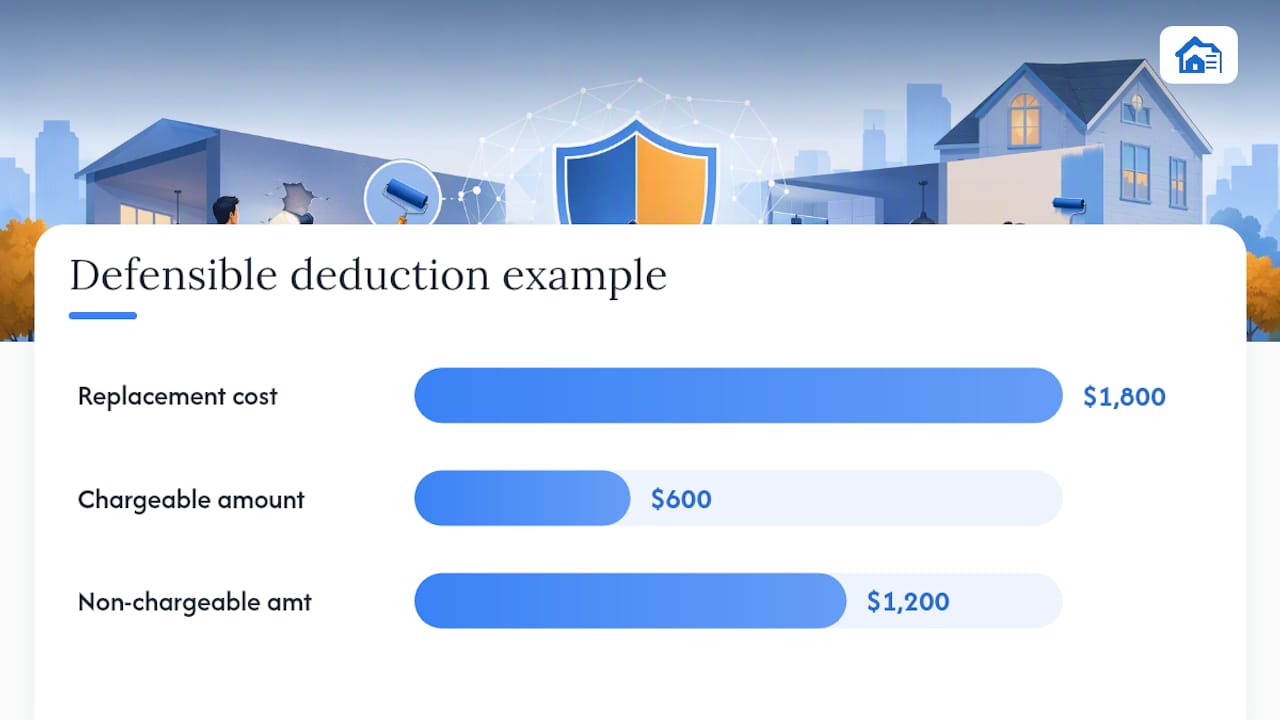
Chargeable amount = replacement cost × (remaining useful life ÷ total useful life)
Say a tenant stains a carpet beyond cleaning, and that carpet has a typical 5 to 7 year useful life under commonly cited HUD-based guidance. If the carpet is 4 years into a 6-year lifespan, it has 2 years of value left. A $1,800 replacement becomes a $600 charge, not $1,800. Bill the full price on a 4-year-old carpet and you’re not just wrong, you’re handing the tenant an easy win if they push back.
To make that number stick, you need three documents in hand before you write the charge:
- The recorded install date for whatever’s being replaced
- Dated move-in photos showing prior condition
- A vendor estimate or invoice reflecting current market replacement cost
Pro Tip: Keep an install-date log for every major surface and appliance in each unit. Landlords who track this only at move-out almost always find gaps that turn a clean deduction into a guess.
A dated move-in baseline paired with known install dates is what turns a deduction from an opinion into arithmetic a tenant, or a judge, can actually verify.
How Long Do You Have to Return a Security Deposit?
Most states give landlords a deadline within a few weeks to return a deposit or send an itemized statement of deductions, but the exact timing and rules depend entirely on the property’s state. There’s no federal standard. The property’s state governs, full stop, which means a portfolio spanning three states needs three separate timing checklists, not one blanket policy.
Connecticut is a useful example of how specific these rules get. Landlords there must return the deposit with interest, or provide an itemized notice of damages, within 21 days of the tenancy ending or the forwarding address being provided, whichever comes later. Miss that window and you can face statutory damages on top of the deposit itself.
A few timing details catch landlords off guard:
- Some states count from the date you mail the check; others count from the date the tenant receives it.
- If a tenant never provides a forwarding address, many states pause or extend your deadline until they do.
- Interest requirements on held deposits exist in some states and not others, and missing an interest payment can itself trigger a penalty separate from the deposit dispute.
Keep every inspection photo, invoice, and mailing receipt on file. Those records are your only defense if a tenant later claims you missed the deadline or shortchanged the interest owed.
Move-Out Reconciliation Checklist to Run Right Now
Work through these steps in order and you’ll close most move-outs within your state’s deadline without scrambling at the end.
- Before the tenant leaves, pull the move-in inspection report and confirm the ledger shows the deposit was received and posted correctly.
- Confirm trust account records show the deposit still sitting in escrow, untouched by operating expenses.
- On vacate day, walk the unit with a timestamped inspection, room by room, comparing directly against the move-in photos.
- Photograph every discrepancy immediately, and note any missing items (keys, garage remotes, appliances) on the spot.
- Request vendor quotes for any repairs beyond normal cleaning, and get them in writing.
- Calculate prorated charges for each damaged item using the useful-life formula, not flat replacement cost.
- Run the three-way reconciliation: tenant sub-ledger, general ledger liability, and trust bank balance all need to match before you finalize a number.
- Draft the itemized disposition statement listing each charge, the remaining balance, and the refund or amount owed.
- Mail the refund or deficiency notice by whatever method your state’s deadline requires, tracked delivery whenever possible.
- Post the final accounting entries closing out the tenant’s ledger to zero.
- Archive everything, photos, invoices, the inspection form, the disposition letter, in one tenant file.
Pro Tip: Set a calendar reminder the day the tenant gives notice, not the day they leave. Vendor quotes and inspection scheduling eat more time than the actual math does.
A tool like LandlordForms’s move-in checklist template makes steps 1 through 3 nearly automatic since the baseline data is already sitting in one place instead of scattered across old emails and phone photos.
Documenting Deductions and Handling Tenant Disputes
An itemized disposition statement needs to hold up on its own, without you standing there to explain it. That means every deduction gets its own line: what it cost, why it was charged, and a copy of the receipt or invoice behind it, plus the remaining balance and where the refund (if any) was sent. Leave the forwarding address off, or fumble the mailing method, and you’ve handed the tenant a procedural argument that has nothing to do with whether the damage was real.
Build the evidence packet before you need it, not after a tenant pushes back. That packet should include:
- Timestamped photos from both move-in and move-out, side by side where possible
- Recorded install dates for anything you’re prorating
- Vendor invoices or written estimates for every repair charge
- The signed move-out inspection form itself
When you communicate with the tenant, keep the language plain and specific rather than legalistic. Offering a joint walk-through inspection before they leave heads off a huge share of disputes, since disagreements are much harder to have in person over what’s actually visible than in writing weeks later. Send the disposition statement by a tracked method, and give the tenant a clear, reasonable deadline to raise objections in writing. A move-out inspection process built around dispute prevention resolves most disagreements before they ever reach small claims.
What Happens When Damages Exceed the Deposit?
Sometimes the math doesn’t stop at zero. A tenant skips out owing back rent, or the damage bill runs past what the deposit covers, and you’re left chasing a deficiency instead of issuing a refund. The reconciliation process doesn’t change, you still run the full ledger math and produce an itemized statement, but the statement now shows a balance owed rather than a balance returned.
Send that deficiency notice the same way you’d send a refund: itemized, documented, and within whatever notice period your state expects for this kind of claim. Some states require you to send the itemized statement regardless of whether money is owed to you or the tenant, so don’t skip that step just because there’s no check to write.
From there, you’re in collections territory rather than deposit territory. Your options generally include sending the tenant a formal demand letter referencing the specific charges, reporting the unpaid balance to a collections agency that handles rental debt, or filing in small claims court if the amount fits your state’s limit. Small claims is usually the more practical route for amounts under a few thousand dollars, since it doesn’t require an attorney and moves faster than a full civil suit.
Whichever path you take, the documentation you built during reconciliation, the photos, the vendor invoices, the signed inspection form, is exactly what makes a collections claim or a court filing credible. A landlord showing up with a spreadsheet and a stack of dated photos wins these cases far more often than one showing up with a verbal account of what happened.
Why Most Deposit Disputes Are Really Documentation Failures
Most deposit disputes that end up in small claims court aren’t actually arguments about whether damage happened. They’re arguments about whether the landlord can prove it happened, when it happened, and what it should reasonably cost to fix. Strip away the emotion on both sides and you’re usually left with a documentation gap, not a genuine disagreement about facts.

That’s the part conventional advice tends to underplay. Landlords get told to “document everything,” which is true but useless without a system. The system that actually holds up is the one built into this checklist: dated baseline photos, recorded install dates, a trust account that’s never touched for anything else, and a three-way reconciliation you run as routine, not as damage control after a bad tenant leaves.
Inconsistent records scattered across phones, emails, and paper files often turn a fair $600 carpet charge into a $1,800 dispute a landlord can’t win. Some software platforms organize move-in and move-out photo documentation, track rent payments, and generate necessary forms at each stage of a tenancy. Using structured templates instead of ad hoc paperwork can save landlords significant time spent hunting down old records when a dispute arises. A free security deposit return template alone shortens the gap between move-out inspection and a mailed disposition statement, which matters when your state’s clock is already running.
— Igor
Where to Verify These Rules
State deposit laws change, so check primary sources before finalizing any deduction. The Connecticut Department of Banking’s rental security deposit page lays out one state’s deadline and interest requirements in detail. For the accounting side, Steph’s Books’ security deposit accounting guide covers trust account separation and liability tracking, while the RentCheck blog on security deposit reconciliation walks through useful-life proration in more depth.
Get Your Reconciliation Process Off Spreadsheets
If you’re still tracking deposits across a mix of spreadsheets, paper inspection forms, and photos buried in your phone’s camera roll, the reconciliation process described here is going to take hours you don’t have. LandlordForms was built specifically for landlords running 1 to 150 units who need that process automated instead of reconstructed from memory every time a tenant moves out.

The platform generates state-aware notices, tracks rent payments against tenant ledgers automatically, and stores move-in and move-out photo documentation in one place tied to each unit. That means when it’s time to reconcile a deposit, your baseline photos, install dates, and payment history are already sitting together instead of scattered across three different apps. Pair that with a rent ledger template built for tenant-level accounting, and you’ve got the sub-ledger half of three-way reconciliation handled before you even start the walk-through inspection. Start a free trial and run your next move-out through the system instead of a stack of folders.
Sources
- Security deposit accounting for property managers: A complete guide
- Security Deposit Accounting Guide | Property Managers | Steph’s Books
- RentCheck Blog: Security Deposit Reconciliation for Property Managers
- Rental Security Deposits (Connecticut Department of Banking)
FAQ
How do you record a security deposit in accounting?
Record it as a liability, not income, by crediting a security deposit liability account when you receive it. It only becomes revenue when you apply part of it to damages, cleaning, or unpaid rent at move-out.
What is a deposit reconciliation?
Deposit reconciliation is the process of matching a tenant’s move-out condition and ledger balance against their move-in baseline to calculate a net refund or deficiency, then confirming that number against your trust account. It closes the tenant’s ledger to zero once the refund or deduction is issued.
What are the 5 steps to reconcile your account?
For security deposits, the core steps are: confirm the move-in baseline, conduct the move-out inspection, calculate prorated charges against documented damage, run three-way reconciliation between tenant ledgers, the general ledger, and the trust bank balance, then issue the itemized disposition statement. Tools like LandlordForms’s move-in checklist template help keep the first two steps consistent across units.
How often are security deposits returned?
Most states require deposits to be returned, or an itemized deduction statement issued, within 14 to 30 days of move-out, though the exact window depends on the property’s state. Connecticut, for example, sets a 21-day deadline that includes interest owed on the held deposit.