Only 3 States Cap Rent Increases: U.S. Rent Increase Laws and Templates

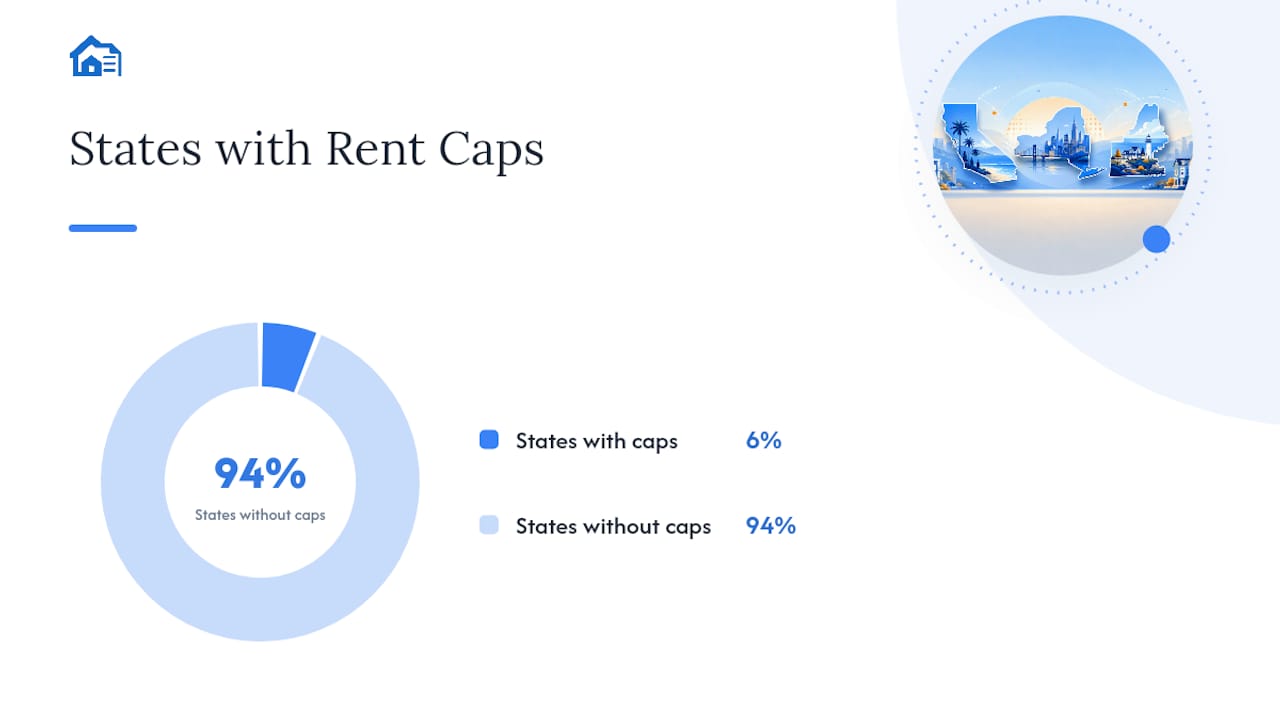
There is no single federal rent increase law. Whether a landlord can raise rent, by how much, and how often depends almost entirely on state and local law, and most states let landlords raise rent by any amount with proper notice. Only California, Oregon, and Washington cap annual increases statewide, and New York City layers on its own Good Cause standard, so where you live determines almost everything.
TL;DR:
- Only California, Oregon, and Washington limit rent increases with specific caps, while most states regulate only notice periods and procedural compliance.
- California caps increases at 5% plus CPI or 10% of the lowest rent in the past year, with 30-90 day notices depending on size of the hike.
- Washington requires a formal notice form disclosing the percentage, dollar amount, and new rent, and restricts increases to once every 12 months.
- Lease terms control whether rent can increase mid-term unless a specific clause permits adjustments, with most tenants protected until renewal.
- Most disputes stem from procedural errors like insufficient notice, wrong delivery method, or math mistakes, not the increase amount itself.
Table of Contents
- Rent Increase Laws by State: The Quick Version
- How Rent Increase Laws Actually Work
- Where Each Cap State Draws the Line
- Serving a Lawful Rent Increase Without a Fight
- Templates and Tools That Cut Down Disputes
- Why Most Rent Disputes Are Preventable
- Get Your Rent Increase Notices Right the First Time
- Where to Confirm Your State’s Exact Rules
- Sources
- FAQ
Rent Increase Laws by State: The Quick Version
Three states set a hard ceiling on how much rent can go up in a year. Everywhere else, the real limits are procedural: how much notice you get, how that notice gets delivered, and whether the increase targets someone for an illegal reason.
Here’s the fast version before you dig into your own state’s statute:
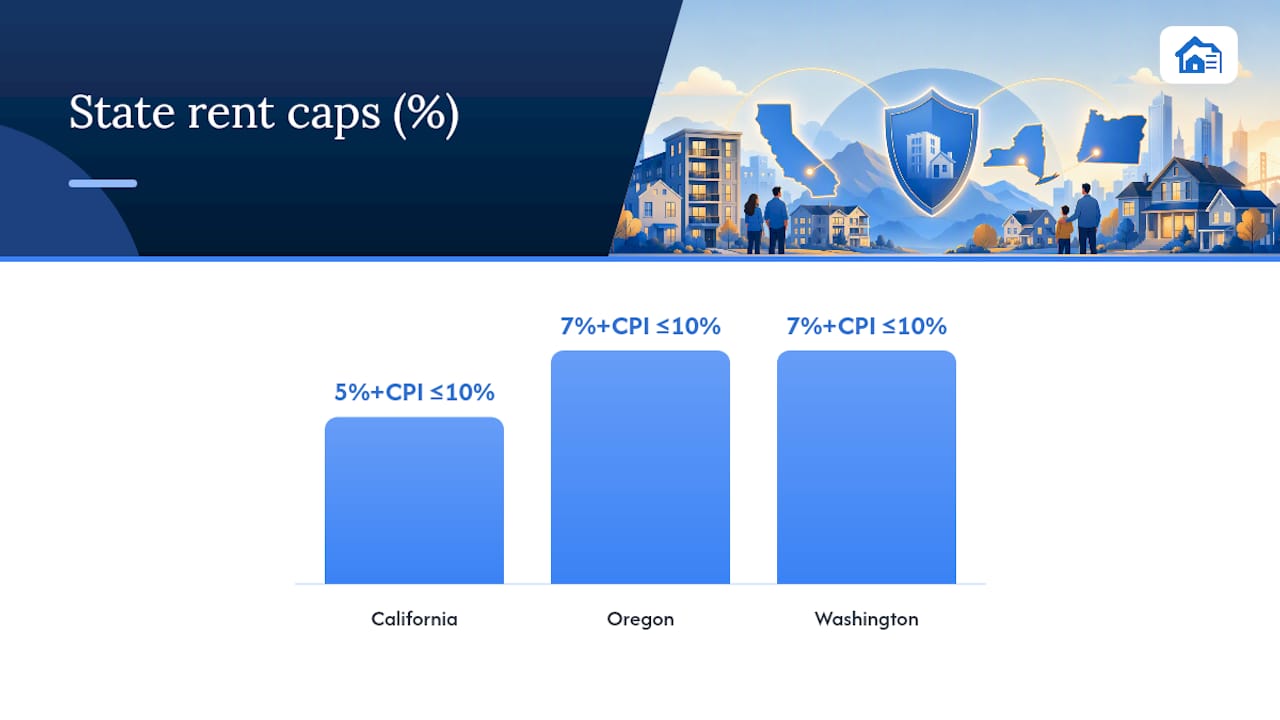
- California: caps increases at 5% plus the local Consumer Price Index, or 10% of the lowest rent charged in the past 12 months, whichever is lower.
- Oregon: caps increases at 7% plus CPI, with a hard 10% ceiling.
- Washington: same 7% plus CPI formula, also capped at 10%, plus a mandatory statutory notice form.
- Every other state: no statewide percentage cap. Increases are governed by notice periods and general tenant protections, not a formula.
Notice periods cluster around three windows. A 30-day notice is standard for month-to-month tenancies with modest increases. Many states bump that to 60 days for longer-term tenants or larger increases. A 90-day notice typically kicks in for the biggest jumps or for California’s own threshold, where increases above 10% require 90 days rather than 30.
Whether a city can add its own rules on top of state law comes down to preemption. In states that preempt local rent control, cities cannot pass stricter caps even if a city council wants to. In states that allow local authority, individual towns and cities can and do write their own ordinances, which is why a rent-controlled unit two towns over from an uncapped one is common in places like New Jersey.
Your one-line action item: pull up your state’s landlord tenant statute first, then check your city or county housing department’s page for anything stricter layered on top.
How Rent Increase Laws Actually Work
Every rent increase law is built from four moving parts: notice, calculation, timing against the lease, and exemptions. Get any one of them wrong and the increase can be challenged or thrown out entirely.
What counts as valid notice
Courts and housing agencies generally recognize a handful of delivery methods as legally sufficient: certified mail, personal hand delivery, posting combined with mailing (used in some states when a tenant can’t be reached directly), and increasingly, tenant portal notifications when the lease specifically allows electronic delivery. Washington goes further than most states by requiring a statutory notice form that must spell out the percentage increase, the dollar amount, the new total rent, the effective date, and the legal basis for any exemption claimed. That level of specificity isn’t decoration. It gives tenants a document they can actually evaluate instead of a vague letter saying “rent is going up.”
How caps and frequency limits get written
Cap formulas usually follow a “base percentage plus CPI” structure. These aren’t arbitrary numbers. They’re designed to let rent track inflation without letting it spike disconnected from the local economy.
Frequency limits matter as much as the percentage. Washington limits landlords to one increase per 12-month period and blocks any increase at all during the first year of a tenancy. Oregon has an identical first-year restriction. That means a new tenant in either state has a full year of price certainty before any increase notice can legally land, regardless of what the local rental market is doing.
When your lease controls, and when it doesn’t
A fixed-term lease is a contract, and during its term it generally overrides a landlord’s ability to raise rent, absent a clause that explicitly permits mid-term adjustments. If your lease runs through October and says nothing about mid-lease increases, a February notice announcing a rent hike has no legal teeth until the lease is up for renewal. This is one of the more commonly misunderstood points in landlord tenant law: people assume a state’s notice period means an increase can happen anytime with enough warning, when in reality the lease term itself is the first checkpoint. State and local law can still override lease language on certain points, like a jurisdiction that limits increases during any renewal regardless of what the previous lease said, but the increase can’t happen out of nowhere mid-term unless the lease allows it.
Pro Tip: Before you sign or renew a fixed-term lease, check whether it includes a “market adjustment” or “CPI escalation” clause. If it doesn’t, you’re generally protected from any increase until renewal, no matter what a landlord verbally promises or threatens.
Common exemptions landlords need to document
Statewide caps almost always carve out exceptions, and landlords who want to rely on one need to actually prove it applies:
- New construction: units built within the last 15 years (the exact window varies by state) are frequently exempt from percentage caps.
- Single-family homes owned by small landlords: several statutes exempt owners with a limited number of units, often one to a handful of single-family rentals, provided proper notice of the exemption is given.
- Subsidized or income-restricted housing: units operating under HUD programs or other affordability agreements typically follow separate rent-setting rules tied to the program, not the general statute.
- Owner-occupied duplexes or shared housing: some jurisdictions exempt units where the landlord lives on the property.
An exemption claim without documentation is a weak legal position. If a landlord tells a tenant “this unit is exempt” but can’t point to a certificate of occupancy date, a unit count, or a program agreement, that claim is unlikely to hold up if challenged.
Where Each Cap State Draws the Line
If you’re in California, Oregon, or Washington, the math is spelled out in statute. If you’re not, the question shifts entirely to notice periods and local ordinances, particularly in places like New York City and parts of New Jersey where local systems do heavy lifting that state law doesn’t.
- California: AB 1482 caps most annual increases at 5% plus local CPI, or 10% of the lowest rent charged in the prior 12 months, whichever is lower. Notice requirements scale with the size of the increase: 30 days for increases at or under 10%, 90 days for anything above that threshold. Landlords are generally limited to two increases within any 12-month period, provided the combined total doesn’t exceed the annual cap.
- Oregon: The formula runs 7% plus CPI, with a 10% hard ceiling regardless of how high inflation climbs. Oregon blocks any rent increase during the first 12 months of a tenancy outright, and requires 90 days’ written notice for any increase after that. Landlords in buildings less than 15 years old are generally exempt from the cap.
- Washington: Also 7% plus CPI, capped at 10%, but Washington’s real distinguishing feature is its mandatory notice form under RCW 59.18.720, which must disclose the dollar amount, percentage, new total rent, and effective date in a single document. Increases are limited to once every 12 months, and, like Oregon, the first year of tenancy is protected from any increase at all.
New York doesn’t run a statewide percentage cap the way the three states above do, but New York City operates one of the most detailed local systems in the country. Units covered by rent stabilization go through annual adjustments set by the NYC Rent Guidelines Board, and market-rate units in the city are increasingly subject to a Good Cause eviction standard. Under Good Cause, an increase above the local rent standard, generally tied to CPI plus a set percentage, is presumed unreasonable unless the landlord can justify it with specific factors like increased property taxes or documented capital improvements. That presumption shifts the burden onto the landlord in a way most states don’t require.
New Jersey doesn’t have a statewide cap either, but it’s one of the clearest examples of local rent control filling that gap. Dozens of New Jersey municipalities, Jersey City, Newark, and Hoboken among them, run their own rent control boards with independent formulas and hearing processes. A landlord operating buildings in three different New Jersey towns could be following three different sets of increase rules simultaneously.
Why preemption decides whether your city can act
The legal mechanism behind all of this is preemption, and it’s simpler than it sounds. Some states apply what’s known as Dillon’s Rule, which holds that local governments only have the powers the state explicitly grants them. In a Dillon’s Rule state with rent control preemption on the books, no city council can pass a stricter cap even if every member wants to. States that don’t preempt local rent control leave the door open, which is exactly why New Jersey has dozens of independent local ordinances while a neighboring state with preemption has none.
For landlords operating in multiple markets, this means checking two separate things every time: the state statute, and then, if the state allows it, the specific city or county ordinance. A local guide covering Berkeley’s rent stabilization program is a good example of just how granular city-level rules can get, down to specific registration requirements and banking provisions for unused increases. Your city’s housing department page or rent board, where one exists, is the fastest way to confirm whether anything stricter applies on top of state law.
Serving a Lawful Rent Increase Without a Fight
Most disputed rent increases don’t get challenged over the dollar amount. They get challenged over process: the notice was late, it went to the wrong address, or the math was off. Both sides benefit from knowing exactly what “doing it right” looks like.
For landlords, the sequence should run in this order:
- Confirm which statute actually applies. State law first, then check whether your city or county layers on additional rules.
- Calculate the maximum allowable increase using the correct CPI figure and base rent, not last year’s rent if a previous increase already happened this cycle.
- Draft written notice with every required element: current rent, new rent, dollar and percentage change, effective date, and any exemption basis if one applies.
- Serve the notice through a method your state recognizes, and keep proof: certified mail receipts, signed acknowledgment, or a timestamped portal notification.
- File or retain a copy in the tenant’s file along with proof of service, not just the notice itself.
For tenants, the response sequence looks like this:
- Check your state’s notice period and your city’s housing department page to confirm the notice you received meets the minimum requirement.
- If your unit is in a cap state, ask for the calculation in writing. A landlord relying on an exemption should be able to point to the specific basis.
- Keep every piece of communication, the notice itself, texts, emails, anything referencing the increase.
- If you believe the notice is retaliatory (filed after a complaint or repair request) or discriminatory, document the timeline and file a complaint with your state attorney general’s office or local housing agency.
Voucher holders under HUD’s Housing Choice Voucher program face an added layer, since rent increases for subsidized tenancies often route through the local housing authority before taking effect, which can change both the notice timeline and who ultimately approves the new rent.
The three procedural errors that void an increase most often: insufficient notice (30 days given when the state requires 60 or 90), improper service (notice left on a door in a state that requires mail or personal delivery), and miscalculated percentages (using the wrong CPI figure or applying the cap to the wrong base rent).
| Issue | What voids the increase | Who to contact |
|---|---|---|
| Notice period too short | State minimum not met before effective date | State AG or housing department |
| Improper service method | Delivery method not recognized by statute | Local housing agency |
| Miscalculated cap | Percentage or dollar figure exceeds statutory formula | Small claims or civil court |
| No exemption documentation | Landlord claims exemption without proof | Tenant rights organization or legal aid |
Escalation paths vary, but most start with a written complaint to a state attorney general’s consumer protection division or a city housing department, and end in small claims or civil court if the amount in dispute is significant enough to warrant it.
Templates and Tools That Cut Down Disputes
A rent increase notice with a missing field, no effective date, no stated exemption basis, is exactly the kind of gap that turns a routine increase into a dispute. Statutory-form states like Washington show why: when the form forces you to disclose the percentage, dollar amount, new total, and legal basis, there’s very little room left for a tenant to argue they weren’t told.
That’s the same logic behind using a structured rent increase notice template instead of drafting a letter from scratch every time. A template with state-aware fields prompts you for exactly what your jurisdiction requires, so you’re not relying on memory for whether your state needs 30, 60, or 90 days of notice.
Math errors are the other quiet source of disputes. Running the numbers through a rent increase calculator before you send a notice removes that guesswork and gives you a defensible figure if a tenant or agency ever asks how you arrived at it.
Recordkeeping rounds out the picture. Keep proof of service (certified mail receipts or portal timestamps), a copy of every notice sent, and, for inspections tied to the unit, photo documentation with timestamps. None of this needs to be complicated. It just needs to exist before a dispute happens, not after.
Pro Tip: Save every rent increase notice and proof of service in the same file as your lease, not in a separate folder. If a dispute ever reaches small claims court, having the full timeline in one place saves hours of scrambling.
Why Most Rent Disputes Are Preventable
Most landlords who end up in a dispute over a rent increase didn’t break the cap. They broke the process. That distinction gets lost in most advice about rent increase laws, which tends to focus entirely on the percentage question and treats notice mechanics as an afterthought.
My honest read, after going through how these statutes are actually written: the states that force landlords to use a specific form, Washington being the clearest example, have it right. A form with mandatory fields protects landlords just as much as it protects tenants, because it forces documentation at the moment the notice goes out rather than reconstructing it later from memory or a text thread.
Transparency is underrated here too. A landlord who explains the calculation, shows the CPI figure used, states the effective date clearly, and gives notice earlier than the legal minimum requires, almost never ends up fielding a complaint, even in states with no cap at all. Tenants generally aren’t disputing that rent can go up. They’re disputing whether they were treated fairly and told the truth about why.
If you’re a landlord, the practical move is to build a consistent process you follow every single time, not just when you remember to. Use the same rent increase notice template for every unit, verify your math the same way every time, and keep documentation as a habit rather than a scramble. That consistency is what actually prevents the disputes that end up in small claims court.
— Igor
Get Your Rent Increase Notices Right the First Time
Landlordforms turns the exact steps covered above, checking your state’s rules, calculating the correct percentage, and documenting the notice, into a few clicks instead of an afternoon of research. The rent increase notice template includes state-aware fields, so you’re not guessing whether your state needs 30, 60, or 90 days or whether an exemption basis needs to be stated.

Pair it with the rent increase calculator to confirm your percentage against the correct CPI figure before you send anything, and the rent proration calculator if the new rent takes effect mid-month. Once the increase is in place, log it in a rent ledger so you have a clean payment history if a tenant ever questions the new total. Start with the free notice template and calculator, both are ready to use right now, no account required to try them.
Where to Confirm Your State’s Exact Rules
State statutes change, and the summaries above should be your starting point, not your final word. Before you send or dispute a rent increase, check the primary source for your specific state.
- California, Oregon, and Washington all publish their statutory language directly. Washington’s is available through RCW 59.18.720.
- New York City tenants and landlords should check the NYC Rent Guidelines Board and rent stabilization pages for current guidelines and Good Cause procedures.
- Voucher holders should review HUD’s Housing Choice Voucher guidance for how rent adjustments interact with subsidy programs.
- State law libraries, like the Texas State Law Library’s landlord tenant guidance, often publish plain-language summaries and links to model forms.
- For a fast first check across all 50 states, iPropertyManagement’s rent control survey is a useful cross-reference before you consult your state’s actual statute.
Sources
- RCW 59.18.720 — Notice to tenant (Washington)
- NYC rent-stabilization and local rent standards (NYC official)
FAQ
Can my landlord raise my rent $300 in New York?
Outside of rent-stabilized units, New York doesn’t cap the dollar amount of an increase, but under the Good Cause standard many units are now covered by, an increase well above the local rent standard is presumed unreasonable unless the landlord justifies it with documented costs.
Can my landlord increase my rent by 33%?
In California, Oregon, and Washington, no.
Can I deny a rent increase?
You can’t simply refuse a lawful increase and stay at the old rent, but you can dispute one that violates notice requirements, exceeds a statutory cap, or appears retaliatory, and you can always choose not to renew if you don’t agree to new terms.
How much are landlords allowed to raise rent in Florida?
Florida has no statewide cap on rent increases, so landlords can raise rent by any amount as long as they provide the notice period required for the tenancy type, typically 15 days for month-to-month leases under Florida’s notice statute, and the increase isn’t retaliatory or discriminatory.
What happens if a landlord doesn’t give proper notice?
An increase served with insufficient notice, or delivered through a method the state doesn’t recognize, generally isn’t enforceable until proper notice is given, which means the tenant can continue paying the old rent until the correct notice period runs.