7 Rent Receipt Fields U.S. Landlords Must Keep to Avoid Eviction Risk

Rent receipt requirements typically kick in the moment a tenant pays in cash. New York, Washington, Texas, and Delaware require a written receipt for cash payments by statute, and most states let a tenant demand a receipt for any payment method on request. When you’re unsure which rule applies, issue a written receipt anyway, listing the rental period and amount received.
TL;DR:
- Tenants paying in cash in New York, Washington, Texas, and Delaware must receive a detailed written receipt, which landlords must retain for at least three years.
- When tenants request proof of payment, landlords in most states are legally required to provide a written or electronic receipt regardless of payment method.
- A valid rent receipt must include seven specific fields, such as the date received, tenant and property details, rental period, amount, payment method, and receiver’s signature.
- Failing to provide or retain proper receipts can weaken a landlord’s legal case in eviction proceedings and lead to statutory penalties or damages.
- Automated receipt-writing software and centralized recordkeeping significantly reduce compliance risks and streamline documentation processes.
Table of Contents
- Which States Require Rent Receipts?
- What Fields Belong on a Rent Receipt?
- When Is a Landlord Legally Required to Provide a Receipt?
- How Should You Issue and Store Rent Receipts?
- What Happens if a Landlord Doesn’t Provide a Receipt?
- Why Automating Receipts Beats Doing It by Hand
- Get Your Rent Receipts and Ledger in One Place
- Sources
- FAQ
Which States Require Rent Receipts?
State rent receipt law splits into three practical categories, and knowing which one governs your property changes how much paperwork you need for every payment.
Mandatory for cash payments. New York’s housing regulations require a receipt whenever rent is paid in cash or by any instrument other than the tenant’s personal check, and the receipt must include the date, amount, the identity of the premises, the period covered, and the signature and title of the person receiving the rent. Landlords in New York also have to keep those cash receipt records for at least three years. Washington’s RCW 59.18.063 follows a similar cash trigger, as does Texas under Property Code § 92.011, which additionally requires the landlord to log the payment in a written record book. Delaware’s 25 Del. C. § 5501(e) requires delivery of the receipt within 15 days of a cash payment and retention of that record for three years.
Required on tenant request. California doesn’t mandate a receipt for every rent payment, but a tenant who pays by any method and asks for proof is generally entitled to one. Maryland leans this direction too, layering request-based duties on top of its own cash rules. This regime puts the burden on the tenant to speak up, but it still creates a legal obligation the moment they do.
Required for all payments in some states or cities. A handful of jurisdictions extend the duty beyond cash, and some cities pile on their own ordinances that exceed state minimums. A 2026 review of state rent receipt rules confirms this patchwork pattern across mandatory-cash states like NY, TX, WA, MD, and DE, alongside request-based states like CA.
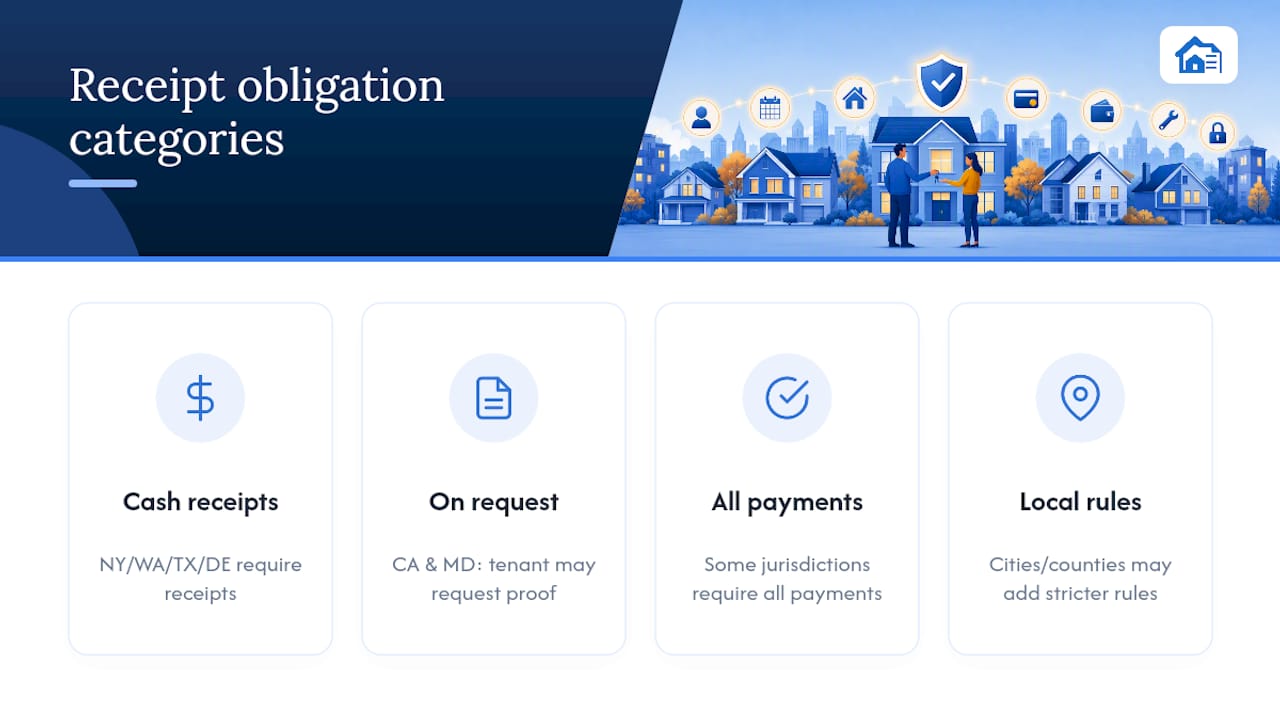
Local housing codes complicate this further. A city rent registry, a habitability ordinance, or a local consumer protection rule can layer stricter documentation duties on top of anything your state code requires, similar to how Ohio’s landlord obligations sit alongside separate municipal rules in some Ohio cities. Before you finalize your receipt policy, search your state code by name and cross-check your city or county housing department’s website. A five-minute search now beats a bad surprise in housing court later.
What Fields Belong on a Rent Receipt?
A rent receipt that will hold up as proof of rent payment needs seven fields, no exceptions. Skip one and you’ve built a document that’s easy for a tenant’s attorney to challenge.
- Date received — the actual date money changed hands, not the due date
- Tenant name — full legal name matching the lease
- Property address and unit number — especially critical for multi-unit buildings
- Rental period covered — the specific month or date range the payment applies to
- Amount received — the dollar figure, plus any remaining balance if the payment was partial
- Payment method — cash, check number, money order number, or electronic transfer reference
- Signature and title of the person receiving rent — this is explicitly required under New York’s regulation and is good practice everywhere else
Pro Tip: Add a receipt number and an “applied as” line showing what the payment covers (rent, late fee, pet fee). Sequential numbering makes it obvious in court that your records are contemporaneous, not reconstructed after a dispute started.
Rental period matters more than most landlords realize. A receipt that only shows the date of payment tells a judge nothing about whether November’s rent was actually paid, since a tenant could pay on November 3 for October. LegalClarity’s breakdown of receipt requirements lists eight core fields, including this period designator, and ties the retention duty to IRS guidance recommending landlords keep income-supporting records for at least three years.
When Is a Landlord Legally Required to Provide a Receipt?
Cash is the trigger most state statutes actually target, and there’s a logical reason: cash leaves no bank trail, so lawmakers shifted the burden of proof onto the person collecting it. Once a tenant hands over cash, the clock starts on your statutory duty, whether that’s immediate issuance under New York’s rule or Delaware’s 15-day window.
A written request from a tenant creates a second, separate trigger, even in states with no cash mandate. If a tenant emails asking for proof of a payment made six months ago, that request matters. Save the email or text. It documents exactly when the duty arose and protects you if the tenant later claims you ignored the request.
Statutory timing varies by state:
- New York: Receipt required immediately at the time of cash payment; records kept for three years
- Delaware: Receipt delivered within 15 days of cash payment; records kept for three years
- Texas: Written receipt plus an entry in a landlord record book at the time of cash payment
If tracking cash receipts feels like more administrative burden than it’s worth, the simplest fix is to stop accepting cash. Requiring checks, money orders, or an electronic rent portal creates a traceable record automatically and sidesteps most cash-specific statutes entirely.
How Should You Issue and Store Rent Receipts?
Electronic receipts are legally valid in every state, provided both parties are operating with the intent to transact electronically. The federal E-SIGN Act makes emailed PDFs, texted images, and platform-generated receipts enforceable the same way a signed paper slip is, as long as the record actually ties the payment method and rental period back to your ledger.
A defensible workflow for issuing receipts at the moment of payment looks like this:
- Fill in the receipt with date, tenant name, unit, rental period, amount, and payment method
- Sign or stamp it, including your title if you’re a property manager rather than the owner
- Hand or send the tenant their copy immediately, whether that’s a paper slip or an emailed PDF
- Log the entry in your rent ledger or property management software so the receipt and your internal record match
On retention, three years is the baseline nearly every relevant statute and IRS recordkeeping guidance point to. Keep records longer if your state requires it or if you’ve had a recent audit, dispute, or eviction filing tied to that tenancy. Sequential receipt numbers paired with a rent ledger make it far easier to prove your records were kept in real time rather than assembled after the fact.
What Happens if a Landlord Doesn’t Provide a Receipt?
A missing receipt can become a tenant’s best defense in a nonpayment eviction. If you sue for unpaid rent and can’t produce receipts for the months in question, a tenant claiming they paid in cash has a credible argument, and judges in mandatory-receipt states tend to scrutinize a landlord’s recordkeeping closely when that duty was ignored.
- Affirmative defense: Tenants can argue they paid and you failed to document it, shifting the credibility burden onto you
- Statutory penalties: Some states attach fines or damages to a documented failure to provide required receipts, and Texas’s record-book requirement under Property Code § 92.011 is one example where noncompliance strengthens a tenant’s position in a dispute
- Practical fallout: Even without a formal penalty, missing receipts slow down or sink otherwise valid eviction filings
If you discover gaps in your receipt history, fix them immediately. Reconstruct what you can from bank deposits or electronic transfer records, notify the tenant in writing that you’re correcting the file, and document that remediation step. A landlord who catches and fixes a recordkeeping gap looks far better in court than one who ignores it until a dispute forces the issue.
Why Automating Receipts Beats Doing It by Hand
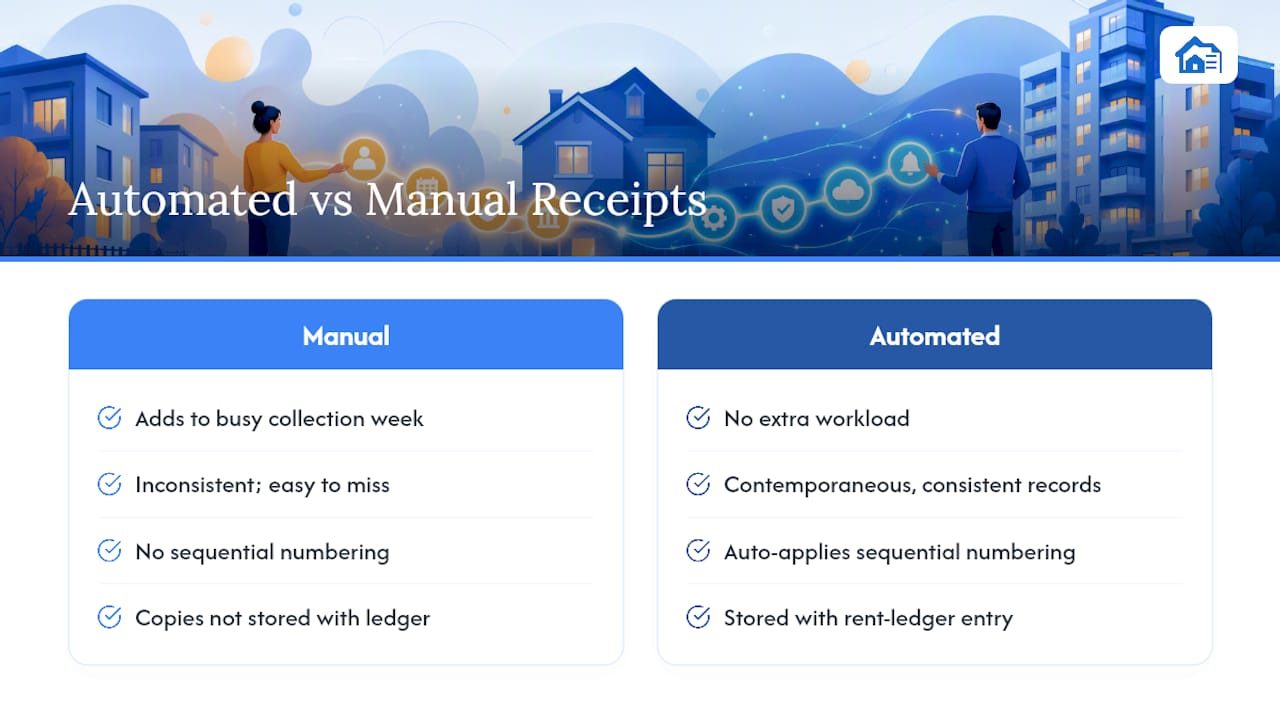
Most landlords who skip receipts aren’t ignoring the law on purpose. They’re managing five or ten units solo and treating a receipt as one more form to remember during a rent collection week that’s already full of texts, deposits, and maintenance calls. That’s where the compliance gap actually opens up, not in willful noncompliance.
Software that auto-generates receipts, applies sequential numbering, and stores every copy against a rent-ledger entry closes that gap without adding to your workload. Landlordforms builds receipts this way specifically because contemporaneous, consistent records are what hold up when a tenant disputes a payment months later. The record either exists in the right format at the right time, or it doesn’t. There’s no partial credit in housing court.
— Igor
Get Your Rent Receipts and Ledger in One Place
Landlordforms turns the seven-field checklist in this article into a document you generate in seconds, not something you retype from scratch every time a tenant hands you cash. The Rent Receipt Template matches the field requirements covered above, and pairing it with the Rent Ledger Template keeps every payment logged with sequential numbering, exactly the kind of contemporaneous record that holds up if a tenant ever disputes a payment.

If you manage a mid-lease move-in or move-out, the rent proration calculator makes sure the amount on your receipt is right the first time. Download the templates and start building a receipt history you won’t have to reconstruct later.
This article is general information, not a substitute for advice from a qualified lawyer. Consult a qualified legal professional about your own circumstances before acting on anything here.
Sources
- N.Y. Comp. Codes R. & Regs. Tit. 9 § 2100.15 - Receipt for rent paid
- Rent Receipt Template: What to Include and When Required - LegalClarity
FAQ
Is a Rent Receipt Mandatory?
It’s mandatory when rent is paid in cash in states like New York, Washington, Texas, and Delaware, and it’s mandatory in most other states the moment a tenant requests one in writing.
What Is Considered a Rent Receipt?
A valid rent receipt is a written or electronic document showing the date received, tenant name, property and unit, rental period covered, amount, payment method, and the signature and title of whoever collected the rent.
What Is the 30% Rule for Rent?
The 30% rule is a personal budgeting guideline suggesting tenants limit rent to a portion of their gross income. It has no connection to receipt requirements or landlord recordkeeping law.
What Is Acceptable for Proof of Rent Payment?
A signed receipt, a bank statement showing a transfer to the landlord, a canceled check, or an electronic payment confirmation from a rent portal all count as acceptable proof of rent payment, provided the record ties the amount to a specific rental period.