Why Landlords Keep Payment Records: A 2026 Guide

TL;DR:
- Accurate payment recordkeeping protects landlords from legal, financial, and tax-related issues.
- It involves issuing receipts, maintaining ledgers, and documenting all transactions thoroughly.
Accurate payment recordkeeping is a landlord’s most important tool for managing properties legally and efficiently. Landlord record retention, the practice of systematically documenting every rent payment, fee, deposit, and related transaction, protects you from IRS audits, tenant disputes, and court losses. Incomplete records can lead to lost deductions, fines, and eviction failures due to lack of proof. Understanding why landlords keep payment records is the foundation of every successful rental operation, whether you manage one unit or one hundred.
Why landlords keep payment records: the core reasons
Payment records serve three distinct purposes: legal protection, financial accuracy, and tax compliance. Each one carries real consequences when records fall short.
Courts require definitive proof of payment history in eviction cases. A tenant who claims they paid rent in cash has an advantage if you cannot produce a signed receipt or a written ledger entry. Date-stamped payment and inspection records create objective evidence that courts favor over verbal accounts. That objectivity is the difference between winning and losing a nonpayment case.
Tax compliance is equally direct. The IRS expects landlords to substantiate rental income and deductions with written records. Without them, you risk losing legitimate expense deductions and facing penalties during an audit. Organized records also make it far easier to file Schedule E accurately each year.
Security deposit compliance adds a third layer. Most states require landlords to return deposits within 14 to 60 days of move-out. Missing those statutory deadlines can result in penalties of two to three times the deposit amount plus attorney fees. That penalty alone justifies a disciplined recordkeeping system.
What types of payment records should landlords keep?
The scope of payment documentation is broader than most new landlords expect. Every transaction type requires its own paper trail.
Core payment records to maintain:
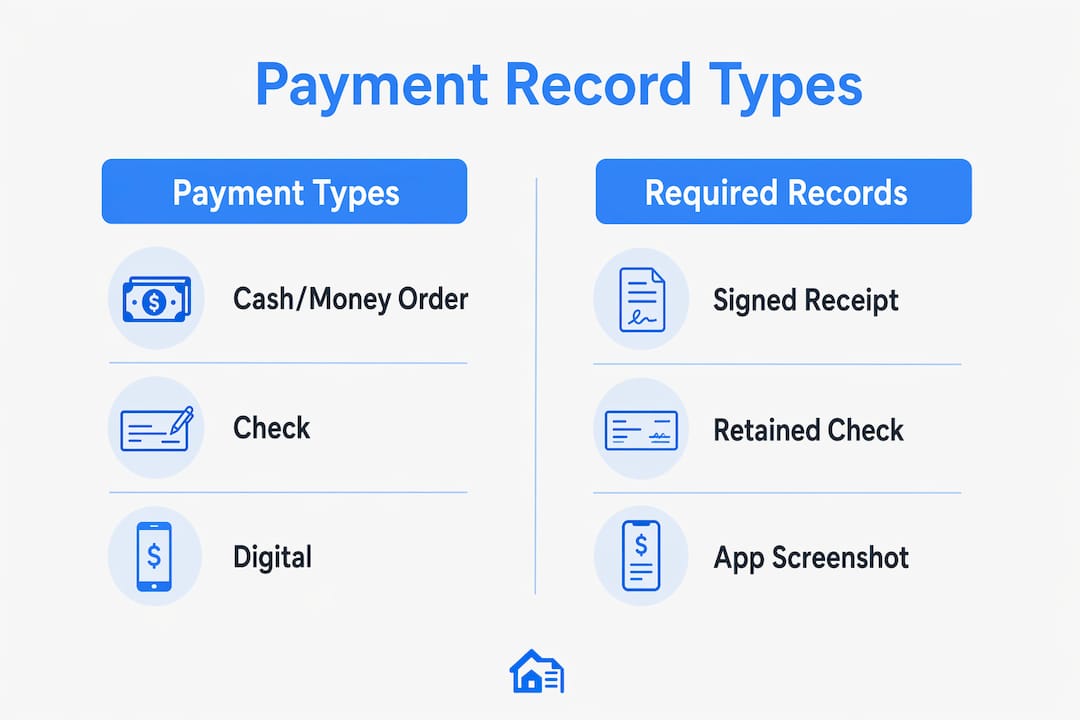
- Rent receipts: Issue a signed receipt for every cash or money order payment. Written receipts issued immediately resolve tenant disputes quickly and build trust. For checks and digital payments, retain the bank record and a corresponding ledger entry.
- Rent ledgers: A written ledger for each tenant should show the payment date, amount, method, and any balance carried forward. Bank statements and app payment histories alone are insufficient as standalone evidence in disputes or audits.
- Late fees and partial payments: Document every partial payment with the date received and the remaining balance. Note whether a late fee was assessed and whether it was collected or waived.
- Security deposit records: Record the deposit amount, the date received, and the account where it is held. At move-out, document every deduction with photos, receipts, and a signed itemization.
- Communication records: Save texts, emails, and written notices that confirm or dispute payments. These records support your ledger entries when a tenant later claims a payment was made.
- Move-in and move-out inspection records: A move-in inspection with photos and signatures is the baseline document that justifies any damage deduction at move-out.
The table below shows which payment types require which record formats.
| Payment type | Required records |
|---|---|
| Cash or money order | Signed receipt, ledger entry |
| Check | Retained check copy or bank record, ledger entry |
| Venmo, Zelle, or app payment | Screenshot confirmation, ledger entry |
| Security deposit | Receipt, separate account record, itemized return |
| Late fee | Written notice, ledger entry showing collection or waiver |
| Partial payment | Written acknowledgment, updated balance ledger |
Pro Tip: Screenshot every Venmo or Zelle confirmation immediately after receiving payment. App histories can be deleted or altered, but a timestamped screenshot saved to cloud storage is permanent evidence.
How do accurate records prevent legal disputes and support evictions?
Courts rule on evidence, not memory. This is the single most important fact landlords need to internalize about payment records.
Eviction for nonpayment requires a clear, date-stamped payment ledger that shows exactly which months were unpaid and when notices were served. A judge who sees a complete ledger alongside signed notices will rule quickly. A judge who sees a spreadsheet with gaps, crossed-out entries, or missing dates will question everything.
Security deposit disputes follow the same logic. The most costly error landlords make is treating the deposit return as an administrative task rather than a legal one. Missing statutory return deadlines results in automatic forfeiture of the right to make deductions and triggers penalty multipliers in most states. Meeting the deadline matters more than the reasonableness of the deductions themselves.
Here is the documentation sequence that protects landlords in deposit disputes:
- Conduct a signed move-in inspection. Both parties sign the checklist and receive a copy. Photos are taken and dated.
- Issue a written receipt for the deposit. Record the amount, date, and account where it is held.
- Conduct a signed move-out inspection. Compare conditions against the move-in record. Photograph every area of concern.
- Prepare an itemized deduction statement. List each charge with the supporting cost and the corresponding photo or receipt.
- Return the balance within the statutory deadline. Send the statement and remaining funds by certified mail to create a delivery record.
A move-in inspection record with photos and signatures is the single most important document for defending deposit deductions. Without it, damage claims are nearly impossible to prove.
Pro Tip: Use a move-in checklist template that requires both your signature and the tenant’s. A checklist signed only by you carries far less weight in court than one signed by both parties.
Why does separating rental finances matter for recordkeeping?
Mixing personal and rental funds is one of the most common and costly mistakes landlords make. Commingled finances increase audit risk and make it nearly impossible to produce a clean paper trail at tax time.

The fix is straightforward. Open a dedicated checking account for each rental property or, at minimum, one account for all rental income and expenses. Every rent payment goes in. Every repair, insurance payment, and mortgage payment comes out. Your bank statement then mirrors your ledger, making monthly reconciliation a five-minute task instead of a weekend project.
Security deposits require an additional layer of separation. Deposits must be treated as liabilities, not income, from the day they are received. They belong to the tenant until the lease ends and deductions are finalized. Depositing them into your operating account inflates your reported income and creates accounting violations. Many states require deposits to be held in a dedicated trust account, and misclassified deposits can trigger audits, penalties, and loss of tenant trust.
Maintain a sub-ledger for each tenant’s deposit, linked to their lease, and reconcile it monthly against the trust account bank statement. This practice satisfies both accounting standards and state landlord-tenant law requirements. Organized financial records also make it straightforward to claim deductions for depreciation, repairs, and management fees on your tax return.
How can technology improve payment recordkeeping?
Digital tools do not replace good recordkeeping habits. They make those habits easier to maintain consistently.
The most practical starting point is a rent ledger template in Excel or a similar format. A well-structured ledger tracks payment dates, amounts, methods, and balances for each tenant in one place. It takes less than two minutes to update after each payment and produces a complete history you can print for court or hand to your accountant.
Cloud storage solves the physical loss problem. Landlords must regularly back up payment records digitally to prevent loss and maintain accessibility. A folder structure organized by property, then by tenant, then by year keeps everything findable in under a minute. Google Drive, Dropbox, and similar services provide automatic version history, which means you can recover an accidentally deleted file.
Combining photographic documentation with written records produces the strongest legal protection. Photo evidence paired with clear written payment records helps landlords win disputes and reduce tenant disagreements. Date-stamped photos uploaded to cloud storage immediately after an inspection create a record that is nearly impossible to challenge.
Set calendar alerts for deposit return deadlines the day a tenant gives notice. Most landlords who miss statutory deadlines do so not from negligence but from distraction. A single calendar reminder eliminates that risk entirely.
Landlordforms automates rent receipt generation, tracks payments in real time, and stores inspection photos alongside payment records. For landlords managing 1 to 150 units, that automation reduces manual entry errors and saves up to eight hours a week.
Key Takeaways
Accurate payment records are a landlord’s primary legal and financial defense, covering everything from IRS audits to eviction proceedings and deposit disputes.
| Point | Details |
|---|---|
| Written receipts are non-negotiable | Issue a signed receipt for every cash or money order payment to prevent disputes. |
| Ledgers outperform bank statements | Maintain a written ledger per tenant; app histories alone are insufficient evidence in court. |
| Deposits are liabilities, not income | Hold deposits in a separate account and treat them as tenant funds until lease end. |
| Deadlines determine deposit outcomes | Missing the 14–60 day return window triggers penalties of two to three times the deposit amount. |
| Digital backups protect your records | Store all payment records and inspection photos in cloud storage with a clear folder structure. |
The record that saved me from a $4,000 mistake
Early in my time working with landlords, I watched a property owner lose a security deposit dispute not because he was wrong about the damage, but because he had no signed move-in inspection. The tenant’s attorney argued the damage was pre-existing. The landlord had photos, but they were undated and unsigned. The judge sided with the tenant. The landlord paid back the full deposit plus penalties.
That case changed how I think about recordkeeping. Most landlords treat it as paperwork. The ones who never lose in court treat it as evidence collection. Every receipt, every ledger entry, every signed checklist is a piece of evidence you are building before you need it.
New landlords consistently make two mistakes. First, they rely on digital payment apps as their only record. Second, they skip the move-in inspection because the tenant seems trustworthy. Both decisions feel reasonable in the moment and become expensive later.
The landlords I have seen manage properties most effectively are not the ones with the fanciest software. They are the ones who issue receipts immediately, update their ledger the same day payment arrives, and photograph every unit before and after every tenancy. That discipline costs almost nothing and protects everything.
Start with one improvement this week. If you do not have a written ledger for each tenant, build one today. If you have never issued a compliant rent receipt, generate one for your next payment. Small, consistent habits compound into a recordkeeping system that holds up anywhere.
— Igor
Landlordforms makes payment recordkeeping straightforward
Managing payment records does not have to mean hours of manual data entry or searching through email threads for proof of payment.

Landlordforms is built for landlords managing 1 to 150 units who want accurate, professional records without the administrative burden. The platform generates compliant rent receipts in seconds, tracks payments in real time, and stores inspection photos alongside your payment history. Download a free rent ledger template to organize your records immediately, or explore the full suite of property management tools designed to keep you audit-ready and dispute-proof year-round.
FAQ
Why do landlords keep payment records?
Landlords keep payment records to prove rental income for IRS audits, support eviction cases for nonpayment, and document security deposit deductions. Incomplete records can result in lost deductions, court losses, and statutory penalties.
What records should a landlord keep for security deposits?
Landlords should keep a receipt for the deposit, a record of the separate account where it is held, a signed move-in inspection, and an itemized deduction statement at move-out. Missing the statutory return deadline of 14–60 days can trigger penalties of two to three times the deposit amount.
Are bank statements enough for landlord recordkeeping?
Bank statements and app payment histories alone are insufficient. Courts and auditors expect written ledgers and signed receipts that document the date, amount, method, and purpose of every payment.
How long should landlords keep payment records?
Most tax and legal advisors recommend keeping rental payment records for at least seven years to cover IRS audit windows and potential litigation timelines. State landlord-tenant laws may require shorter or longer retention periods for specific documents.
Do landlords need to issue rent receipts for every payment?
Many states legally require landlords to issue a receipt for cash or money order payments upon request. Issuing receipts for every payment method, regardless of legal requirement, creates a consistent paper trail that protects both parties.