Why Document Accuracy Impacts Tenant Relations

TL;DR:
- Accurate documentation in property management prevents disputes, builds tenant trust, and protects legal standing. Landlordsoftware automates and organizes records to reduce errors and save time, fostering better tenant relationships.
Document accuracy in property management is defined as the consistent, error-free creation and maintenance of all records that govern a tenancy, from lease agreements and rent receipts to inspection reports and maintenance logs. Landlords who treat documentation as a formality rather than a foundation pay for it in disputes, delayed payments, and eroded trust. Research confirms that 37% of tenant complaints stem from communication failures, not property conditions. That single figure reveals how much of tenant satisfaction lives in the paper trail, not the property itself. Understanding why document accuracy impacts tenant relations is the first step toward running a property that tenants respect and pay on time.
Why document accuracy impacts tenant relations from day one
Accurate documentation shapes the entire tone of a tenancy before a tenant ever moves in. The lease agreement is the first document a tenant reads carefully. If it contains errors in rent amounts, due dates, or pet policies, the tenant enters the relationship already skeptical. That skepticism compounds over time.
The industry term for this discipline is lease administration, which covers the creation, storage, and ongoing management of all lease-related records. Lease administration done well means every figure in a tenant’s account matches what was agreed in writing. Done poorly, it means billing disputes, withheld payments, and formal complaints.
Accurate lease data sets the tone for the entire year’s financial and tenant relations performance. A single transposed digit in a rent amount or an incorrect move-in date can trigger months of back-and-forth that damages the landlord-tenant relationship permanently. Landlordforms automates the creation of lease documents and rent receipts, reducing the manual entry errors that start these disputes.
How accurate lease data builds tenant trust and financial stability
Lease data accuracy is the operational backbone of a well-run rental. When billing is predictable and matches the signed agreement, tenants pay without friction. When it does not, they scrutinize every invoice.
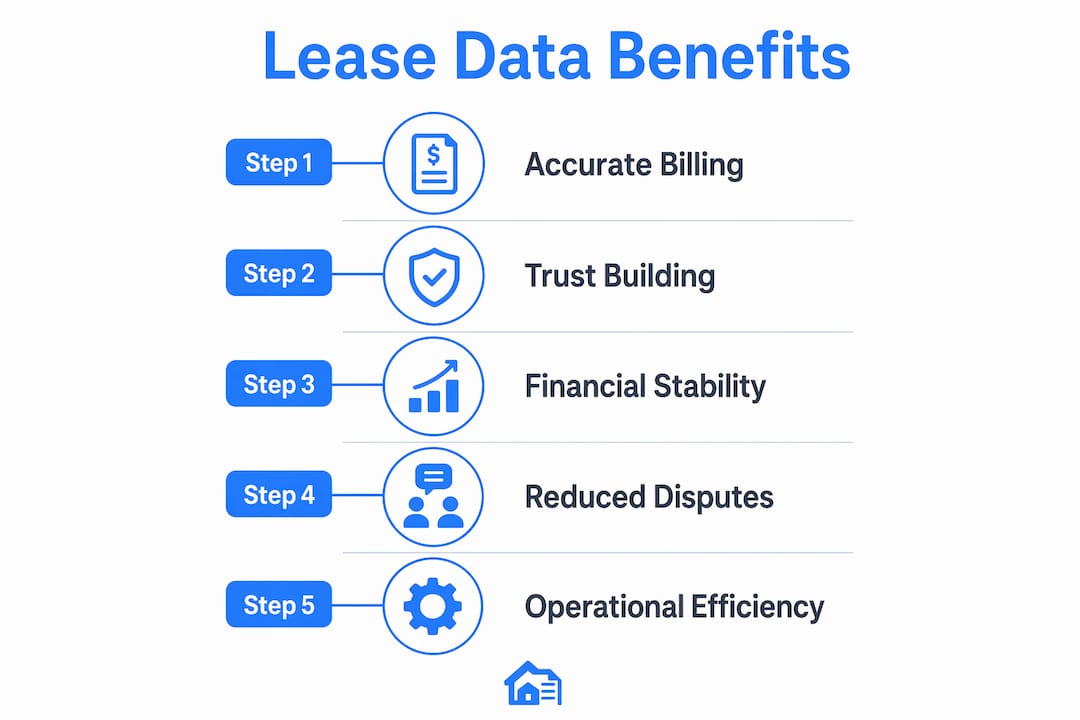
Minor lease errors cause tenants to question invoices aggressively and delay payments. That delay is not just a cash flow problem. It signals a breakdown in the professional relationship between landlord and tenant. A tenant who doubts one number on a bill will soon doubt others.
The financial effects of inaccurate lease data spread quickly across a property operation:
- Billing discrepancies force landlords into time-consuming reconciliations that could have been avoided with a correct original document.
- Incorrect late fee calculations create disputes that escalate to formal complaints or legal action. A late fee calculator removes the guesswork from these figures entirely.
- Misrecorded payment dates damage tenant credit perceptions and generate unnecessary conflict over payment history.
- Inaccurate rent increase notices expose landlords to legal liability if they do not reflect the correct statutory amounts or notice periods.
The interdepartmental effects are real too. A leasing error does not stay in the leasing department. It flows into accounting, maintenance scheduling, and eventually into any legal proceedings that arise from the dispute.
Pro Tip: Before sending any lease or notice, run a three-point check: verify the rent amount against the original agreement, confirm the notice period matches your state’s requirements, and cross-check the tenant’s name spelling against their ID. Three minutes of checking prevents three months of disputes.
Does communication documentation affect tenant satisfaction?
The answer is yes, and the data is specific. 35% of all maintenance inquiries are status update requests, meaning tenants are following up because they received no documented confirmation that their original request was received or acted on. That follow-up volume represents wasted time for both parties and growing frustration for the tenant.
Standardized response timelines are now a recognized best practice in property management. 2026 guidance recommends acknowledging urgent safety issues within 1 hour, essential issues within 4 hours, and routine inquiries within 1 business day. These are not arbitrary targets. They reflect what tenants expect when they have a documented record of their request and a clear channel to submit it.
Multi-channel confusion makes this worse. When tenants can contact a landlord by text, email, phone, and social media, messages get lost and responses become inconsistent. The result is a tenant who feels ignored, even when the landlord is genuinely responsive.
The fix is straightforward:
- Designate one official communication channel and document it in the lease. State clearly that requests submitted outside that channel will not be tracked or guaranteed a response.
- Send written confirmation for every maintenance request received. A simple timestamped message stating “Your request was received on [date] and is being reviewed” eliminates most follow-up calls.
- Log every interaction in a central record. Centralizing tenant communication reduces missed messages and duplicated work, directly improving tenant satisfaction.
- Document resolution, not just receipt. A maintenance log that shows the request, the response, and the completion date is a complete record. A log that shows only the request is half a document.
Tenants who receive timely, documented responses report higher satisfaction and are more likely to renew. The documentation is not just a legal record. It is a signal that the landlord runs a professional operation.
Why contemporaneous event documentation protects relationships and legal standing
Contemporaneous documentation means records created at the moment an event occurs, not reconstructed afterward from memory. Courts and arbitrators treat contemporaneous records as strong evidence. Reconstructed records raise suspicion and often lose disputes outright.
The four pillars of defensible documentation are timestamped records, photographic evidence, linked references (connecting a photo to a specific lease clause or inspection item), and signed acknowledgment from the tenant. Missing any one of these weakens the entire record.
Move-in inspections: the most critical documentation event
The move-in inspection is the single most important documentation event in a tenancy. A signed, dated, and photographed baseline of property condition at move-in determines the outcome of virtually every deposit dispute at move-out. Without it, a landlord has no defensible position. Landlordforms includes photo documentation tools specifically for this purpose, creating a timestamped record that holds up under scrutiny. A detailed move-in checklist captures every room, appliance, and fixture before the tenant takes possession.
Maintenance logs as relationship records
Maintenance logs serve two purposes. They track work orders operationally, and they demonstrate responsiveness legally. A log showing a repair request received on a Monday and completed by Wednesday tells a very different story than a landlord’s verbal claim that “we always fix things quickly.” The written record is the only one that matters in a dispute.

Pro Tip: Date-stamp every maintenance entry at the moment you create it, not at the end of the day. A log entry created at 2:47 PM carries far more credibility than one created at 11:59 PM for the same event.
Rising tenant rights awareness and statutory penalties mean the cost of poor documentation has increased significantly. Statutory penalties for insufficient deposit documentation often run 2x to 3x the deposit amount itself. That is a financial consequence that accurate, contemporaneous records prevent entirely.
What happens when documentation errors compound over time?
Small documentation errors do not stay small. They compound. A wrong move-in date on a lease leads to a disputed lease end date. A disputed lease end date leads to a contested notice period. A contested notice period leads to a holdover tenant situation that costs thousands of dollars to resolve.
Misunderstood documentation drives repeat service calls, inflating operational costs and frustrating both tenants and maintenance staff. When a work order is unclear, technicians arrive unprepared. The tenant sees an incomplete repair. The landlord receives another complaint. The cycle repeats.
The operational and relational consequences of documentation errors include:
- Delayed rent payments caused by billing confusion that tenants use as justification to withhold funds.
- Escalated conflicts that move from informal complaints to formal notices or legal filings.
- Increased maintenance costs from repeat dispatches caused by unclear or incomplete work orders.
- Damaged renewal rates as tenants who feel poorly managed choose not to renew, increasing vacancy and turnover costs.
Measuring documentation accuracy is practical. Track the number of billing disputes per quarter, the volume of maintenance follow-up calls, and the rate of deposit disputes at move-out. A downward trend in all three is a direct indicator that documentation quality is improving. Landlordforms tracks rent payments in real time and organizes tenant records in one place, giving landlords the data they need to spot problems before they escalate. A rent ledger that is current and accurate eliminates the most common source of payment disputes before they start.
Key takeaways
Accurate documentation is the single most effective tool a landlord has for preventing tenant disputes, building trust, and protecting legal standing.
| Point | Details |
|---|---|
| Lease accuracy sets the tone | Errors in lease data trigger billing disputes and erode tenant trust from the first month. |
| Communication records reduce complaints | Documented response timelines and logged interactions cut follow-up calls and tenant frustration. |
| Contemporaneous records win disputes | Timestamped, photographed, and signed records created at the time of an event are the strongest legal defense. |
| Errors compound into larger costs | A single documentation mistake can escalate into holdover disputes, repeat service calls, and lost renewals. |
| Centralized tools prevent most errors | Platforms like Landlordforms reduce manual entry errors and organize records in one place, saving up to eight hours a week. |
What I’ve learned about documentation and tenant trust
After years of watching landlords manage properties well and poorly, the pattern is consistent. The landlords with the fewest disputes are not necessarily the ones with the nicest properties. They are the ones with the best paper trails.
The most common mistake I see is treating documentation as a reactive tool, something you reach for when a dispute has already started. By then, it is often too late. The move-in inspection was not signed. The maintenance log has gaps. The lease has a typo in the rent amount that the tenant noticed three months ago and has been quietly building a case around.
The landlords who get this right treat every document as a communication. A well-written lease tells a tenant that you are organized and serious. A timestamped maintenance log tells them their requests matter. A clear, single communication channel tells them you respect their time. None of this requires expensive software or legal expertise. It requires consistency and the discipline to document things at the moment they happen, not the night before a court date.
The uncomfortable truth is that most documentation failures are not about ignorance. Landlords know they should keep records. The failure is operational. Manual entry is slow, error-prone, and easy to skip when you are managing multiple units. The landlords who solve this problem are the ones who remove the friction from documentation entirely, whether through templates, automated tools, or both. The landlord-tenant relationship is built on paper as much as it is built on trust. Get the paper right, and the trust follows.
— Igor
How Landlordforms helps landlords document with confidence
Landlordforms is built for landlords managing 1 to 150 units who need accurate documents without the manual effort. The platform automates 30-day notices, rent receipts, and lease forms, cutting the human error that starts most tenant disputes.
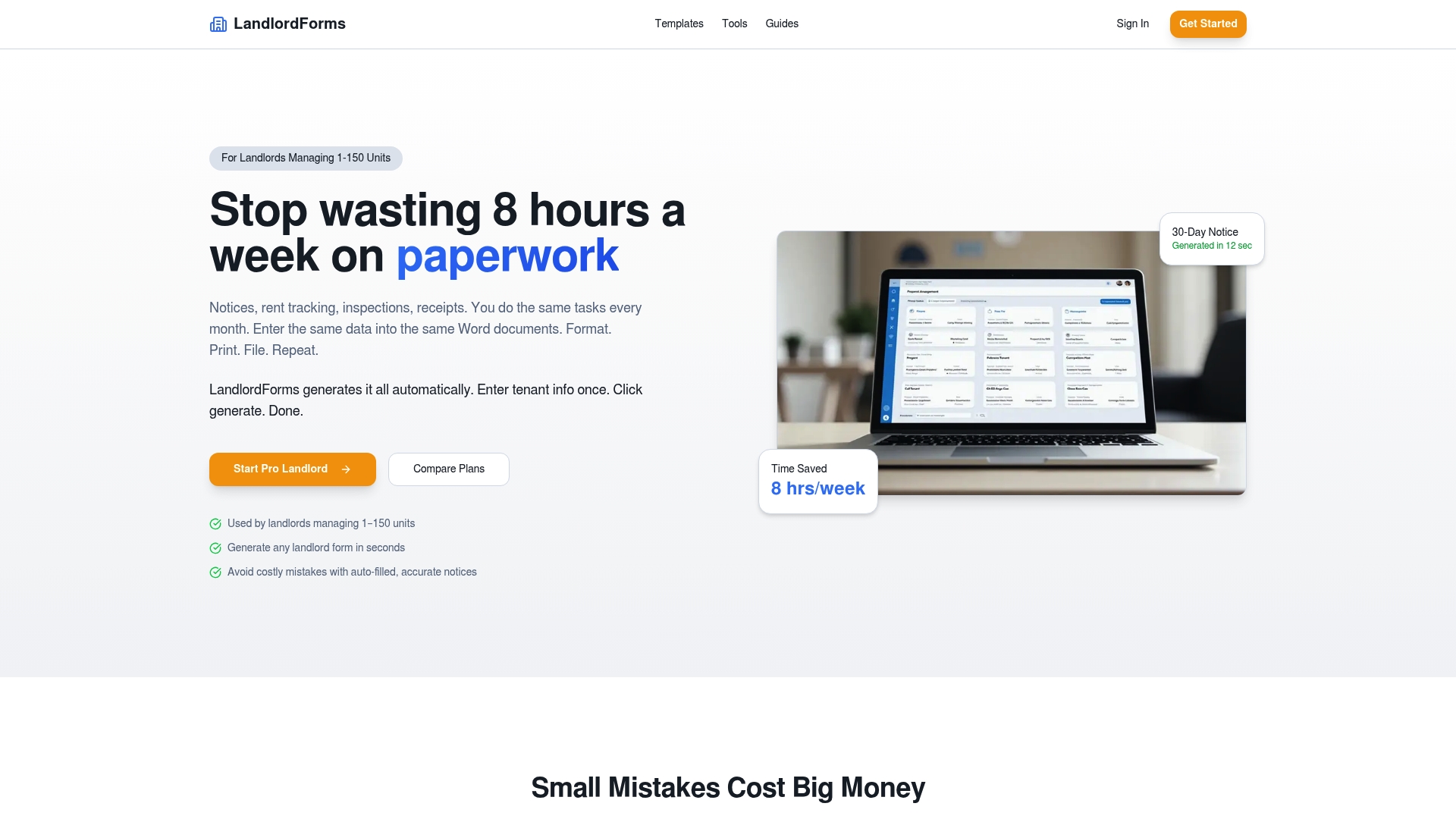
Photo documentation tools create timestamped inspection records that hold up in deposit disputes. Real-time rent tracking keeps payment histories accurate and current. Every document generated through Landlordforms is professional, consistent, and ready for any dispute that arises. Landlords report saving up to eight hours a week by replacing manual paperwork with automated templates. For landlords who want to start with a specific tool, the free landlord document templates library covers the most common documentation needs immediately.
FAQ
Why does document accuracy matter for tenant relations?
Accurate documents prevent billing disputes, build tenant confidence in the landlord’s professionalism, and reduce the communication failures that drive 37% of tenant complaints. Tenants who receive correct, consistent documentation are more likely to pay on time and renew.
What is the most important document in a tenancy?
The move-in inspection is the most critical document. A signed, dated, and photographed record of property condition at move-in determines the outcome of virtually every deposit dispute at move-out.
How do response time standards affect tenant satisfaction?
Industry best practices recommend acknowledging urgent issues within 1 hour, essential issues within 4 hours, and routine requests within 1 business day. Landlords who document these responses consistently report fewer escalated complaints.
What are the legal risks of poor documentation?
Statutory penalties for insufficient deposit documentation often reach 2x to 3x the deposit amount. Reconstructed records created after a dispute begins carry little weight in arbitration or court.
How can landlords reduce documentation errors practically?
Using automated templates, designating a single communication channel, and logging every maintenance request and response at the time it occurs eliminates the most common sources of error. Platforms like Landlordforms automate form creation and organize tenant records in one place, removing the manual steps where errors enter.