Tenant Rights Notice Compliance Guide for Renters

Tenant rights notice compliance is the process of understanding and following legal notice requirements to protect your rental rights and prevent wrongful eviction. Every renter in the United States faces notices at some point, whether it’s a lease violation notice, a notice of entry, or a termination notice. These documents are not just paperwork. They trigger legal deadlines, create rights, and can determine whether you keep your home. This tenant rights notice compliance guide covers every notice type you need to know, the mandatory elements that make a notice legally valid, and the exact steps to protect yourself when one arrives.
What are the legally required tenant notices you need to know?
Tenant notices fall into two categories: notices landlords send to tenants, and notices tenants send to landlords. Both carry legal weight. Both require specific content and delivery methods to be enforceable under state landlord-tenant statutes.
The four most common notice types every tenant should recognize are:
-
Lease violation notice. A landlord’s formal written demand that you correct a specific lease breach. This notice is a legal prerequisite to eviction, giving you a final chance to fix the problem before a court filing.
-
Notice of entry. A landlord’s advance warning before entering your unit. Most U.S. states require 24–48 hours of written notice during reasonable hours, with emergency exceptions for fire or flood.
-
Notice to vacate. A formal demand that you leave the property by a set date. This can come from a landlord ending a tenancy or from a tenant giving notice of their own departure.
-
Notice to repair. A tenant-generated notice demanding the landlord fix a habitability issue. This notice starts the clock on the landlord’s legal repair obligation and protects you if conditions worsen.
Each notice type triggers different statutory deadlines and obligations. A lease violation notice gives you a cure window. A notice of entry requires you to allow access. A notice to repair puts the landlord on record. Knowing which notice you received is the first step in responding correctly.
Delivery method also matters. State law or your lease specifies whether notices must arrive by postal mail, hand delivery, or electronic means. The method affects when the notice period officially begins. A notice sent by mail may add extra days to the timeline under your state’s rules.

What are the essential elements that make a tenant notice legally compliant?
A notice missing required elements is legally defective. That defect can serve as a defense in eviction court. Knowing what a valid notice must contain lets you spot problems before they cost you your home.
A valid lease violation notice must include four mandatory elements:
-
The specific lease clause violated. The notice must name the exact provision, not just say “you broke the lease.”
-
Facts supporting the allegation. Dates, descriptions, and evidence must appear in the notice body.
-
Required cure steps. The landlord must tell you exactly what action will fix the violation.
-
A deadline to cure. The notice must state a specific date by which you must act.
Written notices carry legal weight. Oral warnings do not. Oral warnings do not trigger legal cure deadlines or eviction proceedings in most U.S. states. A landlord who only tells you verbally to fix something has not started the legal clock. You have no obligation to treat a spoken complaint as a formal notice.
State law sets minimum cure periods that your lease cannot shorten. State cure periods range from 3 to 30 days depending on the jurisdiction and the type of violation. If your lease says you have only two days to fix a violation, but your state requires ten, the state minimum controls. Lease terms that shrink statutory cure periods are unenforceable.
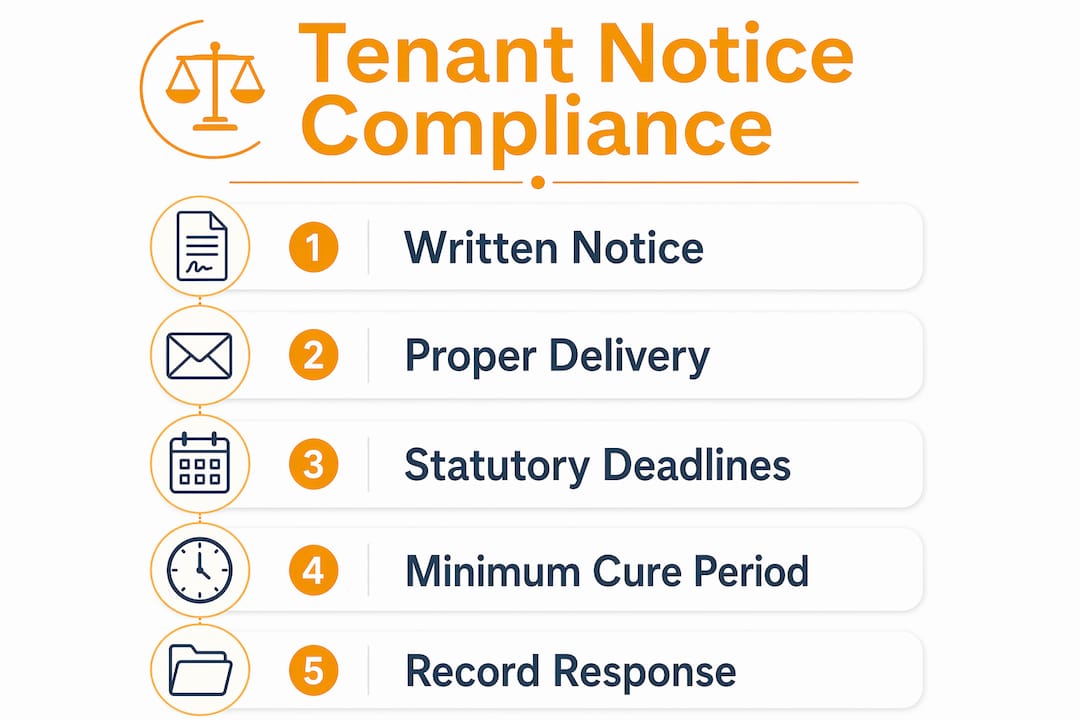
Pro Tip: When you receive any notice, check your state’s minimum cure period before acting on the landlord’s stated deadline. If the landlord’s deadline is shorter than the legal minimum, you have more time than the notice claims.
How to properly respond to tenant notices to protect your rights and avoid eviction
Responding correctly to a notice is as important as the notice itself. A proper response creates a paper trail, preserves your legal options, and may prevent eviction entirely.
Take these steps immediately after receiving a notice:
-
Document receipt. Write down the date, the delivery method (hand delivered, mailed, posted on door), and the exact contents. Take a photo of the envelope and the notice itself.
-
Review your lease. Confirm whether the clause cited in the notice actually exists and whether the landlord’s factual claims are accurate.
-
Verify your statutory rights. Look up your state’s minimum cure period for the violation type. Do not rely solely on the landlord’s stated deadline.
-
Respond in writing. Whether you plan to cure the violation, dispute the notice, or request clarification, put it in writing. Written communication creates the paper trail that protects you in court.
-
Meet the cure deadline. If the violation is real and curable, fix it before the statutory deadline and document that you did so with photos, receipts, or written confirmation.
Properly responding to a lease violation notice may delay or prevent eviction entirely. Courts look at whether tenants acted in good faith. A documented cure, delivered on time, is your strongest defense.
If you believe the notice is defective, do not ignore it. Write to the landlord identifying the missing elements and state that you consider the notice legally insufficient. Keep a copy. Contact a local tenant advocacy organization or legal aid office if you need help evaluating the notice.
Pro Tip: Build a chronological log for every notice you receive. Record the date, delivery method, content, and your response. Detailed logging of dates and delivery methods builds the chronological record that wins disputes.
What are the state-based variations in notice requirements tenants must know?
Notice requirements vary significantly by state. What is legal in California may be insufficient in Virginia. Tenants must know their state’s specific rules to respond correctly.
Landlord entry notice rules
Landlord entry must occur during reasonable hours, commonly defined as between 9 a.m. and 6 p.m., with proper written notice except in emergencies. Delaware, Vermont, and Washington D.C. require 48 hours of advance notice. Virginia requires 72 hours for routine maintenance. Nine states have no specific entry-notice statutes and default to a general “reasonable notice” standard.
State cure period and termination notice overview
| State | Entry notice required | Cure period (curable violations) | Termination notice (month-to-month) |
|---|---|---|---|
| California | 24 hours | 3 days | 30 days (under 1 year) / 60 days |
| New York | Reasonable notice | 10 days | 30 days |
| Texas | Reasonable notice | Varies by violation | 30 days |
| Virginia | 72 hours (maintenance) | 21 days | 30 days |
| Delaware | 48 hours | 7 days | 60 days |
Cure periods in the table above reflect general statutory minimums. Your specific lease and local ordinances may provide additional protections. Always verify current rules with a state-specific resource or legal aid office.
Rent increase notice requirements also vary by state. Some states require 30 days notice for any rent increase. Others require 60 or 90 days, especially for long-term tenants. A rent increase notice that does not meet state minimums is unenforceable, and you are not obligated to pay the new amount until proper notice is given.
The core rule across all states is this: your lease cannot give you fewer rights than state law provides. When in doubt, the statute wins.
What common mistakes do tenants make with notice compliance?
Most tenants who lose eviction cases do so not because they were wrong, but because they failed to assert their rights. Tenants often lose rights solely due to unawareness and failure to act on them.
The most damaging mistakes are:
-
Treating oral warnings as valid notices. A landlord’s verbal complaint is not a legal notice. Do not start a cure period based on a conversation.
-
Failing to document everything. No record means no defense. Failure to keep detailed records leads to losses even when the tenant is in the right.
-
Assuming lease deadlines override state law. If your lease gives you three days to cure but state law requires ten, you have ten days. Leases cannot strip statutory protections.
-
Ignoring notices entirely. A notice you do not respond to becomes a default. Courts treat silence as non-compliance.
-
Accepting illegal landlord actions without reporting them. Self-help evictions such as lock changes, utility shut-offs, or removal of belongings are illegal in all U.S. states. Document the incident, contact police, and reach out to legal aid immediately.
Tenant advocates note that documentation and formal written communication create essential paper trails that protect tenants in disputes and eviction proceedings.
Pro Tip: Send all responses to landlord notices by certified mail with return receipt. This creates a timestamped delivery record that is nearly impossible to dispute in court.
Key takeaways
Tenant notice compliance is your first and most effective defense against wrongful eviction. A defective notice, an oral warning, or a cure period shorter than state law allows can all be used in your favor if you know what to look for.
| Point | Details |
|---|---|
| Written notices only | Oral warnings carry no legal weight and do not start cure periods in most U.S. states. |
| Four required elements | A valid lease violation notice must name the clause, facts, cure steps, and deadline. |
| State law overrides leases | Cure periods set by state statute cannot be shortened by lease terms. |
| Document everything | Log dates, delivery methods, and responses to build a defensible record. |
| Respond, never ignore | A documented, timely cure is the strongest defense against eviction proceedings. |
What I’ve learned after years of watching tenants win and lose on paperwork alone
Most tenants I have seen lose eviction cases were not bad renters. They were uninformed ones. The landlord filed a notice with a missing element, or gave a cure deadline shorter than state law allows, and the tenant never caught it. That single oversight cost them their home.
The most powerful thing a tenant can do is treat every notice as a legal document, because it is one. Read it carefully. Check the four required elements. Verify the cure period against your state’s statute. Then respond in writing, every time, even if just to acknowledge receipt.
Experts recommend viewing a lease violation notice not as an eviction threat, but as a formal request to cure and preserve your tenancy. That reframe changes everything. A notice is an opportunity to fix the problem and stay. Most landlords would rather collect rent than go to court.
The tenants who come out ahead are the ones who create a paper trail from day one. Certified mail, dated photos, written responses. That documentation does not just help in court. It often prevents court entirely, because landlords back down when they see a tenant who knows the rules.
— Igor
Landlordforms: legal notice templates that work for both sides
Whether you are a tenant who needs to understand what a valid notice looks like or a landlord who needs to issue one correctly, having the right template matters. A notice with missing elements is legally defective. A notice with the right content, delivered the right way, protects everyone.

Landlordforms offers free, state-aware templates for the notices that matter most. You can generate a notice to vacate, a lease violation notice, or an eviction notice in minutes, with all required elements built in. The PDF generator formats each document to meet standard legal requirements, reducing the risk of a defective notice derailing a legitimate case. Visit Landlordforms to access the full library of free templates and compliance tools.
FAQ
What is a tenant rights notice compliance guide?
A tenant rights notice compliance guide explains the legal notice types tenants may receive, the required elements that make each notice valid, and the steps tenants must take to protect their rights and avoid eviction.
How much notice must a landlord give before entering my unit?
Most U.S. states require 24–48 hours of written advance notice before a landlord enters a rental unit during reasonable hours, with exceptions for genuine emergencies like fire or flooding.
Can a lease shorten the cure period on a violation notice?
No. State cure periods supersede shorter lease deadlines for curable violations. If state law gives you ten days and your lease says three, you legally have ten days.
What should I do if my landlord changes the locks without notice?
Lock changes, utility shut-offs, and removal of belongings are illegal self-help evictions in all U.S. states. Document the incident with photos, contact local police, and reach out to a legal aid organization immediately.
Does an oral warning from my landlord count as a legal notice?
No. Oral warnings do not trigger legal cure deadlines or eviction proceedings in most U.S. states. A valid notice must be in writing and delivered by a method recognized under state law or your lease.