Act Within 60 Days: Adverse Action Notice Rights for U.S. Consumers

An adverse action notice is a legally required disclosure telling you that a creditor, employer, or landlord took an unfavorable action based partly or fully on your credit report or background check. Two federal laws control it: the Equal Credit Opportunity Act’s Regulation B for credit decisions, and the Fair Credit Reporting Act (FCRA) whenever a consumer report was involved. If you got one, request your free credit report within 60 days and, if something looks wrong, contact the Consumer Financial Protection Bureau (CFPB) or Federal Trade Commission (FTC) to learn your dispute rights.
TL;DR:
- An adverse action notice must include specific reasons if a consumer report influenced the decision, with clear agency contact and dispute rights information.
- Timing rules require notices to be sent within 30 days of application review or adverse action, with precise documentation of delivery date.
- Landlords and employers must follow strict workflows, including pre-notice, waiting periods, and accurate reason disclosures, to avoid compliance violations.
- Vague or boilerplate reasons, especially those not reflecting actual decision factors, are prohibited by recent CFPB guidance and circulars.
- Reviewing and disputing errors in credit reports within 60 days is crucial, along with maintaining detailed records to support compliance and dispute processes.
Table of Contents
- What Counts as Adverse Action Under Federal Law
- Required Contents and Timing for a Compliant Notice
- How Notices Differ for Credit, Jobs, and Rental Applications
- What to Do After You Receive an Adverse Action Notice
- A Compliance Checklist for Landlords and Employers
- Why the CFPB Is Cracking Down on Vague Reasons
- LandlordForms’ Take: Where Landlords Actually Get Tripped Up
- Compliant Notices Without the Guesswork
- Where to Verify These Rules Yourself
- Sources
- FAQ
What Counts as Adverse Action Under Federal Law
Adverse action covers more territory than most people assume. Under Regulation B, it means a creditor denied your application, changed the terms of your account for the worse, or refused to increase your credit line, even if you never technically applied for the increase. A bank that slashes your credit card limit from $10,000 to $2,000 after a rough patch on your credit report has taken adverse action, whether or not it uses that phrase in the letter you receive.
The FCRA layers on a separate trigger. Any time a business uses a consumer report “in whole or in part” to make an unfavorable decision, the notice requirements kick in regardless of what kind of decision it was. That single phrase, “in whole or in part,” is why a landlord who denies an applicant partly because of a low credit score and partly because of a spotty rental history still owes that applicant an FCRA-compliant notice. Ignoring one factor because another factor also mattered is not a valid excuse.
The two laws often apply together, but they answer different questions. Regulation B asks whether a credit-related action happened. The FCRA asks whether a consumer report played any role. A quick breakdown of who does what:
- ECOA / Regulation B (12 CFR §1002.9): Governs credit denials, unfavorable term changes, and account actions, regardless of whether a credit report was pulled.
- FCRA (15 U.S.C. §1681m): Governs any adverse action where a consumer report influenced the decision, across credit, employment, insurance, and housing.
- CFPB and FTC: The federal agencies that write guidance, enforce violations, and field consumer complaints when notices fall short.
Required Contents and Timing for a Compliant Notice
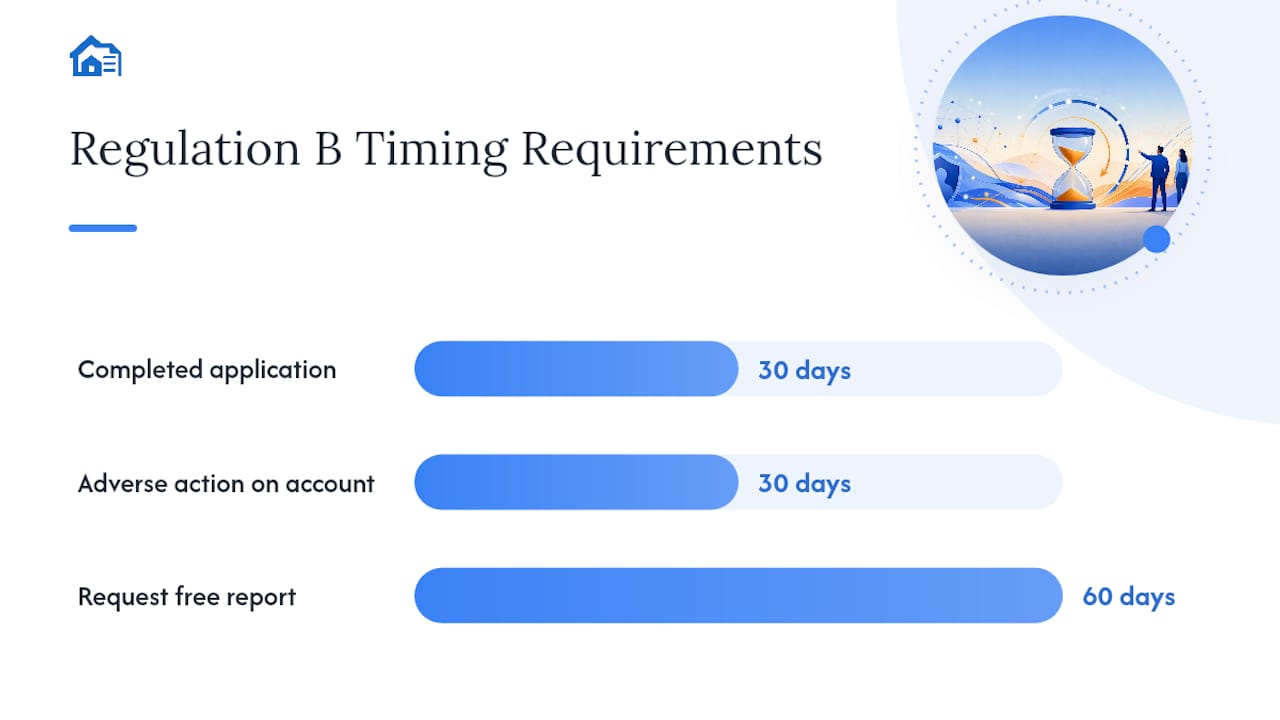
Timing is not negotiable. Regulation B requires creditors to notify applicants of adverse action within 30 days of receiving a completed application, or within 30 days of taking adverse action on an existing account. If an application is incomplete, the creditor can either treat the missing pieces as grounds for denial and send notice, or request the missing information directly, but it cannot simply let the file sit indefinitely.
Pro Tip: If a creditor makes you a counteroffer alongside the denial, such as approving you at a smaller credit limit, it doesn’t need to send a second notice if you decline the counteroffer. That combined counteroffer-and-notice approach is explicitly allowed under Regulation B’s sample form C-4.
When a consumer report factored into the decision, FCRA §615 requires the notice to include specific elements. A notice missing any of these is arguably deficient:
- The name, address, and phone number of the consumer reporting agency that supplied the report.
- A statement that the reporting agency did not make the decision and cannot explain the specific reasons for it.
- Notice of your right to a free copy of that report if you request it within 60 days.
- An explanation of your right to dispute the accuracy or completeness of information in the report.
- Disclosure of the specific credit score used, when a score played a role in the decision.
Notices can be delivered orally, in writing, or electronically, as long as they hit every content requirement. Telephone applications carry an exception worth knowing: if a creditor explains reasons orally over the phone, it may still need to send written confirmation afterward, particularly if you ask for it. Businesses that lean entirely on CFPB’s sample notification forms without adapting them to their actual decision process are walking into compliance trouble, a point regulators have made increasingly clear in recent guidance.
How Notices Differ for Credit, Jobs, and Rental Applications
The core notice requirements stay consistent across contexts, but the practical mechanics shift depending on who is sending the notice and why.
Credit decisions and risk-based pricing are the most straightforward case. If you’re denied a loan outright, you get a standard adverse action notice. If you’re approved but at a higher interest rate than most applicants get, because your credit score fell below a certain threshold, that’s a risk-based pricing notice instead, and it carries slightly different content requirements focused on explaining the pricing tier rather than a flat denial.
Employment background checks work on a two-step process the FCRA requires and that catches a lot of employers off guard. Before an employer can reject a candidate based on a background check, it must send a pre-adverse action notice, along with a copy of the report and a written summary of the candidate’s rights under the FCRA. Only after giving the candidate a reasonable window to respond, typically a few business days, can the employer send the final adverse action notice confirming the decision.
Tenant screening sits in a gray area many landlords underestimate. A landlord who denies an applicant, requires a larger security deposit, or demands a co-signer based on a credit or background report owes that applicant the same FCRA disclosures an employer would. Layer in fair housing law, and a landlord who applies screening criteria inconsistently across applicants risks a discrimination claim on top of an FCRA violation. Templates built for tenant screening documentation help landlords keep that process consistent from one applicant to the next.

What to Do After You Receive an Adverse Action Notice
Getting one of these letters is not the end of the road. It’s a legal trigger for rights you can act on, and the clock starts the moment you open it.
- Request your free credit report within 60 days. The notice should list the reporting agency’s contact information. Ask for the exact report that was pulled, not just a generic version, since some furnishers report differently to different bureaus.
- Review it line by line for errors. Look for accounts that aren’t yours, outdated negative marks, or balances reported incorrectly. These mistakes are more common than people expect, and they’re often fixable.
- File a dispute with both the CRA and the original furnisher. Send it in writing, ideally by certified mail, and attach copies (never originals) of any supporting documents. The CRA is required to investigate within about 30 days.
- Request a written statement of specific reasons if the notice didn’t include one. Under Regulation B, you have 60 days to make that request, and the creditor then has 30 days to respond in writing.
- Escalate if nothing gets resolved. File a complaint with the CFPB or FTC, or consult an attorney if you suspect a pattern of discrimination or repeated violations.
Pro Tip: Keep a paper trail of every letter, email, and phone call tied to the dispute, including dates and names. If the case ever escalates to a formal complaint or legal claim, that timeline becomes your strongest piece of evidence.
A Compliance Checklist for Landlords and Employers
Businesses that skip steps here don’t just risk an unhappy applicant. They risk real legal exposure under both the FCRA and, for credit and lending contexts, Regulation B.
The safest sequence follows a strict order: send the pre-adverse action notice first, provide a copy of the report and a summary of rights, wait a reasonable period for the applicant to respond, and only then send the final adverse action notice if the decision stands.
- Never rely on a checklist of generic reasons pulled straight from a sample form without checking that they match the actual factors behind the decision.
- Document the decision path in writing, especially when a scoring model or algorithm contributed to the outcome, so you can point to the real principal reasons if challenged.
- Keep proof of delivery for every notice sent, whether by email receipt, certified mail tracking, or a timestamped document platform.
- Version your templates so you can prove which language was in effect on the date a given notice went out.
Pro Tip: The single most common violation isn’t a missing notice. It’s a notice sent late, or one built from an unedited sample form that lists reasons that don’t actually match why the applicant was denied. Landlords managing multiple units without a tracked workflow are especially exposed to timing slips. A late notice can escalate quickly into a legal dispute even when the underlying decision was perfectly legitimate.
Why the CFPB Is Cracking Down on Vague Reasons
The CFPB drew a hard line in 2023 that’s still shaping compliance practice today. Its Circular 2023-03 makes clear that creditors cannot lean on the agency’s own sample checklist of reasons unless those reasons genuinely reflect what drove the decision.
Creditors must ensure the reasons disclosed on an adverse action notice accurately identify the principal reason or reasons for the action taken, even when the decision was produced by a complex algorithm or a third-party model whose internal logic the creditor doesn’t fully understand.
That last part matters more every year. As more lenders and screening companies plug in automated scoring tools, the CFPB has been explicit that using an algorithm doesn’t excuse a business from explaining itself in plain language. A business can’t just check the box marked “insufficient credit history” because it seems close enough. If that’s genuinely not the principal factor the model flagged, the notice is deficient, full stop.
For consumers, this circular is a real weapon. If you get a notice with vague, boilerplate reasons like “does not meet our criteria,” you can point directly to the CFPB’s own guidance when disputing it or filing a complaint. Vague is not compliant.
LandlordForms’ Take: Where Landlords Actually Get Tripped Up
Working with landlords managing everywhere from a single duplex to well over a hundred units, one pattern shows up again and again: the violation is almost never intentional. It’s a missed deadline buried in a busy week, or a canned rejection reason copied from a form template three years out of date.
The fix isn’t more legal knowledge. It’s a workflow that doesn’t rely on memory. State-specific notice templates that update when a statute changes, delivery tracking that timestamps when a tenant actually received a document, and a rent ledger that documents payment history before a dispute even starts, all of it closes the gap between “we meant to comply” and “we can prove we did.”
None of this replaces legal counsel when a dispute gets contentious or a pattern of denials starts to look discriminatory. It just removes the paperwork failures that turn a defensible decision into an expensive one.
— Igor
Compliant Notices Without the Guesswork
Manually tracking 30-day deadlines, FCRA content requirements, and delivery proof across a dozen tenant files is exactly where landlords lose. Landlordforms builds that compliance directly into the workflow: state-specific notice templates that stay current, one-click PDF generation, and a timestamped record of exactly when a tenant received a document, so you’re never guessing whether a notice went out on time.

Start with the lease violation notice template, free to generate and built to state requirements, or grab the rent ledger template to keep the payment history you’ll need if a screening decision ever gets disputed. If your situation involves an active legal dispute rather than a paperwork fix, a contract disputes attorney can advise on next steps Landlordforms isn’t built to handle. For everything else, day-to-day compliance runs smoother when the forms build themselves.
Where to Verify These Rules Yourself
For the primary language of each requirement, go straight to the source: Regulation B §1002.9 covers timing and creditor notices, FCRA §1681m covers consumer-report-based notices, and CFPB’s sample forms show the model language regulators expect businesses to adapt, not copy verbatim.
This article is general information, not a substitute for advice from a qualified lawyer. Consult a qualified legal professional about your own circumstances before acting on anything here.
Sources
- § 1002.9 Notifications. | Consumer Financial Protection Bureau
- Using consumer reports for credit decisions: What to know about adverse action and risk-based pricing notices | Federal Trade Commission
- 15 U.S.C. §1681m - Requirements on users of consumer reports
FAQ
Why am I getting an adverse action notice?
You’re getting one because a creditor, employer, or landlord took an unfavorable action, a denial, a rate increase, or a rejected application, and either the decision falls under Regulation B or a consumer report played a role under the FCRA.
When must an adverse action notice be sent?
Under Regulation B, creditors must send notice within 30 days of receiving a completed application or taking action on an existing account. Employers using background checks must send a pre-adverse notice before the final decision, then the final notice after a reasonable response window.
What are the required items in an adverse action notice under Regulation B?
A compliant notice generally needs the specific reasons for the action (or notice of your right to request them), the name and address of the creditor, a statement of the applicable federal law, and, when a report was used, the reporting agency’s information and your dispute rights.
What federal law requires the notice of adverse action?
Two federal laws require it: the Equal Credit Opportunity Act through Regulation B for credit-related decisions, and the Fair Credit Reporting Act whenever a consumer report contributed to the outcome.
Can a landlord use a generic checklist of reasons for a rental denial?
Not safely. Following the same logic the CFPB laid out in Circular 2023-03 for creditors, a landlord’s stated reasons should reflect what actually drove the decision, not a generic list copied from a template.