Most Evictions Close in Six Days: Eviction Timelines & Forms by State

Eviction timelines vary by state, but most routine nonpayment cases resolve in days to a few weeks once a tenant fails to respond or cure. Contested cases, court backlog, or a defective notice can stretch that same case into months. The safest move is to check your state’s exact statutory notice period and counting rules before you file anything.
TL;DR:
- Most uncontested eviction cases in states with short notice periods, such as Texas or Georgia, resolve within one to three weeks after the notice expires.
- Courts’ scheduling delays, service issues, or tenant responses can extend the process from a few days to several months, especially in contested cases.
- Accurate paperwork, including proper notices and proof of service, and familiarity with local statutes significantly reduce delays in the eviction timeline.
- Median case closure time across states is around six days, but contested or backlogged cases can take ten times longer.
- Federal or local ordinances can require longer notice periods and additional procedures, adding to the overall eviction timeline.
Table of Contents
- Eviction Timeline by State: Notice Periods and Uncontested Case Length
- The Four Phases of Eviction and How Long Each One Takes
- Which Notice Type Applies to Your Situation?
- What the Data Actually Shows About Eviction Speed
- Where the Court Process Adds Days and Weeks
- How to Verify Your State’s Exact Eviction Timeline
- Authoritative Resources to Confirm Your State’s Rules
- A Landlord’s Recordkeeping Checklist That Actually Prevents Delays
- Generate Compliant Notices Without Guessing at the Statute
- Sources
- FAQ
Eviction Timeline by State: Notice Periods and Uncontested Case Length
Every state sets its own notice period for nonpayment of rent, and that single number drives most of the timeline difference you’ll see between, say, Georgia and California. Some states allow a landlord to move fast once rent is late; others build in a longer cure window before a case can even reach the courthouse.
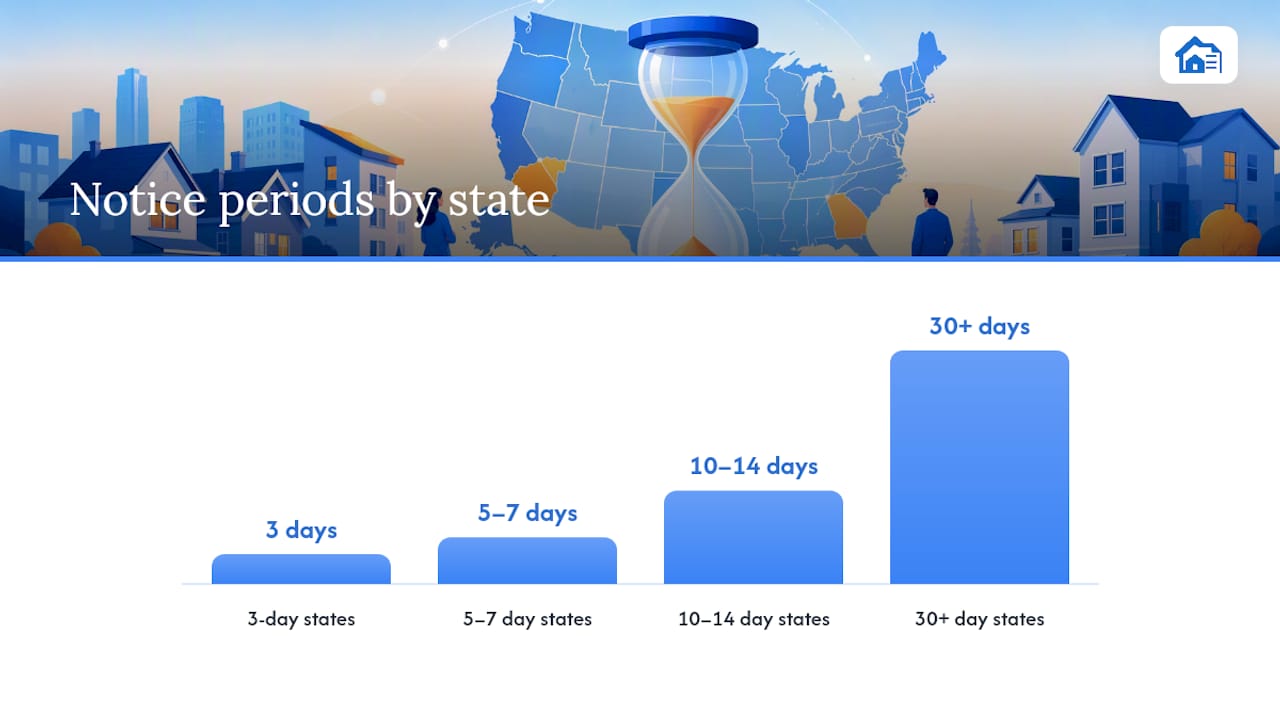
Here’s how the notice windows generally break down, based on statutory patterns tracked across state codes and the LSC Eviction Laws Database:
- 3-day notice states (common pattern): Texas, Georgia, Virginia, and several others allow pay-or-quit notices as short as three days, making these among the fastest uncontested timelines in the country.
- 5 to 7-day notice states: many Midwestern and Southern states, including Ohio and Missouri, sit in this middle band.
- 10 to 14-day notice states: states like New York and Illinois often require longer cure periods before filing.
- 30-day (or longer) notice states: Washington, D.C. sets a 30-day floor for nonpayment cases, and several states extend notice further for month-to-month terminations or no-cause situations.
- No fixed statutory period: a handful of jurisdictions leave timing more open to lease terms or local ordinance, according to Landlord Atlas.
An uncontested case, meaning the tenant doesn’t answer or fight it, typically wraps up in one to three weeks after the notice period expires. Add a contested hearing, and that window commonly grows to four to eight weeks or longer.
Local ordinances complicate this further. Cities with just-cause eviction rules or rent stabilization boards sometimes require notice periods well beyond the state minimum, and pandemic-era federal overlays occasionally still apply to properties with federally backed mortgages. Always confirm whether your notice period counts calendar days or judicial (court) days, and whether weekends and holidays get excluded, because that single counting rule can shift your filing date by several days.
The Four Phases of Eviction and How Long Each One Takes
Every eviction case moves through the same four phases, and knowing which one you’re in tells you roughly how much time is left. The NLIHC’s eviction process breakdown frames these stages clearly, and the timing below reflects typical ranges across states.
- Notice: statutory, ranging from 3 to 30 days depending on your state and the notice type.
- Filing and service: once the notice period expires, filing the complaint and serving the tenant usually takes a few days to two weeks, depending on how fast the sheriff or process server can complete service.
- Hearing: courts typically schedule a hearing one to six weeks out, though busy urban courts can push that further.
- Writ and enforcement: after judgment, the writ of possession is issued and scheduled for execution, often within a few days to three weeks.
Tenant action resets or extends this clock constantly. A filed answer, a request for continuance, or an appeal can each add weeks. Landlord mistakes do the same: a defective notice or a botched service attempt often forces a full restart, according to DiscoveryMark’s eviction timeline analysis. That’s the phase most worth protecting against errors before you file.
Pro Tip: Keep a copy of the notice, proof of service, and your state’s statute citation in one folder before you ever step into court. Judges move faster, and rule in your favor more often, when the paperwork is already organized.
Which Notice Type Applies to Your Situation?
Landlords use three basic notice categories, and picking the wrong one is one of the most common eviction notice mistakes that resets a timeline entirely.
- Pay-or-quit notices apply to nonpayment of rent and give the tenant a fixed window, often 3 to 14 days depending on the state, to pay in full or move out.
- Cure-or-quit notices apply to lease violations other than rent, like unauthorized pets or property damage, and typically give a slightly longer window to fix the issue.
- Unconditional or termination notices apply to month-to-month tenancies ending without cause, or to serious violations, and generally require the longest notice, often 30 days or more.
- Immediate quit situations, reserved for illegal activity or severe safety violations in some states, can bypass the standard cure period entirely, though these carry the highest legal risk if misapplied.
Federal program rules complicate this picture too. Properties tied to HUD-backed financing or certain federal housing programs may require longer notice floors than state law alone demands, per HUD’s program guidance and the eCFR Title 24 regulations governing those properties. Always check whether your rental falls under one of these overlays before assuming state minimums apply.
What the Data Actually Shows About Eviction Speed
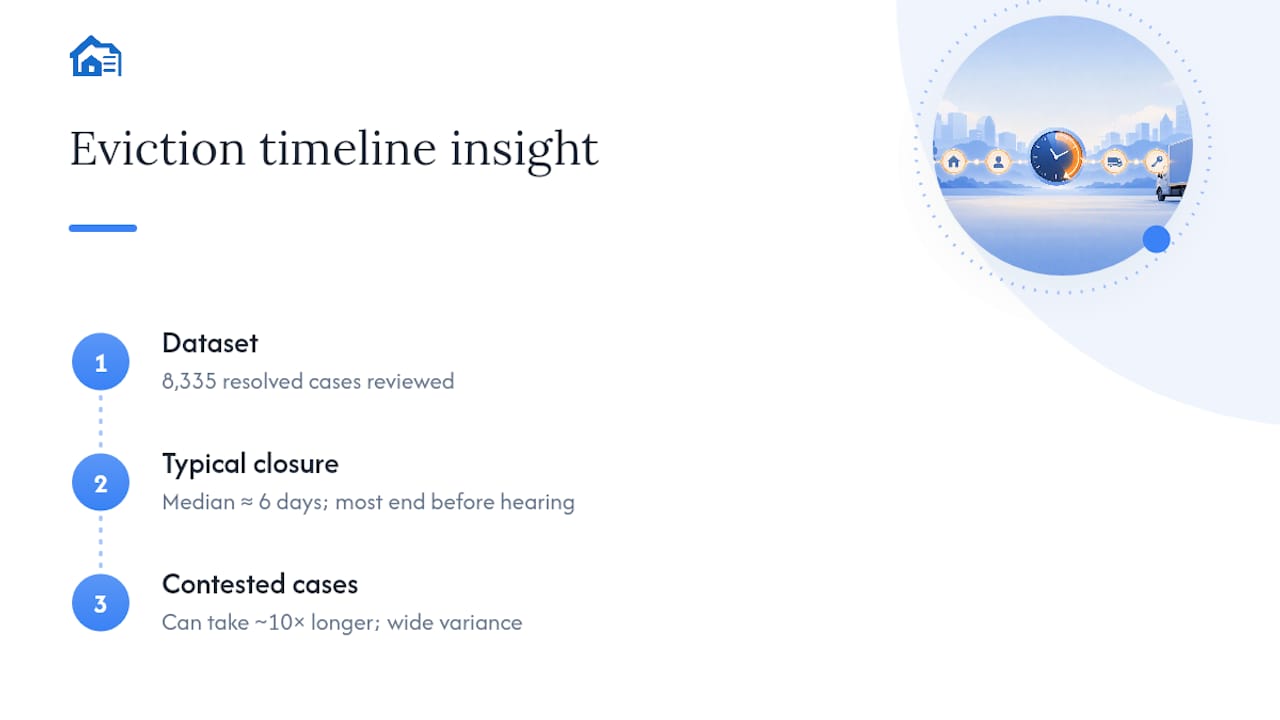
A dataset review of 8,335 resolved eviction cases found the typical case closed in about six days, according to Hemlane’s state-by-state analysis. That number surprises most people who assume every eviction drags through months of court battles.
The short median exists because most cases never reach a contested hearing. Tenants pay, cure, or move out during the notice period, and the case closes before a judge ever sees it. States with faster statutory notice windows tend to post shorter overall medians, while states requiring longer cure periods or busier urban courts show longer tails on the slow end, particularly in cases that do get contested.
The number that matters most: most state medians sit well under a week, but that figure hides wide variance. A contested case in a backlogged court can take ten times longer than the median for the exact same state. Sample sizes also vary significantly by jurisdiction, so treat any single state’s median as directional rather than a guarantee for your specific case.
The takeaway holds regardless of which state you’re in: early resolution, before a case reaches a courtroom, is the single biggest lever you control over your own timeline.
Where the Court Process Adds Days and Weeks
Once a case reaches the courthouse, several mechanical steps can quietly stack up delay if you’re not tracking them.
- Service and summons: if the tenant can’t be served (they’re avoiding the process server, or the address is wrong), the case stalls until service succeeds, which sometimes requires a second attempt or publication.
- Default judgments: if a tenant fails to appear at the hearing, courts commonly issue a default judgment in the landlord’s favor, which speeds the outcome considerably.
- Missed landlord hearings: the reverse holds too. Skip your own hearing, and a judge may dismiss the case outright, forcing you to refile from scratch, per Super Lawyers’ eviction guidance.
- Writ scheduling: after judgment, sheriffs or constables schedule the physical enforcement, and local backlog can push that window from a few days to several weeks.
- Bankruptcy or appeal filings: either one triggers an automatic stay or extended review period, which can add weeks or months regardless of your state’s normal timeline.
How to Verify Your State’s Exact Eviction Timeline
Statutory language uses different terms depending on the state, so search accordingly: “unlawful detainer” (common in western states), “dispossessory” (Georgia), or “summary process” (Massachusetts, where Mass. Gen. Laws c.239, §15 governs the process).
- Confirm your exact notice type and the number of days required.
- Check whether the count uses calendar days or judicial days, since courts exclude weekends and holidays under some state rules.
- Search for local ordinances that extend notice beyond the state minimum.
- Note the appeal window and the typical sheriff scheduling timeline for writ enforcement in your county.
Pro Tip: Print or save the exact statute text before your hearing date. Judges expect landlords to cite the specific code section, not just describe it, and having it printed saves you from fumbling through your phone in front of the bench.
Authoritative Resources to Confirm Your State’s Rules
Start with the LSC Eviction Laws Database for a consolidated, state-by-state legal overview covering procedures from pre-filing through post-judgment. From there, pull the actual statute text from your state’s code portal, the way Massachusetts landlords reference Chapter 239, §15 directly.
Check HUD’s fair housing program pages if your property carries federal financing, since program rules can override state minimums. The National Low Income Housing Coalition maintains legal-aid locator maps for tenants facing court alone, which is worth knowing about even if you’re the landlord in the case, since it affects how quickly the other side responds.
A Landlord’s Recordkeeping Checklist That Actually Prevents Delays
Most timeline disasters I’ve seen traced back to paperwork, not the law itself. A missing service affidavit, an undated rent ledger, or a notice with the wrong statutory citation forces a restart that costs far more time than doing it right the first time.
Keep four things ready before you ever file: a complete rent ledger, dated photos of any property condition disputes, signed service affidavits, and proof of notice delivery. Templates that auto-populate your state’s statutory language cut down on the small drafting errors that judges use to dismiss cases. Show up to every hearing with your citations printed, not memorized.
— Igor
Generate Compliant Notices Without Guessing at the Statute
Getting the notice type, the day count, and the delivery method right the first time is what actually keeps your eviction timeline short. Landlordforms builds state-specific eviction notice templates, including the 3-day notice to pay or quit and 30-day notice to vacate, so you’re not reconstructing statutory language from memory under deadline pressure.

Pair that with the rent ledger template to keep courtroom-ready payment records, since a clean ledger is often the difference between a fast default judgment and a drawn-out dispute over what was actually paid. None of this replaces checking your state’s exact statute; it just means you’re not starting from a blank page when the clock is already running. Download the rent ledger and generate your first notice free to see how much time it saves before your next filing deadline.
Sources
- LSC Eviction Laws Database
- Evictions 101: Eviction process, how it works, and what to know
- HUD — program offices: fair housing
This article is general information, not a substitute for advice from a qualified lawyer. Consult a qualified legal professional about your own circumstances before acting on anything here.
FAQ
Is There a National Database for Evictions?
No single national eviction database tracks every case, but the LSC Eviction Laws Database consolidates state and territory eviction procedures into one reference point.
Can My Landlord Evict Me if I Have Nowhere to Go?
A tenant’s housing situation doesn’t pause a legal eviction; landlords must still follow the statutory notice and court process, but having nowhere to go isn’t a legal defense against a properly filed case.
How Fast Can a Landlord Evict You in Ohio?
Ohio typically requires a 3-day notice for nonpayment before filing, and an uncontested case can resolve within a few weeks total, though contested cases involving a hearing take longer.
Are Evictions High Right Now?
Eviction filing volume varies significantly by region and local economic conditions rather than following one national trend, so check local court data or the LSC database for your specific area.