Florida Lease Form: Free Templates and Compliance Checklist

The fastest way to get a compliant lease in hand is to pull an official form or generate one through state-specific software rather than grab a generic online template. Start with the Florida Association of Realtors standard residential lease, the state forms indexed through the Florida Department of Management Services, or a generator like Landlordforms that builds required disclosures directly into the document. These sources matter because they bake in the state-specific language landlords actually need, and they hand you a finished file in PDF or DOC format instead of a starting point you have to fix later.
Two things separate a usable Florida lease form from a liability: it reflects Florida Statutes Chapter 83, and it includes disclosures such as radon and, where applicable, lead-based paint.
- Download an official PDF or DOC template, or open a generator tool, before you draft anything from scratch.
- Confirm the form matches your lease type (fixed-term versus month-to-month).
- Check for the radon and flood disclosures required under Florida law.
- Verify the security deposit clause matches the notice rules in Chapter 83.
Key Takeaways
The most reliable Florida lease form is one that pairs statutory disclosures with clauses written for the exact tenancy type, not a generic template stretched to fit.
| Point | Details |
|---|---|
| Pick the right source first | State forms, the Florida Association of Realtors template, or Landlordforms all embed required disclosures. |
| Match the lease type to the tenancy | Fixed-term, month-to-month, sublease, and room rentals are not interchangeable documents. |
| Check disclosures before signing | Radon, flood risk (for 1+ year leases), and pre-1978 lead-based paint rules are non-negotiable. |
| Write your own grace period | Florida law does not create one automatically, so late-fee timing has to be explicit. |
| Landlordforms speeds compliance | It embeds Florida-specific disclosures and deposit notice timing directly into generated leases. |
Table of Contents
- Where to Download a Florida Lease Form
- Which Florida Lease Form Do You Need?
- Florida-Required Disclosures You Must Check Before Signing
- Lease Checklist: Clauses Your Form Must Include
- How to Safely Customize a Florida Lease Template
- Fast Path: How Landlordforms Builds a Compliant Lease for You
- Where to Verify the Legal Details
- Editorial Take: What Actually Matters With a Florida Lease
- Get a Compliant Lease Without the Legwork
- Sources
- FAQ
Where to Download a Florida Lease Form
You have four realistic sources for a Florida rental agreement, and each trades speed for a different kind of certainty.
State and association forms. The Florida Association of Realtors’ standard residential lease is the industry benchmark many brokers use, built around the statutory language most landlords need. It is thorough but sometimes more detailed than a small landlord managing a single duplex actually wants.
Free template sites and fillable PDFs. These are quick, but speed comes with a catch: you still have to verify the statutory disclosures are present, since many generic templates are written for no state in particular.
Landlordforms generator. Built specifically for landlords managing 1 to 150 units, it produces a Florida-specific lease with disclosures embedded, then outputs a ready PDF or DOC file you can sign the same day.

Pro Tip: Before using any downloaded lease, search the document for the words “radon” and “flood.” If neither appears and your lease runs a year or longer, the form is likely missing a required disclosure.
Which Florida Lease Form Do You Need?
Picking the wrong form type is the most common self-inflicted mistake landlords make, usually because a one-year template gets forced onto a month-to-month arrangement or a room rental.
- Fixed-term lease (6 or 12 months): best for standard single-family or apartment rentals with a defined end date.
- Month-to-month rental agreement: fits tenants who need flexibility or landlords testing a new tenant before committing to a longer term.
- Sublease agreement: needed when an existing tenant is handing off part or all of the unit to someone else, with the original tenant staying on the hook.
- Roommate or room rental agreement: covers shared housing where each occupant may have separate financial terms.
- Furnished versus unfurnished lease: furnished versions should itemize included items to avoid disputes at move-out.
- Condo or co-op lease addendum: often required on top of a standard lease when an association’s own rules apply.
If your lease term runs one year or longer, Florida law requires a standalone Flood Risk Disclosure attached to the lease, separate from the main body of the document.
Florida-Required Disclosures You Must Check Before Signing
Every Florida lease contract needs to clear a specific set of statutory hurdles, and missing even one can turn an otherwise solid clause into something a court won’t enforce.
Run through this list before you sign anything:
- Security deposit handling and bank notice, governed by Fla. Stat. § 83.49.
- Landlord or agent name and address for notices.
- Radon gas disclosure, required under Fla. Stat. § 404.056.
- Flood Risk Disclosure for leases of one year or longer.
- Lead-based paint disclosure and EPA pamphlet for housing built before 1978, per 42 U.S.C. § 4852d.
- Entry notice procedures and termination or notice periods tied to Fla. Stat. § 83.56.
- No clauses that waive tenant rights or attempt to limit landlord liability outright.
The Florida Department of Agriculture and Consumer Services warns that a signed rental agreement binds both parties immediately — there’s no statutory grace period to back out simply because you signed something you didn’t fully read.
A missing radon disclosure or an incomplete deposit notice doesn’t just create paperwork risk. It can make a clause unenforceable in a dispute, which is exactly the moment you need the lease to hold up.
Lease Checklist: Clauses Your Form Must Include
A usable Florida lease agreement template needs certain clauses by law and benefits from a few more that aren’t required but save you headaches later.
Required clauses:
- Names of all parties and a full property description.
- Lease term, start date, and end date (or renewal terms for month-to-month).
- Rent amount, due date, and late-fee policy.
- Security deposit amount and the bank notice required under § 83.49.
- Landlord or agent contact information for notices and repairs.
- Radon, flood, and (if applicable) lead-based paint disclosures.
- Entry and repair-access rules.
- Termination and notice periods matching Chapter 83.
Recommended but not mandatory:
- Pet policy and pet fees.
- Utility responsibility breakdown.
- Subletting restrictions.
- Move-in/move-out inspection and photo documentation requirements.
- Renters insurance requirement.
- Lock-change policy after tenant turnover.
Remember: you cannot draft around § 83.47. Clauses waiving a tenant’s statutory rights or limiting your own liability outright are void even if the tenant signs them.
How to Safely Customize a Florida Lease Template
Turning a downloaded template into your actual lease takes about eight steps, in this order:
- Confirm you’ve picked the right form type (fixed-term, month-to-month, sublease, or room rental).
- Check that radon, flood, and lead-based paint disclosures are present if they apply to your property.
- Fill in party names, property address, and unit details.
- Set rent amount, due date, and late-fee language, since Florida creates no default grace period unless you write one in.
- Add the security deposit amount, bank information, and the 30-day notice language.
- Insert entry-notice and termination clauses matching Chapter 83 timing.
- Scan for and remove any clause that waives tenant rights or limits your liability.
- Sign and distribute copies, using e-signature tools where both parties consent.
Pro Tip: Get an attorney involved when you’re dealing with a high-value property, unusual occupancy (multiple unrelated tenants, short-term sublets), or lease terms outside the standard 6 to 12-month range. A twenty-minute consultation is cheaper than an unenforceable clause.
If you and your tenant sign an addendum agreeing to it, notices can be delivered by email instead of certified mail. Keep dated copies either way.
Fast Path: How Landlordforms Builds a Compliant Lease for You
Landlordforms exists for exactly the landlord staring at step one of that checklist and wondering if they missed something. It generates a Florida-specific lease with the required disclosures already embedded, then hands you a finished PDF or DOC file instead of a blank template you have to police yourself.
What it includes:
- State-specific lease templates with disclosures built in, not bolted on.
- Automated security deposit notices timed to the § 83.49 deadlines.
- Document storage so every signed lease and disclosure lives in one place.
- E-sign-ready output for faster turnaround on new tenants.
- Free tools like a rent proration calculator for mid-month move-ins.
Getting started takes two steps: download a free template to see the format, or open the generator and fill in your property details directly. It’s built for landlords managing 1 to 150 units who’d rather spend eight fewer hours a week on paperwork than chase down statutory citations themselves.
| Point | Details |
|---|---|
| Fastest compliant source | State forms, association templates, and Landlordforms all embed required disclosures automatically. |
| Match form to lease type | Fixed-term, month-to-month, and sublease forms are not interchangeable. |
| No default grace period | Florida law doesn’t create one; your lease must state late-fee timing explicitly. |
| Deposit notice timing | Landlords must disclose deposit location within 30 days under § 83.49. |
Where to Verify the Legal Details
Templates change less often than the statutes behind them, so it’s worth checking the primary sources directly before you finalize anything.
- Florida Statutes Chapter 83: the full landlord-tenant framework, useful for confirming any clause’s underlying authority.
- Fla. Stat. § 83.49: exact deposit notice and return timing.
- Fla. Stat. § 83.56: nonpayment notice process and termination steps.
- Fla. Stat. § 404.056: required radon disclosure wording.
- 42 U.S.C. § 4852d: federal lead-based paint disclosure requirements for pre-1978 housing.
- Landlordforms’ guide to disclosure forms: a plain-language breakdown of why each disclosure exists.
Editorial Take: What Actually Matters With a Florida Lease
Most advice on Florida leases obsesses over finding the “right” template, as if the document itself does the legal work. It doesn’t. The form is a container; the disclosures and the notice timing are what actually protect you, and those are exactly what generic templates skip.
The overlooked risk isn’t a missing signature line. It’s landlords assuming Florida law fills in gaps it doesn’t fill. There’s no built-in grace period for late rent, no automatic flood disclosure unless the lease runs a year or more, and no forgiveness for a deposit notice sent on day 35 instead of day 30. Every one of those gaps gets exposed at the worst possible moment: during a dispute, not during drafting.
If you take one thing from this guide, prioritize the disclosure checklist over the template hunt. A plain-looking lease with every required disclosure beats a polished one missing the radon clause. That’s where written leases earn their keep over informal arrangements landlords can’t later prove.
Get a Compliant Lease Without the Legwork
Landlordforms is the faster route to a Florida-ready lease compared to editing a generic template and hoping you caught every required disclosure. Instead of cross-checking Chapter 83 line by line, you get a lease generator built for landlords managing 1 to 150 units, with radon, flood, and deposit-notice language already embedded in the output.
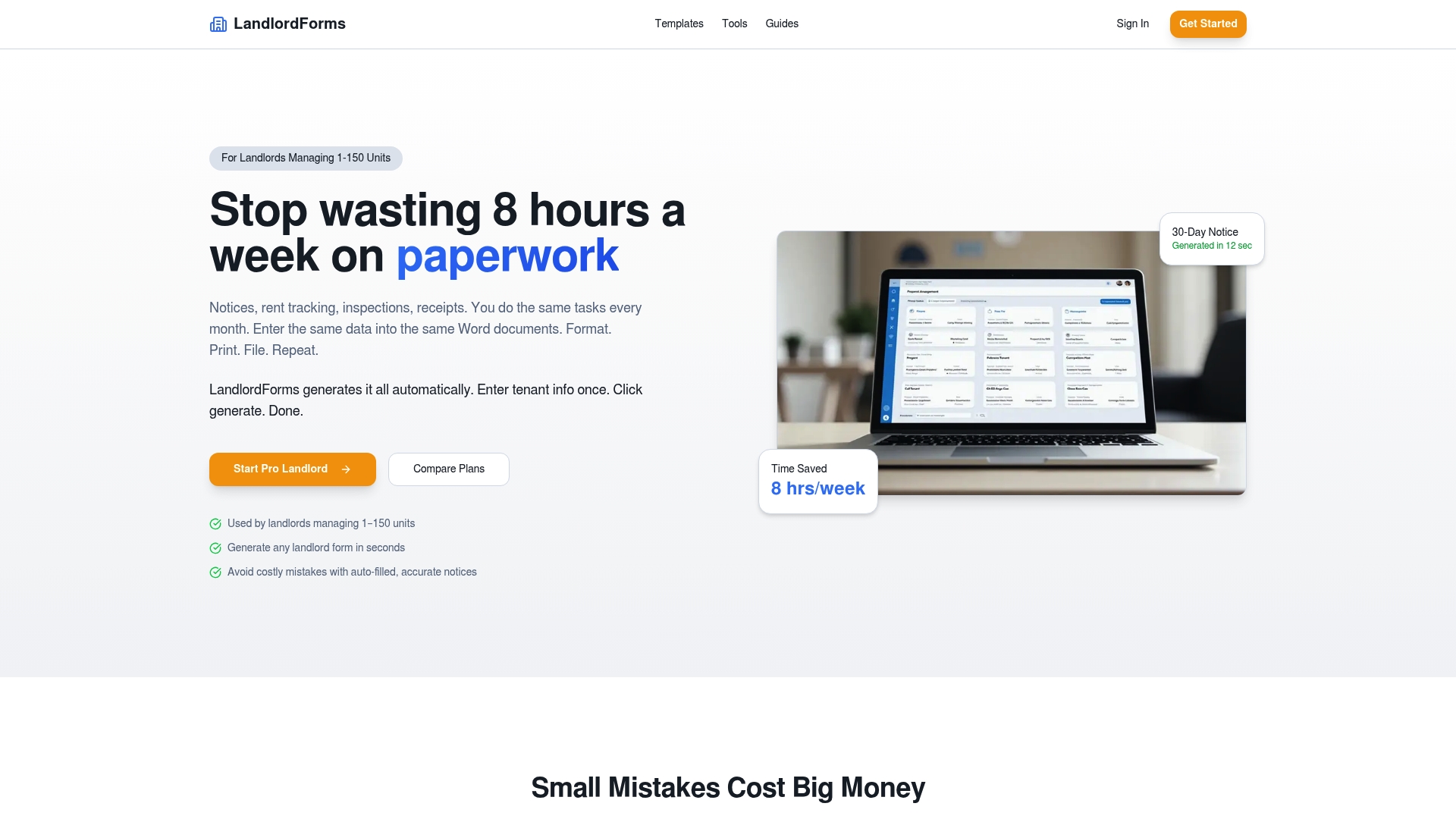
Beyond the lease itself, the same document management setup handles the paperwork that follows: security deposit notices timed to the § 83.49 deadline, a rent ledger to track payments, and photo documentation for move-in and move-out inspections. That’s the part most templates leave you to build yourself in a spreadsheet.
If you’re managing even a single unit and tired of re-verifying statutory language every time a tenant turns over, start with the free lease template download or open the generator directly at Landlordforms and have a signed-ready lease in the same session.
This article is general information, not a substitute for advice from a qualified lawyer. Consult a qualified legal professional about your own circumstances before acting on anything here.
Sources
- Landlord/Tenant Law in Florida – Florida Department of Agriculture & Consumer Services
- Florida Statutes – Chapter 83 (2019)
- Fla. Stat. § 83.49 (2019) – Security deposits
- Fla. Stat. § 83.56 (2024) – Termination by landlord
- 42 U.S.C. § 4852d – Lead-based paint disclosure
FAQ
Can I write my own lease agreement in Florida?
Yes, but a self-drafted lease still has to include every disclosure required under Chapter 83, including radon and, for older properties, lead-based paint. Missing one of those makes the clause unenforceable even if both parties signed it.
Where can I find a free blank Florida lease agreement template?
Free templates are available through association sites, fillable PDF services, and generators like Landlordforms, which builds the required Florida disclosures directly into the document instead of leaving you to add them.
Does Florida have a standard lease agreement?
There’s no single mandatory state form, but the Florida Association of Realtors publishes a widely used standard residential lease, and Chapter 83 sets the legal requirements every lease, regardless of source, must meet.
Where can I get a lease agreement form for free?
Start with official association templates or a free download from a generator built for Florida compliance; verify the radon and deposit-notice language is present before you use it, since not every free template checks that box.
What happens if I use a lease that doesn’t have Florida’s required disclosures?
A missing disclosure, like radon or the flood risk notice for one-year-plus leases, can make that clause unenforceable and increase your exposure in a dispute, even if the rest of the lease is otherwise solid.