The Role of Landlord Disclosure Forms Explained

TL;DR:
- Landlord disclosure forms provide legally required property information to tenants before lease signing and serve as a legal record. Missing disclosures can void leases, result in penalties, or lead to triple damages, especially for federal lead paint violations. Proper timing, written acknowledgment, and jurisdiction-specific compliance are essential for legal protection and effective tenant relations.
Landlord disclosure forms are official documents that landlords must provide to prospective tenants before a lease is signed, formally communicating known property conditions, hazards, and ownership details. The role of landlord disclosure forms goes far beyond paperwork. These documents create a legally recognized record that protects landlords from fraud and negligence claims while giving tenants the information they need to make an informed decision. Federal law, administered through agencies like the EPA, mandates lead-based paint disclosure for properties built before 1978. State laws, many modeled on the Uniform Residential Landlord and Tenant Act (URLTA), layer additional requirements on top. Missing even one required disclosure can void a lease, trigger statutory penalties, or expose you to triple damages.
What are legally required landlord disclosures?
Disclosure requirements in the United States operate at three levels: federal, state, and local. Understanding each level is the starting point for any compliant rental operation.
Federal requirements
Federal law mandates only one universal disclosure: lead-based paint. Any residential property built before 1978 requires a written warning statement, an EPA-approved pamphlet, and a signed acknowledgment from the tenant. The civil penalties for violating this rule reach $37,500 per violation, and tenants can sue for triple damages. That combination makes the lead paint rule one of the most financially dangerous compliance gaps a landlord can have.
State-level requirements
Approximately 21 U.S. states have adopted all or part of the URLTA, which requires landlords to disclose the identity and contact information of both the property owner and any authorized managing agent. That represents roughly half of all states, meaning the odds are good that your jurisdiction has this requirement. Seven states have no state-level disclosure requirements beyond the federal lead paint rule, but landlords there must still comply with federal mandates and any applicable local ordinances.
State-specific property disclosure requirements vary widely. Common examples include:
- Security deposit details: The name of the financial institution holding the deposit and any applicable interest rate
- Mold and asbestos: Written notice of known or suspected presence in the unit
- Flooding history: Prior flood damage or location within a flood zone
- Methamphetamine or fentanyl contamination: Required in several states after prior drug activity
- Death in the unit: Some states require disclosure of deaths within a defined recent time frame
- Foreclosure status: Notice if the property is subject to active foreclosure proceedings
- Move-in inspection checklist: A written record of the unit’s condition at the start of tenancy
The variability across jurisdictions is significant. A disclosure required in California may not be required in Texas, and a city ordinance may add requirements that state law does not. Checking your specific jurisdiction annually is not optional. It is a core part of managing rental property responsibly.
How do disclosure forms reduce landlord liability?
Disclosure forms function as a legal shield. A transparent documented record prevents tenants from later claiming they were misled about a property condition. Without that record, a landlord’s word against a tenant’s is a losing position in most courts.
Timing is the factor landlords most often get wrong. Disclosures are legally insufficient if provided after the lease is signed. The federal lead paint rule requires delivery before the tenant is legally bound to the agreement. The same timing standard applies to most state-level requirements. A disclosure handed over at move-in, after signatures are already on the lease, does not satisfy the law.
“Disclosure forms function as timing mechanisms to protect tenants by ensuring information arrives during the decision phase, not afterwards. A landlord who delivers disclosures after signing has not disclosed anything in the legal sense.”
Property managers and agents carry equal responsibility here. Third-party managers cannot sidestep disclosure obligations by pointing to the property owner. Jurisdictions treat agents as independently responsible for ensuring tenants receive all mandated information. If you manage properties on behalf of an owner, you are on the hook regardless of what the owner did or did not do.
Failure to disclose can result in consequences that go well beyond a fine. Courts have voided leases, stripped landlords of the right to make security deposit deductions, and awarded tenants statutory damages. In lead paint cases, triple damages are available by statute. The financial exposure from a single missed disclosure can far exceed the cost of getting it right.

Pro Tip: Keep a signed copy of every disclosure form in the tenant’s file. If a dispute goes to court, your signed acknowledgment is the difference between a defensible position and an expensive settlement.
Common categories of disclosures landlords must provide
Disclosure requirements fall into four broad categories. Each category carries its own rules, and most landlords need to address all four.
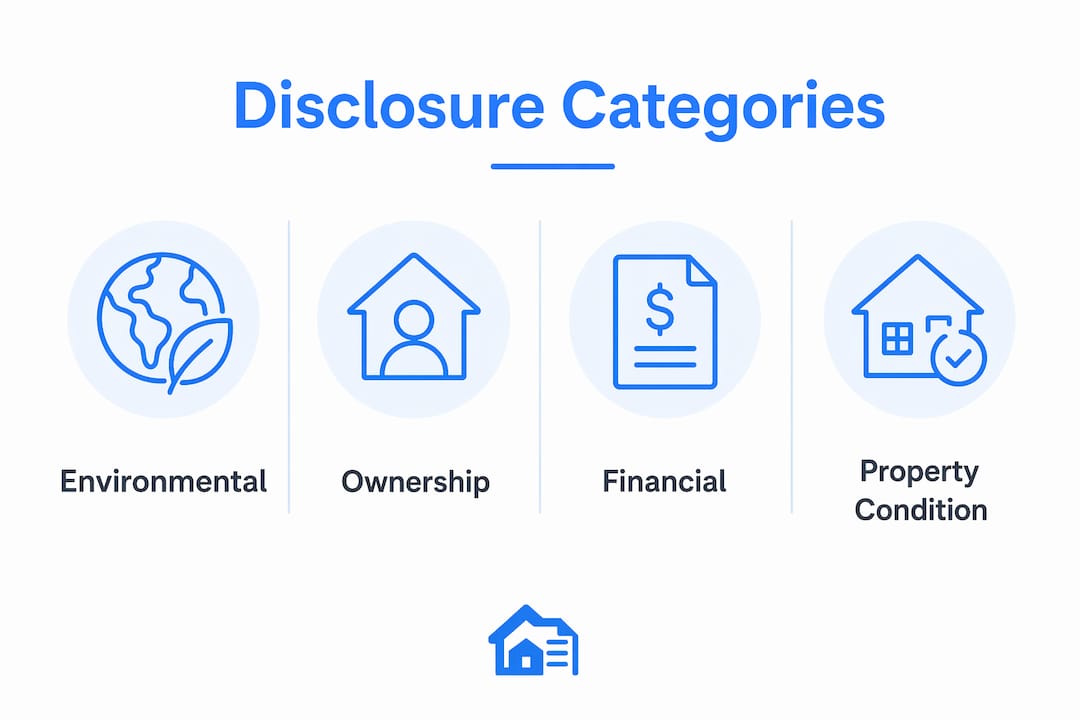
Environmental hazards
Environmental disclosures cover the conditions most likely to affect tenant health. Lead-based paint is the only federally mandated item, but state laws frequently add mold, asbestos, radon, and contamination from prior drug manufacturing. The disclosure requirements for these hazards vary by state in both scope and format. Some states require a specific form. Others accept a written statement in the lease addendum.
| Category | Common Disclosure Items | Consequence of Omission |
|---|---|---|
| Environmental hazards | Lead paint, mold, asbestos, radon, drug contamination | Fines up to $37,500, triple damages |
| Ownership and management | Legal owner name, managing agent contact info | Lease voidability, loss of enforcement rights |
| Financial terms | Security deposit institution, interest rate, conditions | Loss of deduction rights, statutory penalties |
| Property history | Flooding, death in unit, foreclosure, inspection checklist | Lease termination rights for tenant, damages |
Ownership and management identity
About 21 states require landlords to provide the full legal name and contact information of both the property owner and any authorized agent. This requirement exists so tenants know exactly who to contact for repairs, notices, and legal matters. When ownership changes mid-tenancy, the disclosure obligation resets. The new owner must provide updated contact information promptly.
Financial disclosures
Roughly 20 states regulate how landlords must disclose security deposit details. Required information typically includes the name of the financial institution holding the deposit, the account type, and any interest the deposit earns. Failing to provide this information can strip you of the right to make deductions at move-out, even for legitimate damage claims. That is a costly outcome for an omission that takes one sentence to fix.
Property condition and history
Move-in inspection checklists, flooding history, and prior deaths in the unit fall into this category. These disclosures give tenants a factual baseline for the property’s condition. They also protect landlords. A signed move-in inspection record documents the unit’s state before the tenant took possession, which is the foundation of any legitimate security deposit deduction later.
Best practices for staying compliant with disclosure requirements
Compliance does not happen by accident. Landlords who stay out of legal trouble treat disclosure management as a repeatable process, not a one-time task.
-
Build a jurisdiction-specific checklist. List every disclosure required by federal law, your state, and your city or county. Review it every january to catch any new requirements that took effect in the prior year.
-
Use written forms with signed acknowledgments. A verbal disclosure is legally insufficient. Courts require written documentation with a signed acknowledgment from the tenant. Verbal conversations leave no record and provide no protection.
-
Deliver disclosures before lease signing. Timing is a legal requirement, not a courtesy. Attach disclosures to the lease as addendums or deliver them as separate signed documents before the tenant signs anything.
-
Keep copies in the tenant’s file. Store signed disclosure forms alongside the lease, move-in checklist, and any correspondence. If a dispute arises, your documentation is your defense.
-
Update disclosures when ownership or management changes. A change in property manager or ownership triggers a new disclosure obligation in most URLTA states. Do not assume the prior manager’s paperwork covers you.
Pro Tip: When you take over management of a property, request copies of all prior disclosures from the previous manager. Gaps in that record become your liability the moment you sign the management agreement.
Tracking tenant rights notice compliance alongside your disclosure checklist keeps both obligations in one workflow. Many landlords separate these tasks and miss the overlap between them.
Disclosure compliance is more complex than most landlords realize
Landlord disclosure law has grown more layered over the past decade. Federal requirements set the floor, but state and local rules now stack on top in ways that create real compliance traps for landlords managing properties across multiple jurisdictions.
The most common mistake I see is landlords treating disclosure as a one-time event tied to the lease signing. Disclosure obligations can resurface mid-tenancy when ownership changes, when a new hazard is discovered, or when a local ordinance takes effect. Treating it as a static checklist is how landlords end up exposed.
A second misconception is that verbal conversations count. They do not. Courts consistently reject verbal disclosures as legally insufficient. The written and signed standard is not a technicality. It is the entire point. A disclosure that cannot be produced in court never happened.
The landlords I have seen handle this best are the ones who integrate disclosure management into their standard leasing workflow. They do not treat it as a legal burden. They treat it as a communication tool. Tenants who receive clear, complete disclosures before signing are far less likely to dispute conditions later. Transparent disclosure practices reduce costly tenant-lawyer disputes and build the kind of trust that leads to longer tenancies and fewer problems overall.
The regulatory trend is toward more disclosure, not less. New categories like fentanyl contamination and climate-related flood risk are appearing in state legislatures every session. Landlords who build annual compliance reviews into their operations now will be far better positioned as those requirements expand.
— Igor
Landlordforms makes disclosure management straightforward
Managing disclosure forms across multiple units and jurisdictions is one of the most time-consuming parts of running a rental property. Landlordforms is built specifically for landlords managing 1 to 150 units, and it addresses this problem directly.

Landlordforms provides customizable document templates for disclosure forms, lease addendums, and other required landlord documents. Every template is designed to reduce manual entry errors and ensure the right information reaches tenants before lease signing. Digital signing features create a signed acknowledgment record automatically, giving you the documented proof that courts require. If you want to see the full range of tools available, the Landlordforms property management platform brings disclosures, leases, and tenant records into one place.
Key takeaways
Landlord disclosure forms are a legal requirement in every U.S. jurisdiction, and missing even one required disclosure can void a lease, trigger statutory penalties, or expose landlords to triple damages.
| Point | Details |
|---|---|
| Federal baseline | Lead-based paint disclosure is required for all pre-1978 properties, with penalties up to $37,500 per violation. |
| State requirements vary | About 21 states follow URLTA rules requiring owner and agent identity disclosures; check your jurisdiction annually. |
| Timing is mandatory | Disclosures must be delivered before lease signing. Post-signing delivery does not satisfy federal or state law. |
| Written and signed only | Verbal disclosures have no legal standing. Courts require written forms with signed tenant acknowledgment. |
| Agents share responsibility | Property managers cannot defer disclosure obligations to the property owner. Both parties are independently liable. |
FAQ
What is a legally required landlord disclosure?
A legally required landlord disclosure is a written document that landlords must provide to tenants before lease signing, covering material facts about the property such as lead paint, hazards, ownership identity, and security deposit details. Federal law requires lead-based paint disclosure for pre-1978 properties; state and local laws add further requirements.
What happens if a landlord fails to provide required disclosures?
Failure to disclose can result in voided leases, loss of security deposit deduction rights, statutory fines, and in lead paint cases, triple damages awarded to the tenant. Courts treat missing disclosures as a serious legal deficiency, not a minor oversight.
Do property managers have to provide disclosure forms?
Yes. Third-party property managers are independently responsible for ensuring tenants receive all required disclosures. Pointing to the property owner does not remove that obligation under most state laws.
Are verbal disclosures legally valid?
No. A verbal disclosure does not satisfy federal or state requirements. Disclosures must be in writing, attached to or included with the lease, and signed by the tenant to be legally enforceable.
What should landlords disclose about security deposits?
About 20 states require landlords to disclose the name of the financial institution holding the security deposit, the account type, and any applicable interest rate. Omitting this information can strip the landlord of the right to make deductions at move-out.