2 to 30 Days: U.S. Landlords Must Know About Rent Grace Period Laws

No, there’s no federal rent grace period. Most states leave the question entirely to your lease, though roughly a dozen states set a mandatory window between 2 and 30 days, and federal public housing carries its own 14-day written notice rule. Your immediate move: pull up your state’s landlord tenant laws and reread your lease’s late-payment clause side by side, because whichever one is stricter usually wins.
TL;DR:
- Most states do not mandate a rent grace period, leaving it entirely up to the lease agreement unless specific statutes set minimum windows.
- States like Massachusetts require a 30-day grace period, while others like Texas only mandate two days or less, and local ordinances may impose additional rules.
- Lease clauses must specify exact due dates, the number of grace days, and rules for weekends or holidays to be enforceable and avoid disputes.
- Late fees can only be charged after the grace period ends and should be proportionate, reasonable, and properly documented based on actual administrative costs.
- Public housing has a federal 14-day notice rule for evictions, which is separate from general rent grace periods, and emergency declarations can suspend or extend these rules.
Table of Contents
- Rent Grace Period Laws by State: Who Actually Requires One
- Does Your Lease Set the Grace Period? Reading the Fine Print
- Calendar Days or Business Days? Getting the Math Right
- Late Fees: When You Can Charge Them and How Much
- Grace Periods, Eviction Notices, and the Federal Public Housing Rule
- Does a Late Payment Show Up on a Tenant’s Credit Report?
- Residential vs. Commercial Leases: A Different Rulebook
- What Grace Periods Don’t Take Away From Landlords
- Grace Periods During Declared Emergencies and Natural Disasters
- How Tenants Should Notify You About a Late Payment
- Balancing Firm Collections With Reasonable Flexibility
- Automate Your Rent Tracking and Notice Compliance
- Sources
- FAQ
Rent Grace Period Laws by State: Who Actually Requires One
Most states never mention a rent grace period in their landlord tenant laws at all. They treat it as a private contract matter between you and the tenant, which means the lease controls unless local ordinance says otherwise. But a meaningful minority of states carve out a statutory floor, and if you own property in one of them, your lease can’t undercut it.
Here’s how the mandates break down by example:
- Massachusetts requires a 30-day grace period, the longest mandatory window in the country.
- Maine sets 15 days before a landlord can charge a late fee.
- Connecticut gives tenants 9 days.
- Texas requires just 2 days.
- Nevada sets a 3-day minimum.
- Several other states cluster around 5 days, though the exact figure and what it applies to (late fees versus eviction notices) varies by statute.
New Jersey adds a wrinkle worth flagging separately: its 5-day grace period runs in business days, not calendar days, which stretches the real-world deadline further than the number suggests.
Local ordinances complicate the picture further. California has no statewide grace period requirement, but West Hollywood mandates a 5-day grace period on its own, layered on top of whatever the state doesn’t require. If you manage units in a city with rent stabilization rules or a strong tenant protection ordinance, check the municipal code separately from state statute. Assuming state law is the final word is a common and expensive mistake.
Does Your Lease Set the Grace Period? Reading the Fine Print
In every state that doesn’t mandate a grace period, your lease is the only document that creates one. If the lease is silent and state law says nothing, rent is technically late the day after the due date, full stop. That surprises a lot of landlords who assume a “reasonable” unwritten grace period exists by custom. It doesn’t, legally speaking, even though many landlords voluntarily build in 3 to 5 days as standard practice to reduce disputes.
A grace-period clause that will hold up needs a few specific elements:
- The exact due date, stated as a calendar date or day of the month, not “on time.”
- The number of grace days and whether they’re calendar or business days.
- The late-fee formula, triggered only once the grace period expires.
- A rule for what happens when the due date or deadline lands on a weekend or holiday.
- A reference to the governing state statute, especially if your state sets a floor you can’t go below.
Pro Tip: If your state mandates a 9-day grace period like Connecticut, don’t write “5 days” into your lease to save on late fees. Courts and housing authorities will enforce the statutory minimum regardless of what the lease says, and the shorter clause just makes you look noncompliant.
Calendar Days or Business Days? Getting the Math Right
Whether your state counts calendar days or business days changes your actual deadline more than most landlords expect. A statute that reads “5 days” without specifying which kind leaves real room for error.
- New Jersey example: Rent is due Friday the 1st. A 5-business-day grace period skips Saturday and Sunday, pushing the true deadline to the following Friday, not the following Wednesday you’d get by counting calendar days.
- Calendar-day example: Rent is due on the 1st with a 5-calendar-day grace period. The deadline lands on the 6th regardless of what day of the week that falls on, weekend included.
- Ambiguous lease language: If your lease just says “5 days” with no clarification, write in a fallback rule: “if the deadline falls on a weekend or federal holiday, it rolls to the next business day.” That one sentence prevents most late-fee disputes before they start.
Late Fees: When You Can Charge Them and How Much
Late fees can only kick in once the grace period, whether statutory or lease-based, has fully expired. Charge one a day early and you risk the fee being unenforceable if a tenant disputes it in small claims court or with a local housing authority.
Fee structures generally fall into three types:
- Flat fees, a fixed dollar amount regardless of rent size.
- Percentage fees, calculated as a share of monthly rent, commonly landing around 5% to 10%.
- Daily accrual fees, a smaller charge that compounds for each day rent remains unpaid.
Most states don’t cap late fees numerically, they just require the amount to be “reasonable” relative to the actual cost of processing late rent. Where caps do exist, percentage-based limits average around 8%, though some states allow as much as 20% and others hold firm to flat-dollar limits. Document how you arrived at your fee, tie it to a real administrative cost like extra bookkeeping time or NSF bank charges, and keep it proportionate. A $50 late fee on a $2,000 lease reads very differently in court than the same $50 on a $500 studio.
Grace Periods, Eviction Notices, and the Federal Public Housing Rule
Grace periods and eviction timelines aren’t the same clock, and conflating them is one of the more common landlord mistakes. State law governs eviction procedure separately from late-fee timing, and in some jurisdictions a landlord can serve a pay-or-quit notice before the fee grace period even lapses, as long as rent itself is past due.
Public housing runs on its own federal track. Housing authorities must give tenants a statutory 14-day written notice before filing an eviction for nonpayment, under 42 U.S. Code 1437d and 24 CFR 966.4. HUD revoked a prior interim rule that had extended this to 30 days, returning the baseline minimum to 14 days in 2026.
A typical timeline looks like this:
- Day 1: Rent due, unpaid.
- Days 2 to 5 (varies by state): Grace period runs, late fee not yet chargeable.
- After grace period expires: Late fee applies; landlord may serve required notice under state law.
- 14+ days later (if unresolved): Eviction filing becomes possible, pending state procedure.
Eviction is a court process that can take weeks to resolve even after filing, and most landlords would rather collect rent than start it. One late payment rarely triggers eviction on its own; it’s the pattern that matters.
Does a Late Payment Show Up on a Tenant’s Credit Report?
A single late rent payment caught within a grace period generally leaves no mark on a tenant’s credit at all. Traditional credit bureaus don’t track rent payments by default, so unless you actively report to a rent-reporting service, going a few days past due inside a grace window has zero credit consequence.
That changes once rent goes to collections or shows up in an eviction filing. Collections accounts get reported to major bureaus and can sit on a credit file for years, doing real damage to a tenant’s ability to rent again. An eviction judgment shows up in tenant screening reports that most property managers pull before approving an application, even if it never touches a traditional credit score.
This creates a practical incentive on both sides. Tenants who know their landlord reports on-time payments have more reason to pay before the grace period closes, and landlords who use rent-reporting tools give responsible tenants a way to build credit history from routine payments. If you’re not currently reporting payment behavior, a consistent, dated rent ledger still matters. It’s the record you’ll need if a payment dispute ever escalates to a landlord-tenant board or small claims court, and it’s the same record a debt collector or future landlord may eventually ask to see.
Residential vs. Commercial Leases: A Different Rulebook
Statutory grace periods almost universally apply to residential leases only. Commercial leases operate under a completely different legal framework, one built on the assumption that both parties are sophisticated businesses capable of negotiating their own terms without statutory protection.
That means the Massachusetts 30-day rule, the Connecticut 9-day rule, and every other state mandate discussed in this article apply to residential tenancies. A commercial landlord and tenant are generally free to negotiate any grace period they want, including none at all, and courts tend to enforce whatever the lease says without imposing consumer-style protections.
In practice, commercial leases often build in shorter grace periods than residential ones, sometimes just a few days, because commercial tenants are expected to manage cash flow more predictably than individual renters. Commercial leases also more frequently include compounding late fees or default interest rates that would look aggressive in a residential context but are standard in commercial real estate.
If you manage a mixed portfolio, don’t assume your residential grace-period habits transfer to a commercial unit, and don’t assume state residential landlord tenant laws offer any guidance at all for a commercial dispute. Commercial leases are contracts first, and statutory tenant protections mostly don’t reach them.
What Grace Periods Don’t Take Away From Landlords
A grace period delays when a late fee kicks in. It does not suspend your other legal rights as a landlord, and it’s worth being clear with yourself about that distinction so you don’t over-tolerate nonpayment out of a mistaken sense of obligation.
During the grace period, rent is still technically due on the original date even if you can’t charge a fee yet or send an eviction notice. You can still send a friendly reminder, log the missed payment in your rent ledger, and start the documentation trail you’d need if the pattern continues. Nothing about a grace period prevents you from communicating with a tenant about a missed deadline.
Once the grace period closes, your remedies expand to whatever your state and lease allow: late fees, formal notice, and eventually eviction proceedings if nonpayment continues. Some landlords also have recourse to security deposit deductions or, in states that allow it, small claims action for unpaid rent that doesn’t rise to an eviction case. None of that requires waiting for a second or third missed payment. A grace period is a courtesy window on fee timing, not a waiver of your right to enforce the lease.
Grace Periods During Declared Emergencies and Natural Disasters
State and local governments can suspend or extend rent grace periods during declared emergencies, and this has happened repeatedly during hurricanes, wildfires, and public health emergencies over the past several years. These orders override your standard lease terms for the duration they’re in effect, regardless of what your grace-period clause says.
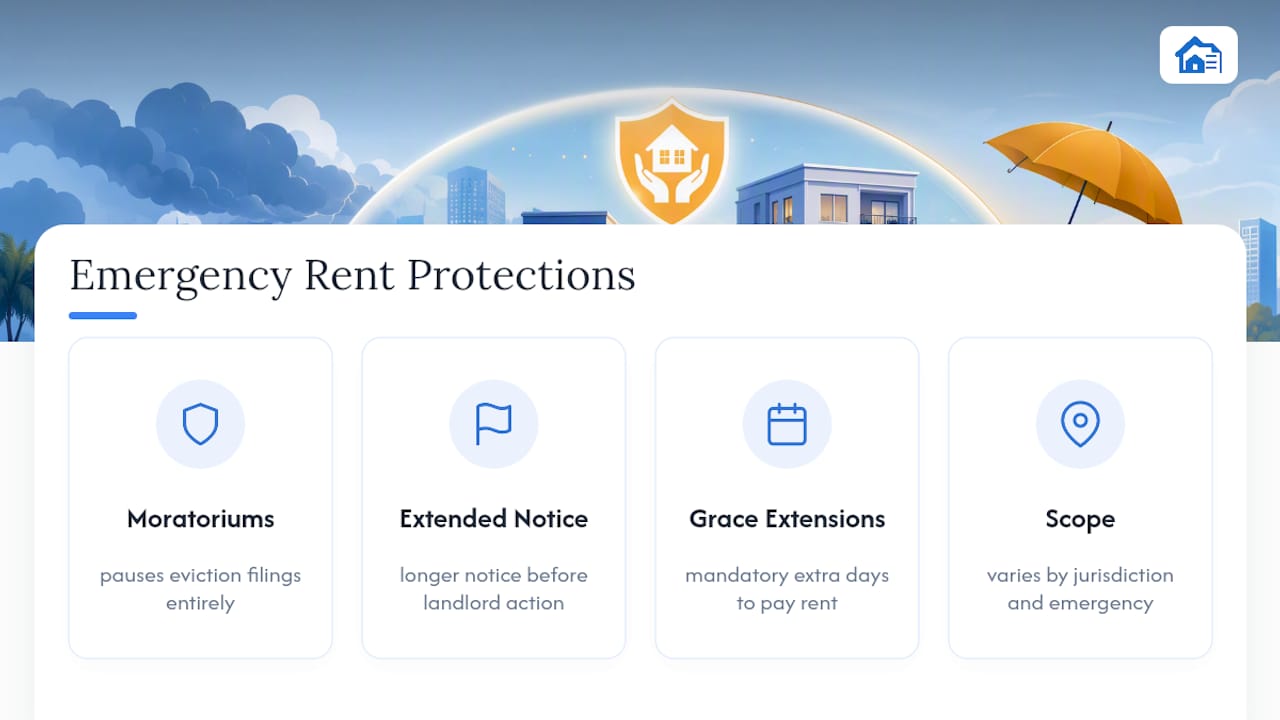
Emergency rent protections typically take one of a few forms: eviction moratoriums that pause filings entirely, extended notice periods before a landlord can act on nonpayment, or in some cases mandatory grace-period extensions tied to a declared disaster zone. The scope and length of these orders vary enormously by jurisdiction and by the specific emergency, and they’re usually announced through a governor’s executive order or a local housing authority rather than through the standard statutes discussed elsewhere in this article.
The practical challenge is that these rules can change quickly and apply only to specific counties or disaster-declared zones, not entire states. If you manage property in a region under an active emergency declaration, check your state housing agency’s website and local government emergency management office directly rather than relying on your usual grace-period reference. Continuing to enforce a normal fee schedule during an active moratorium can expose you to legal liability, even if your lease and state statute would otherwise permit it.
How Tenants Should Notify You About a Late Payment
A grace period works best when it runs in both directions, and tenants who communicate early tend to create far less friction than ones who go silent. Most leases don’t legally require a tenant to notify you before rent is late, but responsible tenants who plan to pay within the grace window typically reach out anyway, and encouraging that habit benefits you as much as them.
A reasonable notification process looks like this: the tenant contacts you in writing, whether by email, text, or your property management portal, stating the expected payment date and the reason for the delay. That written record matters more than a phone call, because it gives you something dated to reference if the situation repeats or escalates. If your lease includes a formal notice clause specifying how tenants must communicate with you, point new tenants to it at move-in so there’s no confusion later.
Encourage tenants to notify you before the due date passes, not after the grace period has already expired. A tenant who calls on day one of a five-day grace period to say a payment will land on day three is giving you useful information. A tenant who goes silent through the entire grace period and only responds once a late fee posts is giving you a much harder problem to manage. Building a simple, low-friction way for tenants to flag a late payment, even just a dedicated email address or portal message, tends to reduce disputes over fees and timing later.
Balancing Firm Collections With Reasonable Flexibility
The landlords who handle late rent best aren’t the strictest or the most lenient, they’re the most consistent. Enforcing the same grace period and fee schedule for every tenant, every time, protects you legally far more than occasional leniency ever will. Documentation beats discretion. A dated rent ledger and a saved notice template do more for your position in a dispute than good intentions ever could.
— Igor
Automate Your Rent Tracking and Notice Compliance
Chasing down which grace period applies, calculating a late fee by hand, and drafting a compliant notice from scratch eats hours you don’t have, especially if you manage units across more than one state. Some software tools turn that manual process into a few clicks: tracking rent payments in real time, generating dated rent receipts automatically, and producing state-aware late notices to simplify compliance.

The Rent Ledger Template gives you a free, ready-to-use way to log every payment with a timestamp, which is exactly the documentation you’d need if a late-fee dispute ever reached a housing authority or small claims court. Pair it with Landlordforms’ late notice generator and photo-documented inspection records, and you’ve got a paper trail that holds up without the manual spreadsheet work. Download the Rent Ledger Template today and start logging payments before your next due date hits.
Sources
State and local rent rules shift often enough that a single article can’t be your last stop. Bookmark these before your next lease renewal:
- Do Landlords Have to Give a Grace Period for Rent? - LegalClarity
- Late Rent Laws & Grace Periods by State (2026) - iPropertyManagement
FAQ
Is there a federal rent grace period?
No. Federal law sets no grace period for private rentals; only public housing carries a federal requirement, a 14-day written notice before eviction filing for nonpayment.
Which states require the longest rent grace periods?
Massachusetts requires 30 days, the longest mandatory window, followed by Maine at 15 days and Connecticut at 9 days.
Can a landlord charge a late fee before the grace period ends?
No, charging a late fee before the statutory or lease-based grace period expires makes the fee vulnerable to challenge in court or before a housing authority.
Do grace period rules differ for business days versus calendar days?
Yes. States like New Jersey count 5 business days, excluding weekends and holidays, which extends the real deadline further than a calendar-day count would.
Does a rent grace period apply to commercial leases?
Generally no. Statutory grace periods target residential leases; commercial lease terms, including any grace period, are set entirely by contract negotiation between the parties.