Rent Verification Letter: Free Templates for Landlords and Tenants

TL;DR:
- A rent verification letter confirms a tenant’s residence, lease details, and payment history through a signed statement. Landlords should ensure it contains required fields, factual data, and is delivered as a signed PDF for legal defensibility. Standardized templates and document management tools streamline the process and create a consistent, audit-ready paper trail.
A rent verification letter is a short, signed statement from a landlord or authorized property manager confirming that a tenant lives at a specific address, the lease dates, the monthly rent amount, and whether payments have been made on time. Lenders, employers, schools, and government agencies all ask for one at some point. Here is a copy-paste-ready version you can edit right now:
[Date] To Whom It May Concern:
This letter confirms that [Tenant Full Name] has resided at [Full Property Address, Unit #] since [Lease Start Date], with a current lease through [Lease End Date or “month-to-month”]. Monthly rent is $[Amount]. As of the date of this letter, rent payments have been [made on time / occasionally late / current with no outstanding balance]. Please contact me at [Phone/Email] with any questions.

[Landlord/Property Manager Name, Signature, Date]

Jump to the full editable templates in the sample templates section below.
Minimum required fields:
- Tenant full legal name
- Rental property address and unit number
- Lease start and end date (or “month-to-month / present”)
- Monthly rent amount
- Payment status statement
- Current outstanding balance (if any)
- Landlord name, contact information, and signature
Table of Contents
- What is a rent verification letter used for?
- Exactly what should a verification letter include?
- How landlords should write a defensible verification letter
- How tenants can request a rent verification
- Sample templates you can use right now
- Legal cautions and U.S. best practices
- How to send a verification letter and how recipients verify it
- Key Takeaways
- Why standardized letters matter more than most landlords realize
- Landlordforms makes verification letters faster and audit-ready
- Useful sources
- FAQ
What is a rent verification letter used for?
A rental verification document is a formal written confirmation from a landlord or property manager that validates a tenant’s residency, lease terms, and payment behavior. It is not a lease agreement and not a credit report. It is simply a signed statement of facts about the tenancy.
The most common situations that trigger a request:
- Mortgage underwriting: Lenders use a proof of rent letter to document housing payment history for borrowers who rent rather than own. For FHA and Fannie Mae loans, underwriters may request a standardized Verification of Rent (VOR) form rather than a freeform letter.
- Employment and benefit applications: — Some employers verify housing stability; federal and state benefit programs may require a leasing verification letter as part of eligibility documentation.
Who typically requests the document varies. A lender wants payment history and dollar amounts. A school district only needs the address and occupancy dates. Knowing the recipient’s purpose before you write saves a round of revisions.
Exactly what should a verification letter include?
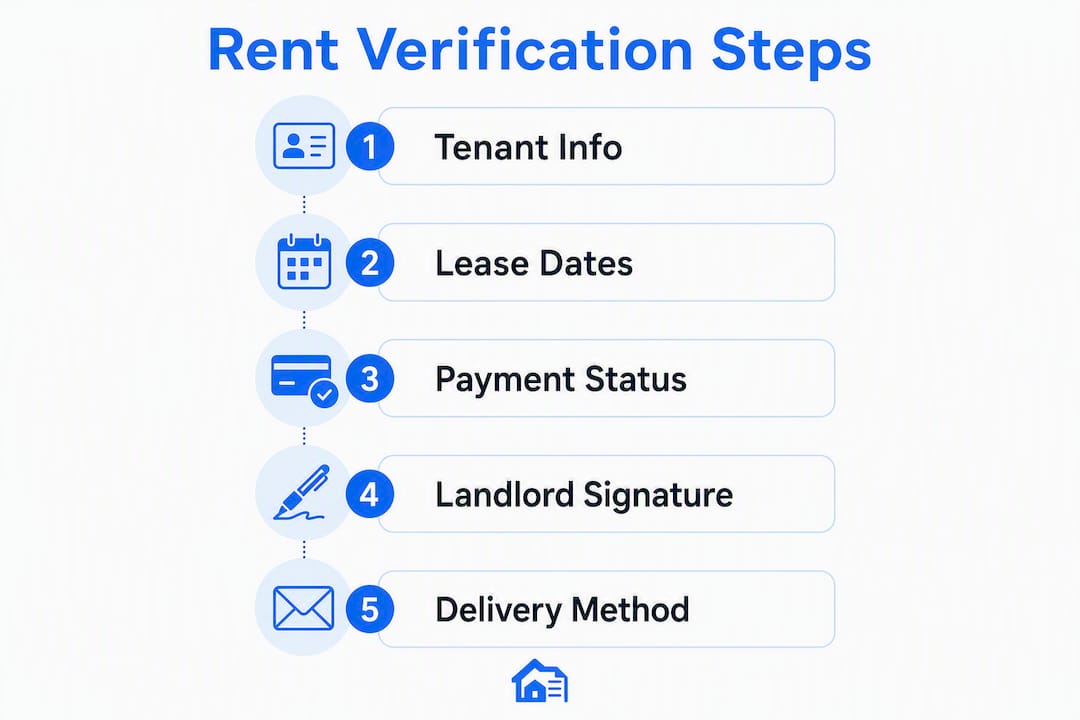
Mandatory fields for an effective verification letter are well established. Before sending, confirm every item below is present and accurate:
Mandatory fields:
- Tenant’s full legal name (as it appears on the lease)
- Full rental property address, including unit number
- Lease start date and end date (or “present” for active leases)
- Monthly rent amount in dollars
- Explicit payment history statement (“paid on time,” “X late payments recorded,” or “currently owes $X as of [date]”)
- Current outstanding balance, if any
- Landlord or property manager full name and contact information
- Landlord signature and date
Optional but useful additions:
- Payment method (check, ACH, payment platform)
- Security deposit amount and current disposition
- Number of late payments with specific dates
- Whether the landlord would rent to this tenant again
- Notarization (required in some immigration and agency cases, but generally not required for FHA or Fannie Mae)
- Attached rent ledger or payment receipts
Warning: Legal experts advise cross-referencing any statements about late payments against lease records and rent ledgers before signing. Overstating or misrepresenting payment history can create defamation liability. Stick to what the records show.
Pro Tip: Attach a copy of your rent ledger to every verification letter you send. It backs up every claim in the letter and gives recipients a line-by-line payment history without requiring a follow-up call.
How landlords should write a defensible verification letter
State facts only. That is the single most important rule. A landlord who writes “this tenant was a nightmare” has created a legal problem. A landlord who writes “three late payments were recorded on [dates]” has stated a fact.
Step-by-step workflow:
- Pull the rent ledger. Confirm every payment date and amount against your records before writing a single word. Errors here are where liability starts.
- Confirm lease dates. Check the original lease and any renewal addenda for exact start and end dates.
- Choose or open your template. Use a standardized form rather than writing from scratch each time. Standardized written forms beat oral confirmations for consistency and dispute prevention.
- Collect a signed tenant authorization. Before disclosing payment history to a third party, attach a signed tenant release authorizing the disclosure. An email from the tenant explicitly requesting the letter counts; a signed form is better.
- Fill in the mandatory fields. Use the checklist above. Do not add opinions, character judgments, or unverifiable statements.
- Sign, date, and deliver. Use your business letterhead if you have it. Sign in ink or with a verified digital signature.
Payment history sentence templates (copy and adapt):
- “As of [date], [Tenant Name] has made all rent payments on time with no late payments recorded during the tenancy.”
- “During the tenancy, [X] late payments were recorded on [list dates]. All balances were subsequently paid in full.”
- “As of [date], [Tenant Name] has an outstanding balance of $[Amount] for the [month] payment.”
Before sending, run a final check: ledger verified, lease dates confirmed, no opinions or predictions included, tenant authorization attached, contact info current.
How tenants can request a rent verification
Send your landlord a short written request. Email works fine and creates a paper trail. Here is a template you can copy:
Subject: Request for Rent Verification Letter
Hi [Landlord Name], I need a rent verification letter for [purpose, e.g., a mortgage application / new rental application]. Please confirm my tenancy at [address] from [start date] to [end date or present], monthly rent of $[amount], and payment history. I authorize you to share this information with [recipient name/organization]. Please let me know if you need anything from me. Thank you.
Timeline: A reasonable turnaround is 5–7 business days for a straightforward request. Send a polite follow-up after five business days if you have not heard back.
If the landlord is slow or unresponsive:
- Follow up by certified mail so you have a documented delivery record.
- Contact the property management company directly if the landlord uses one.
- Gather alternatives: 12 months of bank statements showing rent withdrawals, payment platform histories (Venmo, Zelle, PayPal), or money order receipts.
- For cash payments, receipts signed by the landlord or a written acknowledgment are your best documentation.
- If a lender is involved, ask them whether a standardized VOR form sent directly to the landlord would be easier to get completed.
Sample templates you can use right now
Three templates cover the most common requests. Copy, fill in the brackets, and save as a signed PDF.
Template 1: Standard landlord verification letter
[Date] [Landlord Name] [Landlord Address] [Phone | Email]
To Whom It May Concern:
This letter verifies that [Tenant Full Name] has resided at [Property Address, Unit #, City, State, ZIP] from [Lease Start Date] through [Lease End Date or “present”] under a written lease agreement. Monthly rent is $[Amount].
During this tenancy, rent payments have been [made on time with no late payments / made with [X] late payments on the following dates: [list dates]]. As of [Date], the outstanding balance is $[0 or Amount].
I can be reached at [Phone] or [Email] to verify this information.
[Landlord Signature] [Printed Name, Title] [Date]
Template 2: Occupancy verification (for utilities and school enrollment)
[Date]
To Whom It May Concern:
This letter confirms that [Tenant Full Name] and the following household members — [Names] — currently reside at [Full Address, Unit #]. The tenancy began on [Start Date] and is ongoing as of the date of this letter.
[Landlord Signature, Printed Name, Phone, Date]
Template 3: Rent payment history (for lenders)
[Date]
Re: 12-Month Rent Payment History for [Tenant Full Name] Property: [Address]
| Month | Amount Due | Amount Paid | Date Paid | Status |
|---|---|---|---|---|
| January | $[X] | $[X] | [Date] | On Time |
| February | $[X] | $[X] | [Date] | On Time |
| March | $[X] | $[X] | [Date] | Late |
Monthly rent: $[Amount]. Lease term: [Start] to [End].
[Landlord Signature, Printed Name, Contact, Date]
When to use each template:
- Template 1 for rental applications, mortgage underwriting, and employment verification
- Template 2 for utilities, school enrollment, and basic residency proof
- Template 3 when a lender specifically requests a 12-month payment history
Download formats: Save as a PDF before sending so the formatting stays intact and the document cannot be edited after signing. Word or Google Docs works for drafting; PDF is the delivery format. Keep the signed original in the tenant’s file. A free rent ledger template makes building Template 3 much faster.
Legal cautions and U.S. best practices
The legal risk in a verification letter is almost always on the landlord’s side. Overstating or misrepresenting facts about late payments or lease violations can create liability, including defamation claims. The fix is simple: write only what the records confirm.
Core rules:
- Cross-reference every payment claim against your rent ledger before signing.
- Never include opinions, predictions, or character assessments.
- Attach a signed tenant authorization before disclosing payment history to any third party.
- Keep the issued letter, the tenant’s authorization, and the supporting ledger in the tenant file. A retention period of at least three years is a reasonable baseline, though state rules vary.
State variation matters. Landlord-tenant law differs significantly across states, including rules about what landlords may and may not disclose, required response timelines, and privacy obligations. Templates need periodic review for state law changes, and professional document management tools simplify that process. When a tenancy involves contested payment history or an eviction, consult a local attorney before issuing any written statement.
Pro Tip: Maintain one standardized template and require a tenant-signed authorization for every request. This removes ad-hoc wording, keeps your disclosures consistent, and gives you a paper trail if a statement is ever challenged.
For deeper guidance on keeping payment records audit-ready, the documentation practices behind a defensible tenant file are worth reviewing before you issue your next letter.
How to send a verification letter and how recipients verify it
Delivery options:
- Email PDF with digital signature: Fast, traceable, and accepted by most lenders and employers. Use a verified digital signature tool so the recipient can confirm authenticity.
- Mailed on letterhead: Slower but carries more weight in formal or legal contexts. Include the landlord’s printed name and contact information prominently.
- Direct-to-lender submission: Some mortgage underwriters prefer the landlord to submit the VOR form directly to the lender, bypassing the tenant entirely. Ask the lender for their preferred process.
- Notarized copy: Required in some immigration and agency cases. Notarization is generally not required for FHA or Fannie Mae loans, but confirm with the requesting party.
When mailing a verification request to a previous landlord, including a stamped, self-addressed return envelope increases response rates. Some landlords request a small processing fee to complete and return the form.
| Delivery method | Typical turnaround | Best for |
|---|---|---|
| Email PDF | Same day | Lenders, employers, rental applications |
| Mailed on letterhead | 3–7 business days | Formal or legal contexts |
| Direct-to-lender VOR | 5–7 business days | Mortgage underwriting |
| Notarized copy | 1–3 business days after signing | Immigration, agency applications |
How recipients verify the letter: Most lenders and employers will call the landlord’s listed phone number to confirm the letter’s contents. Provide a direct number, not just an email. If a lender uses a standardized VOR form, they expect specific fields and may reject a freeform letter that omits them.
Key Takeaways
A valid rent verification letter requires eight mandatory fields, a signed tenant authorization, and delivery as a signed PDF to be accepted by most lenders and recipients.
| Point | Details |
|---|---|
| Mandatory fields | Include tenant name, address, lease dates, rent amount, payment status, balance, landlord name and contact information, and signature. |
| Tenant authorization | Attach a signed release before disclosing payment history to any third party. |
| Verify before you sign | Cross-reference every payment claim against your rent ledger to avoid liability. |
| Delivery format | Send as a signed PDF; keep the original in the tenant file with the ledger and authorization. |
| Landlordforms | Landlordforms automates prefilled verification templates, tracks rent payments, and exports signed PDFs for audit-ready tenant files. |
Why standardized letters matter more than most landlords realize
Most landlords treat verification letters as a one-off chore. Write something, sign it, move on. The problem with that approach shows up later, when a tenant disputes what you wrote, a lender rejects the letter for missing fields, or a previous tenant claims you misrepresented their payment history.
The real value of a standardized template is not speed, though it does save time. It is consistency. When every letter you issue follows the same structure, uses the same language, and draws from the same ledger, you have a defensible paper trail. The letter becomes a document, not just a favor.
Tenants benefit too. A landlord who has a ready template responds faster, which matters when a mortgage application or lease approval is on a deadline. The tenant screening workflow runs more smoothly when verification is a procedure rather than a scramble.
State-specific rules add another layer. What a landlord in California may disclose differs from what one in Texas is expected to provide. For contested histories or anything touching an eviction, a local attorney’s review is worth the cost before you put anything in writing.
Landlordforms makes verification letters faster and audit-ready
Eight hours a week is what manual paperwork costs the average small landlord. Landlordforms cuts that down by automating the forms that eat most of that time, including rent verification letters.
With Landlordforms, you get prefilled templates that pull from your existing tenant and lease data, so the mandatory fields populate automatically rather than by hand. The platform supports digital signatures, exports signed PDFs with timestamps, and stores every document in the tenant’s file alongside the rent ledger and authorization. No hunting through email threads for the version you sent six months ago.
For landlords managing 1–150 units, the practical difference is fewer errors and a complete audit trail when a lender or agency calls to verify. Start with the free rent ledger template to build the payment history that backs every letter you issue, then explore the full platform at Landlordforms.
Useful sources
These resources are worth bookmarking for state-specific rules and federal guidance:
- LegalClarity: Proof of Rent Letter Guide — Covers notarization rules, VOR forms, and lender expectations.
FAQ
What is a verification of rent form?
A verification of rent (VOR) form is a standardized document, often supplied by a lender or agency, that a landlord completes to confirm a tenant’s lease dates, monthly rent, and payment history. Lenders prefer it over freeform letters because it captures the specific fields underwriters need.
How do I write a letter to prove rent?
Include the tenant’s full name, property address, lease start and end dates, monthly rent amount, payment history statement, any outstanding balance, and your contact information, then sign and date it. Use a signed PDF for delivery so the document cannot be altered after the fact.
How do I obtain a rent verification letter as a tenant?
Send your landlord a written request by email or certified mail, state the purpose, and authorize them to share your tenancy details with the recipient. A reasonable turnaround is 5–7 business days; if the landlord is unresponsive, bank statements and payment platform records are common alternatives.
What is a tenant verification letter?
A tenant verification letter is sent by a prospective landlord to a previous landlord asking about a rental applicant’s payment history, lease compliance, and general tenancy. It differs from a proof of rent letter in that it is a request for information rather than a confirmation of current residency.
Does a rent verification letter need to be notarized?
Notarization is generally not required for standard lender, FHA, or Fannie Mae verification requests. Some immigration and government agency applications do require a notarized copy, so confirm the requirement with the requesting party before scheduling a notary.