Sample Lease Purchase Agreement for Landlords: Annotated Template

TL;DR:
- A lease-purchase agreement obligates tenants to buy the property at the end of the lease, unlike a lease-option. Accurate documentation of rent credits, non-refundable option fees, and clear obligation language are crucial for enforceability at closing. Using a structured template and professional review reduces legal risks and ensures smooth transaction completion.
A fillable, annotated sample lease-purchase agreement is the right starting point for any landlord structuring a rent-to-own deal. Before you scroll to the template, three things determine whether this contract holds up at closing.
Quick watch-outs:
- Lease-purchase vs. lease-option: A lease-purchase creates a legal obligation to buy at term end. A lease-option gives the tenant a choice. Mixing up the language can accidentally create an obligation you never intended, or void one you counted on.
- Option fee and rent-credit norms: Option fees typically run 2–5% of the purchase price; rent credits commonly fall in the 20–30% range of monthly rent. Both must be documented in writing from day one.
- Attorney review and documentation: State disclosure rules vary widely. Get a qualified real estate attorney to review your draft before the tenant signs anything.
Generate a state-specific version of this template instantly with Landlordforms, then use the checklist below to fill every field correctly.
Table of Contents
- What does a sample lease-purchase agreement actually look like?
- What clauses must every lease-purchase agreement include?
- What are the typical numbers for option fees, rent credits, and term length?
- Step-by-step landlord checklist: from offer to closing
- What legal risks come with a lease-purchase agreement?
- How Landlordforms helps you generate and track a lease-purchase agreement
- Key Takeaways
- Why documentation wins the deal at closing
- Landlordforms makes lease-purchase paperwork faster and cleaner
- Useful sources
- FAQ
What does a sample lease-purchase agreement actually look like?
A well-drafted lease-purchase contract combines two documents in one: a residential lease section and a contract of sale section. The lease governs the tenancy; the sale section locks in the purchase terms. Every fillable field below needs a deliberate decision, not a placeholder.
Fillable fields at a glance
| Field | Example Entry |
|---|---|
| Landlord/Seller legal name | Jane A. Smith |
| Tenant/Buyer legal name | Marcus T. Johnson |
| Property address | 412 Elm Street, Austin, TX |
| Lease start and end date | January 1, 2026 – December 31, 2027 |
| Monthly rent | $1,850 |
| Purchase price (fixed) | $295,000 |
| Option fee amount | $7,375 |
| Monthly rent credit | $370 (20% of monthly rent) |
| Financing contingency deadline | 30 days before lease end |
| Closing date | On or before December 31 |
Clause-by-clause annotations:
- Parties and property: Full legal names and the exact property address. Ambiguity here can void the entire contract in some states.
- Lease term: Typical terms usually span a few years; longer terms increase appreciation risk for the seller.
- Purchase price: Fixed at signing or tied to an appraisal formula. A fixed price protects the buyer; a formula protects the seller against a rising market.
- Obligation language: For a lease-purchase (not a lease-option), write explicitly: “Tenant is obligated to purchase the Property at the end of the Lease Term.” Vague language is the single most litigated clause in these deals.
- Option fee: State the dollar amount, confirm it is non-refundable, and specify whether it credits toward the purchase price at closing.
- Rent credits: Define the exact dollar credit per payment cycle, not just a percentage. Attach a ledger exhibit.
- Financing contingency: Specify the deadline by which the buyer must show mortgage approval. Without a hard date, closing can stall indefinitely.
- Default and remedies: List cure periods (commonly 10–30 days written notice) and state clearly that the option fee is forfeited on buyer default.
Pro Tip: Print the DocuModels lease-purchase template as a structural reference, then customize every clause for your state before use.
What clauses must every lease-purchase agreement include?
The key drafting elements for an enforceable contract go beyond the basics. Here is what landlords commonly miss.
Non-negotiable clauses:
- Parties and property description with full legal names and parcel or address details
- Lease term with specific start and end dates
- Purchase price method — fixed dollar amount or a defined appraisal formula
- Obligation language — state clearly that the tenant must purchase (not merely may)
- Option fee terms — amount, non-refundability, and credit at closing
- Rent-credit formula — exact dollar amount per cycle, not just a percentage
- Financing contingency — deadline and consequences of failure to obtain financing
- Closing mechanics — who pays closing costs, title search requirements, and settlement date
- Maintenance and insurance — in many lease-purchase deals, buyers assume more repair responsibility than standard tenants; spell out exactly which repairs, taxes, HOA dues, and insurance obligations shift to the tenant during the lease period
- Default and remedies — written notice period, cure window, and forfeiture language
- Dispute resolution — mediation or arbitration clause and governing state law
- Notice requirements — how and when each party must deliver written notices
- Recordkeeping — require monthly ledger entries as exhibits to the agreement
Short example snippets for high-risk clauses:
Option fee handling: “The Option Fee of $____ is non-refundable and shall be credited toward the Purchase Price solely upon Tenant’s timely completion of settlement.”
Rent-credit accounting: “Owner shall credit $____ toward the Purchase Price for each monthly rental installment paid on time and received by Owner during the Lease Term, as documented in Exhibit A (Rent-Credit Ledger).”
Default remedy: “Upon Tenant’s default, Owner may terminate this Agreement by written notice; all rent credits and the Option Fee are forfeited and non-recoverable.”
Pro Tip: Keep option fee payments and rent-credit allocations in a dedicated rent ledger separate from your regular rent account. That independent paper trail is what closes disputes at the settlement table.
What are the typical numbers for option fees, rent credits, and term length?
Getting the numbers right is where most landlords either price themselves out of a deal or leave money on the table.
| Term | Typical Range | Landlord Consideration |
|---|---|---|
| Option fee | 2–5% of purchase price | Higher fee = stronger buyer commitment |
| Rent credit | the typical range is 20–30% of monthly rent credited toward purchase | Must be explicitly documented each month |
| Lease terms generally last for multiple years | Longer term = more appreciation risk |

Worked example: On a $295,000 purchase price with a 24-month term and $1,850/month rent, a 20% rent credit equals $370/month. Over 24 months, that accumulates to $8,880 credited toward the down payment, on top of the option fee.
Purchase price is often set above current market value to account for expected appreciation during a 1–3 year term. That protects the seller but can strain buyer affordability. Run the numbers against local comps before locking in a price, and consider whether the buyer can realistically qualify for a mortgage at that figure when the term ends.
Step-by-step landlord checklist: from offer to closing
- Screen and prequalify the buyer. Pull credit, verify income, and confirm the buyer has a realistic path to mortgage approval within your term. A buyer who cannot qualify at closing costs you the sale and the time.
- Negotiate and document the purchase price and term. Fix the price or define the appraisal formula in writing before any money changes hands.
- Collect the option fee and issue a receipt. Use a rent receipt template that identifies the payment as an option fee, confirms non-refundability, and states the credit at closing.
- Place the option fee in escrow or a separate account. Commingling it with operating funds creates disputes and, in some states, legal liability.
- Document rent credits monthly. Update the ledger after every on-time payment. Attach it as Exhibit A to the agreement and send the buyer a copy each month.
- Schedule inspections and appraisals. Document property condition at move-in with photos. Landlordforms’s photo documentation tool creates a timestamped record that holds up in disputes. Review the legal value of inspection records before your first walkthrough.
- Confirm financing contingency timelines. Set a hard deadline, typically 30–60 days before lease end, and follow up in writing.
- Prepare closing documents and title search. Order the title search at least 60 days before the scheduled closing date.
- Handle buyer default or early termination. If the buyer defaults, issue a written lease termination letter and document the forfeiture of credits and option fee per the agreement terms.
Documents to keep on file: signed agreement, option fee receipt, monthly rent-credit ledger (Exhibit A), move-in/move-out inspection reports with photos, all written correspondence, and the financing contingency confirmation.
Pro Tip: A property documentation audit checklist run at the start of the lease term prevents the scramble to reconstruct records six months before closing.
What legal risks come with a lease-purchase agreement?
Lease-purchase deals carry meaningfully higher legal risk than standard leases, and the most expensive mistakes are almost always drafting errors, not bad tenants.
The four most common failure points: confusing lease-purchase and lease-option language (which can accidentally obligate or release a party), unclear rent-credit accounting (a percentage alone is not enough), improperly handled option fees (commingling or failing to receipt them), and missing or vague default-remedy language.
Highest-risk mistakes to avoid: Ambiguous purchase-obligation language — if the contract does not state explicitly that the tenant is obligated to buy, a court may treat it as a lease-option and the buyer walks away with no penalty. Undocumented rent credits — a verbal agreement or a percentage in the contract with no monthly ledger is nearly impossible to enforce at closing. Both mistakes are preventable with precise drafting and consistent recordkeeping.
State-specific disclosure requirements add another layer. Some states require specific rent-to-own disclosures, seller financing notices, or contract-for-deed compliance rules that do not apply to standard leases. Free templates are useful starting points, but they require modification for state law. Always have a qualified real estate attorney review the final draft for your state before execution. What to look for in a rental agreement varies by jurisdiction, and the stakes in a lease-purchase are higher than in a standard tenancy.
How Landlordforms helps you generate and track a lease-purchase agreement
Landlordforms is built for landlords managing 1–150 units who need accurate documents without the manual entry risk. For a lease-purchase deal, the workflow looks like this:
- Generate a state-specific lease-purchase template from the Landlordforms template library, pre-populated with your property and tenant data.
- Populate all fillable fields — purchase price, option fee, rent-credit formula, term dates, and contingency deadlines — directly in the platform.
- Issue an option fee receipt automatically at collection, with the non-refundability language and closing-credit terms built in.
- Enable the rent ledger to track monthly payments and auto-calculate the running rent-credit total. Export the ledger as Exhibit A for the agreement.
- Document property condition with Landlordforms’s photo inspection tool at move-in and at each scheduled inspection.
- Export the full document package — agreement, receipts, ledger, and inspection reports — for closing or attorney review.
Key Takeaways
A lease-purchase agreement requires precise obligation language, documented rent credits, and a properly receipted option fee to be enforceable at closing.
| Point | Details |
|---|---|
| Lease-purchase vs. lease-option | A lease-purchase obligates the tenant to buy; a lease-option gives a choice. State this explicitly in the contract. |
| Option fee range | Set the option fee at 2–5% of the purchase price; confirm it is non-refundable and credited at closing. |
| Rent-credit documentation | Credit 20–30% of each monthly rent payment toward the purchase; record the exact dollar amount in a monthly ledger. |
| Attorney review | State disclosure and contract rules vary; have a real estate attorney review the final draft before signing. |
| Landlordforms | Use Landlordforms to generate a state-specific template, issue receipts, and maintain a closing-ready rent ledger. |
Why documentation wins the deal at closing
The lease-purchase agreements that fall apart at closing almost always have one thing in common: the landlord assumed the paperwork would sort itself out later. It never does. Rent-credit disputes are particularly damaging because by the time they surface, the buyer is emotionally invested in the purchase and the landlord is counting on the sale proceeds. A clean monthly ledger, receipted option fee, and timestamped inspection photos do not just protect you legally. They remove the ambiguity that turns a straightforward closing into a negotiation.
The landlords who handle these deals cleanly treat documentation as part of the product they are selling, not an afterthought. That shift in mindset, more than any single clause, is what separates a smooth closing from a dispute.
Landlordforms makes lease-purchase paperwork faster and cleaner
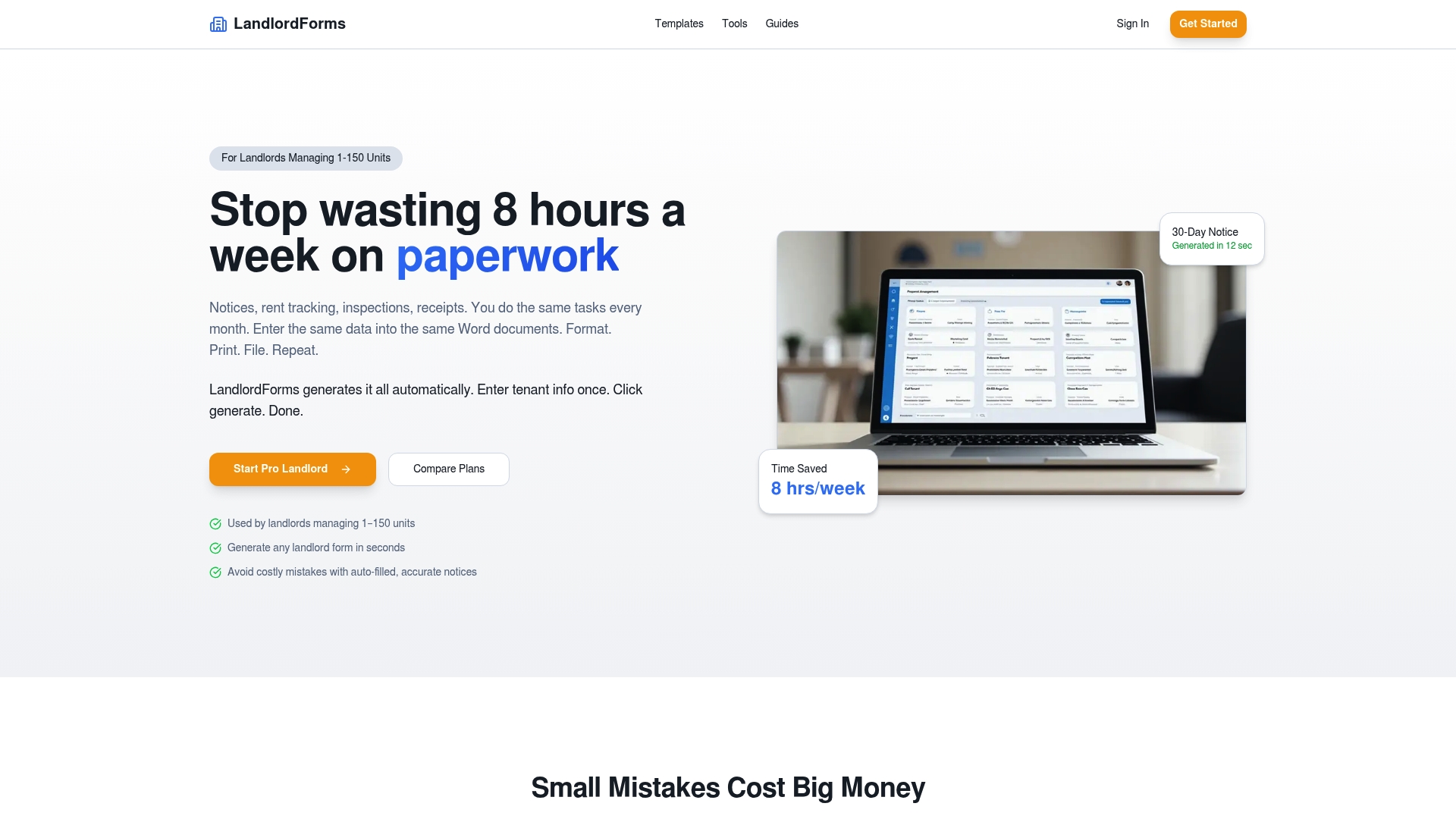
Eight hours a week is what landlords typically spend on manual paperwork. Landlordforms cuts that down by automating the documents that matter most in a lease-purchase deal: state-specific templates, option fee receipts, and a rent ledger that tracks every credit automatically and exports clean for closing.
Start with the free rent ledger template to set up your credit-tracking system today, then use Landlordforms to generate your state-specific lease-purchase agreement, issue receipts, and organize your full closing document package. No manual entry, no missed credits, no closing-day surprises.
Useful sources
- Rocket Mortgage: Understanding lease purchase and lease-to-own agreements
- ContractsCounsel: Lease Purchase Agreement Drafting
- DocuModels: Lease Purchase Agreement Template
- Cimphony: Drafting a Lease-Purchase Agreement
- eForms: Free Rent-to-Own (Lease Agreement)
- State-specific rules: Search “[your state] + lease purchase agreement disclosure requirements” and “[your state] + rent-to-own contract law” to find applicable statutes. Confirm compliance with a licensed real estate attorney in your state.
FAQ
What is the difference between a lease-purchase and a lease-option?
A lease-purchase legally obligates the tenant to buy the property at the end of the term; a lease-option gives the tenant the right to buy but no obligation. Using the wrong language in the contract can accidentally create or eliminate that obligation.
How much should the option fee be in a lease-purchase agreement?
Option fees typically run 2 3% to 5% of the purchase price and are non-refundable. On a $295,000 home, that corresponds to that typical percentage range.
How do rent credits work in a lease-purchase deal?
Most agreements credit 20–30% of each monthly rent payment toward the purchase price or down payment. The exact dollar amount must be documented in a monthly ledger attached to the agreement as an exhibit.
Does a lease-purchase agreement need attorney review?
Yes. State disclosure requirements, contract enforceability rules, and default-remedy standards vary by state. A qualified real estate attorney should review the final draft before either party signs.
Can Landlordforms generate a lease-purchase agreement?
Landlordforms generates state-specific landlord forms and templates, including lease agreements with fillable fields, and provides rent-ledger tracking and receipt automation to support the full lease-purchase workflow.