Property Documentation Audit Checklist for Investors

A thorough property documentation audit checklist covers six core categories every investor must verify before closing: title and legal documents, lease agreements and tenant files, financial statements, physical inspection reports, zoning and compliance records, and environmental assessments. The specific documents that matter most include the title commitment, ALTA/NSPS land title survey, executed leases and all amendments, trailing 12-month profit and loss statement, rent roll, estoppel certificates, Phase I Environmental Site Assessment, and certificates of occupancy. Cross-verification across these documents is what separates a sound acquisition from an expensive mistake.
Here is a quick-reference breakdown of the core audit categories:
- Title and legal: Title commitment, ALTA/NSPS survey, deed, recorded easements, pending litigation disclosures
- Lease and tenant files: All executed leases and amendments, estoppel certificates, resale certificates, tenant payment history, security deposit records
- Financial records: Trailing 12-month P&L (T12), rent roll, 2–3 years of tax returns (Schedule E), bank statements, capital expenditure history, HOA financial statements
- Physical condition: Professional inspection reports, Property Condition Assessment (PCA), maintenance logs, code compliance history, roof and HVAC service records
- Zoning and compliance: Zoning verification letter, certificates of occupancy, building permits, open code violations, certificate of good standing
- Environmental: Phase I ESA, Phase II ESA (if Phase I flags contamination), remediation records, regulatory correspondence
Missing documents in any category are not a neutral gap. Experienced investors treat missing documents as active risk signals that require resolution before closing, not after.
Why due diligence audits make or break real estate investments
Due diligence is hypothesis testing. Before signing a purchase contract, you model projected returns using available data. After signing, you test those assumptions against actual property documents. The goal is to confirm the property is what the seller represented, or to identify gaps that justify renegotiation or walking away.
The due diligence period typically runs from 30 to 60 days from contract execution, and every discrepancy you find during that window is a potential negotiation lever. Seasoned investors do not treat this period as administrative paperwork. They treat it as the most consequential phase of the entire acquisition, where price adjustments, seller credits, and repair demands get made before contingencies expire.
Due diligence covers four pillars: financial verification, physical condition, legal status, and market context. Each pillar has its own document set and its own failure modes. A property that looks clean financially can still carry title encumbrances, open permits, or environmental liabilities that kill the deal or erode returns after closing. Covering all four pillars is the only way to know what you are actually buying.
1. Physical property inspection checklist
Physical due diligence protects against structural or mechanical surprises that erode value after closing. A standard home inspection is not enough for investment properties. You need a full Property Condition Assessment (PCA) from a qualified engineer, plus specialty inspections tailored to the property’s age and type.
Properties older than 20 years require specialty inspections beyond a standard walkthrough, including sewer line scopes, roof integrity checks, and electrical panel assessments. A seller who can produce five years of HVAC service records and plumbing maintenance logs managed the property well. A seller who produces nothing almost certainly deferred maintenance.
Key items to verify and collect:
- Building systems: HVAC inspection reports, plumbing condition, electrical panel and wiring, roofing condition and remaining useful life
- Structural elements: Foundation, load-bearing walls, drainage and grading
- Specialty inspections (20+ year properties): Sewer line scope, chimney inspection, asbestos and lead paint testing
- PCA report: Immediate repair needs, deferred maintenance estimates, capital expenditure projections
- Maintenance logs: HVAC service records, roof inspection history, plumbing repairs
- Code compliance: Open permits, code violations, condemned status from the local building department
- Updated survey: Property boundary confirmation, encroachments, easements
Retain every inspection report permanently. These documents establish the property’s condition at acquisition and protect you in future disputes with tenants or insurance carriers. Landlordforms supports photo documentation during inspections, creating a timestamped visual record that holds up in disputes.
Pro Tip: Tailor your inspection scope to the property type, not just the age. A 1990s multifamily building in a humid climate needs a mold assessment that a dry-climate industrial property of the same age does not.

2. Property title and legal documentation audit checklist
Legal due diligence verifies the seller’s right to convey the property, confirms regulatory compliance, and identifies encumbrances that transfer to the buyer at closing. Clear, transferable ownership confirmed through a title search is the foundation of any secure transaction. Unresolved title issues frequently derail closings.

The two documents that anchor this category are the title commitment and the ALTA/NSPS land title survey. The title commitment, issued by a title company, lists all recorded encumbrances, easements, covenants, and liens. The ALTA/NSPS survey maps legal boundaries, improvements, easements, and access rights. Discrepancies between the survey and the title report must be resolved before closing, not flagged and ignored.
Core legal documents to audit:
- Title commitment: Recorded encumbrances, easements, covenants, and liens
- ALTA/NSPS land title survey: Boundary lines, improvements, access rights, easement locations
- Deed: Confirms current ownership and chain of title
- Executed lease agreements and all amendments: Every amendment or side letter can modify rent, term, or termination rights
- Zoning compliance letter: Confirms permitted use aligns with your intended operation
- Estoppel certificates: Tenant-signed confirmations of lease terms, rent amounts, security deposits, and any landlord defaults
- Resale certificate (HOA properties): Monthly assessment amounts, special assessments, reserve fund status
- Pending or threatened litigation: Any active or anticipated legal disputes affecting the asset
- Entity and authority documents: Seller’s organizational documents confirming legal authority to convey
Cross-verification between the estoppel certificate and the resale certificate catches a common deal-killer. Differing monthly assessment amounts between these two documents often derail transactions, and cross-checking both against the master HOA budget is the only way to catch the discrepancy before closing.
3. Financial due diligence: reviewing key property documents
Financial due diligence verifies that the income and expenses the seller represents are accurate. This is where most deals either get confirmed or fall apart. The trailing 12-month profit and loss statement (T12) is your starting point, but it tells you nothing on its own. You need to cross-verify it against multiple sources.
Cross-verifying the rent roll against lease agreements, bank deposits, and tenant estoppel certificates is the core of income verification. Any discrepancy greater than 5% between the rent roll and bank deposits is a red flag that warrants investigation or price renegotiation. Underreported expenses and inflated income are the two most common forms of seller misrepresentation, and both show up when you compare the T12 against tax returns.
Financial documents to request and verify:
- Trailing 12-month P&L (T12): Actual income and expenses; compare against bank deposits line by line
- 2–3 years of Schedule E tax returns: Reported rental income to the IRS; discrepancies between claimed and reported income are a red flag
- Current rent roll: Tenant names, unit numbers, lease terms, rent amounts, vacancy status, pending abatements
- Bank statements (12 months): Verify collected rent matches deposit totals
- Utility bills (12 months): True operating costs, especially if seller-paid utilities are involved
- Property tax records (3 years): Tax basis, assessment trends, pending reassessment risk
- Capital expenditure records: Recent major investments; absence may signal deferred maintenance
- HOA financial statements: Reserve fund health, special assessments, budget projections
- Insurance premium history: Coverage costs and claims history
- Debt service coverage ratio (DSCR): Lenders generally require a DSCR above 1.25; a ratio below that threshold signals cash flow risk
A lender’s DSCR requirement above 1.25 is not just a financing hurdle. It is a useful benchmark for your own underwriting. If the property’s net operating income barely clears debt service, there is no cushion for vacancy, repairs, or rate increases.
Pro Tip: Request the rent ledger alongside the rent roll. The ledger shows payment timing and partial payments, which the roll does not. Patterns of late or partial payments reveal tenant quality problems that vacancy numbers alone will not show.
4. Zoning, environmental, and compliance checks
Zoning and environmental due diligence protects against two distinct but equally costly risks: regulatory non-compliance that prevents your intended use, and environmental liability that transfers to you at closing. Both are avoidable with the right documents.
Start with zoning. The zoning compliance letter from the local planning department confirms the property’s legal use aligns with your intended operation. Review certificates of occupancy for each unit or building, and check for any recorded variances. A property operating outside its permitted zoning classification can face forced closure or costly remediation.
Environmental due diligence follows a two-step process. A Phase I Environmental Site Assessment identifies recognized environmental conditions through a desktop review and site inspection, without soil or groundwater sampling. Most institutional lenders require one. If the Phase I flags contamination, a Phase II ESA follows with physical sampling to quantify contamination levels and determine remediation scope. A Phase II that yields a no-further-action letter from the relevant regulator substantially reduces acquisition risk.
Compliance and environmental documents to audit:
- Zoning verification letter: Confirms permitted use and any recorded variances
- Certificates of occupancy: One per unit or building; confirms legal habitation status
- Building permits: All open and closed permits; open permits transfer to the buyer
- Code violation notices: Active citations from the local building department
- Phase I ESA: Recognized environmental conditions, site history, regulatory database review
- Phase II ESA (if applicable): Soil and groundwater sampling, contamination quantification, remediation scope
- Environmental remediation records: Prior agency correspondence, no-further-action letters, monitoring plans
- Insurance policies: Current coverage, exclusions for natural disasters or environmental damage
- Loss run reports (5 years): Claims history; prior water damage claims may signal unresolved plumbing issues
- Tenant insurance certificates: Proof of renter’s insurance where lease requires it
5. Market and neighborhood analysis checklist
Physical and financial audits tell you what the property is. Market analysis tells you what it is worth in context and whether the income assumptions hold against local reality. Skipping this step is how investors overpay for assets in declining submarkets.
Key market factors to evaluate:
- Comparable property performance: Vacancy rates, rental rates, and cap rates for similar assets within a one-mile radius
- Neighborhood demographics: Population trends, income levels, employment base, and household formation rates
- Planned developments: New supply pipelines, infrastructure projects, or zoning changes that could affect demand or value
- Economic indicators: Local unemployment rate, major employer concentration, and economic diversification
- School district ratings: For residential properties, school quality directly affects tenant demand and turnover rates
- Crime statistics: Local law enforcement data; high crime rates increase vacancy and insurance costs
- Walkability and transit access: Proximity to amenities, public transit, and employment centers
Integrate market findings with your financial model. A rent roll showing 95% occupancy in a submarket with 15% vacancy is a red flag, not a selling point. Either the property is genuinely outperforming its peers, or the numbers are wrong.
6. Best practices for managing your property documentation audit
The biggest operational risk in due diligence is not missing a document. It is losing track of what you have, what is outstanding, and what the gaps mean. A systematic approach to document management prevents that.
Secure, audit-trailed virtual data rooms (VDRs) give deal teams a single source of truth for all transaction documents. Every access, download, and print action is logged, creating the transparency that lenders and regulators require. Disorganized document collections add days to review timelines regardless of team capacity.
AI-assisted document analysis can reduce review time for large disclosure packages from hours to minutes by flagging inconsistencies and items marked “Unknown” in seller disclosures. This is particularly useful for large lease files and multi-tenant rent rolls where manual cross-referencing is time-consuming and error-prone.
Practical document management steps:
- Submit your full document request list on Day 1 of the due diligence period; the faster documents arrive, the more time you have to analyze them
- Use a diligence tracking matrix to monitor request status, consultant deliverable timelines, and contingency waiver deadlines
- Organize by category: Financial, legal, physical, environmental, and operational documents in separate folders with consistent naming conventions
- Flag gaps immediately: Do not wait until Day 45 to notice a missing Phase I ESA or three years of missing tax returns
- Cross-reference systematically: Use the reconciliation matrix approach, comparing rent roll against lease agreements, T12 against bank deposits, and security deposit ledger against individual lease files
Pro Tip: Treat every missing document as a question that needs an answer before you release contingencies. “The seller will provide it at closing” is not an acceptable answer for title documents, environmental reports, or financial records.
7. Verification of seller’s ownership and authority to sell
Confirming the seller’s legal right to convey the property is not a formality. It is the first thing to verify, and it needs to happen before you spend money on inspections or third-party reports.
A title search confirms that the seller legally owns the property and identifies any liens or encumbrances that could block the transfer. Initiate this search immediately after signing the purchase agreement, and cross-reference ownership data with local assessor and recorder’s office records. For properties held in an LLC, trust, or corporate entity, review the organizational documents to confirm the signing party has actual authority to bind the entity. A managing member of an LLC may not have unilateral authority to sell without member approval, depending on the operating agreement.
Request the following to verify ownership and authority:
- Recorded deed in the seller’s name
- Entity organizational documents (operating agreement, articles of organization, corporate resolutions)
- Any court orders or probate documents if ownership transferred through an estate
- Confirmation that no other party holds a right of first refusal or purchase option on the property
Reviewing real estate contract terms carefully at this stage catches authority issues before they become closing-day surprises.
8. Review of existing leases and tenant agreements
Buying a property with existing tenants means acquiring both the income stream and the legal obligations. Every lease, amendment, side letter, and addendum transfers to you at closing. What you do not read before closing becomes your problem after it.
Read every executed lease in full, not just the rent roll summary or broker-prepared abstracts. Look for tenant options (renewal, expansion, termination, right of first refusal), co-tenancy clauses, exclusive-use restrictions, and landlord obligations that do not appear on a summary. A single early termination option in a key tenant’s lease can collapse the income model you underwrote.
Estoppel certificates are the buyer’s direct verification from tenants themselves. Each tenant signs a document confirming lease terms, rent amounts, security deposits, and whether any landlord defaults exist. Lenders typically require estoppels from tenants representing a threshold percentage of gross income before advancing funds. Any verbal agreement the prior landlord made with a tenant can become your obligation. Get everything in writing before closing.
For a practical framework on tenant relationship documentation, Landlordforms provides structured guidance on what belongs in a tenant file and how to organize it from day one.
Key lease audit items:
- All executed leases and every amendment, side letter, and addendum
- Lease abstracts verified against the executed documents
- Tenant estoppel certificates from each tenant
- Security deposit records and state law compliance
- Tenant payment history (12 months): late payments, partial payments, patterns
- Active eviction proceedings or pending disputes
- Tenant correspondence revealing promises made by the prior owner
9. Assessment of property tax status and liabilities
Property tax records reveal more than just the current tax bill. They show assessment trends, pending reassessments, and whether the seller is current on payments. A delinquent tax bill does not disappear at closing. It transfers to you.
Request three years of property tax bills and verify the seller is current. Check for any pending reassessment that could significantly increase the tax burden after you acquire the property. In many jurisdictions, a sale triggers a reassessment at the purchase price, which can materially change the operating expense assumptions in your financial model. Factor the post-sale tax estimate into your underwriting, not the seller’s current bill.
Also check for special assessments levied by the municipality or HOA. These are one-time charges for infrastructure improvements, road repairs, or utility upgrades, and they can run into tens of thousands of dollars. An HOA with underfunded reserves is particularly likely to levy a special assessment within a few years of acquisition.
IRS Publication 527 requires investors to maintain records of acquisition costs, closing expenses, and capital improvements for each rental property separately. These records establish your tax basis and support depreciation deductions from day one.
10. Investigation of outstanding liens or encumbrances
Liens and encumbrances that are not cleared before closing transfer to the new owner. A mechanics’ lien from an unpaid contractor, a judgment lien from a lawsuit, or a tax lien from delinquent property taxes all survive the sale unless specifically addressed in the purchase agreement or cleared at closing.
The title commitment identifies all recorded liens and encumbrances. Review it carefully and require the seller to clear any liens as a condition of closing. Common types to watch for include mortgage liens, mechanics’ liens, judgment liens, tax liens, and HOA assessment liens. Easements and deed restrictions are encumbrances that typically do not need to be cleared but must be understood before you close, since they can restrict how you use or develop the property.
For properties held in an LLC or corporate entity, also check for UCC financing statements filed against the entity. These can encumber personal property, including equipment and fixtures, that you expect to receive as part of the acquisition. A title search covers real property liens; a UCC search covers personal property encumbrances.
Work with a real estate attorney to review the legal documents and confirm that all liens are either cleared at closing or specifically addressed in the purchase agreement with a seller credit or escrow holdback.
11. Evaluation of insurance policies and claims history
Insurance due diligence serves two purposes: confirming the property is currently insurable at a reasonable cost, and revealing physical problems the seller may not have disclosed. The claims history is where the second purpose lives.
Request the CLUE (Comprehensive Loss Underwriting Exchange) report for the property. This report shows the five-year claims history. A property with multiple water damage claims in a short period signals unresolved plumbing problems, not just higher premiums. Review the current insurance policies for coverage gaps, particularly exclusions for natural disasters, environmental damage, or equipment breakdowns that are common in the property’s geography.
For investment properties, also verify that the existing policy is a landlord policy, not a standard homeowner’s policy. The coverage requirements differ significantly. Confirm tenant renter’s insurance requirements in the leases and whether tenants are actually in compliance.
Insurance documents to collect:
- Current landlord insurance policy and declarations page
- Loss run reports (5 years): claims type, frequency, and resolution
- CLUE report for the property
- Flood insurance policy or quote (if in a FEMA flood zone)
- Umbrella liability policy details
- Tenant certificates of insurance (where lease requires it)
- Open or pending claims that could affect coverage at closing
Landlordforms makes post-acquisition documentation manageable
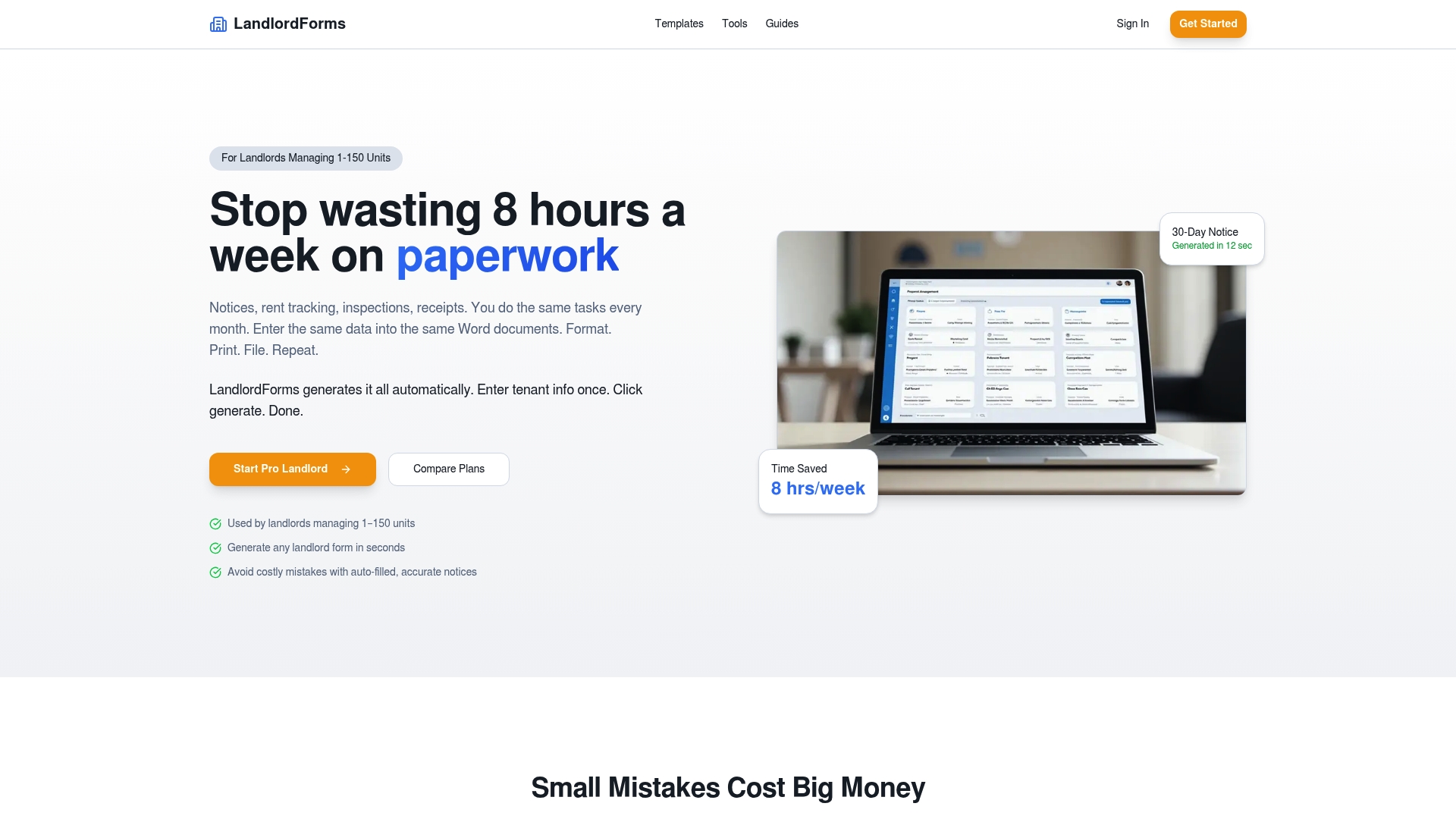
Once you close, the documentation work does not stop. Rent tracking, lease renewals, inspection records, and tenant notices all need to be organized and current. Landlordforms is built for landlords managing 1–150 rental units, automating the creation of notices, receipts, and lease documents while keeping tenant information in one place.
The rent ledger template from Landlordforms gives you a ready-to-use tool for tracking rent payments and verifying income accuracy from day one of ownership. Real-time payment tracking and photo documentation for inspections mean you are always prepared if a dispute arises.
Key Takeaways
A complete property documentation audit checklist covers title, leases, financials, physical condition, zoning, and environmental records, and every gap in that checklist is a risk that transfers to the buyer at closing.
| Point | Details |
|---|---|
| Cross-verify financial documents | Compare rent roll against lease agreements, bank deposits, and T12; any discrepancy greater than 5% warrants investigation. |
| Treat missing documents as red flags | Gaps in documentation are active risk signals, not neutral absences, and require resolution before contingencies expire. |
| ALTA/NSPS survey and title commitment | These two documents anchor legal due diligence and must be reconciled against each other before closing. |
| Phase I ESA is a lender standard | Environmental assessments protect against cleanup liability and are required by most institutional lenders. |
| DSCR above 1.25 is the lender benchmark | A debt service coverage ratio below 1.25 signals cash flow risk and typically blocks conventional financing. |
FAQ
What documents should every investor request during due diligence?
At minimum, request the title commitment, ALTA/NSPS survey, all executed leases and amendments, trailing 12-month P&L, current rent roll, 2–3 years of tax returns, bank statements, Phase I ESA, certificates of occupancy, and insurance loss run reports. Submit the full request list on Day 1 of the due diligence period.
What is the 3-3-3 rule in real estate?
The 3-3-3 rule is not a standardized industry framework with a single canonical definition; different practitioners use the phrase to describe different screening criteria. For due diligence purposes, focus on the four documented pillars: financial, physical, legal, and market verification.
What should an audit checklist for investors include?
A property documentation audit checklist should cover title and ownership verification, lease and tenant file review, financial statement analysis, physical inspection reports, zoning and compliance records, environmental assessments, insurance policies, and property tax status. Each category has its own document set and its own failure modes.
What are the 4 pillars of investment due diligence?
The four pillars are financial due diligence (verifying income and expenses), physical due diligence (inspecting building condition), legal due diligence (confirming title and compliance), and market due diligence (validating assumptions against local data). A complete investment property audit checklist addresses all four before contingencies expire.
How do you verify rent roll accuracy?
Cross-check the rent roll against three independent sources: the executed lease agreements for each unit, actual bank deposit records for the past 12 months, and tenant estoppel certificates. Any discrepancy greater than 5% between the rent roll and bank deposits is a red flag that warrants investigation or price renegotiation.