Stop Wrongful Deposit Deductions: Prorate & Document Wear vs Damage (U.S.)
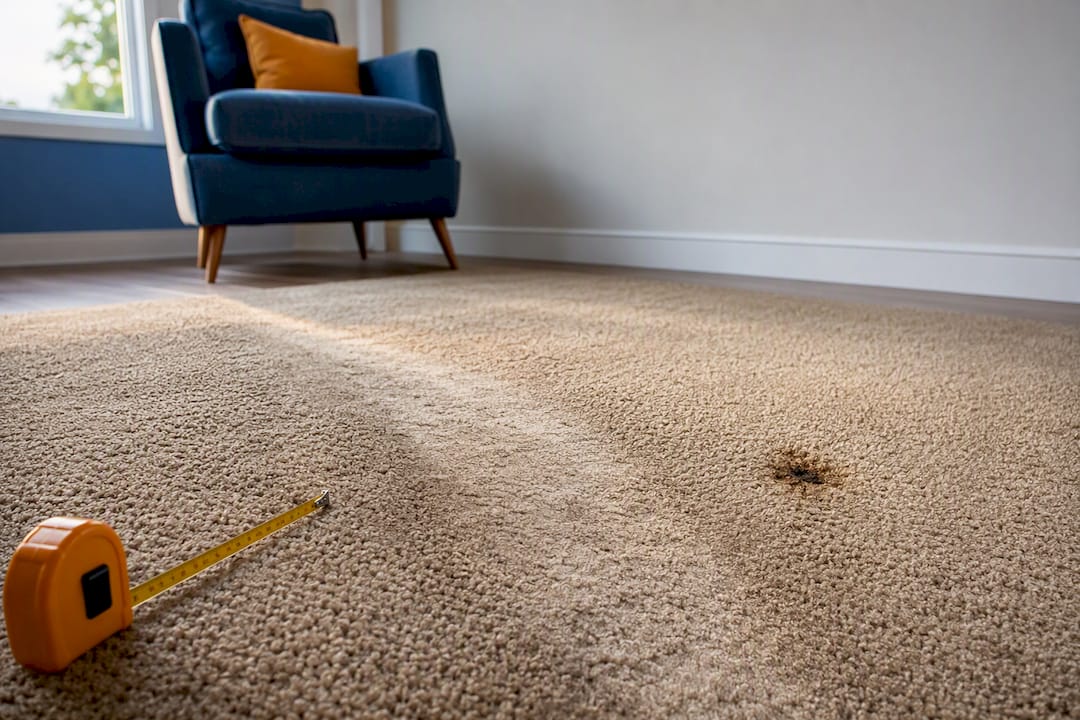
Wear and tear is the slow, unavoidable decline that comes from ordinary living, and damage is harm caused by negligence, misuse, or an unauthorized change to the unit. Landlords may deduct security deposit funds only for the second category, and only when they can document it. If a landlord can’t point to a signed move-in checklist, dated photos, or a repair invoice, the claim usually fails. Start there: compare current condition to move-in records, check HUD or your state’s life-expectancy guidance, and photograph everything before you argue about who pays.
TL;DR:
- Landlords must document damage claims with signed checklists, photos, or repair invoices to justify deducting from security deposits, especially for damages versus wear.
- Normal wear and tear includes fading paint, worn carpet, and small nail holes, which vary depending on tenancy length, property quality, and sunlight exposure.
- Damage involves harm that a careful tenant would have avoided, such as large holes, deep stains, broken fixtures, or structural alterations caused by negligence or misuse.
- Landlords are required to prove damages with clear, organized evidence, and should prorate costs based on the item’s remaining useful life to avoid overcharging tenants.
- Using standardized paperwork, such as move-in/check-out checklists and photo documentation, significantly improves the chances of resolving disputes in favor of the party with better records.
Table of Contents
- What Qualifies as Normal Wear and Tear
- What Counts as Tenant or Property Damage
- How Deposit Deductions and Proration Actually Work
- Documenting and Proving Your Case
- Room-by-Room: What’s Wear and What’s Damage
- Why Paperwork Wins More Disputes Than Arguments
- Tools That Turn These Rules Into Habits
- Sources
- FAQ
What Qualifies as Normal Wear and Tear
Normal wear and tear is the deterioration that happens simply because someone lived in the unit and used it the way it was built to be used. The U.S. Department of Housing and Urban Development frames it as the natural result of “intended use,” not neglect or misuse, and that phrase does most of the legal heavy lifting in deposit disputes. A tenant who lives in a unit for three years and leaves behind faded paint, a worn path in the carpet, and a sticky drawer track has not done anything wrong. That’s just what three years of living looks like.
Courts and state housing agencies tend to draw the line at reasonable care. If a tenant used the space the way an average careful person would, the resulting wear falls on the landlord’s side of the ledger, not the tenant’s.
Common examples of wear and tear include:
- Faded, chipped, or peeling paint from age and sunlight exposure
- Small nail holes or pushpin marks from hanging photos or art
- Worn traffic lanes in carpet near doorways and hallways
- Loose or wobbly cabinet handles and drawer slides from repeated use
- Minor scuffs on walls, baseboards, or door frames
- Faded curtains or window blinds from sun exposure
- Small cracks in grout from normal settling
- Worn spots on wood floors’ finish where foot traffic is heaviest
Tenancy length changes what’s reasonable. A five-year tenant’s unit should show more visible aging than a one-year tenant’s, and a landlord who tries to charge a long-term tenant for “worn carpet” without accounting for that stretch of time is on shaky ground. Material quality matters too. Builder-grade carpet rated for five years of foot traffic will look different at year four than premium carpet rated for ten. That’s precisely why HUD’s useful-life guidance exists: it gives both sides a baseline for what “expected” deterioration looks like at a given point in a lease.
What Counts as Tenant or Property Damage
Damage is harm that a reasonably careful tenant would have avoided. It’s the difference between a carpet that’s simply worn thin and a carpet with a cigarette burn or a pet urine stain that’s soaked into the pad. Minnesota Housing’s guidance draws this line clearly with side-by-side lists, and most state agencies follow a similar framework: if the harm came from negligence, abuse, or an unauthorized change to the property, it’s chargeable.
The test isn’t really about intent. A tenant doesn’t need to have broken something on purpose for it to count as damage. Leaving a bathtub faucet running and flooding the unit downstairs is damage even though nobody meant for it to happen. The question is whether ordinary, careful use would have prevented it.
Examples that typically qualify as tenant damage:
- Large or gaping holes in drywall beyond what a picture hanger would leave
- Burns, deep gouges, or stains on flooring or countertops
- Pet urine or feces stains that have penetrated carpet, pad, or subfloor
- Broken or cracked windows not caused by a structural or weather event
- Missing fixtures, such as removed light fixtures or cabinet doors
- Unauthorized paint colors or wallpaper the lease didn’t approve
- Structural alterations, like removed walls or unpermitted electrical work
- Mold growth caused by a tenant failing to report a leak for months
Gray areas come up constantly. A tenant who reports a leak immediately and the landlord takes three weeks to fix it isn’t liable for the resulting mold. A tenant who ignores the same leak for months probably is. Cornell Law’s summary of reasonable wear and tear notes that many states lean on common-law reasoning rather than a precise statutory checklist, which means outcomes often hinge on the specific facts and, most heavily, on whatever evidence either side brings to the table. A landlord with dated photos showing the leak was reported and addressed quickly has a strong case. A landlord with no maintenance log at all has a weak one, regardless of who’s technically right.
How Deposit Deductions and Proration Actually Work
Most states put the burden of proof on the landlord, not the tenant. That means a landlord who wants to keep part of a security deposit has to show, with an itemized list and supporting evidence, exactly what was damaged, what it cost to fix, and why the cost is fair. A vague line item reading “cleaning and repairs, $400” rarely survives a dispute or a small-claims hearing.
The part landlords miss most often is proration. Under HUD’s useful-life framework, you don’t get to charge a tenant full replacement cost for something that already had years of wear on it before they moved in. Carpet with a typical useful life of several years and burns before its expected replacement is worth only a fraction of its original price. Charging the tenant for a brand-new carpet on an old one is functionally overcharging them, and a judge will usually see it that way.
Pro Tip: Keep a simple spreadsheet with purchase dates and estimated useful life for major items like carpet, appliances, and paint. When damage happens, the math takes thirty seconds instead of turning into a guessing game.
Here’s the basic method landlords should apply for any prorated deduction:
- Determine the item’s original cost or a reasonable current replacement cost.
- Find its typical useful life (carpet around 5 to 7 years, most appliances around 10, according to Realtor).
- Calculate the percentage of useful life already used before the damage occurred.
- Subtract that percentage from the replacement cost to find the item’s remaining value.
- Charge the tenant only for that remaining value, not the full replacement price.
A carpet that is several years old with a typical useful life partially used up has likewise diminished value. If replacement costs a certain amount, the tenant owes only a prorated portion, not the full amount. This is the single most common mistake in deposit disputes, and it’s also the easiest one to fix with a calculator and a little record-keeping.
Timing matters as much as math. Most states require landlords to return deposits, along with an itemized list of any deductions, within a set window after move-out, often somewhere between 14 and 30 days depending on the state. Missing that deadline can forfeit the right to withhold funds entirely in some jurisdictions, regardless of how legitimate the damage claim is.
Documenting and Proving Your Case
Every dispute eventually comes down to evidence, and evidence starts before the tenant ever moves a box in. A signed move-in checklist noting the exact condition of every room, paired with time-stamped photos, is the single strongest piece of proof either party can produce later. Without it, a landlord trying to charge for a stained carpet at move-out has no way to prove the stain wasn’t already there.
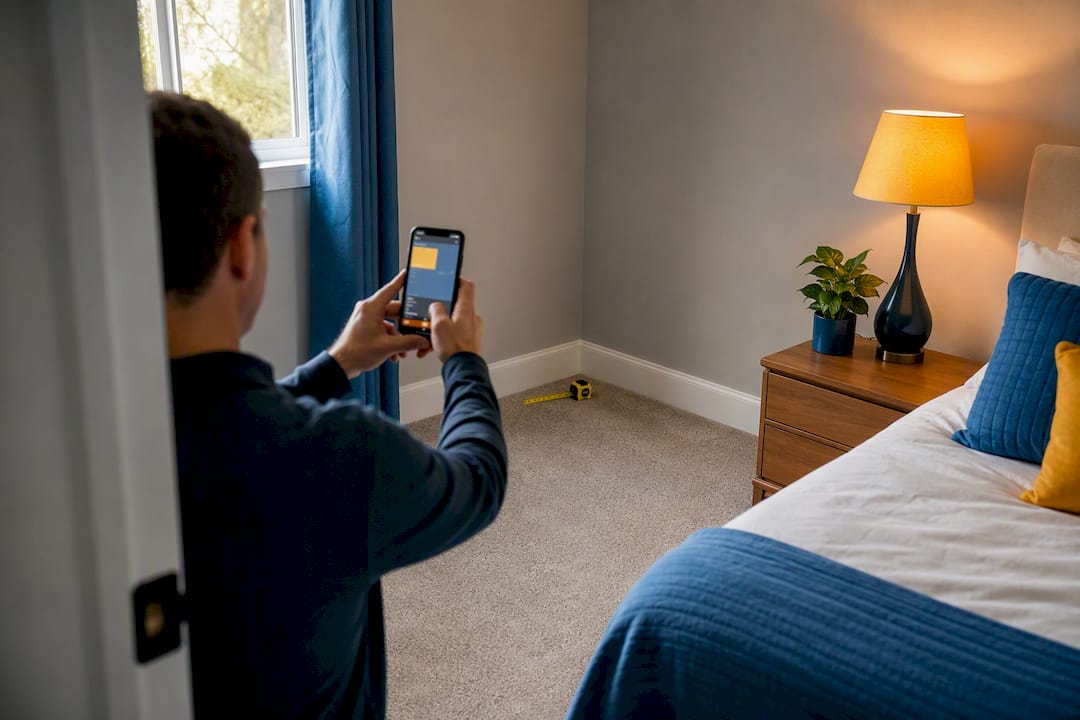
Pro Tip: Photograph every wall, appliance, and floor surface from the same angles at move-in and move-out. Consistent angles make side-by-side comparisons instantly obvious to anyone reviewing the claim later, including a judge.
A practical documentation workflow looks like this:
- Walk the unit with the tenant at move-in and complete a written, signed condition checklist covering every room.
- Take dated, time-stamped photos of walls, floors, appliances, and fixtures, including any pre-existing wear.
- Store copies of the signed checklist and photos somewhere both parties can access, not just a phone camera roll.
- Repeat the same walkthrough at move-out, using the same checklist and comparable photo angles.
- Note any new issues, get repair estimates or invoices, and attach them to an itemized deduction list.
- Keep all records for at least the length of your state’s small-claims statute of limitations, often several years.
Evidence carries weight in a hierarchy. Time-stamped photos beat a landlord’s or tenant’s verbal recollection every time, and an itemized invoice from a licensed contractor beats a rough estimate scrawled on a receipt. Zillow’s guidance on documentation and most legal primers agree on this point: whoever shows up with dated, organized proof usually wins the argument, not whoever has the more persuasive story. Small-claims judges see dozens of these cases and tend to favor the party with a paper trail over the party with a grievance. A landlord move-out checklist template can standardize this process so nothing gets skipped between tenants.
Room-by-Room: What’s Wear and What’s Damage
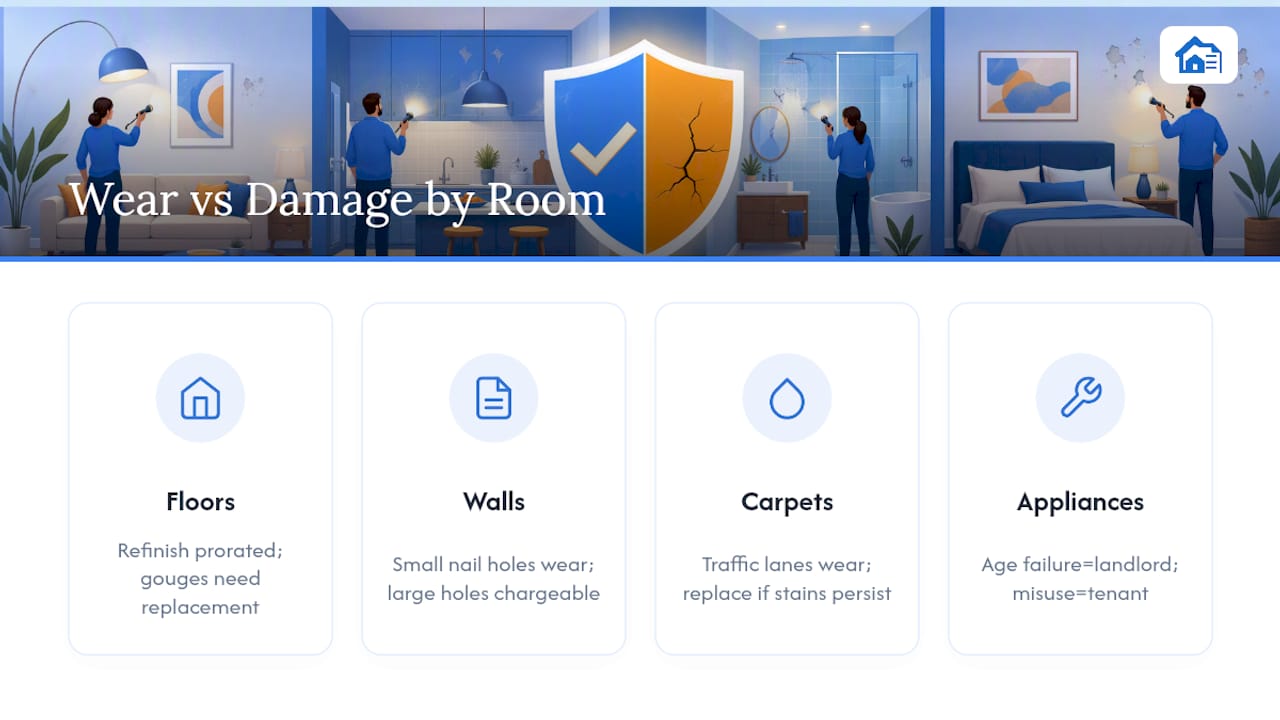
Floors. Light scuffs, dulled finish in high-traffic areas, and small scratches from years of foot traffic are wear and tear. Deep gouges from dragged furniture, water damage from an unreported spill, or holes from stiletto heels crossed with careless walking cross into damage. Refinishing a wood floor is often cheaper than full replacement and should be prorated the same way as carpet, based on the floor’s remaining useful life.
Walls. A handful of small nail holes from framed photos is standard wear, even in a unit with white walls. Large holes from doorknobs slamming through drywall, unapproved bold paint colors, or wallpaper glued on without permission are chargeable. Patching a few nail holes is a landlord’s routine turnover cost. Patching and repainting an entire wall because of an unauthorized color choice is a fair deduction.
Carpets. Worn traffic lanes and slightly flattened fibers near doorways are expected after a normal lease term. Burns, deep-set stains, or pet urine that penetrated the pad usually require professional cleaning at minimum, and full replacement if the odor or stain won’t lift. According to Minnesota Housing’s examples, the classification often comes down to whether normal cleaning restores the carpet or not.
Appliances and fixtures. A refrigerator compressor failing after nine years of a ten-year expected lifespan is age-related failure, not tenant misuse, and the landlord absorbs that cost. A stove burner destroyed because a tenant left aluminum foil melted onto it is misuse, and the burden falls on the tenant, but only if the landlord can document how the damage happened.
Why Paperwork Wins More Disputes Than Arguments
Most deposit disputes aren’t decided by clever legal arguments. They’re decided by whoever kept better records. A landlord with a signed move-in checklist and dated photos from day one has an enormous advantage over a landlord relying on memory, and the reverse is true for tenants who documented pre-existing damage before they ever unpacked a box.
The pattern holds across nearly every housing agency guide and legal summary on this topic: consistency beats cleverness. Landlords who use the same checklist format, the same photo angles, and the same filing system for every tenant build a habit that pays off the one time a dispute actually lands in small-claims court. Landlordforms’s move-in and move-out checklist templates, photo documentation tools, and rent ledgers exist specifically to make that consistency automatic rather than something you have to remember to do under pressure. Pair that with a documented inspection workflow and disputes stop being arguments about memory and start being straightforward comparisons of evidence.
— Igor
Tools That Turn These Rules Into Habits
Knowing the difference between wear and tear and damage only helps if your paperwork can back it up when a tenant moves out. Landlordforms is built specifically for that gap: instead of digging through text messages and phone photos after the fact, you get standardized templates that capture the same information every single time, for every unit you manage.

The move-in and move-out checklist template covers the condition report step from this guide, giving you a signed record the moment a tenant gets their keys. The rent ledger template keeps payment history organized in one place, which matters when a dispute stretches into a broader conversation about the tenancy. And the rent proration calculator handles the math on partial charges quickly, the same logic you’d apply when prorating a damaged item’s remaining useful life. Landlords managing anywhere from a single unit to 150 use these tools to cut hours of paperwork down to minutes and to walk into a deposit dispute with documentation instead of guesswork. Start with the free move-in checklist template and build the habit before your next tenant turnover.
Sources
A handful of primary sources cover almost everything landlords and tenants need to settle a wear-and-tear dispute:
- Minnesota Housing — examples of tenant damage vs normal wear and tear
- Cornell Law — reasonable wear and tear
- Zillow: What is normal wear and tear?
This article is general information, not a substitute for advice from a qualified lawyer. Consult a qualified legal professional about your own circumstances before acting on anything here.
FAQ
What Is Normal Wear and Tear After 5 Years in California?
After five years, California landlords should expect noticeably faded paint, worn carpet in high-traffic areas, and minor scuffing on floors and walls as normal deterioration, not damage a tenant can be billed for. California follows the same general burden-of-proof and reasonable-care principles most states use, meaning a landlord still has to prove any deduction goes beyond ordinary aging for that length of tenancy.
What Should You Avoid Saying to Your Landlord During a Damage Dispute?
Avoid admitting fault verbally without documentation to back it up, and avoid agreeing to a deduction amount before you’ve seen an itemized list with photos or invoices. Ask for everything in writing, since verbal agreements are far harder to dispute later if the numbers don’t match what you discussed.
Is a Broken Toilet Seat Considered Wear and Tear?
A toilet seat that’s cracked from years of normal use and age is generally wear and tear, especially in a longer tenancy where the seat has simply outlived its useful life. A toilet seat broken by obvious force, misuse, or a single reckless incident is more likely to be classified as tenant damage.
Are Nail Holes in Walls Considered Normal Wear and Tear?
Yes, a reasonable number of small nail holes from hanging pictures or shelves is considered normal wear and tear in nearly every state, since it results from ordinary use of the walls. Excessive holes, large anchors that leave gaping damage, or holes from unauthorized shelving installations can shift into chargeable damage territory.