One Rent Check Can Reset Your Eviction: U.S. Holdover Tenant Rules

A holdover tenant is someone who stays in a rental after the lease ends without a new agreement, and the law usually treats them as a tenant at sufferance with no lease rights. If you’re a landlord who wants them out, don’t accept rent, and serve the correct notice right away. Accepting payment can accidentally create a new month-to-month tenancy, which resets your timeline and your leverage.
TL;DR:
- Accepting rent from a holdover tenant can inadvertently create a month-to-month tenancy, requiring additional notice and legal procedures to evict.
- Timelines for eviction depend on state laws, with some states allowing as little as a few days for nonpayment notices, and others requiring up to 30 days or more for no-cause terminations.
- Proper service of notices and maintaining thorough documentation are critical, as errors or accepting payments without reservation can weaken eviction cases.
- Self-help eviction methods, such as changing locks or disconnecting utilities, remain illegal nationwide, and court-ordered eviction is the only lawful route.
- State-specific rules dramatically influence notice periods, damages, and procedural steps, making it essential to verify local laws before proceeding.
Table of Contents
- What Holdover Tenant Laws Say About Legal Status
- Landlord Rights in a Holdover Situation: Your Real Options
- How to Evict a Holdover Tenant: The Process Step by Step
- Do State Tenant Laws Change How You Evict a Holdover Tenant?
- A Practical Checklist for Handling a Holdover Tenant
- Common Mistakes That Sink a Holdover Eviction Case
- Where to Verify Holdover Tenant Laws in Your State
- Keep Your Paper Trail Airtight From Day One
- Sources
- FAQ
What Holdover Tenant Laws Say About Legal Status
A holdover tenant is a renter who remains in a property after the lease term ends without the landlord’s explicit agreement to a new lease. Courts generally place this person in one of two legal categories, and the difference between them changes who has rights and how fast you can act.
Tenancy at sufferance applies when the landlord has not agreed to the tenant staying. The tenant is essentially occupying without permission, though eviction still requires legal process rather than a lockout. Tenancy at will (or a periodic tenancy) can form when the landlord accepts rent or otherwise signals consent to the tenant remaining, according to Cornell’s Legal Information Institute.
That second category is where landlords get tripped up. A single accepted rent check, even a partial one, can be read by a court as consent to a new tenancy in some states, converting the arrangement into a month-to-month lease with fresh notice requirements. Investopedia’s explainer on holdover tenants confirms this conversion risk and notes it varies by jurisdiction.
Quick distinctions worth remembering:
- Tenancy at sufferance: no landlord consent, minimal tenant rights, fastest path to eviction.
- Tenancy at will: implied consent through rent acceptance or communication, tenant gains notice protections.
- Written lease renewal: an entirely different animal, since it’s a negotiated new term, not a holdover at all.
Landlord Rights in a Holdover Situation: Your Real Options
You have three real paths once a tenant holds over, and each carries different legal weight. Pick wrong and you could lose months of leverage or, worse, expose yourself to a lawsuit.
- Refuse rent and pursue eviction. This is the cleanest path if you want the unit back. Send a written notice reserving your rights and do not cash any rent checks in the meantime.
- Accept rent and convert to a new tenancy. If you’re fine with the tenant staying, accepting payment and documenting it as a renewed month-to-month arrangement is legitimate, but get it in writing.
- Negotiate a short-term or formal lease extension. Sometimes the cleanest fix is simply papering a new term instead of leaving things ambiguous.
Whatever you choose, document it. A text message agreeing to “let it ride a few more weeks” can be used against you in court as evidence of implied consent to a new tenancy.
Pro Tip: If you’re unsure whether to accept a holdover payment, accept it explicitly as “use and occupancy” charges in writing, not rent, and state clearly that you reserve the right to proceed with eviction. This preserves your legal position while you sort things out.
One option that’s off the table no matter what: self-help eviction. Changing locks, shutting off utilities, or removing a tenant’s belongings without a court order is illegal in every state and can expose you to civil and criminal liability, according to guidance from Mass.
How to Evict a Holdover Tenant: The Process Step by Step
Evicting a holdover tenant follows a set procedure, and skipping a step or missing a deadline can send you back to square one.
- Serve the correct notice. This might be a notice to quit (no cause, lease has ended), a pay or quit notice (rent owed), or a cure or quit notice (lease violation). The type and length depend on your state and lease terms.
- Wait out the notice period. Most jurisdictions require anywhere from a few days to a full month before you can file, depending on notice type and tenancy length.
- File for eviction (unlawful detainer or summary process). This is a formal court filing, not a letter or a phone call to the tenant.
- Attend the hearing. Both sides present evidence. Judges weigh proof of service, the lease, and any payment history heavily.
- Obtain judgment and request execution. If you win, the court issues an order, but only a sheriff or constable can physically remove the tenant, never you personally.
Timing traps show up constantly in this process:
- Improper service of the notice (wrong method, wrong recipient) can void the entire filing and force a restart.
- Accepting even one rent payment mid-process can undercut your case.
- Many states allow a stay of execution or an appeal window after judgment, which delays actual move-out even after you win, per Mass.gov.
Keep every notice, proof-of-service record, and communication log in one place from day one. Courts respond well to landlords who show up organized, and Landlordforms’ eviction notice template helps make sure the notice itself meets your state’s formatting requirements before you ever get to the courthouse.
Do State Tenant Laws Change How You Evict a Holdover Tenant?
Yes, significantly. Notice periods, required language, and even what counts as valid service differ from state to state, and getting this wrong is one of the fastest ways to lose an eviction case.
Florida’s statute, for example, spells out specific holdover provisions directly in its code. Florida Statute 83.58 addresses what happens when a tenant holds over after lease expiration, including the landlord’s right to damages. Massachusetts, by contrast, lays out a detailed process through its courts covering notice, filing, hearing, and post-judgment stays, as described in the Mass.gov eviction guide. Nevada courts distinguish between summary eviction (faster, more limited) and formal eviction (slower, but allows a money judgment), a distinction laid out in the state’s landlord-tenant handbook.
Three things tend to vary the most between states:
- Notice length. Some states require just a few days for nonpayment; others require a full month for no-cause termination.
- Subsidy protections. Tenants receiving housing assistance often get extra procedural protections that override standard timelines.
- Damages and penalties. Some statutes, like Florida’s, spell out how landlords calculate holdover rent or penalty amounts directly in the code.
Statistic Callout: Notice periods for no-cause holdover terminations can range from as little as a few days to a full 30 days or more depending on the state and lease length, which is why checking your specific state statute before serving anything is not optional. Landlordforms’ state notice rule breakdown is a good starting point before you draft anything.
A Practical Checklist for Handling a Holdover Tenant
Before you serve anything or accept a single payment, run through this list.
- Confirm the lease’s actual expiration date and whether any renewal clause auto-triggered.
- Decide upfront: are you evicting, or accepting a new tenancy? Don’t leave it ambiguous.
- Draft your notice using your state’s required language and timeline, not a generic template.
- Serve the notice using a method your state recognizes as valid (certified mail, posting, personal service).
- Keep every document: the original lease, the notice, proof of service, and a running rent ledger.
- If you accept any payment during this period, label it in writing as “use and occupancy,” not rent.
Pro Tip: The single most common way landlords accidentally create a new tenancy is by depositing a rent check “just to be safe” while eviction paperwork is in progress. Don’t do it. If you’re not ready to formally offer a new lease, refuse the payment or document it explicitly as use and occupancy.
This is exactly the kind of paperwork Landlordforms was built to handle. Its 3-day notice to pay or quit template and 30-day notice to vacate template generate state-specific language automatically, and its rent tracking tools flag exactly when a payment might blur the line between holdover and renewal.
Common Mistakes That Sink a Holdover Eviction Case
Most landlords who lose holdover eviction cases don’t lose on the facts. They lose on process.
The biggest mistakes: accepting rent without a written reservation of rights, attempting a lockout or utility shutoff instead of going through court, and serving notice incorrectly or too late. Each one can force you to restart the entire timeline.
Tenants also have real protections that can stall or block removal entirely, including habitability claims (the unit has unresolved health or safety issues), retaliation defenses (eviction filed shortly after a complaint), and additional procedural steps for subsidized housing tenants. If any of these come up, or if your state’s notice rules feel unclear for your situation, pause and consult a local attorney before filing. Landlordforms’ tenant rights compliance guide is a useful primer on what protections tenants can raise.
Where to Verify Holdover Tenant Laws in Your State
For primary sourcing, start with Cornell’s Legal Information Institute for legal definitions, Mass.gov’s eviction guide for a detailed process walkthrough, and Florida’s statute on tenant holdover as a model of how state code frames the issue. Always check your own state’s landlord-tenant statute and your local court’s eviction forms before filing anything.
Keep Your Paper Trail Airtight From Day One
Documentation wins holdover cases more often than clever legal arguments do. A judge presented with a clean rent ledger, a properly served notice, and a dated communication log tends to move faster and rule more confidently than one handed a shoebox of scattered texts and half-remembered conversations. That’s the part most landlords underestimate. They focus on getting the notice language right, which matters, but then fail to keep the supporting record that proves they followed their own process.
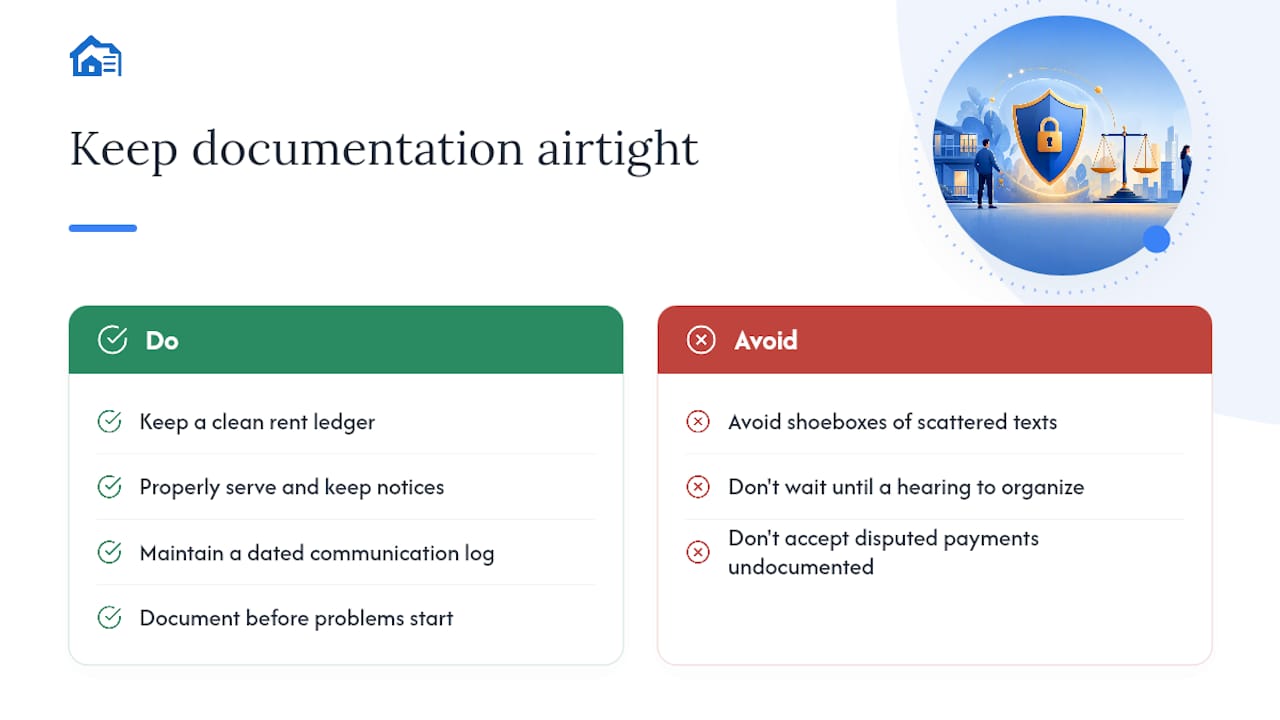
The conventional advice on holdover tenants tends to stop at “serve a notice and file for eviction,” as if the legal mechanics were the whole story. They’re not. The mechanics are table stakes. What actually decides these cases in court is whether you can prove, with dates and paper, exactly what happened and when. A rent ledger that shows you never accepted a disputed payment is worth more in front of a judge than a strongly worded notice.
If you take one thing from this: build your documentation habit before you ever need it, not after a tenant stops paying. By the time you’re standing in front of a hearing officer, it’s too late to start organizing.
— Igor
This article is general information, not a substitute for advice from a qualified lawyer. Consult a qualified legal professional about your own circumstances before acting on anything here.
Sources
- holdover tenant | Wex | US Law | LII / Legal Information Institute
- Mass
- Understanding Holdover Tenant Rights and Legal Implications
- The 2026 Florida Statutes
FAQ
What Rights Do Holdover Tenants Have?
A holdover tenant classified as tenancy at sufferance has minimal rights, but one classified as tenancy at will (through accepted rent) gains standard tenant protections, including proper notice before eviction and, in many states, habitability and anti-retaliation protections.
How Long Does It Take to Evict a Holdover Tenant?
Timelines vary widely by state and notice type, ranging from a few days for nonpayment cases to a month or more for no-cause terminations, plus additional time for filing, the hearing, and any post-judgment stay of execution, according to Mass.gov.
How Do You Get Rid of a Holdover Tenant?
Refuse further rent payments, serve the correct written notice for your state and situation, and if the tenant doesn’t leave, file an unlawful detainer or summary process action in court. Never attempt a lockout or utility shutoff, since self-help eviction is illegal in every state.
How Is Holdover Rent Calculated?
Holdover rent calculations vary by state and lease terms; some statutes, like Florida’s, address how a landlord may claim damages for a tenant holding over, while other jurisdictions calculate it based on the prorated daily rate under the expired lease. Check your specific state statute, since there’s no single national formula.