Oklahoma Lease Agreement: Landlord and Tenant Guide

Download the OREC Residential Lease (01-01-2026) from the Oklahoma Real Estate Commission, attach the Tenancy Guidelines and lead-disclosure brochure where required, and run the clause checklist below before anyone signs. That is the fastest path to a state-compliant Oklahoma lease agreement. The Oklahoma Residential Landlord and Tenant Act (ORLTA), Title 41 O.S., governs enforceability, and several clauses common in generic templates are explicitly void under Oklahoma law.
- Download the OREC Residential Lease PDF and save the version date (01-01-2026).
- Attach the 2026 Tenancy Guidelines and the EPA lead-disclosure brochure for pre-1978 properties.
- Use the clause checklist in Section 3 to confirm all required provisions are present.
- Get attorney review for any clause involving unusual indemnities, complex assignments, or large deposits.
Pro Tip: Never use an undated or generic “Oklahoma lease” template pulled from a random search result. The OREC form was drafted by the Real Estate Contract Form Committee and reflects court-tested phrasing — that pedigree matters when a dispute reaches a judge.
General information only. This guide is not legal advice. Confirm current rules with the ORLTA statute or a licensed Oklahoma attorney before executing a lease.
Key Takeaways
A state-compliant Oklahoma lease agreement starts with the official OREC form, requires specific statutory disclosures, and must avoid the prohibited clauses ORLTA §113 explicitly voids.
| Point | Details |
|---|---|
| Start with the OREC form | Download the 2026 Residential Lease from OREC and confirm the version date before use. |
| Attach required documents | Include the Tenancy Guidelines and lead-based paint brochure for pre-1978 properties with every lease packet. |
| Document deposits thoroughly | Issue a written receipt, conduct a joint move-in walkthrough, and photograph all rooms before possession. |
| Know the notice timelines | Nonpayment requires 5 days’ written notice; month-to-month termination requires 30 days under ORLTA. |
| Landlordforms automates the paperwork | Oklahoma landlords managing 1–150 units can generate leases, notices, and receipts without rebuilding forms each tenancy. |
Table of Contents
- Where to download official Oklahoma lease forms and templates
- Clause checklist: the lease sections Oklahoma landlords and tenants should include
- Security deposits in Oklahoma: handling, receipts, and returns
- Rent, late fees, and notice-to-quit timelines under Oklahoma law
- Lease term, holdover tenancy, renewals, and notice requirements in Oklahoma
- Lease provisions Oklahoma law forbids or will not enforce
- Mandatory disclosures and attachments for Oklahoma leases
- How to write or customize a simple Oklahoma lease
- When templates have limits: a note on attorney review
- Landlordforms makes Oklahoma lease paperwork faster
- Sources
- FAQ
Where to download official Oklahoma lease forms and templates
The single authoritative source is the OREC Contract Forms and Related Addenda page, which hosts the current Residential Lease, supplements, and all related attachments. Download directly from that page rather than third-party mirrors so you always have the current version.
- OREC Residential Lease (01-01-2026): The official starting point for any Oklahoma rental contract. It includes standard sections, attachment checkboxes, and blank fields designed for state compliance.
- OREC Tenancy Guidelines (01-01-2026): OREC expects landlords to attach this document to the lease packet. It covers maintenance obligations, smoke detector care, and move-in/move-out reporting.
- EPA lead-disclosure materials: Required for properties built before 1978. The EPA “Protect Your Family From Lead In Your Home” brochure must be given to tenants, and both parties must sign an acknowledgment.
- State-specific template generators: If you want fillable, auto-populated forms rather than a static PDF, a state-specific generator can pre-fill party names, dates, and rent fields while preserving Oklahoma-required language.
Pro Tip: Write the version date of every OREC PDF on the file name when you save it (e.g., “OREC_Residential_Lease_2026-01-01.pdf”). OREC updates forms periodically, and using a stale version can create enforceability gaps.
Clause checklist: the lease sections Oklahoma landlords and tenants should include
A solid Oklahoma lease agreement covers these categories. Sample fill-in language follows each item, with relevant ORLTA cross-references.
- Parties and premises. Full legal names of all adult tenants and the landlord or property manager, plus the complete street address. Sample: “This agreement is between [Landlord Name] (‘Landlord’) and [Tenant Name(s)] (‘Tenant’) for the premises located at [Address], Oklahoma.”
- Lease term. Exact start and end dates. Without a stated term, Oklahoma law presumes a one-year tenancy. Sample: “The lease term begins [Date] and ends [Date], unless renewed in writing.”
- Rent amount and due date. Dollar amount, due date (typically the 1st), and acceptable payment methods. Sample: “Rent of $[Amount] is due on the 1st of each month, payable by [check/ACH/portal].”
- Late fees. Amount and grace period, written clearly so enforceability is not in question. Sample: “A late fee of $[Amount] applies if rent is not received by the [X]th day of the month.”
- Security deposit. Amount, receipt procedure, and accounting obligations. ORLTA governs how deposits must be handled. Sample: “Tenant has paid a security deposit of $[Amount], receipt of which Landlord acknowledges.”
- Maintenance and repair responsibilities. Distinguish landlord obligations (structural, HVAC, plumbing) from tenant obligations (routine cleanliness, minor upkeep). Tie language to ORLTA duties.
- Entry and inspection notice. Oklahoma practice follows reasonable-notice standards. Sample: “Landlord will provide at least 24 hours’ written notice before entering, except in emergencies.”
- Utilities. List which utilities the landlord covers and which the tenant pays. Ambiguity here causes disputes.
- Subletting and assignment. State whether subletting requires written landlord consent. Sample: “Tenant may not sublet or assign this lease without prior written consent of Landlord.”
- Pets. Allowed or prohibited; if allowed, reference a pet addendum with deposit or fee terms.
- Insurance. Recommend or require renters insurance. Sample: “Tenant is encouraged to obtain renters insurance; Landlord’s policy does not cover Tenant’s personal property.”
- Dispute resolution. Reference applicable Oklahoma courts and ORLTA remedies.
| Clause | ORLTA Reference | Enforceability Note |
|---|---|---|
| Security deposit handling | Title 41 O.S. | Deposit must be returned with itemized deductions |
| Entry notice | Title 41 O.S. | Reasonable notice required; no waiver allowed |
| Prohibited waivers | ORLTA §113 | Waiving statutory rights is void |
| Termination notice | Title 41 O.S. §113 | Written notice required; oral notice insufficient |
Security deposits in Oklahoma: handling, receipts, and returns
Oklahoma does not cap the security deposit amount by statute for most residential leases, but how you document and return it is where disputes actually start. The OREC Tenancy Guidelines explicitly recommend documenting property condition at move-in and move-out, which is the single most effective way to defend a deduction.
- Written receipt at move-in. Issue a written receipt stating the deposit amount and the date received. Record it in a rent ledger immediately.
- Separate accounting. Keep deposit funds identifiable; commingling with operating funds creates legal exposure.
- Itemized deductions. When deductions are made, provide a written itemized statement. Vague entries like “cleaning” without a dollar amount invite disputes.
- Return timing. Return the deposit (or the balance with the itemized statement) within the period required by ORLTA after the tenancy ends.
Sample deduction notice text: “Pursuant to the lease dated [Date], the following deductions are made from the security deposit of $[Amount]: [Item 1] — $[Amount]; [Item 2] — $[Amount]. Balance of $[Amount] is enclosed.”
Pro Tip: Combine a signed move-in condition report with timestamped photos and attach both to the lease packet. A move-in checklist paired with photo documentation is the strongest evidence you have if a tenant disputes a deduction months later.
Steps to protect your deposit position:
- Conduct a joint move-in walkthrough with the tenant and have both parties sign the condition report.
- Photograph every room, appliance, and fixture before the tenant takes possession.
- Store the signed report and photos with the lease file, not separately.
- Repeat the process at move-out and compare the two sets of photos side by side.
- Issue the itemized statement promptly after move-out to stay within ORLTA’s required window.
Rent, late fees, and notice-to-quit timelines under Oklahoma law
Clear rent language in the lease prevents the most common landlord-tenant friction. Define the due date, the grace period (if any), and the late fee in plain terms. A grace period is not required by Oklahoma law, but if you include one, write it precisely: “Rent is due on the 1st; a grace period of [X] days applies before the late fee of $[Amount] is assessed.”
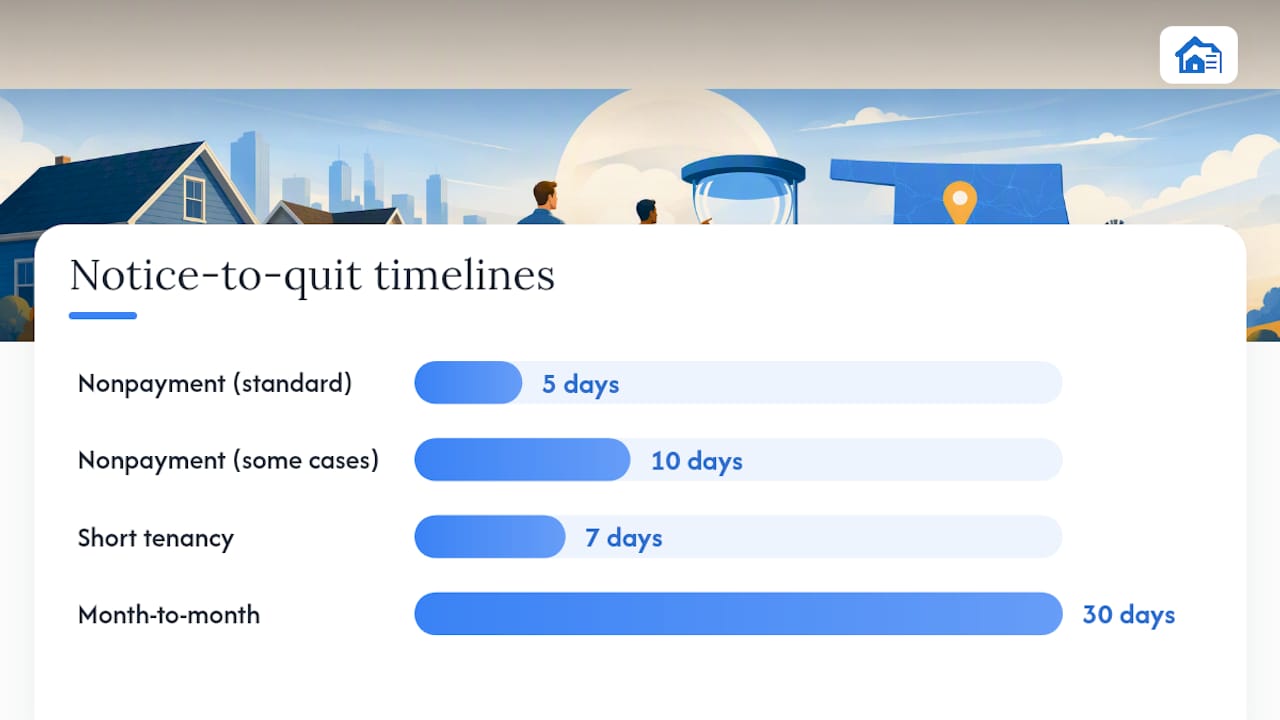
For nonpayment, the ORLTA and Oklahoma statutory sections (Title 41) set notice-to-quit timelines that the lease cannot shorten. Landlords should keep a rent demand template and a notice-to-quit form ready to serve the moment rent is overdue.
| Situation | Required Notice | Notes |
|---|---|---|
| Nonpayment of rent | 5 days (or 10 days in some circumstances) | Written notice; tenant may cure by paying |
| Month-to-month termination | 30 days written notice | Either party may terminate |
| Short tenancy (less than month-to-month) | 7 days in many instances | Confirm with ORLTA for specific tenancy type |
| Lease violation (non-rent) | Reasonable written notice | ORLTA governs cure period |
Late fees are enforceable when the lease states the amount and the trigger date clearly. A fee that is disproportionate or buried in fine print is more likely to be challenged. Keep the fee reasonable and the language visible.
Oklahoma landlords must serve written notice before filing for eviction. Oral notice does not satisfy the statutory requirement, regardless of what the lease says.
Lease term, holdover tenancy, renewals, and notice requirements in Oklahoma
When a lease does not specify a term, Oklahoma law presumes a one-year tenancy. That default matters because it sets the notice clock for termination. A written lease with explicit start and end dates removes that ambiguity entirely.
- Fixed-term lease: Ends on the stated date. Neither party needs to give notice to end it, but many landlords include a renewal-notice clause anyway to avoid confusion.
- Month-to-month tenancy: Either party may terminate with 30 days’ written notice under ORLTA.
- Holdover after a one-year lease: When a tenant stays past the end of a one-year written lease with the landlord’s assent, Oklahoma law treats the tenancy as a tenancy at will, not an automatic renewal of the same fixed term. That distinction changes the eviction timeline and notice requirements.
- Renewal clause: Include explicit language stating whether the lease auto-renews, converts to month-to-month, or requires a new signed agreement.
Sample holdover clause: “If Tenant remains in possession after the lease expiration date with Landlord’s consent and without a new written agreement, the tenancy converts to a month-to-month tenancy at will, terminable by either party on 30 days’ written notice.”
Sample renewal clause: “Landlord will provide written notice of renewal terms no later than [30/60] days before the expiration date. Failure to provide notice converts the tenancy to month-to-month.”

Pro Tip: Use a lease renewal notice template to send renewal offers on a consistent schedule. Landlords who let leases expire silently often find themselves in a holdover situation they did not intend.
Lease provisions Oklahoma law forbids or will not enforce

ORLTA §113 and related sections void specific types of lease language regardless of whether both parties signed. Generic templates from other states frequently contain exactly these clauses.
Specific prohibited provisions and corrected alternatives:
- Waiving ORLTA rights. Bad: “Tenant waives all rights under Oklahoma landlord-tenant law.” Corrected: Remove entirely; no waiver of statutory rights is enforceable.
- Exculpation clause. Bad: “Landlord is not liable for any damage to Tenant’s property under any circumstances.” Corrected: “Landlord is not liable for damage to Tenant’s personal property except where caused by Landlord’s negligence; Tenant is encouraged to obtain renters insurance.”
- Confessing judgment. Bad: “Tenant consents to entry of judgment against Tenant without notice.” Corrected: Remove entirely; confession-of-judgment clauses are void.
- Requiring tenant to pay landlord’s attorney fees. Bad: “Tenant agrees to pay all of Landlord’s attorney fees in any dispute.” Corrected: Remove; ORLTA prohibits this one-sided fee-shifting.
- Waiving emergency assistance. Bad: “Tenant agrees not to call emergency services without Landlord’s prior approval.” Corrected: Remove entirely; this waiver is void and potentially dangerous.
Pro Tip: Flag these items for attorney review before signing: unusual indemnity clauses, nonstandard liability allocations, complex assignment provisions, and any clause that purports to limit a party’s statutory remedies. A one-hour attorney review costs far less than a voided clause discovered during litigation.
Mandatory disclosures and attachments for Oklahoma leases
Two categories of disclosures attach to nearly every Oklahoma residential lease: federal lead-based paint requirements and OREC-recommended state documents.
- Lead-based paint disclosure (federal). Required for all residential properties built before 1978. Landlords must give tenants the EPA “Protect Your Family From Lead In Your Home” brochure and a signed disclosure form. The EPA lead-disclosure rule fact sheet details the acknowledgment process and enforcement expectations.
- OREC Tenancy Guidelines. OREC expects landlords to attach the 2026 Tenancy Guidelines to the lease packet. These cover maintenance responsibilities, smoke detector obligations, and move-in/move-out reporting procedures.
- Property condition disclosure. While primarily associated with sales transactions, noting the property’s known condition in writing at lease signing protects both parties.
- Recording delivery. The lease itself should include a line confirming attachments: “The following documents are attached and incorporated into this lease: Tenancy Guidelines, Lead-Based Paint Disclosure (if applicable), Move-In Condition Report.”
| Disclosure | Trigger | Delivery Method |
|---|---|---|
| Lead-based paint brochure + disclosure | Property built before 1978 | Physical or electronic copy; signed acknowledgment |
| OREC Tenancy Guidelines | All OREC lease packets | Attached to lease; tenant initials receipt |
| Move-in condition report | All tenancies | Signed by both parties at move-in |
How to write or customize a simple Oklahoma lease
Filling an Oklahoma lease agreement template correctly takes about 30 minutes when you have the right materials in front of you. Work through these steps in order.
- Identify the parties. Enter the full legal names of every adult tenant and the landlord (or property management company). Include contact addresses for notice purposes.
- Describe the premises. Full street address, unit number if applicable, and any included storage or parking.
- Set the term. Enter exact start and end dates. If month-to-month, state that explicitly.
- Define rent. Dollar amount, due date, grace period (if any), late fee amount and trigger date, and accepted payment methods.
- Record the deposit. Amount, date received, and the accounting procedure for return.
- Allocate utilities. List each utility and mark it as landlord-paid or tenant-paid.
- Add a pet addendum if needed. Allowed breeds/sizes, pet deposit or fee, and damage responsibility.
- Attach disclosures. Lead-based paint disclosure (pre-1978 properties), OREC Tenancy Guidelines, and the move-in condition report.
- Sign and date. All adult tenants and the landlord sign. Per Phillips Murrah’s Oklahoma leasing guide, witnesses are not required and counterpart signatures are enforceable in Oklahoma.
- Distribute copies. Each party keeps a fully signed copy. Upload a digital version to your document manager immediately.
- Use a tenant onboarding checklist to confirm every document in the packet is signed and dated before the tenant takes possession.
- Electronic signatures are generally enforceable under federal e-sign law; confirm your platform complies.
- Name files with the tenant’s last name and the lease start date for easy retrieval.
Pro Tip: Keep a dated, signed copy for both parties and store it in a cloud document manager with the move-in photos. If a dispute arises six months later, having everything in one searchable folder saves hours.
When templates have limits: a note on attorney review
Templates, including the OREC form, are built for standard residential situations. They handle the common cases well. Where they fall short is in anything unusual: a lease with a purchase option, a property with shared commercial space, a tenant who is also a business entity, or a deposit arrangement that deviates from the norm. Landlordforms handles state-specific document generation and recordkeeping efficiently for landlords managing 1 to 150 units, but no software replaces legal judgment on genuinely complex provisions.
The situations that most often warrant attorney review are: unusual indemnity or liability allocations, complex assignment or subletting arrangements, long-term leases (over one year) with escalation clauses, large security deposit disputes, and any clause a tenant’s attorney has flagged in writing. A short “attorney review” note in the lease packet, listing the specific provisions sent for review and the date, creates a clean paper trail.
Landlordforms makes Oklahoma lease paperwork faster
Eight hours a week is a real number for landlords who manage lease paperwork manually across even a handful of units. Landlordforms cuts that down by automating the documents Oklahoma landlords generate most: state-specific lease agreements, 30-day and 3-day notices, rent receipts, move-in/move-out checklists, and rent ledgers.

For Oklahoma landlords, that means pre-filled lease templates that stay current with state requirements, automatic rent receipt generation, and a rent ledger that tracks payments and deposit balances in one place. Move-in photo documentation and inspection records attach directly to the tenant file, so everything you need for a deposit dispute is already organized. If you manage between 1 and 150 units and want to stop rebuilding the same forms from scratch every tenancy, start with Landlordforms and see how much of the paperwork disappears.
Sources
Verify and download the forms directly from these official sources before use. Confirm the version date on every OREC PDF.
- 2026 Residential Lease.pdf — Oklahoma Real Estate Commission
- Real Estate Leasing: Oklahoma — Phillips Murrah
This article is general information, not a substitute for advice from a qualified lawyer. Consult a qualified legal professional about your own circumstances before acting on anything here.
FAQ
Can I get a free lease agreement in Oklahoma?
Yes. The OREC Residential Lease (01-01-2026) is available as a free PDF download from the OREC Contract Forms page. Attach the Tenancy Guidelines and lead-disclosure brochure to complete the packet.
What notice is required to terminate a month-to-month Oklahoma rental?
Either party must give 30 days’ written notice to terminate a month-to-month tenancy under the Oklahoma Residential Landlord and Tenant Act.
How do I write a simple lease agreement in Oklahoma?
Use the OREC Residential Lease form as your base, fill in the party names, premises address, term, rent amount, deposit, and utility allocations, then attach the Tenancy Guidelines and any required disclosures before both parties sign.
What clauses are unenforceable in an Oklahoma lease?
Under ORLTA §113, clauses that waive a tenant’s statutory rights, exculpate the landlord from negligence, require the tenant to pay the landlord’s attorney fees, or confess judgment are void regardless of whether both parties signed.
What are the requirements for a lease-to-own agreement in Oklahoma?
A lease-to-own (or lease-option) agreement must clearly state the option price, the option period, how option payments apply to the purchase price, and the conditions for exercising the option. These provisions go beyond a standard residential lease and typically require attorney drafting to be enforceable.