24 Hour Notice for California Landlords: Entry Template & Proof
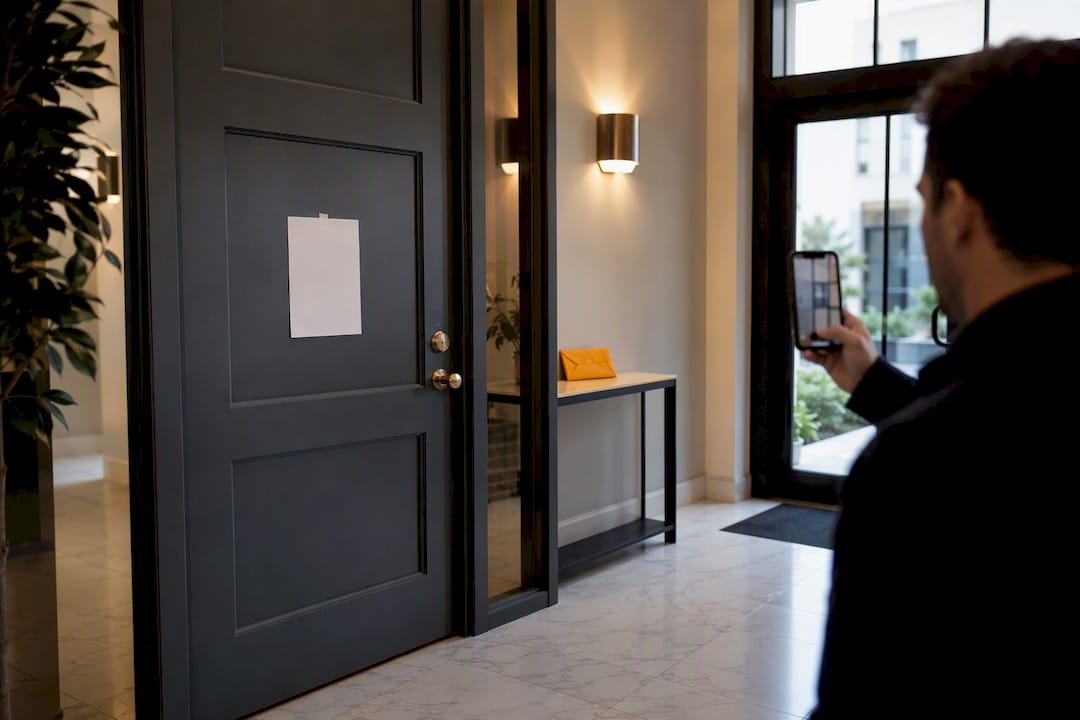
Under California Civil Code §1954, landlords must give tenants reasonable written notice before entering a rental unit, and 24 hours is presumed reasonable. The notice must state the date, approximate time, and purpose of entry, and entry must fall within normal business hours unless the tenant agrees otherwise. If you’re unsure whether your situation qualifies for an exception, the safest move is to serve a written 24-hour notice every time and keep proof you delivered it.
TL;DR:
- A written notice must include the date, a narrow time window, purpose, and confirmation if entry occurs outside normal hours, to ensure legal compliance.
- It is safest to serve a 24-hour notice for routine visits, with evidence of delivery, since mailing adds a six-day delay and limits quick access.
- Emergency situations, tenant consent, or abandonment allow entry without notice, but only these exceptions justify bypassing the standard protocol.
- Using a consistent notice template and documented proof of service significantly reduces disputes and demonstrates compliance if challenged.
- Proper recordkeeping of all notices, proof of delivery, and entry logs is essential to defend against tenant complaints or legal issues.
Table of Contents
- What Does California Law Require for a Notice of Entry?
- When Is Entry Notice Not Required?
- How Do You Write a Compliant Notice of Entry?
- What Records Should You Keep After Serving Notice?
- What Mistakes Do Landlords Make With Entry Notices?
- Why Standardized Notices Change How Disputes Play Out
- Get a Compliant Notice Template Without Starting From Scratch
- Where to Verify These Rules Yourself
- Sources
- FAQ
What Does California Law Require for a Notice of Entry?
California Civil Code §1954 sets the baseline every California landlord has to work from. The notice itself doesn’t need to be fancy, but it does need specific ingredients or it won’t hold up if a tenant challenges it later.
A compliant written notice of entry must include:
- The date you intend to enter
- The approximate time of entry (a one-hour window works better than “sometime Tuesday”)
- The purpose of the visit (repair, inspection, showing, etc.)
- Confirmation the visit falls within normal business hours, generally understood as weekday daytime hours, unless the tenant has agreed to something else
Twenty-four hours’ notice is presumed reasonable under the statute, and that presumption covers most routine situations: maintenance visits, annual inspections, pest control. If you mail the notice instead of delivering it in person, the law presumes it takes six days to reach the tenant, so factor that lag into your planning if you’re mailing rather than hand-delivering or posting at the door.
Delivery method matters because it affects what you can later prove. Personal delivery and posting a notice on the door both create an immediate, dated event you can document with a photo or witness. Mail is legally presumed to add six days for delivery, which protects you but also slows down anything time-sensitive, like an emergency repair that technically wasn’t an emergency.
When Is Entry Notice Not Required?
Three situations let a landlord skip the written notice requirement entirely under the statute’s exceptions.
- Genuine emergencies. A burst pipe, a gas leak, a fire, anything threatening life or property lets you enter immediately, no notice needed.
- Tenant present and consenting. If the tenant is home and agrees to let you in on the spot, you don’t need advance paperwork.
- Abandonment or surrender. Once a tenant has moved out and given up the unit, normal notice rules no longer apply.
Showings for a sale work differently. If you’ve already given tenants written notice within the prior 120 days that the property is listed for sale, you can give oral notice for each individual showing, but you still have to leave written evidence of entry inside the unit afterward. Skip that 120-day written notice and you lose the oral shortcut entirely, so document it or default back to written notice every time.
One caution: the 24-hour reasonable notice standard is a rebuttable presumption, not an ironclad rule. Treat it as a floor, not a target, and lean conservative when timing is close.
How Do You Write a Compliant Notice of Entry?
A notice that holds up doesn’t need legal jargon. It needs precision. Here’s how to build one from scratch.
- State the exact date and a narrow time window. “Between 10:00 a.m. and 11:00 a.m.” beats “morning” or “sometime this week” because a tight window is easier to defend and harder to dispute.
- Name the specific purpose. “Routine plumbing inspection” or “showing to prospective tenant” gives the notice legal weight that “maintenance” alone doesn’t.
- Confirm the timing falls within normal business hours, or get written tenant consent if it doesn’t.
- Choose your delivery method and document it immediately. Hand it over and get a signature, tape it to the door and photograph the posting with a timestamp, or mail it and note the mailing date for the six-day presumption.
- After entry, leave written evidence inside the unit confirming you were there, especially for sale showings under the oral-notice exception, and log the visit with dated photos if anything was inspected or repaired.
A basic template might read: “This notice is to inform you that [Landlord Name] intends to enter the unit at [address] on [date] between [time] and [time] for the purpose of [reason]. This notice is provided in accordance with California Civil Code §1954.” Adjust the language to match the specific visit, and never reuse a vague, undated notice from a prior tenancy.
Pro Tip: Skip the multi-day window. A specific one-hour block, logged and photographed, is the single easiest way to convert a disputed entry into an easy defense.
Landlords who don’t want to draft this from scratch every time can start from a Notice of Entry template built to these exact statutory requirements.
What Records Should You Keep After Serving Notice?
Documentation is what separates a landlord who can defend an entry from one who’s guessing. Los Angeles County’s Department of Consumer and Business Affairs specifically recommends keeping records of every notice and entry, precisely because disputes tend to surface weeks or months after the fact, when memory alone won’t cut it.
Keep these on file for every entry:
- A copy of the written notice itself, with the date it was created
- Proof of service: a signed receipt, a photo of the notice posted on the door, or a mail tracking record
- Timestamped photos taken during the visit, especially for inspections or repairs
- Notes on what was observed or completed inside the unit
- Any tenant messages related to the entry, including consent given by text or email
Store these digitally in dated folders by property and tenant, backed up somewhere outside your phone. Manual tracking works until you’re managing a dozen units and can’t remember which notice went to which door. That’s the exact gap tools like LandlordForms are built to close, pairing photo documentation with automated, state-specific templates so nothing gets lost between units.
What Mistakes Do Landlords Make With Entry Notices?
Most entry disputes trace back to a handful of repeat mistakes, and every one of them is avoidable.
- Vague time windows. “Sometime this week” isn’t a time, it’s a guess, and it won’t satisfy the statute’s “approximate time” requirement.
- No written evidence left behind. Especially during sale showings, skipping this step erases your proof the visit ever happened.
- Entering outside normal business hours without consent. This is one of the fastest ways to trigger a tenant complaint.
- Repeated, unconsented entries. Even lawful individual visits can look like harassment in a pattern, and county consumer offices treat that pattern seriously.
The fallout ranges from an annoyed tenant to a formal complaint filed with a county agency, a police call, or a civil claim over invasion of privacy. Fixing this costs nothing: use exact time windows, keep proof of every notice, and space out entries so they never read as pressure tactics. Landlords chasing down late-notice errors after the fact usually find the fix would have taken thirty seconds up front.
Why Standardized Notices Change How Disputes Play Out
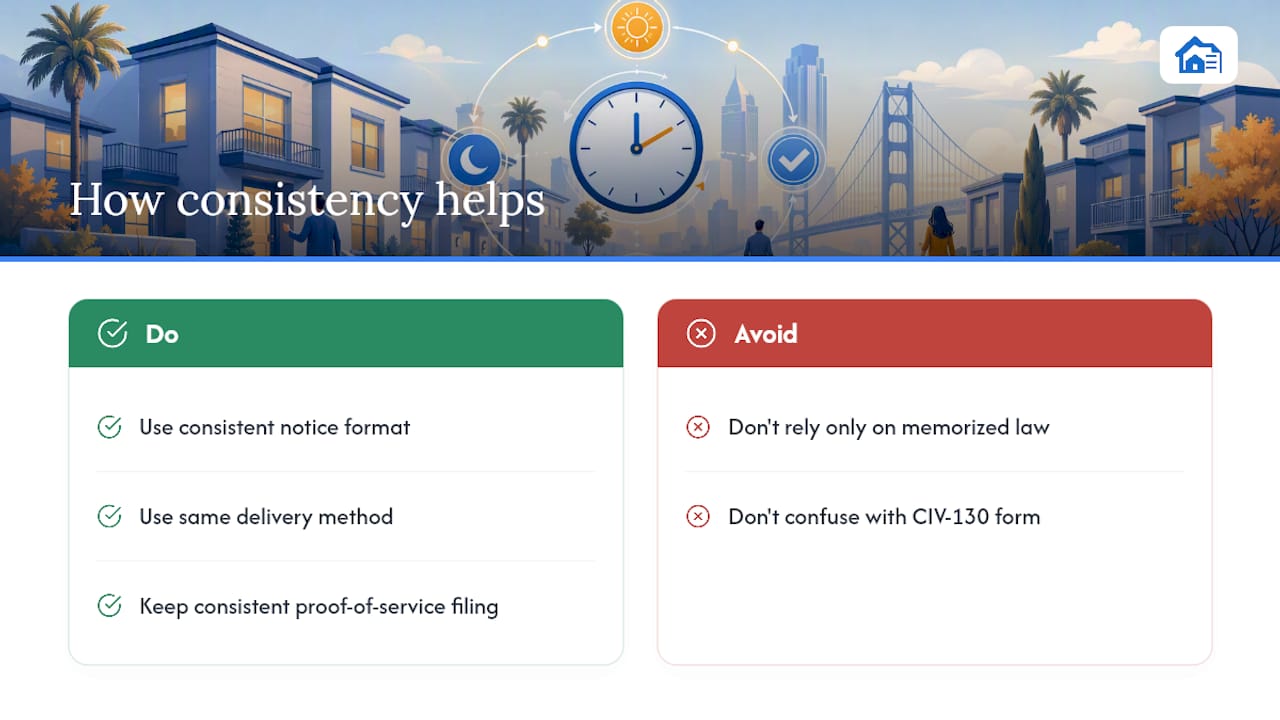
The landlords who never end up in a drawn-out dispute over entry aren’t the ones who know the statute best. They’re the ones who never deviate from their own process. A consistent notice format, a consistent delivery method, a consistent filing habit for proof of service, that repetition is what actually protects you, not memorized legal language.
Worth flagging too: “notice of entry” and California’s Notice of Entry of Judgment (CIV-130) are entirely different documents serving entirely different purposes. Confusing the two, which happens more often than you’d expect when landlords search for templates online, wastes time and occasionally causes real filing errors.
— Igor
Get a Compliant Notice Template Without Starting From Scratch
Certain online services provide the exact fields Civil Code §1954 requires already built into a ready-to-use form, so you’re not reconstructing the date, time window, and purpose language from memory every time you need to enter a unit. The free Notice of Entry template generates a compliant notice in a few clicks, and the platform’s photo documentation feature lets you log timestamped evidence from the visit itself, the same proof-of-service habit this guide walks through.

If you’re also juggling partial-month move-ins or mid-lease rent changes, the free rent proration calculator and the rent ledger template handle the math and recordkeeping side of the same compliance workflow. Landlords managing short-term or vacation listings alongside standard leases may also find useful context in Miami Airbnb Rules: What Every Host Must Know, which covers a different but related layer of entry and access rules. Try the free templates first and see how much time they cut from your notice routine.
Where to Verify These Rules Yourself
Read the statute directly at California Civil Code §1954, check county-specific guidance like the Los Angeles County DCBA page, and confirm court form distinctions on CIV-130.
This article is general information, not a substitute for advice from a qualified lawyer. Consult a qualified legal professional about your own circumstances before acting on anything here.
Sources
- California Civil Code § 1954
- Landlord Entering Your Unit – Los Angeles County DCBA
- Notice of Entry of Judgment or Order (CIV-130) — California Courts Self-Help
FAQ
How much notice must a California landlord give before entering?
Twenty-four hours’ written notice is presumed reasonable under Cal. Civ. Code §1954, and the notice must state the date, approximate time, and purpose.
Can a landlord enter without any notice at all?
Yes, in three situations: a genuine emergency, when the tenant is present and consents on the spot, or after the tenant has abandoned or surrendered the unit.
Does mailing a notice count as valid delivery?
Yes, but mailed notice carries a six-day delivery presumption, so it needs to go out at least six days before the intended entry date to satisfy the timing requirement.
Is a “notice of entry” the same as CIV-130?
No. CIV-130 is a court form called Notice of Entry of Judgment or Order, completely unrelated to a landlord’s notice to enter a rental unit.
What’s the easiest way to create a compliant notice?
Landlordforms offers a free Notice of Entry template built around the statute’s exact requirements, so you fill in the specifics instead of drafting the language from scratch each time.