Real Estate Investing Clubs: Find and Join the Best Ones

The fastest way to find a reputable real estate investing club is to start with National REIA, which represents a large number of local chapters and tens of thousands of members across the U.S. From there, search BiggerPockets forums, browse Meetup for local investor groups, and check city-level REIAs like the Chicago Real Estate Investors Association.
Top places to start right now:
- National REIA — structured chapters, vetted speakers, statewide advocacy
- BiggerPockets — large online community with local group threads and forums
- Meetup — search “real estate investing” in your city for weekly or monthly meetups
- REIClub.com Real Estate Clubs Directory — state-by-state club listings
- Local REIAs — LAREIA (Los Angeles), Chicago REIA, North Texas Association of Real Estate Investors, and similar metro chapters
Your next step: RSVP for one meeting this month. Bring a business card, a 30-second pitch covering what you buy and where, and a short list of your current goals.
Pro Tip: Attend as a guest before paying dues. Most clubs allow one or two free visits, which is enough to gauge the room.
Key Takeaways
Active participation in real estate investing clubs, not passive attendance, is the primary driver of deals, partnerships, and long-term networking value.
| Point | Details |
|---|---|
| Start with National REIA | Over 120 local chapters and about 40,000 members make it the most structured U.S. starting point. |
| Match club type to strategy | Education clubs suit beginners; deal-flow and niche groups suit active dealmakers and wholesalers. |
| Evaluate before paying dues | Ask members about deal frequency, speaker quality, and chapter history before committing. |
| Follow up within 48 hours | A quick email after meeting someone converts a contact into a real relationship. |
| Landlordforms | Free rent ledger and proration tools help investors organize deal paperwork after networking events. |
Table of Contents
- How to network effectively inside a real estate investing club
- Questions to ask existing members before you join
- What type of real estate investing club actually fits your goals?
- Active participation is what actually pays off
- Keep your paperwork organized after every meeting
- Sources
- FAQ
How to network effectively inside a real estate investing club
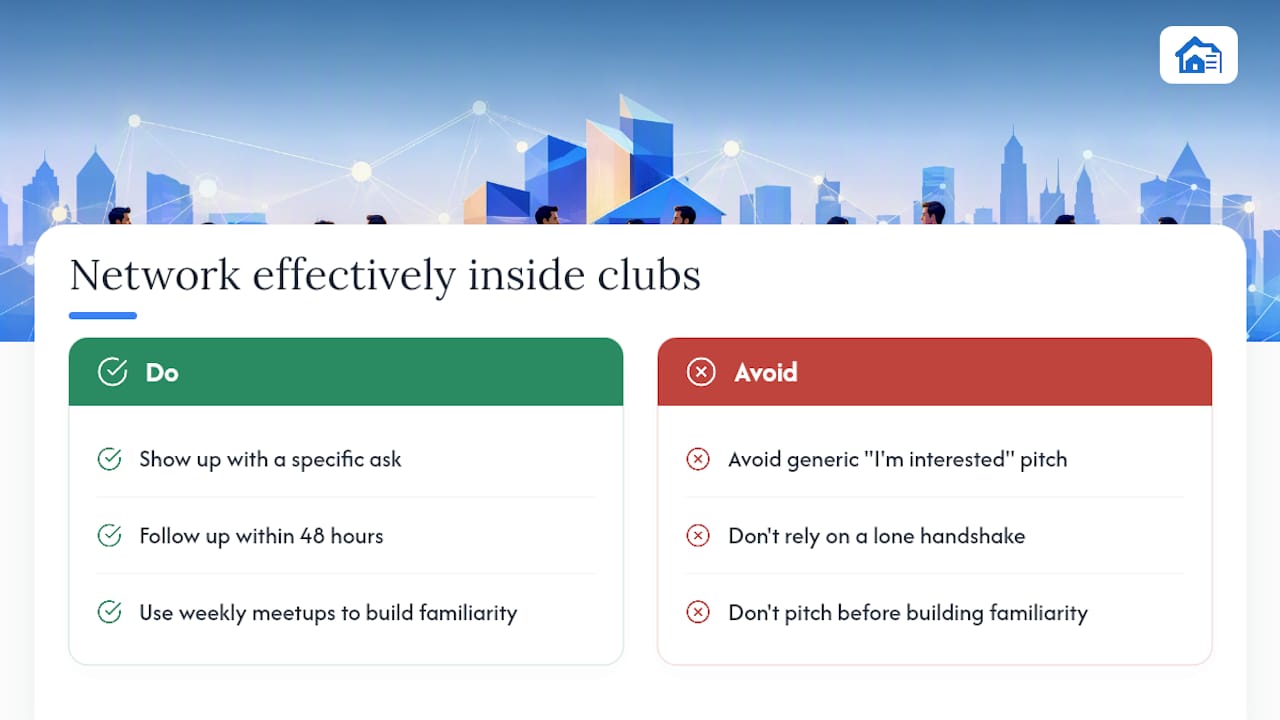
Show up with a specific ask, not just a handshake. The investors who close deals through clubs are the ones who say exactly what they need: “I’m looking for a buy-and-hold duplex in a mid-range price point in North Texas” lands better than “I’m interested in real estate.”
Follow up within 48 hours. A brief email referencing something specific from the conversation converts a business card into a real contact. Clubs like the San Jose Real Estate Networking Club (SJRENC) and NJ Flippers and Funders Meetup are built around exactly this kind of recurring, relationship-first deal flow.
Meetup-style groups often run weekly sessions, which gives you more at-bats than a monthly REIA. Use that frequency to build familiarity before pitching a joint venture.
Questions to ask existing members before you join
Before paying annual dues, talk to two or three current members. Ask:
- How often do deals actually get done through this group? Testimonials on a website mean less than a member saying “I closed two wholesales last quarter through leads here.”
- Who speaks at meetings? Clubs like the Real Estate Investing Incubator bring in curriculum-driven instructors. Others, like Wholesalers R US!, lean toward peer-led deal sharing. Neither is wrong, but they serve different goals.
- What does membership cost, and what do you get? Annual dues vary widely. Some groups charge nothing; exclusive mastermind-style clubs charge significantly more in exchange for curated deal access and mentor relationships.
- How long has the chapter been active? Multi-year event histories and published speaker rosters are reliable trust signals. Verify speaker credentials through your state real estate regulator — Texas investors, for example, can cross-check licensing claims at TREC.
What type of real estate investing club actually fits your goals?
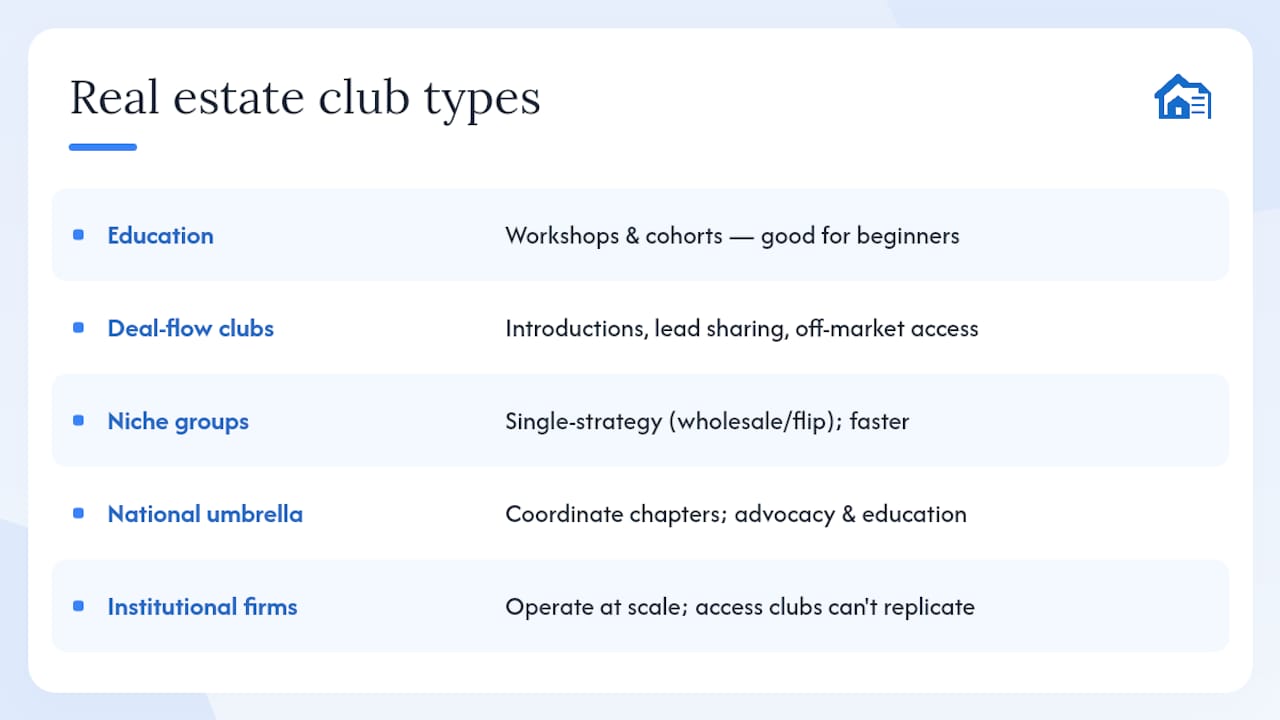
Not every club serves the same investor. The main categories:
Education-focused clubs (Real Estate Investing Incubator, AAII Atlanta Investment Chapter) run structured workshops and cohort programs. Good for beginners building a foundation.
Deal-flow and networking clubs (BadAss Real Estate Investors, Orange County Investment Club FIBI, SJRENC) prioritize introductions, lead sharing, and off-market access. Property networking clubs globally use this same model: member-led deal sharing and training as the core value.
Niche and transactional groups (Wholesalers R US!, NJ Flippers and Funders Meetup) focus on a single strategy. If you wholesale or flip, these groups move faster than broad REIAs.
National umbrella organizations (National REIA, National Real Estate Investors Association) coordinate local chapters and provide advocacy and education infrastructure. Think of them as the framework; local chapters are where the actual networking happens.
One contrast worth keeping in mind: institutional firms like Blackstone operate at a scale and access level that individual investor clubs simply don’t replicate. Clubs are for deal partners, education, and local market intelligence, not institutional-grade fund access.
Active participation is what actually pays off
Passive attendance rarely produces deals. National REIA’s own guidance makes this point directly: the return on membership scales with how much you contribute, not how many meetings you attend.
What that looks like in practice: volunteer to introduce a speaker, join a deal review committee, or co-host a subgroup focused on your niche. Those roles put you in front of the same people repeatedly, which is how trust builds fast enough to share off-market leads.
The honest time split is roughly 30% meetings, 70% one-on-one follow-ups. A monthly REIA meeting is the introduction; coffee the following week is where the partnership actually forms.
Keep your paperwork organized after every meeting
After a productive real estate networking event, most investors lose momentum on follow-up because their notes, contacts, and deal details are scattered. Landlordforms fixes that for landlords managing 1–150 units: automated notices, rent ledgers, lease generation, and state-specific compliance documents, all in one place.

Grab the free rent ledger template to start tracking prospective rents and deal comparisons right after your next meeting, or use the rent proration calculator to model partial-month scenarios on the spot. When a deal moves forward, your property documentation is already organized.
Sources
- Welcome to National REIA - National REIA
- Real Estate Investment Association - Chicago
- Seattle Investors Club - We do real estate deals together
- Professional Investors Club | PIC
- The Property Club | The Property Club
- Blackstone Real Estate - Global Alternative Asset Manager
FAQ
What is a real estate investment club?
A real estate investment club (also called a REIA) is a group where investors meet regularly to share deals, learn from speakers, and build partnerships. Membership can be free or paid, and meetings range from casual meetups to structured chapter events.
What is the best real estate investment group?
National REIA is a large structured network, with many local chapters and tens of thousands of members members. For online communities, BiggerPockets is the most active. For local deal flow, city-level REIAs like Chicago REIA or LAREIA often produce faster results.
Are investment clubs a good idea?
Yes, for investors who participate actively. Clubs provide deal access, education, and partners that are hard to find solo. The risk is wasting time in low-quality groups; vetting a club before paying dues avoids that.
What is the 3-3-3 rule in real estate?
The “3-3-3 rule” has multiple meanings depending on context; definitions vary by club and instructor, so ask the specific group how they apply it.