U.S. Landlords: Stop 3–14 Day Notice Errors With State Forms

Use the delivery method your state statute actually authorizes, include the exact wording that statute requires, and keep dated proof of every step. Skip any of those three and a judge can toss your case before it starts. Two anchors worth bookmarking: your state’s court self-help page (California Courts covers delivery methods here) and a set of state-specific notice templates. When a tenant contests service or claims abuse, stop and call a local attorney.
TL;DR:
- Serving the correct notice type with precise wording and timing is essential; using a template built for a different state can invalidate the process.
- Acceptable service methods include personal delivery, substitute service plus mail, posting and mailing, and certified mail with proof, all governed by state-specific rules.
- Recordkeeping must include affidavits, photos, mail receipts, and copies of notices; these documents are crucial if a tenant disputes service in court.
- Serving a notice to a tenant on active military duty requires following the Servicemembers Civil Relief Act, and calling an attorney before proceedings is advised.
- Using jurisdiction-specific automated templates and proof-of-service tools reduces errors, saves time, and helps ensure compliance with local law.
Table of Contents
- Common Notice Types Landlords Use and When to Serve Each
- What to Check in Your State’s Landlord Notice Requirements
- How to Serve a Notice Correctly, Step by Step
- Proof, Recordkeeping, and Document Evidence Courts Expect
- Common Mistakes That Invalidate a Notice
- How LandlordForms Reduces Notice Errors and Saves Time
- Steps to Verify Tenant Identity Before Serving Notice
- Template Examples and Recommended Language for Notice Types
- Serving Notices to Tenants in the Military Under the SCRA
- A Landlord’s Quick Checklist Before Serving Any Notice
- Skip the Drafting Errors with LandlordForms Templates
- Sources
- FAQ
Common Notice Types Landlords Use and When to Serve Each
Serving notices to tenants only works if you’re serving the right notice for the right problem. Courts don’t forgive a mismatch, even when the underlying issue is real.
- Pay-or-quit notice: for unpaid rent. Common statutory windows run 3 to 14 days depending on the state, and the amount demanded must be rent only.
- Cure-or-quit notice: for a fixable lease violation, like an unauthorized pet or a parking issue. Gives the tenant a set window to fix the problem before the lease ends.
- Unconditional quit notice: reserved for serious breaches, such as property damage or illegal activity. No chance to cure; some states restrict when landlords can use this notice at all.
- Notice to vacate or nonrenewal notice: ends a tenancy at the lease term or converts a month-to-month arrangement, typically requiring 30 or 60 days depending on tenancy length and state.
- Notice of entry: informs a tenant of a landlord’s planned visit for repairs or inspection, usually 24 to 48 hours ahead.
- Rent increase notice: required before raising rent on existing tenants, often 30 to 90 days out depending on the increase size and local rent-control rules.
- Repair or abatement notice: documents a tenant’s request for repairs, which matters if the case later turns into a habitability dispute.
Every one of these has a state-specific timing rule. Before you draft anything, confirm the exact day count in your jurisdiction rather than assuming a national standard exists.
What to Check in Your State’s Landlord Notice Requirements
Notice length, accepted delivery methods, and mail grace periods change by state and sometimes by city. A 3-day pay-or-quit notice in one state might require 14 days somewhere else, and a method that satisfies a Texas court might fail in Seattle, Washington.
Massachusetts requires close attention to lease terms and court procedure before any eviction can proceed, and the Attorney General’s guide to landlord and tenant rights walks through what has to happen before you get anywhere near a courtroom. California’s self-help courts page lays out exactly which delivery methods count as valid. Seattle layers on its own rules through the RentinginSeattle housing provider guidance, including a flat ban on charging tenants for the cost of preparing or serving notices.
Before you serve anything, confirm these five items against your own state statute:
- The exact wording the notice must contain (some states require specific statutory language, not a paraphrase).
- Who is legally allowed to serve the notice (owner, agent, or process server).
- Whether substitute service, posting, or mail-only delivery is allowed, and under what conditions.
- How to count the notice period, including whether the day of service counts and whether mailing adds extra days.
- Any fee restrictions, like Seattle’s rule against passing service costs to tenants.
Pro Tip: Search your state’s official court self-help or landlord-tenant statute site directly, using terms like “[your state] eviction notice service statute,” rather than relying on a generic blog. Statutes get amended, and outdated guidance is one of the most common causes of a dismissed filing.
How to Serve a Notice Correctly, Step by Step
There isn’t one universal method for serving notices to tenants. Courts generally recognize a short list of accepted approaches, and mixing them up, or skipping the required follow-up step, is exactly what gets cases dismissed.
- Personal delivery. Hand the notice directly to the tenant. Note the date, time, and the name of whoever served it. If a witness is present, have them sign a line confirming what they saw.
- Substitute service plus mail. If the tenant isn’t home, some states let you leave the notice with another adult at the property, then mail a copy the same day. Record both actions separately, with dates.
- Post and mail. When no one answers and substitute service isn’t possible, tape the notice to the door (never slide it fully under, where it could go unnoticed) and mail a copy immediately after. Photograph the posted notice with a visible timestamp before you leave.
- Certified mail with return receipt. Useful for creating a paper trail, but check your state statute first. Some jurisdictions accept it as a standalone method; others require it only as a supplement to personal or posted service.
- Skip email and text unless your lease and state law both allow it. Digital delivery is often insufficient for formal eviction-related notices, and relying on it without statutory backing is one of the fastest ways to lose a case on a technicality.
Seattle’s ordinance illustrates how local rules layer on top of state law: landlords there must attempt personal service first, and if that fails, posting and mailing adds five extra days before the notice period runs out.
Build a proof-of-service packet as you go: a signed affidavit with the date, time, method, and server’s name; photos of any posted notice; certified mail receipts; and a copy of the notice itself, cross-referenced to whatever you eventually file with the court.
Proof, Recordkeeping, and Document Evidence Courts Expect
Courts generally accept properly executed service even if the tenant insists they never saw the notice. What matters is the documentation, not the tenant’s claim of receipt, according to practice guidance on service of notices.
Build your case folder around these documents:
- A signed affidavit or certification of service listing the method, date, time, and server’s name. Some jurisdictions want it notarized before filing.
- Timestamped photos of any posted notice, saved with the original file metadata intact.
- Mail tracking numbers and receipts, kept with the envelope if possible.
- A copy of the notice itself, dated and matched to your affidavit.
Keep this folder for at least as long as your state’s statute of limitations on landlord-tenant disputes, and bring physical copies to any hearing.
Common Mistakes That Invalidate a Notice
A tenant eviction notice that looks fine on paper can still fail in court over small procedural errors. The most frequent ones:
- Using the wrong notice type or the wrong day count for your state, often because a landlord copied a template built for a different jurisdiction.
- Charging tenants for the cost of preparing or delivering the notice, which Seattle’s ordinance specifically prohibits and other cities restrict too.
- Sending a formal notice by email or text with no lease clause or statute permitting it.
- Missing documentation: no date on the affidavit, no witness signature, no mail receipt saved.
Pro Tip: If a pay-or-quit notice lists anything beyond rent, like late fees or a preparation charge, some jurisdictions will invalidate the whole notice, not just the extra charge. Itemize rent only when the notice is a rent demand.
How LandlordForms Reduces Notice Errors and Saves Time
Some software automates the parts landlords get wrong most often: state-specific notice wording, automatic date stamps, and exportable proof-of-service records. Users report saving time that used to go into manual drafting and filing. That translates directly into fewer missed statutory deadlines and fewer drafting mistakes. For a routine pay-or-quit or nonrenewal notice, the templates cover it. For contested evictions or anything involving disability accommodations or retaliation claims, bring in local counsel.
Steps to Verify Tenant Identity Before Serving Notice
Serving a notice to the wrong person doesn’t just waste time. It can invalidate the entire filing if the tenant later argues they were never properly served.
Start by confirming the name on the notice matches the name on the current, signed lease exactly, including any co-tenants or authorized occupants listed. If a tenant has sublet the unit or added an occupant without your written consent, serve the notice to every name that appears on the lease, not just whoever answers the door.
When personal delivery is your method, ask for the recipient’s name before handing over the notice, and note it on your affidavit even if you already know them. If someone claims to be a “friend” or “family member” answering the door, that’s exactly the scenario substitute service rules exist for. Confirm the person is an adult residing at the property, not a visitor, before treating the delivery as valid substitute service.

For properties with high turnover or multiple occupants, cross-check your records against your signed lease and any addenda before serving. A quick pull from your tenant rights and compliance records can confirm who’s actually on the hook. If you’re unsure whether someone living at the unit is a legal tenant or an unauthorized occupant, that ambiguity alone is often reason enough to consult an attorney before serving anything formal.
Template Examples and Recommended Language for Notice Types
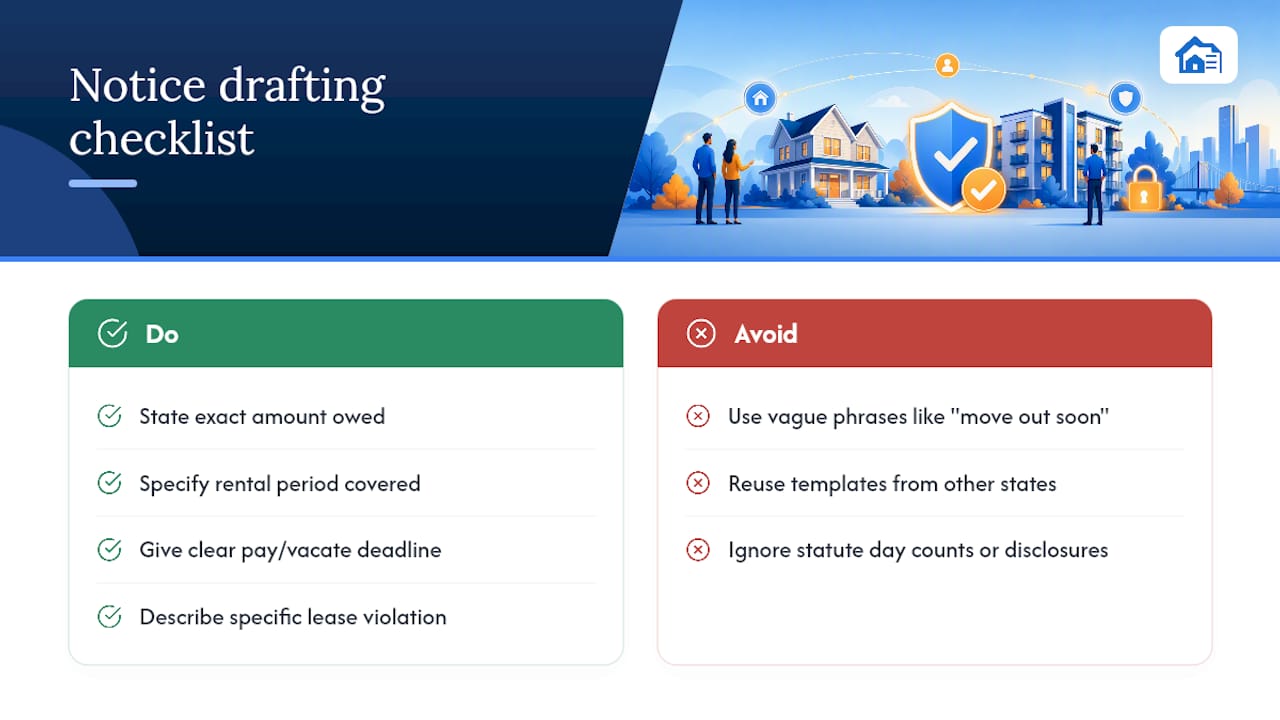
A pay-or-quit notice needs to state the exact amount owed, the rental period it covers, the deadline to pay or vacate, and the consequence of neither. Language like “You are hereby notified that rent in the amount of [dollar amount] for the period of [dates] is due and unpaid. You have [number] days from the date of this notice to pay the full amount or vacate the premises” hits the required elements in most states, but the day count and required disclosures still need to match your statute.
A cure-or-quit notice should describe the specific lease violation, cite the lease section if possible, and state exactly what remedying the violation looks like: “You are in violation of Section [X] of your lease regarding [violation]. You have [number] days to cure this violation or vacate the premises.”
A notice to vacate for nonrenewal is simpler but still needs precision: state the termination date clearly, reference the lease or tenancy type, and confirm the required notice period has been met. Skip vague language like “move out soon.” Courts want dates.
Rather than drafting from scratch or reusing a template built for a different state, an eviction notice generator that adjusts wording by jurisdiction removes the guesswork on required statutory phrases. The same logic applies to renewals: a lease renewal notice template keeps the required advance-notice language consistent across every unit you manage.
Serving Notices to Tenants in the Military Under the SCRA
The Servicemembers Civil Relief Act adds a layer of protection that a lot of landlords don’t think about until it’s already a problem. If a tenant is on active duty, standard eviction timelines and notice procedures don’t automatically apply the way they would to a civilian tenant.
Before serving any notice tied to nonpayment or lease termination, check whether the tenant is currently serving. The SCRA generally requires a court to review an eviction case involving a servicemember, and in many circumstances, a judge can delay proceedings or require the landlord to show the eviction isn’t connected to the tenant’s military service. This applies even if the lease was signed before the tenant enlisted or was called to active duty.
Practically, that means: don’t skip formal notice procedures because you assume a court will fast-track a case against a deployed tenant. If anything, document everything more carefully, since a servicemember eviction case gets more judicial scrutiny than a standard one. If a tenant identifies as active duty, or you have reason to believe they might be, loop in an attorney before filing anything. The stakes for getting this wrong include the case being stayed for months or dismissed outright, and some jurisdictions impose penalties on landlords who proceed without the required court review.
A Landlord’s Quick Checklist Before Serving Any Notice
Confirm the right notice type, verify your state’s required wording and day count, choose an authorized delivery method, document every step with dates and photos, keep mail receipts, and file your affidavit with the eviction case. Escalate to an attorney the moment a tenant disputes service, claims retaliation, or raises a servicemember protection. For the paperwork itself, state-aware notice templates and a solid recordkeeping habit handle the rest.
— Igor
Skip the Drafting Errors with LandlordForms Templates
Online tools offer alternatives to drafting notices from scratch or recycling templates built for the wrong state. Some provide jurisdiction-specific wording, automatic date stamps, and exportable proof-of-service records to help reconstruct delivery timelines before a hearing.

Start with the eviction notice generator if you’re facing a nonpayment or lease-violation issue right now. Pair it with the rent ledger template to document exactly what’s owed and when, which matters if a pay-or-quit notice ever gets challenged in court. If you’re prorating rent for a mid-month move-out tied to a notice period, the rent proration calculator gets the math right without a spreadsheet. Try the templates free, and if a case turns contested or involves a servicemember tenant, bring in local counsel. LandlordForms handles the paperwork; it doesn’t replace an attorney when a case gets complicated.
This article is general information, not a substitute for advice from a qualified lawyer. Consult a qualified legal professional about your own circumstances before acting on anything here.
Sources
- Issuing Notices - RentinginSeattle
- Deliver the notice | California Courts | Self Help Guide
- Mass
- Service of Notices — Wallace Law
FAQ
Can I Serve Notice on My Own Tenants?
Yes, in most states landlords can serve notices themselves, though some require personal delivery to be attempted before other methods, and a few states restrict who can serve court-related paperwork. Check your state’s specific rule on who qualifies as a proper server before you serve it yourself.
How Much Notice Must a Tenant Give to Vacate in Washington State?
Requirements vary by tenancy length and lease type, and Seattle adds its own layer on top of state law, including rules on service methods and mail grace periods. Check the RentinginSeattle guidance for the exact current requirement before serving.
How Do I Serve an Eviction Notice in California?
California accepts personal delivery, leaving the notice with another adult plus mailing a copy, or posting and mailing, and requires a written record of how and when the notice was delivered, according to California Courts’ self-help guidance. Keep a signed record no matter which method you use.
What Happens if I Serve a Notice Incorrectly?
Improper service is one of the most common reasons eviction cases get dismissed, which restarts your notice period and delays the entire process. In some cases it can also expose you to the tenant’s attorney fees, so confirm your method matches your state statute before serving.
Does LandlordForms Cover State-Specific Notice Wording?
Yes, LandlordForms builds notices with state-specific required language and automatic date stamping, which reduces the drafting errors that most often cause dismissed filings. It’s built for routine notices; contested cases still call for local counsel.