Tenant Dispute Evidence Documentation Best Practices

TL;DR:
- Proper recordkeeping is essential for landlords to meet the standard of proof in tenant disputes, which requires showing claims are more than 50% likely true. Organizing evidence into six categories—contracts, payments, communications, photos, correspondence, and notices—ensures comprehensive and effective documentation. Maintaining unedited photos with EXIF data, exporting full message threads, and matching evidence to dispute types strengthen a landlord’s case.
Tenant dispute evidence documentation is the process of collecting, organizing, and preserving records that prove your claims meet the balance of probabilities standard in civil and deposit disputes. That standard means your evidence must show your claim is more than 50% likely true. Without comprehensive records, landlords routinely lose cases they should win. The core evidence categories every landlord needs are contracts, payment records, communication logs, and inspection photos. Landlordforms helps property managers build and maintain exactly these records before a dispute ever reaches a hearing.
1. What are the essential categories of evidence every landlord should collect?
Strong dispute resolution documentation starts with knowing which record types courts and mediators actually rely on. Missing even one category can leave a critical gap in your case.
The six categories that form the backbone of any tenant dispute case are:
- Lease agreements and addenda. The signed lease is your legal foundation. Keep every version, every addendum, and every renewal with signatures intact.
- Payment records. Bank statements, rent ledgers, and receipts create an unbroken financial timeline. A rent ledger template makes this easy to maintain from day one.
- Communication logs. Emails, text messages, and formal written notices all count. Export full threads rather than isolated messages to preserve context.
- Photographs and video. Dated, unedited images of the property at move-in and move-out are the most persuasive visual evidence available.
- Prior dispute correspondence. Any letters, repair requests, or complaints exchanged before the formal dispute show the history of the relationship.
- Notices and deadlines. Copies of every official notice, along with proof of service, establish that you followed proper legal procedure.
Each category serves a different function. Payment records answer financial claims. Photos answer condition claims. Notices answer procedural challenges. A landlord who collects all six categories is prepared for any direction a dispute takes.
2. How to organize and label evidence for maximum legal effectiveness
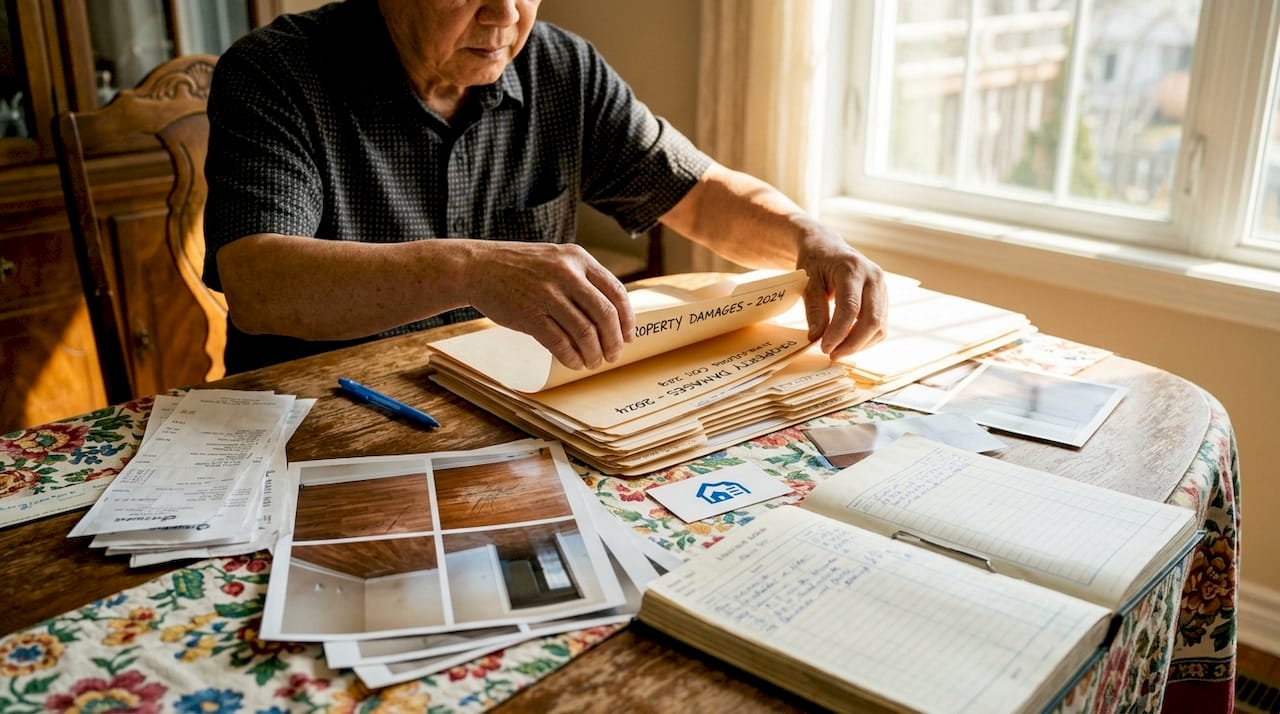
A disorganized evidence packet loses cases even when the underlying facts are favorable. Organizing evidence into six categories with ISO-date file names allows judges and mediators to locate any document in under 30 seconds. That speed matters in hearings where time is limited.
A practical folder structure looks like this:
- 01_Contract — lease, addenda, and renewal documents
- 02_Payments — rent ledger, bank statements, and receipts
- 03_Communications — exported email threads and text logs
- 04_Photos_Video — inspection images and walkthrough recordings
- 05_Prior_Correspondence — repair requests, complaints, and responses
- 06_Notices_Deadlines — served notices with proof of delivery
Name every file using ISO date format: YYYY-MM-DD followed by a brief description. For example, “2026-03-15_Move-In-Inspection-Photos.zip” is instantly sortable and unambiguous. Create a one-page index document inside the root folder that lists every file, its category, and a one-sentence description. This index lets a judge or attorney scan your entire packet in minutes.
Pro Tip: Keep both a digital backup in cloud storage and a physical printed copy. Courts sometimes request paper submissions, and a hardware failure before a hearing can be catastrophic.
Under California Evidence Code §§ 1400–1402, documents must show clear provenance without alteration. A clean folder structure with original, unmodified files satisfies that requirement directly.
3. Photo documentation best practices for tenant disputes
Visual evidence is the most persuasive tool in a deposit or property damage dispute. Detailed inspection records with side-by-side move-in and move-out photos convert emotional arguments into factual conversations. The difference between winning and losing often comes down to whether your photos were taken correctly.
Follow the three-shot method for every area of the property:
- Wide shot. Capture the entire room or space to establish context and location.
- Medium shot. Move closer to show the specific area of concern within its surroundings.
- Close-up shot. Get tight on the damage or condition, and place a ruler or coin in frame for scale.
Forensic photography standards require adding a physical scale object to close-up images. A ruler next to a crack or stain proves its size quantitatively. That detail alone can shift a dispute from opinion to measurable fact.
“A move-in condition report signed by both parties is the most important document to resolve deposit disputes. It sets the baseline for assessing property condition changes and damage claims.”
Shoot from the same angle and under the same lighting at move-in and move-out. Consistency makes side-by-side comparison undeniable. Store original files without any editing, cropping, or AI enhancement. Editing or cropping photos destroys EXIF metadata, which courts use to verify when and where an image was taken. A modified photo can be ruled inadmissible entirely.
Pro Tip: Record a video walkthrough at both move-in and move-out with narration. State the date, address, and tenant name at the start of the recording. This creates a timestamped, continuous record that is very difficult to dispute.
The photo documentation guide from Landlordforms covers the full workflow for property managers who want a repeatable system.
4. How to document communication and payment history
Communication records prove what was said, when it was said, and who said it. Exporting full digital message threads preserves context and metadata far better than screenshots alone. A screenshot of a single text message out of context can be challenged. A full exported thread cannot.
When screenshots are your only option, each one must show:
- The sender’s name or phone number
- A visible timestamp
- Enough surrounding messages to establish context
- Overlapping content between consecutive screenshots so there are no gaps
For formal notices, keep a copy of the notice itself plus proof of service. Proof of service means a signed delivery receipt, a certified mail confirmation, or a process server’s affidavit. Without proof of service, a tenant can claim they never received the notice.
Pro Tip: Never delete any message, even one that seems unfavorable. Selective deletion is a form of evidence spoliation and can destroy your credibility with a judge far more than an awkward message ever would.
Maintain a running rent ledger that records every payment received, the date it was received, and any balance due. Bank statements alone are not enough because they do not show what each deposit was for. A dedicated rent ledger paired with bank statements creates an airtight financial record. Landlordforms generates this ledger automatically, reducing the chance of manual entry errors.
5. Common mistakes that undermine tenant dispute evidence
The most damaging errors in evidence collection are not dramatic. They are small, avoidable habits that quietly destroy a case. Common mistakes like deleting messages or using cropped screenshots can undermine an entire evidence packet.
Avoid these specific errors:
- Deleting or editing files. Any modification to an original document raises questions about authenticity. Courts treat altered evidence with deep suspicion.
- Cropping or enhancing photos. Even minor adjustments strip EXIF metadata. Submit originals only.
- Random, unsorted photo dumps. A folder of 300 unnamed photos is nearly useless in a hearing. Label and organize every image at the time it is taken.
- Missing proof of service. Serving a notice without documenting delivery is the same as not serving it at all in many jurisdictions.
- Informal communication conduct. Angry or unprofessional messages undermine your legal standing even when the underlying facts support your position.
Evidence spoliation, which is the destruction or alteration of evidence, can result in sanctions or an adverse inference ruling. That means a judge may instruct a jury to assume the destroyed evidence was unfavorable to you. The cost of a careless deletion far exceeds the discomfort of preserving an unflattering message.
6. How dispute type shapes your documentation strategy
Different dispute types require tailored evidence. A landlord preparing for a deposit dispute needs a very different evidence packet than one facing an unpaid rent claim. Knowing which evidence type to prioritize saves time and strengthens your specific case.
| Dispute type | Primary evidence | Supporting evidence |
|---|---|---|
| Security deposit deduction | Move-in/out photos, signed condition report | Repair receipts, itemized deduction list |
| Unpaid rent | Rent ledger, bank statements | Communication logs, lease payment terms |
| Property damage | Inspection reports, repair invoices | Contractor estimates, before/after photos |
| Breach of lease | Signed lease with violated clause | Written warnings, communication history |
For deposit disputes, a move-in checklist signed by both parties is the single most important document. It sets the baseline that every later photo comparison depends on. For unpaid rent cases, the financial record trail is everything. For breach of lease claims, documented warnings show you followed proper procedure before taking action.
Align your evidence collection to the dispute you are most likely to face. A landlord managing older properties should prioritize detailed inspection documentation. A landlord with a history of late payments should maintain meticulous payment records from day one.
Key takeaways
Strong tenant dispute evidence documentation requires six organized evidence categories, unedited photos with EXIF metadata intact, full communication thread exports, and a signed move-in condition report as the baseline for every deposit claim.
| Point | Details |
|---|---|
| Meet the burden of proof | Your evidence must show your claim is more than 50% likely true to succeed. |
| Use six evidence categories | Organize records into contract, payment, communication, photo, correspondence, and notice folders. |
| Protect photo metadata | Never edit or crop inspection photos; original EXIF data is required for legal authentication. |
| Export full message threads | Full thread exports preserve context and metadata better than individual screenshots. |
| Match evidence to dispute type | Prioritize photos for deposit claims, financial records for unpaid rent, and signed warnings for breach cases. |
Documentation is a fairness tool, not just legal armor
Most landlords think about documentation only when a dispute is already brewing. That is the wrong frame entirely. The landlords I have seen navigate disputes most cleanly are the ones who built their documentation habits before any tension existed.
When you document consistently, something unexpected happens. Disputes become shorter. Tenants who know you have thorough records are far less likely to make claims they cannot support. The inspection photos you took at move-in are not just legal protection. They are proof that you cared about the property’s condition and gave the tenant a fair baseline. That transparency changes the dynamic of the entire relationship.
The cases that drag on for months, the ones that end up in small claims court or before a housing board, almost always share one feature: incomplete records on both sides. When neither party has solid documentation, disputes become contests of memory and credibility. Strong records shift that contest to facts. Facts resolve faster and cheaper than feelings.
My honest recommendation is to treat documentation as a professional standard, not a defensive reaction. Build your folder structure before a tenant moves in. Take your three-shot photos on day one. Export your first communication thread the week the lease is signed. By the time a dispute arises, your evidence packet practically builds itself.
— Igor
Landlordforms tools that support your evidence workflow
Landlordforms is built for landlords managing 1 to 150 units who need professional documentation without the paperwork burden. The platform generates move-in and move-out checklists, rent ledgers, and formal notices in a few clicks, saving up to eight hours a week on manual tasks.

The free move-in checklist generator produces a signed, dated condition report that serves as the legal baseline for every deposit dispute. The rent ledger template tracks every payment with dates and balances, creating the financial record trail unpaid rent cases depend on. For landlords who want a full library of ready-to-use forms, the document templates collection covers notices, receipts, and inspection reports. Visit Landlordforms to access every tool in one place.
FAQ
What is the burden of proof in a tenant dispute?
In civil and deposit disputes, landlords must prove their claims are more than 50% likely true. This standard is called the balance of probabilities, and comprehensive records are the most reliable way to meet it.
What is the most important document in a deposit dispute?
A move-in condition report signed by both parties is the most critical document. It establishes the baseline property condition that all move-out comparisons depend on.
How should landlords store inspection photos?
Store original, unedited photo files with EXIF metadata intact in a clearly labeled folder using ISO date format. Never crop, enhance, or apply filters, as any modification can make the photo inadmissible in court.
What counts as proof of service for a formal notice?
Proof of service includes a signed delivery receipt, a certified mail confirmation, or a process server’s affidavit. Without one of these, a tenant can claim the notice was never received.
How does documentation differ by dispute type?
Deposit disputes rely primarily on move-in and move-out photos paired with a signed condition report. Unpaid rent cases center on rent ledgers and bank statements. Breach of lease claims require the signed lease, documented warnings, and a clear communication history.