24–48 Hour Norms That Shape U.S. Notice of Entry Laws for Landlords

Most states expect landlords to give tenants somewhere between 24 and 48 hours’ notice before entering an occupied rental, though the exact rule depends entirely on where the property sits. Emergencies like fire, flooding, or a gas leak are the universal exception, letting landlords enter immediately without warning. A handful of states, including Texas, have no statute at all, leaving the notice period to the lease and long-standing quiet enjoyment principles.
TL;DR:
- Most states require landlords to give between 24 and 48 hours’ notice before entry, with emergencies being the only exception for immediate access.
- Notice must include the specific date, an approximate time window, the purpose, and the entering party, with delivery methods affecting legal validity.
- Landlords managing multiple units should use state-specific notice templates and keep proof of delivery to prevent disputes or claims of improper entry.
- Lease terms can override state minimums by requiring longer notice periods, but cannot demand less than the law specifies.
- Proper documentation and adherence to legal notice protocols are essential to avoid penalties, rent abatements, or legal claims of breach.
Table of Contents
- How Notice Periods Differ From State to State
- What a Valid Entry Notice Must Say and How to Deliver It
- When Landlords Can Enter Without Standing Notice
- What Tenants Can Do When a Landlord Enters Improperly
- How to Build a Defensible Notice Workflow, Step by Step
- How Your Lease Terms Interact With State Entry Law
- Notice Rules Across Different Types of Rental Properties
- Commercial Leases Play by Different Rules Than Residential Ones
- A Practical Take on Notice Defaults and Documentation
- Skip the Guesswork With State-Aware Notice Templates
- Sources
- FAQ
How Notice Periods Differ From State to State
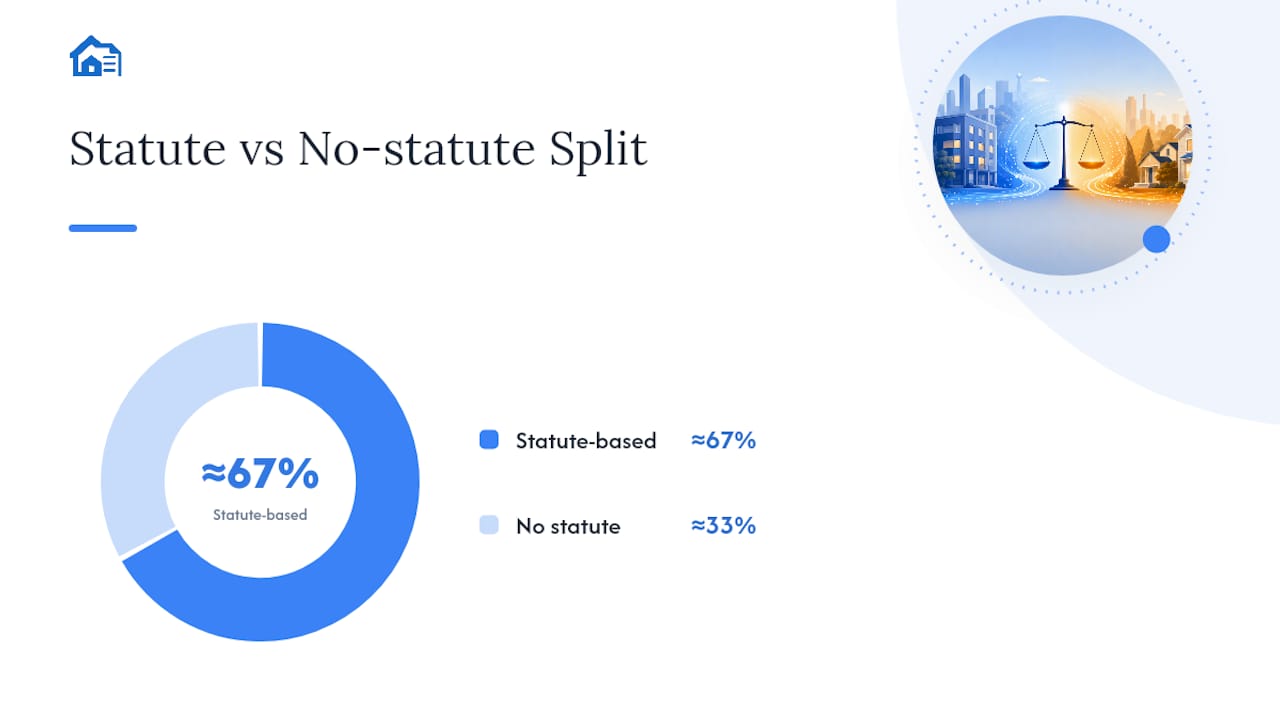
There is no single national standard for notice of entry laws, and that surprises a lot of landlords who assume 24 hours is a federal rule. It isn’t. About two-thirds of states plus D.C. have statutes that spell out entry rules, according to a national review of landlord entry requirements, and the remaining states rely on lease language, local ordinances, or common-law protections like quiet enjoyment.
Three patterns show up again and again once you start comparing states side by side:
- Defined-hour statutes. California’s Civil Code §1954 presumes 24 hours’ written notice is reasonable, and that 24-hour figure has become something of an industry default even in states without a formal law.
- Longer notice windows. Seattle’s Department of Construction & Inspections recommends at least two days’ written notice for inspections, repairs, or service calls, which is stricter than the statewide Washington minimum.
- Reasonable notice or statutory silence. Florida’s Statute §83.53 allows entry on “reasonable notice” at “reasonable times,” and most Florida landlords treat that as 24 hours for routine repairs, though the statute itself never names a number.
Wisconsin sits in an interesting middle ground. Its statutes require advance notice and entry at reasonable times, and the administrative code goes further than most states by explicitly addressing acceptable delivery methods, including text or email where the tenant has agreed to it. Maryland’s statute similarly ties notice to specific permitted purposes rather than a flat time window. Texas, by contrast, has no statewide law on landlord entry at all. The Texas State Law Library confirms that entry rights in Texas come from the lease itself and from the tenant’s common-law right to quiet enjoyment rather than from a numbered statute.
One detail trips up more landlords than it should: mailed notice and hand-delivered notice don’t start the clock at the same moment. California’s mailing presumption assumes mailed notice is reasonable only if sent several days before the intended entry, which means a landlord who waits until the last minute and mails a notice instead of delivering it in person can accidentally violate the very statute they’re trying to follow.
What a Valid Entry Notice Must Say and How to Deliver It
A notice that skips a required element is legally worthless, even if the timing is perfect. Templates and legal summaries consistently point to the same four elements as the baseline for a defensible notice:
- The specific date of entry. “Sometime next week” doesn’t satisfy any statute.
- An approximate time window. A two to four hour range is standard practice.
- The stated purpose. Repair, inspection, showing, or another lawful reason.
- Who will be entering. The landlord, a contractor, a property manager, or an agent.
Delivery method matters just as much as content, and not all methods carry equal legal weight. Personal delivery to the tenant is the most defensible option because there’s a clear moment of receipt. Posting a notice on the door combined with mailing a copy is the next tier, often used when the tenant can’t be reached directly. Certified mail with a return receipt creates a paper trail but adds days to the timeline. Email or text can work, but only where the tenant has consented to electronic notice, either in the lease or through a separate signed acknowledgment. Wisconsin’s rules are among the more explicit here, permitting electronic delivery when tenants have agreed to it in writing.
The statutory clock almost always runs from the moment the tenant receives the notice, not from when the landlord sends it. That distinction is why proof of delivery matters so much in a dispute.
Pro Tip: Keep a dated copy of every notice you send, along with a screenshot or delivery confirmation. If a tenant later claims they never received it, a timestamped record is often the only thing standing between you and a rent abatement claim.
When Landlords Can Enter Without Standing Notice
Every state that regulates entry carves out the same short list of lawful reasons, even when the notice period itself varies. The most common permitted purposes are:
- Repairs, maintenance, or landlord-ordered improvement work
- Routine inspections tied to lease terms or local housing codes
- Showings to prospective tenants or buyers, typically near the end of a lease
- Court-ordered access, including eviction enforcement
- Situations where the unit appears abandoned
Emergencies override the notice requirement entirely. A burst pipe flooding the unit below, an active gas leak, or a fire are the textbook examples, and every state statute that addresses entry treats these as exceptions where advance warning simply isn’t practical. The logic is straightforward: a delayed response to a gas leak causes more harm than skipping a 24-hour notice ever could.
There’s also a quieter shortcut that a lot of landlords overlook. If a tenant verbally agrees to a specific time, that consent generally satisfies the notice requirement on its own, even without a formal written notice. It’s worth documenting that agreement anyway, ideally with a quick confirmation text, so there’s no ambiguity later about what was actually agreed to.
What Tenants Can Do When a Landlord Enters Improperly
Tenants who experience a lockbox opened without warning or a landlord walking in mid shower have real options, and they start with documentation, not confrontation. Photographing the scene, saving any notice that was provided (or noting that none was), and writing down the exact time of entry all build a record that matters later.
From there, tenants typically have several paths available depending on how serious or repeated the violation is:
- Filing a written, dated complaint with the landlord or property manager as a first step
- Reporting the violation to a local housing authority or code enforcement office
- Pursuing rent abatement or small-claims damages where local law allows it
- Seeking a harassment claim or injunction if entries are repeated or clearly retaliatory
Landlords face real exposure here too, and not just reputational. Improper entry can support a rent abatement claim, a breach of quiet enjoyment lawsuit, or in repeated cases, a harassment finding that damages a landlord’s standing in future disputes. The single worst response to a stalled negotiation over access is self-help: changing locks, removing tenant belongings, or forcing entry without going through notice and, if necessary, the courts. Those moves tend to convert a minor notice dispute into a much larger legal liability.
How to Build a Defensible Notice Workflow, Step by Step
A repeatable process beats scrambling every time you need to schedule a repair. Here’s the sequence that holds up under scrutiny:
- Confirm your state’s rule first. Check the statute or municipal guidance for your city, and cross-reference your lease, since some leases specify a longer notice period than state law requires.
- Draft the notice with all four required elements: date, time window, purpose, and who is entering.
- Choose the strongest delivery method your jurisdiction recognizes. Personal delivery when possible, posted-and-mailed when the tenant is hard to reach, and email or text only with documented consent.
- Log proof of service and inspection notes the moment the notice goes out, not after the visit happens.
Where a state requires posting and mailing together, both steps need to happen, not just one. And where tenants have consented to electronic notice, that consent should live somewhere permanent, like the signed lease, rather than a text thread that can get deleted.
Landlords managing more than a handful of units tend to lose track of which notice went to which tenant on which date, which is exactly the kind of gap that turns into a rent abatement claim months later. A state-aware entry notice template removes the guesswork on formatting, and pairing it with a centralized log of delivery dates and inspection photos gives you a complete paper trail if a dispute ever reaches small-claims court.
How Your Lease Terms Interact With State Entry Law
A lease can require more notice than state law demands, but it generally cannot require less. If Florida law treats 24 hours as reasonable and your lease promises tenants 48 hours, the lease terms win because they’re more protective of the tenant, and courts typically enforce the more generous standard when there’s a conflict.
This is exactly why lease drafting matters as much as knowing the statute. A landlord who copies a generic lease template from another state might accidentally promise a notice period that doesn’t match local law, then finds themselves bound to the stricter number anyway. In states like Texas, where there’s no statewide entry statute, the lease becomes the primary source of truth. Whatever the lease says about notice and access essentially fills the gap the statute leaves open, right alongside the tenant’s common-law right to quiet enjoyment.
The safest approach is to write specific notice language into every lease regardless of what the state minimum happens to be. Spell out the notice period, the acceptable delivery methods, and how emergencies are handled. That way, both landlord and tenant are working from the same document instead of arguing over what a vague state statute might mean in practice. It also protects landlords who operate across multiple states, since a single standardized lease clause, set to the most conservative applicable standard, avoids the trap of accidentally under-notifying a tenant in a stricter jurisdiction.
Notice Rules Across Different Types of Rental Properties
Single-family rentals are usually the simplest case, since there’s one tenant, one unit, and the statutory notice period applies cleanly. Multi-family buildings introduce more moving parts. A landlord entering common areas, like a shared laundry room or hallway, generally doesn’t need tenant notice at all, but entering an individual unit still triggers the full notice requirement regardless of how many other units are in the building.
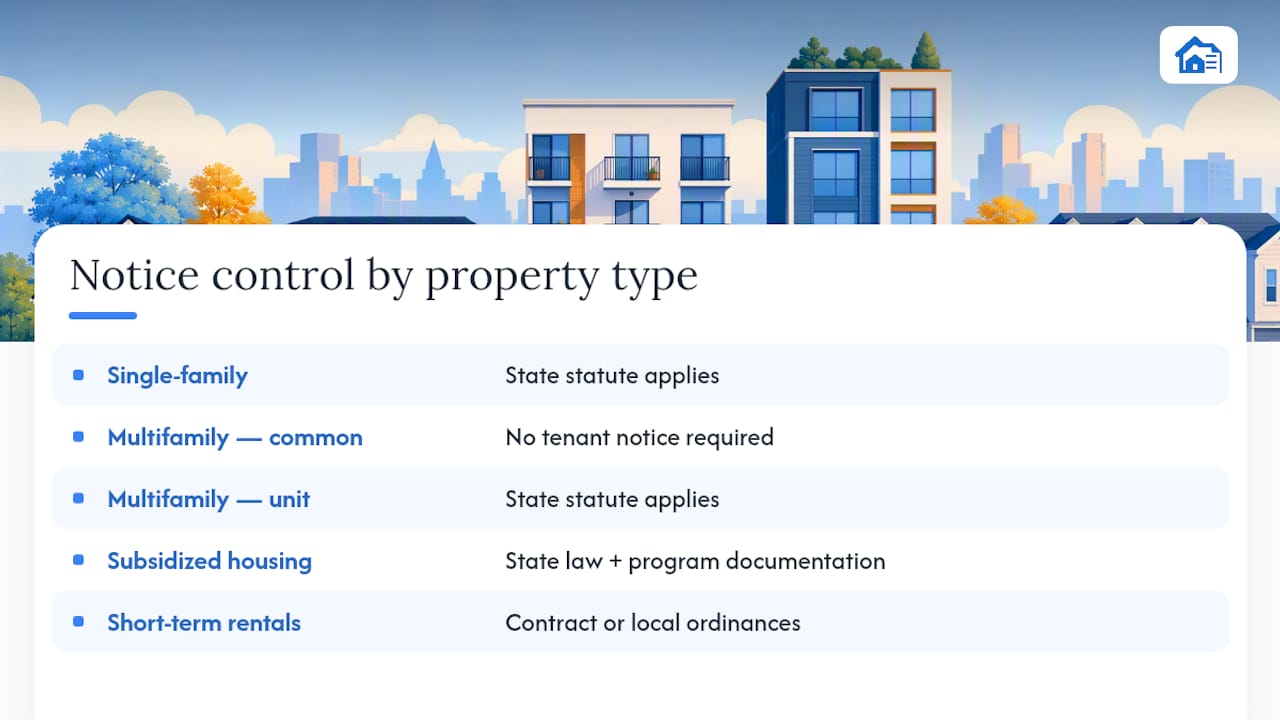
Subsidized housing, including properties operating under Section 8 or other HUD-linked programs, often layers additional requirements on top of state law. Housing authorities sometimes require documented notice procedures as a condition of program participation, which means a landlord in subsidized housing may need to satisfy both the state statute and the program’s own paperwork standards. Skipping the program-specific documentation can create compliance problems even if the state notice period itself was met.
Short-term and furnished rentals occupy a gray area in some states, since certain entry statutes apply specifically to residential leases of a minimum length. A month-to-month arrangement typically still counts as a residential tenancy for notice purposes, but a true short-term stay booked through a rental platform may fall outside standard landlord-tenant law entirely, governed instead by contract terms or local short-term rental ordinances. Landlords managing a mixed portfolio, some long-term leases and some short-term units, need to check which framework actually applies to each property rather than assuming one policy covers everything they own.
Commercial Leases Play by Different Rules Than Residential Ones
Residential notice-of-entry statutes exist specifically to protect a tenant’s home, and that protection generally does not extend to commercial space in the same way. Commercial leases are treated as negotiated contracts between businesses, so entry rights are whatever the lease says they are, with far less statutory backstop than residential tenants get.
That makes the lease document itself the entire ballgame in commercial real estate. A commercial landlord who wants the right to inspect, show the space to prospective tenants, or perform maintenance needs that spelled out in the lease terms, because there typically isn’t a state statute like California’s Civil Code §1954 sitting in the background to impose a default rule. Sophisticated commercial tenants often negotiate their own notice provisions into the lease precisely because they know the statutory protection residential tenants enjoy isn’t automatically available to them.
The practical takeaway for anyone managing both residential and commercial units under one portfolio: don’t assume the notice practices that work for an apartment building translate to a retail space or office suite. They don’t, and treating them the same way risks either overpromising access rights you don’t actually have, or under-using rights the lease already grants you.
A Practical Take on Notice Defaults and Documentation
When a state’s rule is vague or the statute is silent, defaulting to 48 hours instead of the bare legal minimum is the smarter move. It costs a landlord almost nothing in scheduling flexibility and it demonstrates good faith if a dispute ever lands in front of a judge. Consistent templates and timestamped delivery logs do more to protect landlords than any clever legal argument, because judges tend to favor the party with a paper trail. None of this replaces treating tenants like people who deserve a heads-up before someone walks into their home.
— Igor
Skip the Guesswork With State-Aware Notice Templates
Chasing down the right statute for your state every time you need to schedule a repair wastes time you don’t have, especially if you’re managing units across more than one jurisdiction. Landlordforms builds notice periods and required content directly into its templates, so the document you generate already reflects what your state expects instead of a generic form you have to double-check against a statute yourself.

Landlordforms’s entry notice template is free to use without creating an account, and it covers the same four elements courts and statutes look for: date, time window, purpose, and who’s entering. For landlords who want the delivery and inspection side handled too, including photo documentation and a running log of every notice sent, the Starter Landlord, Pro Landlord, and Small PM Suite plans starting at $9 per month automate that recordkeeping so you’re not hunting through email threads if a tenant ever disputes an entry. Grab the free template first, then decide if the paid tracking tools fit how many units you’re managing.
This article is general information, not a substitute for advice from a qualified lawyer. Consult a qualified legal professional about your own circumstances before acting on anything here.
Sources
- California Civil Code §1954
- Notice to Enter a Rental Unit - Seattle DCI
- Wisconsin Statutes §704.05
- Texas State Law Library — Landlord entry FAQ
- Landlord notice of entry: requirements, timing, and form — LegalClarity
FAQ
What is a legal notice of entry?
A legal notice of entry is written notification a landlord gives a tenant before entering an occupied rental, stating the date, approximate time, purpose, and who will be entering. Most states that regulate this require 24 to 48 hours’ notice for non-emergency entry, though the exact requirement depends on your state’s statute or your lease terms.
Can I refuse entry to my landlord in Texas?
Texas has no statewide statute specifically regulating landlord entry, so your rights come primarily from your lease and the common-law right to quiet enjoyment, according to the Texas State Law Library. If your lease specifies a notice period and your landlord ignores it, you may have grounds to object, but the analysis depends heavily on what your specific lease says.
Can my landlord show up unannounced in Florida?
Generally no, except in an emergency. Florida Statute §83.53 requires landlords to enter on reasonable notice at reasonable times for repairs, and Florida landlords commonly treat 24 hours as the standard, even though the statute itself doesn’t name an exact number.
How much notice does a landlord have to give before they can enter?
It depends on the state: California presumes 24 hours is reasonable, Seattle recommends at least two days for inspections and repairs, and states without a specific statute default to whatever the lease requires. Emergencies are the one universal exception that allows immediate entry without any notice at all.
What happens if a landlord enters without proper notice?
Consequences range from a tenant complaint or rent abatement claim to a lawsuit for breach of quiet enjoyment, particularly if the entry was repeated or clearly retaliatory. Landlords should always use the formal notice process and the courts to resolve access disputes rather than resorting to lockouts or forced entry.