U.S. Landlords: Stop Rent Increase Notice Mistakes With Free Template

To raise rent legally, deliver a written rent increase notice that names the new amount and an effective date that satisfies your state and any local law, then keep provable delivery records. The notice period is your gating requirement, and in California, Oregon, and Washington, a statewide cap may limit how much you can raise rent at all. Skip the paperwork or fumble delivery, and the increase can be flatly unenforceable.
TL;DR:
- Landlords must follow specific state and local laws for notice periods, caps, and delivery methods to ensure rent increases are enforceable.
- Incorrect or incomplete notices, such as missing fields or improper delivery, are common reasons for disputes and can nullify the increase.
- Using standardized templates and proof of delivery, like certified mail or signed receipts, significantly reduces legal risks.
- Emergency rules and local rent control ordinances may impose stricter limits, requiring landlords to verify current regulations before acting.
- Rent increases on fixed-term leases are generally not allowed mid-term unless specified in the lease, and proper documentation is critical for all notices.
Table of Contents
- What Are the Rent Increase Notice Rules You Must Follow?
- How Much Notice Do You Need to Give for a Rent Increase?
- What Must a Rent Increase Notice Include?
- How Do You Deliver and Document a Rent Increase Notice?
- What Happens if a Rent Increase Notice Is Defective?
- Did COVID-19 Emergency Rules Change Rent Increase Notice Requirements?
- Are There Exemptions for Certain Housing Types or Tenants?
- What Can a Tenant Do After Receiving a Rent Increase Notice?
- Do Commercial Leases Follow the Same Rent Increase Notice Rules?
- Why Documentation Is the Real Safeguard Against Rent Disputes
- Turn This Checklist Into a Compliant Notice in Minutes
- Where to Verify Your State’s Exact Rent Increase Rules
- Sources
- FAQ
What Are the Rent Increase Notice Rules You Must Follow?
Getting a rent increase right is less about the math and more about sequence. Do these steps in order and you avoid the mistakes that void an otherwise legal increase.
- Confirm your state and local notice period, plus any rent cap. Look up your state’s statute and your city or county ordinance separately. They don’t always agree.
- Pick an effective date, then count backward. The notice period runs from delivery, not from when you write the letter.
- Fill in every required field. Tenant name, unit address, current rent, new rent, delivery date, effective date, and your signature all belong on the document.
- Choose a delivery method you can prove. Certified mail with return receipt, personal delivery with a signed acknowledgment, or tenant-elected electronic delivery where the statute allows it.
- Log the delivery and update your rent ledger. Note the date, method, and amount so the record matches the notice.
Pro Tip: Set your effective date a few days past the statutory minimum, not right on the line. A single day’s miscalculation on delivery can push your entire increase into the following month, and a buffer costs you nothing.
Landlords managing multiple units often lose track of which tenant got which notice on which date, but property owners can improve efficiency by using property automation solutions to manage notices and document workflows. A Rent Increase Notice Template that auto-fills these fields removes the guesswork before it becomes a legal problem.
How Much Notice Do You Need to Give for a Rent Increase?
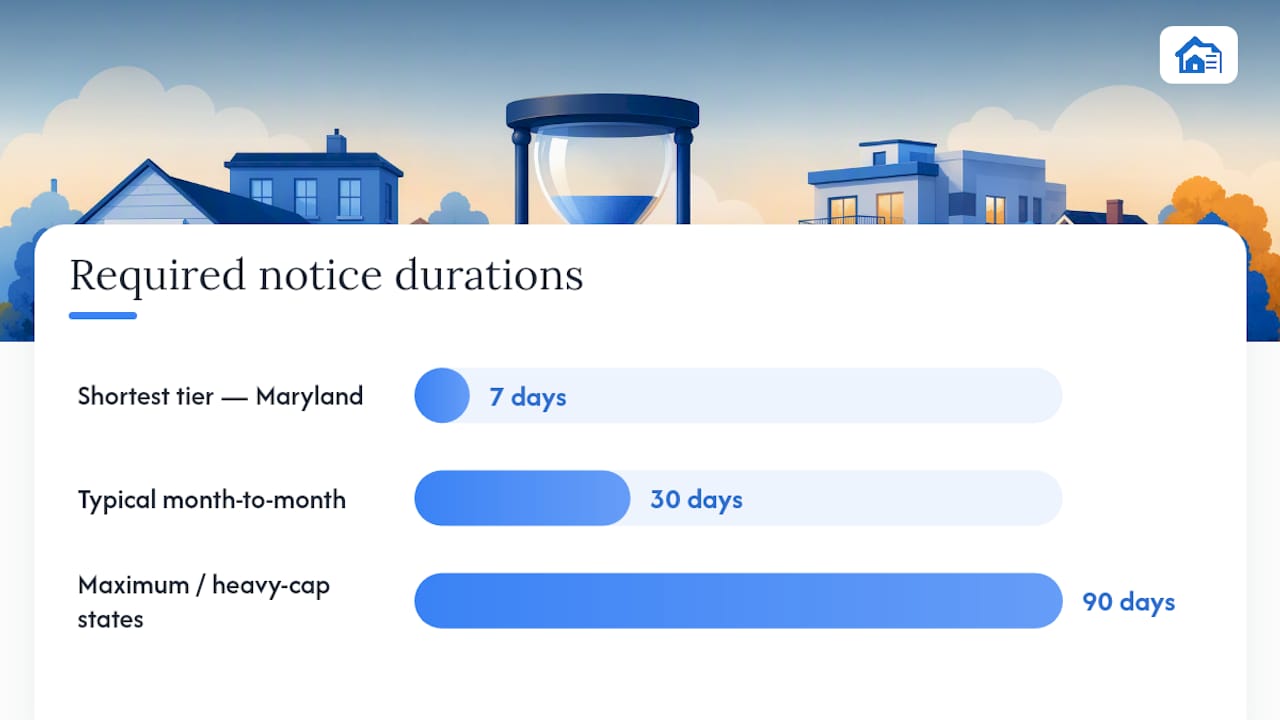
Most states default to 30 days’ notice for month-to-month tenancies, but that baseline shifts fast once you factor in the size of the increase, the length of the tenancy, or where the property sits. A 50-state survey of notice requirements shows the range runs from no statewide statute at all to a flat 90 days, depending on the state and the circumstances.
Three states carry the heaviest compliance burden because they cap the increase itself, not just the notice window:
- California caps annual increases at 5% plus CPI, up to a 10% ceiling, under Cal. Civ. Code §§ 827 and 1947.12. Notice runs 30 days for increases at or below 10% and 90 days for anything above that threshold.
- Oregon limits increases to 7% plus CPI, capped at 10%, under ORS 90.323, and requires 90 days’ written notice regardless of the amount.
- Washington follows a similar 7% plus CPI or 10% structure under RCW 59.18.700 and .720, also with a 90-day notice requirement and a state-prescribed notice form.
Outside those three, notice periods vary widely by tenancy length and jurisdiction. Maryland ties its notice period to how long the tenant has lived there under Md. Code, Real Property § 8-209: 90 days for tenancies over a month, with shorter tiers down to 7 days for week-to-week arrangements. New York adjusts notice based on how long the tenant has occupied the unit and how large the increase is. Some states, including Alabama, have no statewide notice statute at all, which means the lease terms and general termination rules govern instead, according to state-by-state notice tables.
None of that replaces a local check. Rent control ordinances at the city or county level frequently impose stricter limits than the state, and a landlord who complies with state law but ignores a municipal cap can still end up with an unenforceable increase.
What Must a Rent Increase Notice Include?
A valid notice isn’t a friendly heads-up. It’s a legal document, and missing even one field can give a tenant grounds to challenge it.
- Tenant’s full name and the property address, including unit number
- Current rent amount and the new rent amount, stated in dollars
- Date the notice is delivered
- Effective date the new rent begins
- Reference to the lease or governing statute, when applicable
- Signature of the landlord or authorized agent
A few additions strengthen the notice without being strictly required: a line noting the tenant’s elected delivery method, a signature or acknowledgment line for hand delivery, and a brief statutory citation if your state requires a specific form, as Washington does.
One distinction trips up a lot of landlords: whether the tenancy is periodic or fixed-term matters enormously. You generally can’t raise rent mid-lease on a fixed-term tenant unless the lease itself has an increase clause. Month-to-month tenants, by contrast, can be given a new rent at each renewal cycle, provided you meet the notice period.
| Field | Why It Matters |
|---|---|
| New rent amount | Ambiguity here is the most common ground for a tenant dispute |
| Effective date | Must fall after the full statutory notice period has run |
| Delivery date | Starts the notice-period clock |
| Signature | Confirms the notice came from the landlord or authorized agent |
| Statute or lease reference | Shows the increase has a legal or contractual basis |
Populating these fields by hand invites typos and inconsistent formatting across units. A generator that standardizes the layout, like the Rent Increase Notice Template, keeps every notice you send looking identical and legally complete.
How Do You Deliver and Document a Rent Increase Notice?
The method you use to deliver a notice is just as important as what the notice says. Courts and tenants alike can challenge an increase if you can’t show when and how it arrived.
- Certified mail with return receipt. The gold standard for proving delivery when you can’t hand the notice over in person.
- Personal delivery with a signed receipt. Fast and free, but only as good as your habit of getting a signature.
- First-class mail with a certificate of mailing, where your state statute permits it as a standalone method.
- Tenant-elected electronic delivery, when the tenant has agreed to it and the statute allows proof of transmission, as Maryland’s rent statute specifically permits.
Counting the notice period starts at delivery, not the date you drafted the letter. California court guidance on notice timing makes clear that a notice delivered late in the month can push the legal effective date into the following billing cycle, which means demanding the higher rent on the original date is not enforceable.
Pro Tip: Scan every delivery receipt the same day you get it and attach it to the tenant’s file immediately. Receipts that sit in a glove box or a kitchen drawer for two weeks tend to disappear right when you need them.
For electronic delivery specifics, see how digital rent increase notices work under current state rules, and pair that with a tenant communication record system so every notice, receipt, and reply lives in one place.
What Happens if a Rent Increase Notice Is Defective?
A defective notice is more common than most landlords realize, and it’s rarely a dramatic mistake.
- Missing or ambiguous effective date
- Notice delivered with too few days remaining before the intended increase
- Attempting to raise rent mid-term on a fixed lease with no increase clause
- No delivery record at all, so there’s nothing to point to if the tenant disputes it
The fix is almost always the same: void the defective notice, issue a corrected one, and restart the notice-period count from the new delivery date. Keep both versions in the tenant file and send a short written note explaining the correction. If a tenant keeps paying the old rent while you sort this out, continue accepting it. Demanding the new amount before the corrected notice takes effect can expose you to claims for the excess collected, and some states allow tenants to recover damages or fees for improper increases.
Did COVID-19 Emergency Rules Change Rent Increase Notice Requirements?
Pandemic-era emergency orders reshaped rent increase timing in many jurisdictions between 2020 and 2023, and the after effects are still worth checking if your property sits in a jurisdiction that adopted local emergency measures. Several cities and a handful of states imposed temporary rent freezes or extended notice periods well beyond the normal 30 to 90 day range, tied to declared states of emergency rather than the standard statute.
Most of those emergency freezes have expired. But two things changed permanently in their wake. First, California’s AB 1482 cap, Oregon’s SB 608, and Washington’s HB 1217 all predate or overlap with the pandemic period and remain fully in force today, independent of any emergency order. Second, several cities that had no rent control before 2020 adopted permanent ordinances afterward, partly in response to pandemic-driven rent spikes. That means a property that had zero local rent restrictions in 2019 might sit inside a capped zone now.
The practical takeaway: don’t assume the notice period or cap you looked up two or three years ago still applies. Emergency measures created a habit of frequent local rule changes, and some municipalities kept that pace even after formally ending their emergency declarations. Check your city’s current ordinance page before you send anything, not just your state statute.
Are There Exemptions for Certain Housing Types or Tenants?
Not every rental unit follows the standard rent increase rules, and missing an exemption can create liability in the other direction, too.
Subsidized housing, including units under Section 8 or other HUD programs, typically requires landlord participation in a separate rent-adjustment process tied to the program’s own rules rather than a simple written notice. You generally can’t just send a standard increase notice to a tenant with a housing voucher. The increase has to route through the local housing authority first, and the authority’s approval timeline can run longer than your state’s standard notice period.
Mobile home and manufactured home communities often have their own statutory framework entirely separate from standard residential leases, frequently with longer notice periods and stricter limits on the reasons a rent increase is allowed. Several states treat mobile home park tenancies as long-term relationships with more tenant protection built in, precisely because a tenant who owns a home but rents the lot has fewer options to simply move.
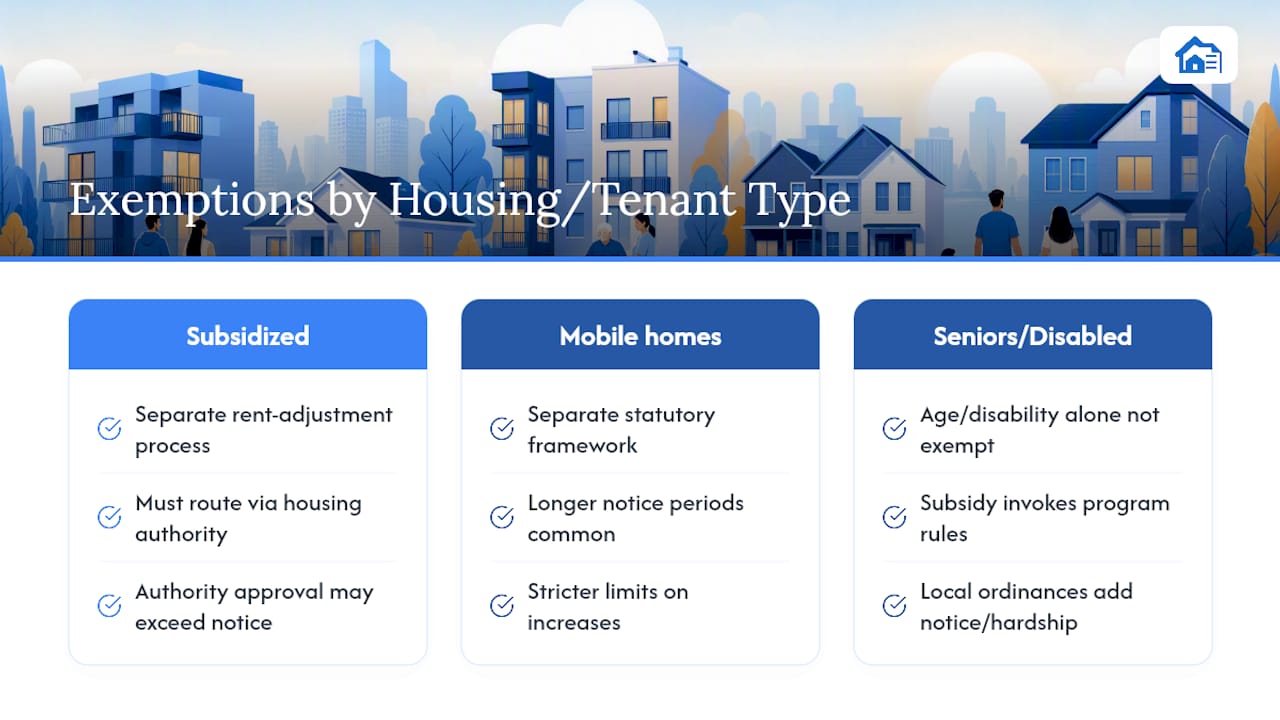
Age or disability alone doesn’t typically exempt a tenant from a rent increase under general landlord-tenant law, but it can intersect with other protections. A senior or disabled tenant receiving a subsidy still falls under that program’s separate rent rules, and some local ordinances build in additional notice time or hardship provisions for specific protected categories. Check your property type and any tenant-linked subsidy before assuming the standard notice rules apply.
What Can a Tenant Do After Receiving a Rent Increase Notice?
A tenant who receives a valid notice has more options than simply accepting or moving out. Negotiation is common and often successful, particularly for long-term tenants with a clean payment history. Many landlords would rather adjust a proposed increase slightly than absorb the cost and vacancy risk of turnover.
Refusal carries real consequences on both sides. A tenant who simply refuses to pay the new rent while remaining in the unit is treated as if they’re paying less than the amount now due, which can lead to a formal notice to pay or vacate once the increase is legally effective. But a tenant isn’t without recourse before that point. They can challenge the notice’s validity if it’s missing required fields, was delivered improperly, or violates a local cap, and in rent-controlled jurisdictions, tenants often have a formal petition process through a local rent board.
If a tenant disagrees with an increase they believe is unlawful, most jurisdictions offer some path to dispute resolution, whether that’s a city rent board hearing, mediation through a local tenant union, or small claims court for recovering excess rent already paid. As a landlord, the strongest position you can hold in any of those forums is a clean paper trail: the notice itself, proof of delivery, and a ledger showing exactly when the new rent began.
Do Commercial Leases Follow the Same Rent Increase Notice Rules?
Commercial rent increases operate on almost entirely different terms, and conflating the two is a common mistake for landlords who manage mixed portfolios. Residential rent increase law, including the state notice periods and caps covered throughout this guide, generally does not extend to commercial tenancies at all.
Commercial leases are contracts first. The notice period, the increase amount, and even whether an increase is allowed mid-term come down to what the lease itself says, not a state-mandated notice statute. Many commercial leases build in scheduled increases, often tied to CPI adjustments or fixed percentage bumps, spelled out years in advance. Others require formal renegotiation at renewal, with no statutory notice period governing the process at all.
The consumer protections built into residential law, rent caps in California, Oregon, and Washington among them, don’t apply to office, retail, or industrial leases. A commercial landlord has far more contractual freedom, but that freedom cuts both ways: without a clear increase clause in the lease, raising commercial rent mid-term without tenant agreement can be just as legally shaky as a defective residential notice, just under contract law instead of landlord-tenant statute. If you manage both residential and commercial units, keep the two processes completely separate in your paperwork and your recordkeeping.
Why Documentation Is the Real Safeguard Against Rent Disputes
The notice you can prove is the notice that holds up. Every landlord I’ve seen get burned by a rent increase dispute had the right idea and the wrong paper trail: a verbal heads-up, a text message, a notice with no delivery record. Standardizing your notices and centralizing proof of delivery isn’t extra work. It’s the difference between an increase that sticks and one a tenant successfully challenges months later.
— Igor
Turn This Checklist Into a Compliant Notice in Minutes
Landlordforms is the alternative to drafting notices by hand or paying a lawyer to review a routine rent increase. You get a free Rent Increase Notice Template that auto-fills the tenant, property, and rent fields, plus a calculator that computes your correct effective date based on your state’s notice period so you’re not counting days on a calendar.

Landlordforms is built for landlords managing 1 to 150 rental units, and it automates the paperwork that eats up your week, including 30-day notices and rent receipts. Property owners using it report saving up to eight hours a week they’d otherwise spend on manual forms and chasing signatures. Every notice you generate can be logged straight into a Rent Ledger so your rent history and your delivery proof live in the same file, ready if a tenant ever disputes the increase. Start with the free template generator, then move into the full platform when you’re managing more than a handful of notices a year.
Where to Verify Your State’s Exact Rent Increase Rules
State rules and local caps change often enough that a rule you confirmed last year may already be outdated. Cross-check your state against the 50-state notice requirement survey and the state-by-state notice period tables, then read the actual statute for your state, such as Maryland’s rent-increase notice law, before finalizing any notice. Always confirm your city or county ordinance separately, since local rent control can override the state default.
Sources
- Md. Code, Real Property § 8-209 — Rent-increase notice
- Rent Increase Notice Requirements: 50-State Survey | Ezel
- Rent Increase Notice Requirements by State — All 50 States | Plexd
FAQ
How much notice do I need to give for a rent increase?
Most states require 30 days for month-to-month tenancies, but California, Oregon, and Washington require 90 days when the increase exceeds their statutory caps, and states like Maryland tie the period to how long the tenant has lived there.
Can I raise rent on a fixed-term lease before it ends?
Generally no, unless the lease itself contains a clause allowing a mid-term increase; otherwise you have to wait until renewal or the lease’s natural end date.
What happens if I deliver a rent increase notice late?
The notice period restarts from the actual delivery date, which can push your effective date into the following month and make any early demand for the higher rent unenforceable.
Do I have to use certified mail for a rent increase notice?
Not always. Certified mail with return receipt is the most defensible method, but personal delivery with a signed receipt or tenant-elected electronic delivery with proof can also satisfy most state requirements.
Can I use a template to generate a compliant rent increase notice?
Yes. A Rent Increase Notice Template that fills in the required fields, including the new rent, effective date, and delivery method, helps landlords avoid the most common defects that make notices unenforceable.