Tenant Acknowledgment Signatures: Legal Role and Best Practices

What is the role of tenant acknowledgment signatures?

A tenant acknowledgment signature is formal legal proof that a tenant received, read, and understood specific documents — inspection reports, disclosures, house rules, or policy notices. It is not a lease acceptance. It does not create or modify any rental terms. What it does is establish a clear paper trail showing that the landlord fulfilled their notification obligations.
Documents commonly covered by tenant acknowledgments include:
- Move-in and move-out inspection reports
- Lead paint and mold disclosures
- Bed bug and pest control policies
- Pet policies and parking rules
- Automatic lease renewal clauses
- Fair Housing Act notices
- Local habitability and maintenance disclosures
That distinction between “receipt confirmed” and “terms agreed” matters enormously in court. A signed acknowledgment tells a judge that the tenant had the information. What the tenant did with it is a separate question entirely.
Table of Contents
- Who typically requires tenant acknowledgments and why
- Common legal scenarios where tenant signatures make or break a case
- What makes a tenant acknowledgment legally binding?
- How to properly fill out a tenant acknowledgment form
- Why tenant acknowledgment signatures matter more than most landlords realize
- Key Takeaways
- FAQ
Who typically requires tenant acknowledgments and why
Landlords and property managers are the primary users, but the requirement often runs deeper than personal preference.
- State and federal law mandates: Many states require landlords to provide written disclosures — lead paint hazards, mold, sex offender registry access — and to document delivery. A tenant acknowledgment is how that documentation happens.
- Property management companies: Professional managers handling multiple units use acknowledgment forms to standardize compliance across their entire portfolio, reducing the risk that one missed signature creates a liability gap.
- HOA-governed communities: Landlords renting within homeowner associations often require tenants to acknowledge receipt of HOA rules, since violations can result in fines the landlord is ultimately responsible for.
- Commercial landlords: Even in residential-adjacent commercial leases, acknowledgment clauses confirm tenant awareness of hazardous materials, building rules, and operating restrictions.
The underlying reason is accountability. When a tenant later claims they never knew about a no-smoking policy or a pet fee, the signed acknowledgment form ends that conversation quickly. It formally documents that the information was communicated, which is why tenant communication records are worth maintaining with the same care as the lease itself.
Common legal scenarios where tenant signatures make or break a case
Tenant acknowledgment signatures show up in disputes more often than most landlords expect. Here are the situations where they carry the most weight.
- Automatic lease renewal enforcement: In Maryland, automatic lease renewal clauses beyond one month require a separate written acknowledgment — a signature or initials — to be enforceable. Without it, that clause is void, even if the rest of the lease stands.
- Fair Housing Act compliance: Federal law requires landlords to provide certain disclosures. Courts recognize properly executed acknowledgments as evidence that landlords met those obligations, which directly reduces dispute risk by creating proof of delivery.
- Policy change notices: When a landlord updates a no-smoking rule, pet policy, or parking restriction mid-tenancy, a signed acknowledgment of the change prevents tenants from later claiming they were never informed.
- Move-in condition disputes: A tenant-signed move-in inspection report is often the single most important document in a security deposit dispute. Without it, the landlord has no baseline to compare against at move-out.
- Hazardous material notifications: Commercial and residential leases involving asbestos-containing materials (ACMs) or lead paint require tenants to acknowledge receipt of those notifications. Courts treat unsigned disclosures as undelivered.
The stakes are real: Landlords who rely on postal delivery alone — without a signed receipt — face growing legal exposure. A UK Court of Appeal case highlighted exactly this gap, with a tenant successfully arguing that proof of postage was not proof of receipt. US landlords face the same logic in state courts, where obtaining a tenant’s signature upon document delivery is increasingly treated as the minimum standard of proof.
What makes a tenant acknowledgment legally binding?
A tenant acknowledgment letter is legally binding when properly executed, but its binding effect is narrow. It confirms receipt of information or agreement to terms without altering the original lease.
Key legal characteristics to understand:
- Acknowledgment vs. representation: An acknowledgment records that a party was informed of something. A representation asserts a fact is true. A warranty guarantees a condition. Mixing these up in your forms creates ambiguity that tenants’ attorneys will exploit.
- Estoppel effect: Once a tenant signs an acknowledgment, they are legally estopped from claiming they lacked informed consent about the acknowledged documents. That estoppel is the core legal value of the form.
- No new obligations created: Signing an acknowledgment does not impose new lease terms. As Virginia’s housing forms make clear, the form confirms delivery — it does not waive rights or create new rental conditions.
- State-specific nuances: Enforceability varies. Some states require acknowledgments for specific disclosures to be on separate forms with specific language. California’s lead paint disclosure requirements, for example, have precise formatting rules. Using a generic form in a state with specific requirements can render the acknowledgment unenforceable.
- Explicit scope language matters: The form should distinguish between acknowledging receipt, acknowledging review, and acknowledging understanding. Each carries a different legal implication, and vague language gives tenants room to argue they only confirmed receipt, not comprehension.
The landlord-tenant relationship documentation process works best when acknowledgment forms are treated as precision instruments, not boilerplate afterthoughts.
How to properly fill out a tenant acknowledgment form
Getting the form right is not complicated, but skipping steps creates the exact gaps that make acknowledgments useless in court.
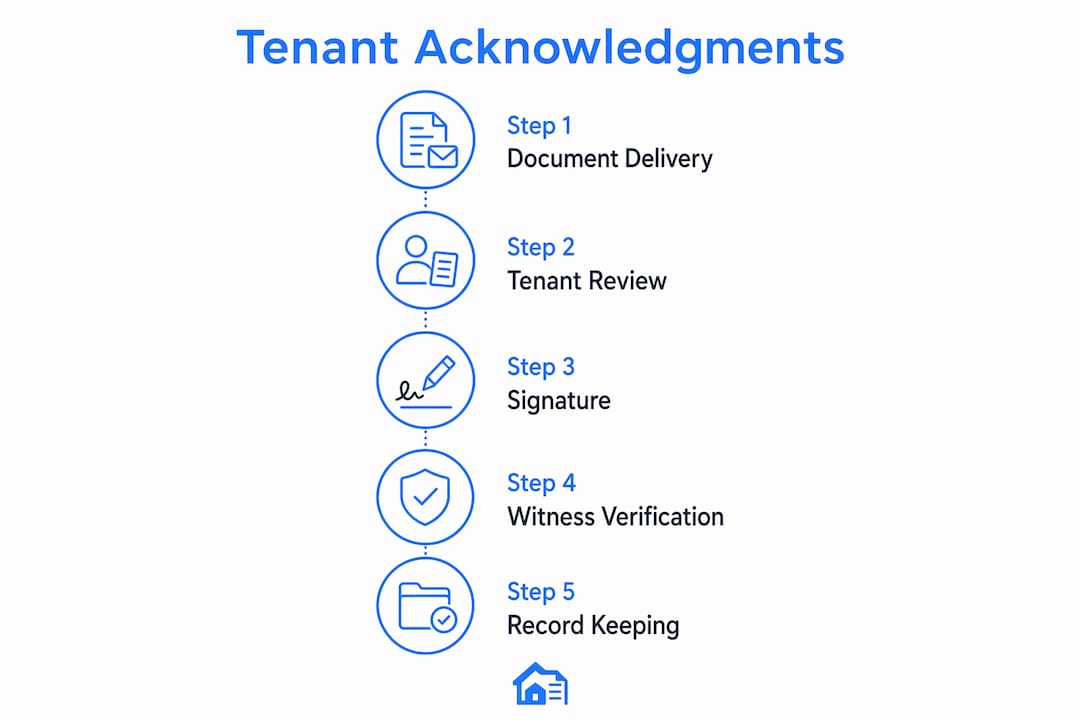
-
Gather tenant and property information. The form needs the tenant’s full legal name, the property address, and the lease start date. Every adult occupant who will live in the unit should be listed here, not just the primary leaseholder.
-
List every document being acknowledged. A standard tenant acknowledgment form includes a clear acknowledgment statement naming each specific document — move-in checklist, lead paint disclosure, house rules, pet addendum. Vague language like “all attached documents” is weaker than naming each one explicitly.
-
Give the tenant time to review. Hand over the documents before the signing appointment, not at the table. A tenant who signs after a 30-second glance has a stronger argument that they lacked adequate opportunity to review. Courts look at whether the process was fair, not just whether a signature exists.
-
Obtain signatures and dates from all adult occupants. Every adult living in the unit should sign. An adult occupant who does not sign the lease or acknowledgment lacks tenant rights but also lacks liability, which leaves the landlord with fewer legal recovery options if something goes wrong.
-
Sign as the landlord or property manager. The landlord or their authorized agent should countersign and date the form. This confirms the documents were actually provided, not just that the tenant claims to have received them.
-
Distribute copies immediately. Give the tenant their copy the same day. Holding it creates questions about whether the process was completed in good faith.
-
Store records securely. Digital copies stored in a property management system are harder to lose and easier to produce in court than paper files in a drawer. Keep acknowledgment records for at least as long as the statute of limitations for landlord-tenant disputes in your state, which is typically three to six years.
Why tenant acknowledgment signatures matter more than most landlords realize
The evidentiary value of a properly executed acknowledgment goes well beyond paperwork compliance. According to the American Bar Association, acknowledgment clauses create written records that shift the burden of proof to the acknowledging party in disputes, making it genuinely difficult to claim unawareness of disclosed information. That burden shift is the difference between a landlord defending a claim and a tenant having to explain why their signature means nothing.
A few practices that separate careful landlords from vulnerable ones:
- Have tenants sign before you sign. Landlords who sign first can inadvertently create a contractual obligation that prevents them from leasing to other applicants if the tenant backs out. Getting the tenant’s signature first avoids that trap and reduces vacancy risk.
- Include all adult occupants. Requiring every adult in the unit to sign acknowledgment forms gives the landlord individual liability against each person. When only one person signs, the landlord’s legal recourse runs through that one person only — a significant gap if that person moves out and leaves others behind.
- Update acknowledgments when policies change. A signed acknowledgment from move-in does not cover a policy added six months later. Re-obtaining signatures when rules change is the only way to maintain the evidentiary chain.
- Use acknowledgments for dispute evidence documentation. Courts treat signed acknowledgments as strong evidence that landlords fulfilled notification obligations. Without them, the landlord’s word against the tenant’s is a coin flip.
Pro Tip: When a tenant refuses to sign an acknowledgment, note the refusal in writing, date it, and have a witness present. A documented refusal still creates a record that the landlord attempted proper notification — which courts weigh in the landlord’s favor.
Landlords managing multiple units benefit from systems that automate acknowledgment generation and track which tenants have signed. Landlordforms does exactly that, cutting the administrative time involved in preparing, distributing, and storing these forms while reducing the risk of a missed signature creating a compliance gap.


Landlordforms also offers a free rent ledger template to help landlords keep payment records as organized as their acknowledgment files. When a dispute reaches court, having both in order tells a consistent story.
Key Takeaways
Tenant acknowledgment signatures are the landlord’s primary evidentiary tool for proving that required disclosures and policies were communicated, and courts treat them as the minimum standard of proof in notification disputes.
| Point | Details |
|---|---|
| Acknowledgment confirms receipt, not agreement | Signing confirms a tenant received documents; it does not create new lease terms or waive tenant rights. |
| All adult occupants should sign | Excluding any adult occupant limits the landlord’s legal recovery options if that person causes damage or remains after the lease ends. |
| Burden of proof shifts to the tenant | A properly executed acknowledgment makes it legally difficult for a tenant to claim ignorance of disclosed information in court. |
| State law governs enforceability | Some states, like Maryland, require separate written acknowledgments for specific clauses to be enforceable; generic forms may not meet local requirements. |
| Update signatures when policies change | A move-in acknowledgment does not cover later policy changes; re-obtaining signatures preserves the evidentiary chain. |
FAQ
What is a tenant acknowledgment?
A tenant acknowledgment is a signed confirmation that a tenant received, read, and understood specific documents or disclosures related to their tenancy. It creates a legal record of delivery without modifying the lease itself.
Is a tenant acknowledgment legally binding?
Yes, when properly executed, a tenant acknowledgment is legally binding in the narrow sense that it confirms receipt and estops the tenant from later claiming ignorance of the acknowledged information. It does not create new lease obligations.
What does a tenant’s signature on an acknowledgment actually mean?
A tenant’s signature confirms they received the referenced documents and had the opportunity to review them. It does not mean they agree to new terms beyond what the lease and applicable law already establish.
What is the difference between a witness signature and an acknowledgment?
A witness signature confirms that a person observed the signing of a document, verifying the signer’s identity and willingness. An acknowledgment signature confirms the signer received and understood specific information. Both serve evidentiary purposes, but they address different legal questions.
Do all adult occupants need to sign tenant acknowledgment forms?
Yes, as a best practice. An adult occupant who does not sign lacks individual liability to the landlord, which limits legal recovery options if that person causes damage or disputes a policy they claim not to have known about.