What Is an Occupancy Agreement? A Landlord's Guide

TL;DR:
- An occupancy agreement is a legal contract that allows someone to inhabit a property without creating a landlord-tenant relationship. It differs from a lease because it does not grant exclusive possession, making termination and entry rights easier for owners. Proper drafting and understanding of rights are essential to avoid court reclassification as a lease.
An occupancy agreement is a legal contract that grants permission to inhabit or use a property for a defined purpose and duration without establishing a landlord-tenant relationship. That single distinction carries enormous legal weight. Landlords who understand it gain more control over their property, simpler termination rights, and fewer obligations under state tenant protection statutes. This guide explains the occupancy agreement definition, how it differs from a lease, the main types you will encounter, and the key provisions that protect your interests.
What is an occupancy agreement and how does it differ from a lease?
An occupancy agreement and a lease look similar on paper but operate under fundamentally different legal frameworks. A lease grants a tenant exclusive possession of a property, which triggers a full set of statutory protections: formal eviction procedures, required notice periods, and limits on owner entry. An occupancy agreement, by contrast, grants permission to occupy without transferring exclusive possession, keeping the owner in a stronger legal position.
The practical difference shows up most clearly at termination. Under a lease, removing a non-paying or non-compliant tenant requires a court-supervised eviction process that can take weeks or months depending on the state. Under a properly drafted occupancy agreement, the owner retains broader entry rights and can terminate occupancy more quickly when the agreed conditions end. That speed matters when a real estate transaction is pending or when an employee vacates a company-owned unit.
A common misconception is that labeling a document “occupancy agreement” automatically avoids tenant protections. Courts do not work that way. Courts assess actual rights granted to the occupant, not the document title. If your agreement effectively gives someone exclusive possession and control, a judge can reclassify it as a lease and apply all the tenant protections you were trying to avoid.
Pro Tip: Never rely on the document title alone. Review the rights your agreement actually grants. If the occupant can exclude you from the property, a court may treat the agreement as a lease regardless of what you call it.
Key differences at a glance:
- Exclusive possession: Leases grant it; occupancy agreements do not.
- Statutory eviction: Required for leases; generally not required for occupancy agreements.
- Owner entry rights: Restricted under leases; more flexible under occupancy agreements.
- Tenant protections: Full statutory coverage under leases; limited or none under occupancy agreements.
- Notice requirements: Legally mandated for leases; contractually defined for occupancy agreements.
For a deeper look at how notice requirements differ across agreement types, the tenant notice types guide covers the distinctions property managers need to know.
What are the main types of occupancy agreements?
Occupancy agreements are not one-size-fits-all. Three main types appear regularly in property management, and each serves a distinct purpose.
-
Use and Occupancy (U&O) agreements. A U&O agreement is a short-term contract allowing a buyer or seller to occupy a property before or after closing. U&O agreements typically last a few days to a few weeks, with per diem fees built in to motivate timely vacating. They are common in residential real estate transactions when closing dates shift or when a seller needs extra time to move out. The per diem fee structure creates a financial incentive to leave on schedule, which protects the buyer or seller on the other side of the deal.
-
Service occupancy agreements. These agreements tie occupancy directly to employment or program participation. A property manager living on-site, a caretaker in a company-owned home, or a student in university housing all occupy under this model. Service occupancy agreements treat housing as a conditional license rather than a tenancy. When the qualifying status ends, whether through resignation, termination, or program completion, occupancy rights end with it. The agreement should state that explicitly to avoid any ambiguity.
-
Conditional or status-based occupancy agreements. These cover situations where occupancy depends on an ongoing relationship or condition beyond employment. Examples include caretaker arrangements, family member accommodations, and transitional housing programs. Termination of qualifying status ends occupancy rights near-immediately, without the extended notice periods that tenants receive under state law. Grace periods in these agreements are contractual courtesies, not legal rights.
Each type carries different risk profiles. U&O agreements face the most transactional risk if a real estate deal collapses. Service occupancy agreements face the most risk when employment ends but the occupant refuses to leave. Conditional agreements face risk when the qualifying condition is poorly defined. Knowing which type you are using shapes every clause you write.
What does an occupancy agreement include?
A well-drafted occupancy agreement covers six core areas. Missing any one of them creates legal exposure.
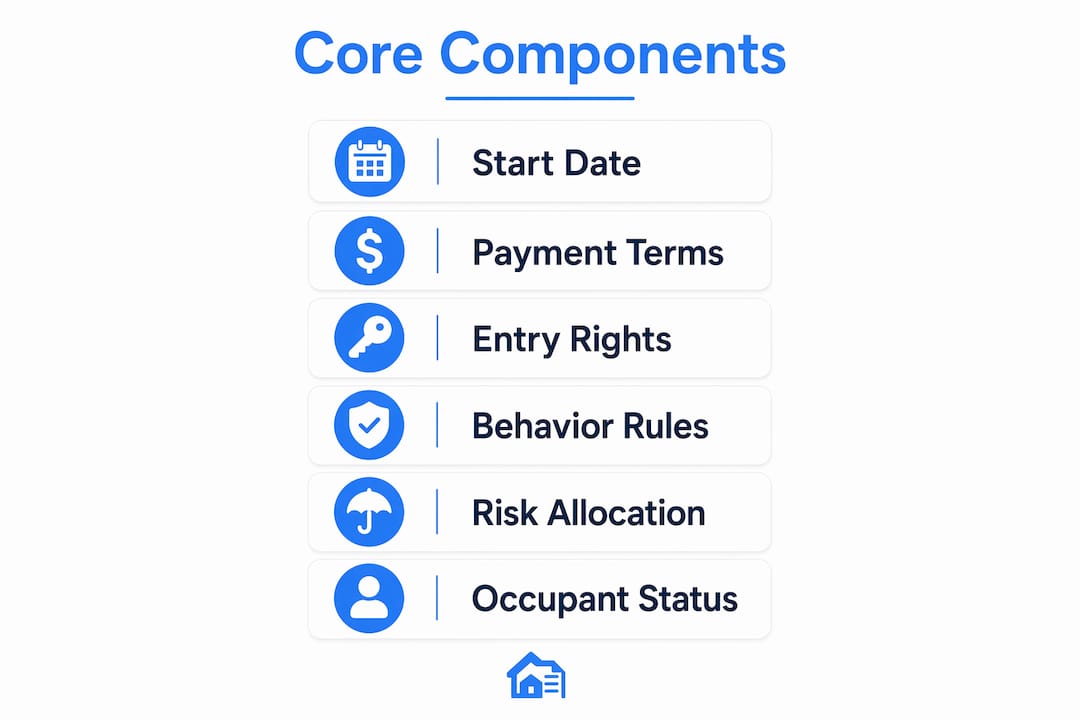
Duration and termination rights. State the exact start date, end date, and the conditions that trigger early termination. For service occupancy, include explicit language that occupancy ends on the same day employment ends. Housing should end concurrently with employment termination to prevent legal ambiguity and extended occupant rights.
Payment terms. U&O agreements typically calculate fees using the PITI formula: principal, interest, taxes, and insurance divided by 30 days. This produces a daily rate that is fair and defensible. Include deposit requirements, payment due dates, and holdover penalties. Holdover fees should be high enough to discourage overstaying.

Entry rights. Specify when and how the owner or property manager may enter the property. Broad entry rights reinforce the license nature of the agreement. Restricted entry rights start to look like a lease.
Behavioral clauses. Behavioral clauses such as inspections, conduct rules, and curfews demonstrate institutional control over the space. They legally substantiate the agreement as a license rather than a lease. Include rules about guests, noise, alterations, and maintenance responsibilities.
Risk allocation. Address what happens if the occupant refuses to leave, if a real estate transaction fails, or if the property is damaged. Clauses requiring immediate vacancy if closing fails protect sellers from being stuck with a buyer who is already in the property and has no legal obligation to leave quickly.
Clear definitions of occupant status. Define exactly who the occupant is and why they have permission to be there. Vague definitions give courts room to reclassify the agreement.
Pro Tip: Have a licensed real estate attorney review your occupancy agreement before signing. A single poorly worded clause about exclusive possession can convert your agreement into a lease in court.
What are the biggest risks landlords face with occupancy agreements?
The single greatest risk is court reclassification. Granting exclusive possession can lead a court to reclassify an occupancy agreement as a lease, triggering the full statutory eviction process and tenant protections you intended to avoid. This risk is highest when the agreement restricts owner entry, gives the occupant full control over the space, and lacks behavioral clauses that demonstrate institutional oversight.
Pre-closing occupancy creates a specific and serious risk. If a buyer moves in before closing and financing falls through, the seller faces a difficult situation.
“In pre-closing occupancy, if financing fails and the buyer is already in the property, the seller must show license revocation and may face lengthy disputes to regain possession. Airtight agreements with explicit vacancy clauses are the only reliable protection.”
The second major risk is holdover occupancy. An occupant who stays past the agreed end date creates legal and financial complications. Without a strong holdover penalty clause, the occupant has little incentive to leave. Without clear termination language, the owner may have to pursue formal eviction anyway, defeating the purpose of using an occupancy agreement in the first place.
The third risk is poor documentation. Landlords who rely on verbal agreements or loosely worded documents lose in court. Photo documentation of the property’s condition at the start of occupancy, signed acknowledgment of the agreement terms, and written notice of termination all create a paper trail that protects the owner. Tools like Landlordforms support property management workflow efficiency by keeping documentation organized and accessible when disputes arise.
Key Takeaways
An occupancy agreement protects property owners by granting permission to occupy without creating a landlord-tenant relationship, but only when the agreement is drafted with precision and reviewed by legal counsel.
| Point | Details |
|---|---|
| Core definition | An occupancy agreement grants permission to inhabit property without establishing a landlord-tenant relationship. |
| Lease vs. occupancy | Exclusive possession triggers lease reclassification; limit owner entry restrictions to preserve license status. |
| Types to know | U&O, service occupancy, and conditional agreements each carry distinct risks and termination rules. |
| Essential clauses | Include duration, payment terms, entry rights, behavioral rules, and explicit vacancy requirements. |
| Biggest risk | Court reclassification occurs when occupants receive exclusive possession, regardless of the document title. |
Why I think most landlords underestimate occupancy agreements
Most landlords treat occupancy agreements as a lighter version of a lease, something simpler and faster to put together. That framing is exactly backward. Occupancy agreements are more legally sensitive than leases in one critical way: they depend entirely on precise drafting to hold up in court. A lease has statutory backing. An occupancy agreement has only the words you put on the page.
I have seen landlords lose the legal protection they were counting on because they copied a generic template and left in language about “exclusive use of the premises.” That phrase alone was enough for a court to treat the agreement as a lease. The landlord then had to go through a full eviction process for an occupant they thought they could remove in days.
The fix is not complicated, but it requires discipline. Write behavioral clauses. Define entry rights broadly. State termination conditions in plain language. And never let an occupant move in under a pre-closing U&O agreement without a clause that requires immediate vacancy if the deal falls through. A lease termination letter is a useful reference for understanding how termination language should be structured, even when you are not dealing with a formal lease.
The landlords who manage occupancy agreements well treat them as precision instruments, not shortcuts. That mindset is what keeps them out of court.
— Igor
Landlordforms templates for occupancy agreements
Drafting an occupancy agreement from scratch takes time and legal knowledge most landlords do not have on hand. Landlordforms provides ready-to-use document templates built for landlords managing 1 to 150 units, covering occupancy agreements, notices, and related forms.

Each template is designed to reduce manual errors and cover the clauses that matter most: termination rights, payment terms, entry provisions, and behavioral rules. Landlordforms saves property managers up to eight hours a week by automating document creation and keeping tenant records in one place. Explore the full library of landlord document templates to find occupancy agreements, notice forms, and other tools that keep your properties legally protected and professionally managed.
FAQ
What is the occupancy agreement definition in real estate?
An occupancy agreement is a legal contract granting permission to inhabit a property for a defined purpose or time without creating a landlord-tenant relationship. It gives the owner more control and avoids standard eviction procedures.
How does an occupancy agreement differ from a lease?
A lease grants exclusive possession and triggers statutory tenant protections. An occupancy agreement does not transfer exclusive possession, so the owner retains broader entry rights and simpler termination options.
What does a U&O agreement include?
A Use and Occupancy agreement typically includes a per diem fee calculated using the PITI formula, a deposit, insurance requirements, maintenance responsibilities, and penalties for holdover occupants.
Can an occupancy agreement be reclassified as a lease?
Yes. Courts look at the actual rights granted, not the document title. If an occupancy agreement gives the occupant exclusive possession, a court can reclassify it as a lease and apply full tenant protections.
When does a service occupancy agreement end?
A service occupancy agreement ends when the qualifying employment or program status ends. Occupancy rights terminate concurrently with that status, without the extended notice periods required under standard tenancy law.