Why Physical Paperwork Slows Landlords and Costs More

TL;DR:
- Physical paperwork causes landlords to lose time, face compliance failures, and risk costly disputes.
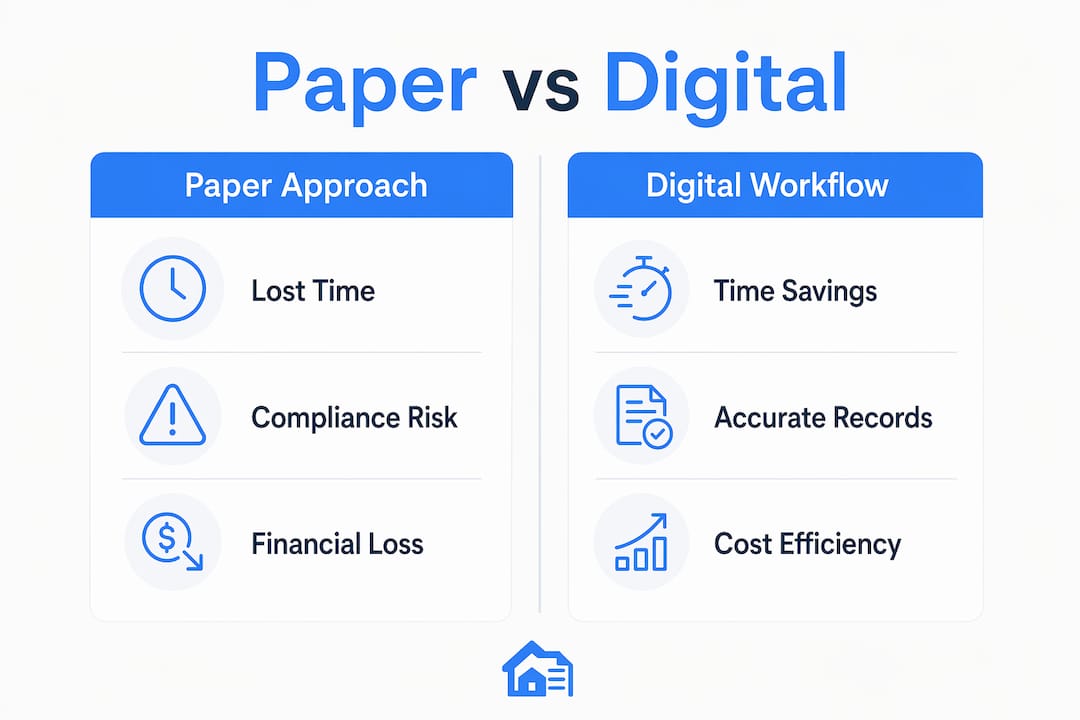
- Transitioning to digital records improves efficiency, reduces errors, and ensures compliance with 2026 regulations.
Physical paperwork is the leading cause of lost time, compliance failures, and avoidable financial losses in rental property management. Landlords who rely on paper forms, handwritten notes, and physical filing systems face a compounding problem: every manual step adds delay, every misplaced document creates risk, and every error in a lease or notice can trigger a costly legal dispute. Understanding why physical paperwork slows landlords is the first step toward protecting your income and your time. Regulations like Making Tax Digital, which takes full effect in april 2026, make the shift to digital documentation not just practical but legally necessary.
Why physical paperwork slows landlords: the time cost of manual processes
Paper-based property management is a direct drain on productive hours. Landlords relying on paper inspections can lose up to 20 hours per month on documentation alone. That is half a standard work week spent on tasks that digital tools can complete in minutes.
The problem compounds during inspections. A landlord managing five or more units must schedule walkthroughs, write up condition reports by hand, photograph damage, file paper copies, and then re-enter notes into a separate system for tenant records. Each step introduces the chance of a transcription error or a lost page. According to McKinsey research on paper-based processes, manual paperwork slows task completion and hides labor costs that never appear on a balance sheet.
Repair scheduling suffers too. When a maintenance request arrives on a paper form, it sits in a pile until someone processes it. Digital workflows route requests instantly, assign responsibility, and create a timestamped record. Paper cannot do any of that.
The impact on tenant communication is equally real. Landlords who track rent payments by hand or mail paper receipts spend time on tasks that a digital rent ledger handles automatically. That time adds up fast across multiple units.
- Paper inspection reports require manual transcription, doubling the work.
- Handwritten maintenance logs create gaps in repair history that hurt you in disputes.
- Mailed notices add days to legally required timelines.
- Physical filing systems make it hard to retrieve documents quickly during audits or court proceedings.
- Duplicate data entry across paper forms and spreadsheets multiplies the chance of error.
Pro Tip: Switch to digital inspection reports with photo attachments. A timestamped photo linked to a specific unit and date is far stronger evidence in a dispute than a handwritten note.
What do paperwork errors actually cost landlords?
The financial risks of paper reliance are concrete and well-documented. Eviction costs average approximately $3,500 in direct legal and turnover expenses, and that figure excludes lost rent during the weeks or months a unit sits vacant. A single paperwork error in a notice to quit or an eviction filing can restart the entire process from scratch.
Paper-intensive eviction processes delay tenant removals, extending vacancy periods and reducing rental income. A missed deadline on a legally required notice, a form served to the wrong address, or a missing signature can invalidate months of effort. The legal risks of incomplete landlord paperwork are not theoretical. Courts dismiss eviction cases on procedural grounds regularly, and paper-based systems make procedural errors far more likely.
Security deposit mismanagement is another costly paper failure. Mismanaged deposits reported as income create phantom income on your tax return and expose you to audit risk. When deposit records live in a paper folder, it is easy to lose track of what was collected, what was returned, and what deductions were documented. Without a clear paper trail, a tenant can successfully dispute a deduction in court, and you will have no evidence to counter it.
Expense categorization errors are just as damaging. Landlords who track repairs and maintenance on paper often mix personal and business expenses, miscategorize capital improvements as repairs, or simply lose receipts. Each of those mistakes affects your taxable income and your ability to defend your return.
Incomplete or inaccurate landlord records do not just create administrative headaches. They create legal exposure in eviction proceedings, tax audits, and tenant disputes where the burden of proof falls on you.
The ways paperwork errors affect ROI for landlords go beyond direct costs. Every hour spent correcting a paper error is an hour not spent evaluating a new property, negotiating a lease renewal, or managing a repair before it becomes a major expense.
- A defective eviction notice restarts the legal clock, adding weeks of lost rent.
- Missing deposit documentation gives tenants grounds to recover their full deposit in court.
- Uncategorized expenses reduce deductible costs and inflate your tax bill.
- Lost maintenance records make it impossible to prove a repair was completed before damage worsened.
- Unsigned or undated lease addenda are unenforceable in most jurisdictions.
Why do 2026 digital record-keeping rules matter for landlords?
Making Tax Digital changes the compliance baseline for landlords in 2026. From april 2026, landlords with qualifying rental income must file quarterly updates digitally through HMRC-compatible software. Scanning paper receipts and storing them in a folder does not meet the standard.
HMRC requires digital audit trails that link each receipt to a specific transaction in your accounting software. A scanned image sitting in a folder with no ledger connection fails the compliance test. The record must be traceable from the original document through to the submitted return.
Spreadsheets are not a safe alternative. Spreadsheets carry risks of formula errors and become time-consuming to maintain under quarterly reporting requirements. A single broken formula or an incorrectly copied cell can misrepresent your income or expenses across an entire tax year.
The penalty structure reinforces the urgency. Repeated missed quarterly updates trigger a points-based penalty system, with a £200 fine applied after four missed submissions. The fines are not the real risk. The real risk is an HMRC inquiry triggered by inconsistent records, which costs far more in accountant fees and lost time.
| Record type | Paper approach | Digital requirement |
|---|---|---|
| Rental income | Handwritten ledger or spreadsheet | Software with bank feed integration |
| Expense receipts | Physical folder | Digitized and linked to transactions |
| Quarterly submissions | Manual calculation and filing | HMRC-compatible software submission |
| Audit trail | Paper copies in binders | Timestamped digital records with transaction links |
Property management accounting software with bank feed integration solves the linkage problem automatically. Transactions import directly from your bank, receipts attach to the matching entry, and the audit trail builds itself. The role of digital paper trails for landlords is not just organizational. It is the difference between a compliant return and an HMRC inquiry.
Pro Tip: Do not just scan your receipts. Attach each scan directly to the matching transaction in your accounting software. That linkage is what HMRC actually requires, not the scan itself.
How can landlords move from paper to digital workflows?
The transition from physical paperwork to digital documentation does not require replacing everything at once. A phased approach reduces disruption and builds confidence in the new system.
Start with the documents that carry the most legal and financial risk. Leases, notices, inspection reports, and deposit records should move to digital formats first. These are the documents most likely to appear in a dispute or an audit. Landlordforms automates the creation of notices, rent receipts, and other critical forms, reducing manual entry and the errors that come with it.
Digital inspection documentation replaces handwritten condition reports with timestamped photos and structured checklists. Each entry is dated, linked to a specific unit, and stored in a searchable format. That structure makes it far easier to retrieve records when a tenant disputes a deduction at move-out.
Photo documentation is one of the most underused tools in property management. Photo documentation in property management creates a visual record that paper cannot replicate. A photo of a clean carpet at move-in and a photo of the same carpet at move-out is evidence that holds up in small claims court.
- Digitize leases and addenda first. These carry the highest legal risk if lost or unsigned.
- Use a consistent naming convention for digital files so you can retrieve them in seconds.
- Set calendar reminders for notice deadlines, lease renewals, and quarterly tax submissions.
- Store documents in cloud-based software, not on a single device that can fail.
- Run a monthly audit of your digital records to catch missing attachments or unsigned forms before they become problems.
The benefits of digital documentation for landlords extend beyond compliance. Landlords who manage their records digitally spend less time on administration, respond faster to tenant issues, and carry less legal risk into every dispute. Landlordforms reports saving landlords up to eight hours a week by replacing manual form creation with automated document generation.
The paper habit is costing you more than you think
I have worked with landlords managing anywhere from two units to over a hundred, and the ones still running paper systems share a common blind spot. They underestimate how much time they spend on documentation because the cost is invisible. It does not show up as a line item on a profit and loss statement. It shows up as a Sunday afternoon spent hunting for a lease addendum, or a court date lost because a notice was served one day late.

The landlords I have seen make the fastest progress are not the ones who buy the most expensive software. They are the ones who pick one paper process, replace it with a digital equivalent, and build from there. Start with your inspection reports or your rent receipts. The time savings are immediate and the compliance benefit is real.
The legal risks of incomplete landlord paperwork are not going away. If anything, Making Tax Digital and evolving tenant protection laws are raising the bar. A landlord who cannot produce a timestamped, linked digital record of every transaction and every notice is carrying unnecessary risk. The landlord-tenant relationship documentation standard has changed. Paper no longer meets it.
— Igor
Landlordforms makes the switch straightforward
Physical paperwork creates real costs: lost hours, compliance failures, and disputes you cannot win without proper records. Landlordforms is built for landlords managing 1 to 150 units who want to replace manual paperwork with accurate, professional documents generated in a few clicks.

Landlordforms automates 30-day notices, rent receipts, and other critical forms, cutting human error and saving up to eight hours a week. The platform also includes free landlord document templates and a rent ledger template to help you track income digitally from day one. Visit Landlordforms to replace your paper stack with a system that keeps you compliant, organized, and ready for any dispute.
FAQ
Why does physical paperwork slow landlords down?
Physical paperwork requires manual entry, physical storage, and time-consuming retrieval. Paper-based processes increase hidden labor costs and slow task completion compared to digital systems.
How much can paper inspections cost landlords in time?
Landlords relying on paper inspections can lose up to 20 hours per month on documentation tasks. That time comes directly out of hours that could go toward managing repairs, evaluating properties, or communicating with tenants.
What are the legal risks of incomplete landlord paperwork?
Missing or defective paperwork can invalidate eviction notices, expose landlords to deposit disputes, and trigger HMRC inquiries. Eviction costs average $3,500 in direct expenses, and a single procedural error from a paper process can restart that clock entirely.
Does scanning receipts satisfy Making Tax Digital requirements?
A scanned receipt only satisfies HMRC requirements if it is linked to a specific transaction in compliant accounting software. Storing scans in a folder without that linkage does not meet the digital audit trail standard.
What is the fastest way for landlords to reduce paperwork errors?
Replace your highest-risk paper documents first: leases, notices, and inspection reports. Landlordforms automates these forms and reduces manual entry errors, which is where most costly mistakes originate.
Key takeaways
Physical paperwork is the single biggest source of avoidable time loss, compliance risk, and financial exposure for landlords managing rental properties in 2026.
| Point | Details |
|---|---|
| Time lost to paper processes | Landlords can lose up to 20 hours per month on paper-based inspections and documentation. |
| Eviction cost from paper errors | A single defective notice can restart an eviction, adding to the $3,500 average direct cost. |
| MTD compliance requires digital linkage | Scanned receipts must link to transactions in accounting software to satisfy HMRC standards. |
| Security deposit records need a clear trail | Missing deposit documentation gives tenants grounds to recover their full deposit in court. |
| Digital tools reduce error and save time | Landlordforms automates critical forms and saves landlords up to eight hours a week. |