6 Recordkeeping Steps U.S. Landlords Need for Fair Housing Notices

Federal regulations require anyone offering housing for sale or rental to display the HUD fair housing poster at every place of business and, in most cases, at the dwelling itself. Separately, 24 CFR 100.75 bans any notice, ad, or spoken statement that indicates a preference or limitation based on a protected class. State and local rules often add more on top of that federal floor.
TL;DR:
- The fair housing poster must be displayed in visible areas at the property or office, with exceptions only for vacant land or private owner sales without advertising.
- Any notice or ad indicating a preference or limitation based on protected classes like race, religion, or disability can lead to violations, especially if language or imagery subtly communicates exclusion.
- The official poster should be 11 by 14 inches, kept legible, replaced promptly when damaged, and documented with timestamped photos to avoid defaulting to prima facie evidence of discrimination.
- State and local laws often require additional notices or language protections beyond federal rules, making it essential to check regional requirements and display obligations.
- Maintaining consistent, compliant language in all listings, applications, and notices, along with meticulous recordkeeping, significantly reduces the risk of fair housing violations and penalties.
Table of Contents
- Fair Housing Notice Requirements Under Federal Law (24 CFR Part 110)
- What Counts as a Discriminatory Notice or Ad Under 24 CFR 100.75
- Poster Specifications, Sourcing, and Display Best Practices
- State and Local Rules That Go Beyond the Federal Baseline
- Affirmative Fair Housing Marketing Plans for Multifamily Projects
- A Recordkeeping Checklist That Actually Holds Up in a Dispute
- Enforcement, Complaints, and What Happens When You Get It Wrong
- Language Access: Do You Need Notices in Other Languages?
- Common Interest Communities and Assisted Housing: What Changes
- How to Update or Replace a Damaged or Outdated Poster
- What Non-Compliance Can Actually Cost You
- Why Proactive Compliance Beats Reactive Damage Control
- Where LandlordForms Fits Into Your Compliance Routine
- Primary Sources for Fair Housing Notice Requirements
- Sources
- FAQ
Fair Housing Notice Requirements Under Federal Law (24 CFR Part 110)
The federal posting rule comes from 24 CFR § 110.10, and it applies to anyone subject to sections 804 through 806 of the Fair Housing Act. That’s a wide net: landlords, brokers, property managers, developers, and anyone else who sells, rents, or facilitates the sale or rental of a dwelling.
The location rules shift depending on what kind of property you’re dealing with. For most multifamily buildings and rental offices, the poster has to go up at the place of business where the housing is actually offered, and often at the dwelling itself if there’s a rental office or model unit on site. For single-family homes sold or rented through a broker, posting at the broker’s office generally satisfies the requirement instead of posting at each individual house. Model dwellings can substitute for posting at every unit in some multifamily developments, which saves a lot of paper for a mid-sized multifamily complex.
There are exceptions. Vacant land offered for sale without an accompanying dwelling doesn’t trigger the posting duty. Certain private, unadvertised single-family sales by an owner (sometimes called the “Mrs. Murphy” exemption territory, though that term specifically covers a narrower advertising exemption) may fall outside the rule too, but the exemptions are narrow and easy to misjudge. If you’re renting out even one unit and advertising it publicly, assume the poster requirement applies to you.
A few practical points worth locking in:
- The poster must be displayed where prospective tenants or buyers will actually see it, not tucked in a back office.
- Brokers handling multiple single-family listings can typically satisfy the rule at their office rather than at each property.
- HUD regional and area offices distribute the official poster, and it’s also available through HUD’s own website.
- A facsimile is acceptable as long as it matches the official poster in size and legibility, which matters more than people expect.
If you manage even a handful of rentals, treat this as a baseline task, not an optional courtesy.
What Counts as a Discriminatory Notice or Ad Under 24 CFR 100.75
24 CFR 100.75 prohibits publishing any notice, statement, or advertisement that signals a preference, limitation, or exclusion based on race, color, religion, sex, disability, familial status, or national origin. That covers written material, but it also covers what you say on the phone or in a walkthrough. A verbal comment to an applicant like “this building is really better suited for young professionals” is just as actionable as a printed flyer saying the same thing.
The rule also reaches beyond words. The regulation makes clear that photographs, illustrations, symbols, or even the choice of where you place an ad can convey that a unit is available only to certain groups, which is why marketing materials showing only one demographic repeatedly can become evidence in a complaint.
A few examples of language that has landed landlords in trouble:
- “No kids” or “adults preferred” in a listing, which targets familial status.
- “Perfect for able-bodied tenants only,” which excludes people with disabilities.
- “Christian community welcome,” which signals a religious preference.
- Screening questions asking about citizenship status beyond what’s legally required for income or identity verification.
- Placing ads exclusively in publications or platforms that reach a narrow demographic, which can functionally exclude other groups even without explicit language.
Application forms deserve the same scrutiny as your ads. If your screening documents ask about family composition, source of income, or immigration status in ways not tied to a legitimate business need, you’re building risk into your own paperwork. The tenant screening process is one of the most common places this shows up, because it feels administrative even when the language crosses a line.
Pro Tip: Run every listing and application form past a simple test: would this sentence make sense if you swapped the group being described? If it would sound obviously discriminatory about a different protected class, rewrite it.
Poster Specifications, Sourcing, and Display Best Practices
The HUD fair housing poster has fixed physical specs. It generally measures 11 by 14 inches and must carry the legend and Equal Housing Opportunity language specified in 24 CFR Part 110. You don’t have to use the exact printed original. A facsimile works fine as long as it matches the official version in size and legibility, so a slightly reformatted PDF printed at the correct dimensions is compliant.
You can request the poster from a HUD regional or area office, and HUD’s website hosts a downloadable version too. Once you have it:
- Post it somewhere a prospective tenant will actually walk past, not a hallway they never enter.
- Use a frame or laminate to keep it legible, since a faded or torn poster can undercut your compliance if it becomes illegible.
- Check it periodically, especially after repainting, renovations, or office moves.
- Photograph the posted poster with a timestamp and keep that image on file.
That last habit matters more than most landlords assume. The regulation treats failure to display the poster as prima facie evidence of a discriminatory practice, meaning the absence of a poster alone can shift the burden onto you in a dispute.
State and Local Rules That Go Beyond the Federal Baseline
Federal law sets the floor, not the ceiling. States and cities regularly add protected classes or require additional notices, so checking your state’s Department of State or housing finance agency page is not optional homework, it’s part of the job.
New York is a clear example. The New York Housing and Anti-Discrimination Notice from the state Department of State requires disclosure of protected classes that go beyond the federal list, including source of income and status as a victim of domestic violence. Real estate licensees in New York are required to provide this notice to prospective buyers and tenants, separate from the federal poster obligation.
Pennsylvania takes a similar approach through agency-published nondiscrimination notices, with guidance appearing on Pennsylvania Housing Finance Agency program pages for housing developments that receive state funding or tax credits. If you operate PHFA-financed units, the nondiscrimination notice requirements attach to the funding, not just the property type.
A quick way to think about layering these rules:
- Federal poster: applies nationwide, covers six protected classes, tied to 24 CFR Part 110.
- State notices: often add protected classes like source of income, sexual orientation, or lawful occupation.
- Local ordinances: some cities layer on additional notice or posting requirements tied to rent stabilization or just-cause eviction rules.
Never assume the federal poster alone covers you if you operate in a state with its own housing agency guidance. Pull your state’s actual notice template rather than guessing at compliance.
Affirmative Fair Housing Marketing Plans for Multifamily Projects
An Affirmative Fair Housing Marketing Plan, known as an AFHMP, is a separate obligation that applies mainly to multifamily projects, particularly those with HUD financing or insurance. HUD’s AFHMP guidance under form 935.2A requires covered projects to prepare a written marketing plan describing how the owner will affirmatively market to groups least likely to apply without special outreach.
The plan itself has to be kept available at the sales or rental office, not filed away somewhere inaccessible. Project sites also need signage displaying the HUD-approved Equal Housing Opportunity logo, separate from the interior poster requirement.
Key obligations to track:
- The AFHMP must be available for inspection at the project’s sales or rental office.
- Site signage with the Equal Housing Opportunity logo is required at the project location.
- Plans need periodic review and updates, particularly when marketing strategies or target populations change.
- HUD-financed or HUD-insured projects typically require HUD review and approval of the plan before marketing begins.
If you manage a smaller portfolio of single-family rentals, an AFHMP likely doesn’t apply to you. If you’re involved in a multifamily development with HUD ties, treat it as a standing compliance document, not a one-time filing.
A Recordkeeping Checklist That Actually Holds Up in a Dispute
Turning these rules into daily practice comes down to six steps, done consistently rather than once a year.
- Verify applicability. Confirm whether the federal poster rule, state notice requirements, and AFHMP obligations apply to each property you manage.
- Post the required notices. Display the HUD poster and any state-mandated notice where applicants will see it.
- Audit your ads and forms. Review listings, applications, and screening criteria for language tied to protected classes.
- Standardize your language. Use the same vetted wording across every listing and applicant communication so nobody improvises risky phrasing.
- Photograph and log postings. Date-stamp photos of every posted notice and keep a running log of when you checked them.
- Retain records. Hold onto posting photos, ad copies, and applicant communications for at least the length of your state’s statute of limitations on housing complaints, and longer if you can.
Recordkeeping is genuinely the best defense you have. A dated photo showing the poster was up, paired with archived ad copy showing consistent language across listings, does more to protect you in an investigation than any amount of good intent. This is also where consistent tenant onboarding documentation pays off, since a clean paper trail from move-in forward makes every later dispute easier to defend.
This is exactly the kind of repetitive, detail-heavy task that state-specific templates and automated date tracking are built for. Storing photo evidence alongside your lease and inspection records in one place beats digging through email threads when a complaint lands on your desk eight months later.
Pro Tip: Set a recurring calendar reminder every 90 days to re-photograph your posted notices. Buildings get repainted, offices get renovated, and posters go missing more often than landlords expect.
Enforcement, Complaints, and What Happens When You Get It Wrong
Failing to display the required poster isn’t a paperwork slip in HUD’s eyes. The regulation states that failure to display it can serve as prima facie evidence of a discriminatory housing practice, which means the burden shifts to you to prove otherwise once a complaint is filed. Consequences can extend to loss of eligibility for HUD programs, and in serious or repeated cases, referral to the Department of Justice.
If someone believes they were discriminated against, they can file a complaint directly through HUD’s housing discrimination complaint process, which routes to the relevant regional Fair Housing and Equal Opportunity office for investigation. These complaints can come from a rejected applicant, a tenant, or even a fair housing testing organization.
If you’re facing an allegation or investigation:
- Preserve every relevant document immediately, including ad copies, applications, emails, and posting photos.
- Correct any deficient posting or advertising language right away, but don’t destroy the record of what existed before.
- Consult an attorney familiar with fair housing law before responding formally to HUD or a complainant.
- Review your adverse action notice practices since rejection communications often get scrutinized alongside the original ad language in these investigations.
Investigations move slower than most landlords expect, sometimes taking months, so early documentation matters more than a fast response.
Language Access: Do You Need Notices in Other Languages?
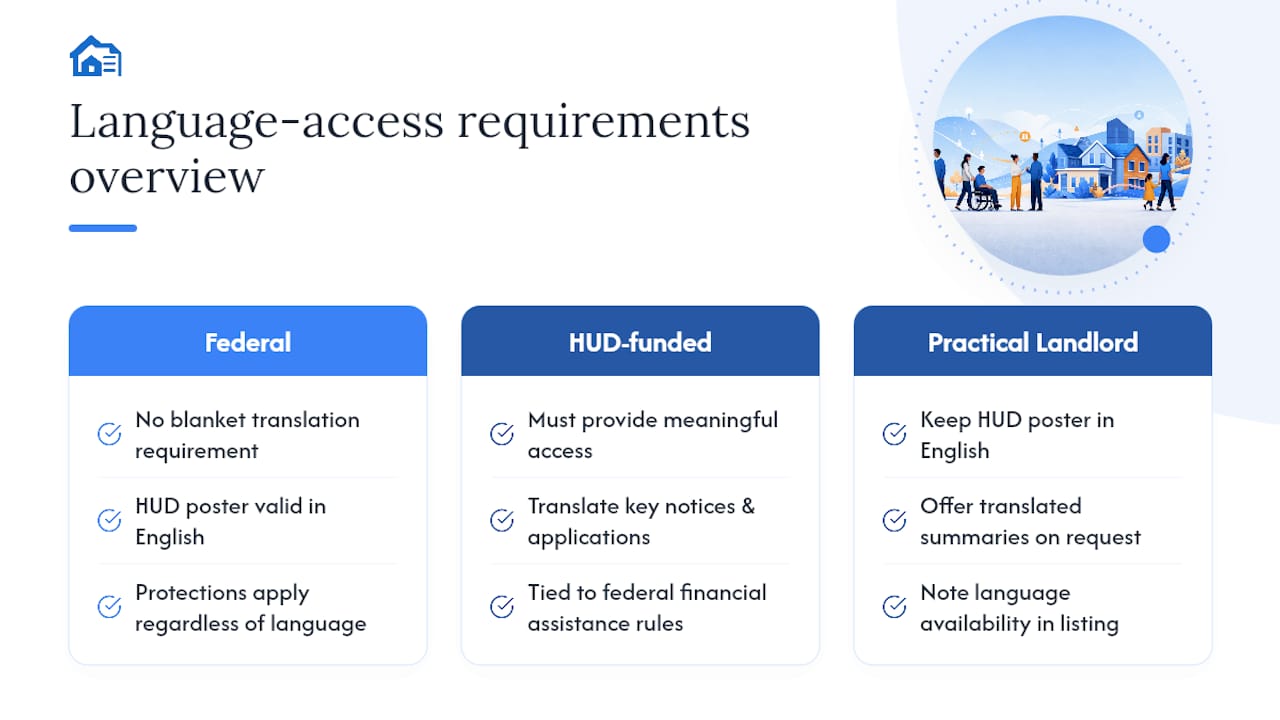
Federal fair housing regulations don’t set a blanket requirement that every poster or notice be translated into multiple languages. The core HUD poster and 24 CFR 100.75 protections apply regardless of the language a notice is written in, but the practical reality is different depending on your local tenant population and, in some cases, your funding source.
HUD-funded and HUD-insured properties are generally expected to provide meaningful access to programs and services for people with limited English proficiency, which often means translating key notices, applications, and marketing materials into the languages most commonly spoken by the community you serve. This obligation ties more closely to federal financial assistance rules than to the poster requirement itself, but the two frequently overlap for subsidized housing providers.
Some states and cities go further and require translated notices as a matter of local law, particularly in jurisdictions with large non-English-speaking populations. If you operate in a city with a significant limited-English-proficient renter base, providing your state notice and application materials in Spanish, Mandarin, or another commonly spoken language isn’t just good practice, it can reduce your exposure to a discrimination claim based on national origin.
A practical middle ground works for most independent landlords: keep the official HUD poster in English as required, but make translated summaries of your key policies available on request, and note that availability in your listing. That single step addresses both the spirit of the rule and the practical needs of a diverse applicant pool, without requiring a full multilingual poster library.
Common Interest Communities and Assisted Housing: What Changes
Condominium associations, homeowners’ associations, and cooperative boards are covered by the Fair Housing Act just like any other housing provider, which surprises a lot of board members who assume the rules only apply to landlords. If an HOA or co-op board is involved in approving occupants, screening applicants, or enforcing occupancy rules, the same prohibitions against discriminatory notices and communications under 24 CFR 100.75 apply to their materials, meeting minutes, and policies.
Where this gets specific: association rules that restrict occupancy based on familial status, such as “no children in the pool area after 6 PM” or blanket age restrictions that don’t meet the narrow federal exemption for qualified senior housing, are a frequent source of complaints. If a community isn’t a properly qualified 55-and-older development under the federal senior housing exemption, its age-based rules are exposed to the same scrutiny as any other housing provider’s.
Assisted housing, including HUD-subsidized units and properties receiving Low-Income Housing Tax Credits, carries additional layers on top of the standard poster and notice rules. These properties often must post additional notices related to tenant rights specific to their subsidy program, alongside the standard fair housing poster, and many are subject to AFHMP requirements described earlier if they’re part of a larger multifamily development. Property managers overseeing subsidized units should treat the standard fair housing poster as the floor, then layer on whatever program-specific notices their funding source requires.
How to Update or Replace a Damaged or Outdated Poster
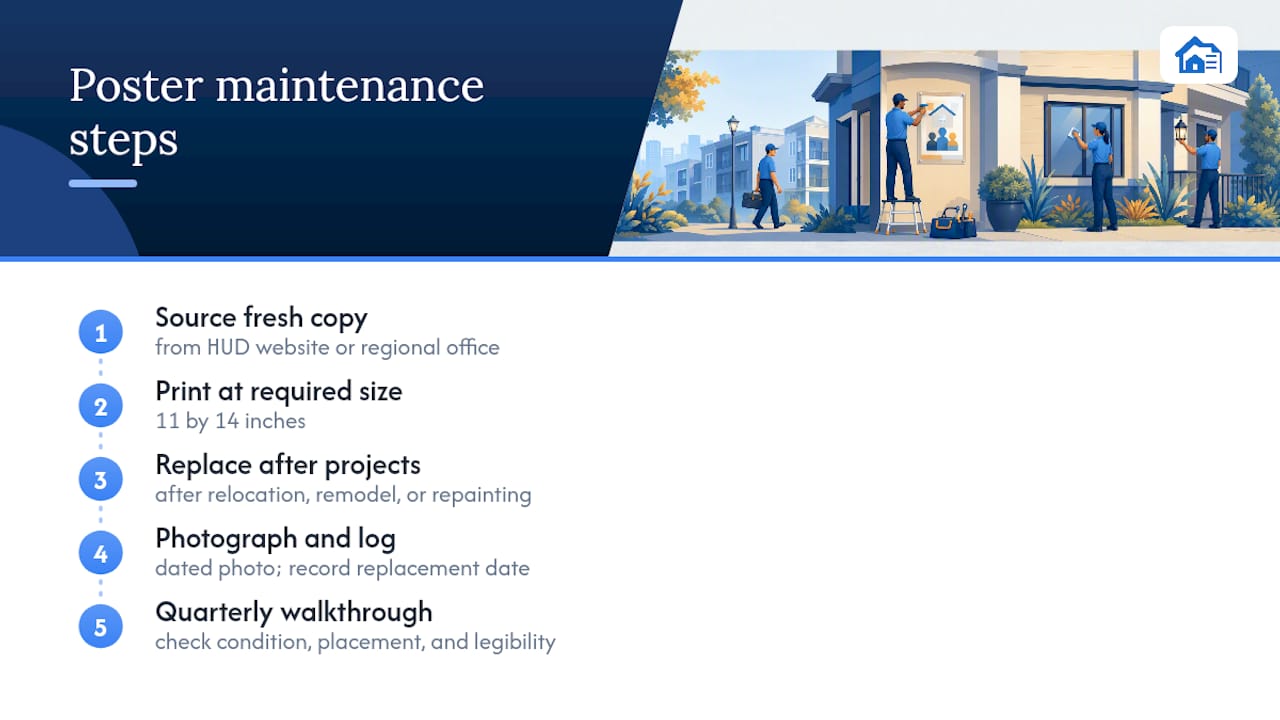
A poster that’s faded, torn, or missing its legend text isn’t functionally different from having no poster at all, and it can trigger the same prima facie evidence problem described earlier. Treat replacement as routine maintenance, not an afterthought.
Start by pulling a fresh copy from HUD’s website or a regional HUD office rather than reusing an old scan that might not match current size and legibility standards. Print it at the required 11 by 14 inch dimensions, and if you’re framing it, make sure the frame doesn’t obscure any part of the required legend.
Replace the poster immediately after any office relocation, remodel, or repainting project, since these are the moments when posters most often go missing or get taken down and forgotten. Before rehanging, take a dated photo of the new poster in place, and log the replacement date alongside your other compliance records.
If you manage multiple properties, a simple quarterly walkthrough checklist covering poster condition, placement, and legibility catches problems long before they turn into a complaint. Pairing that walkthrough with your existing inspection routines keeps the task from becoming a separate chore you forget to schedule.
What Non-Compliance Can Actually Cost You
Fair housing violations carry consequences of the immediate poster or advertising fix. Under the Fair Housing Act’s enforcement framework, civil penalties for a first violation can escalate significantly for repeat offenders, and cases that proceed to federal court can result in compensatory and punitive damages awarded to the complainant, on top of any civil penalty.
Administrative law judge proceedings through HUD can result in actual damages to the aggrieved person, injunctive relief requiring specific changes to your practices, and civil penalties payable to the government. Cases that the Department of Justice pursues directly, often after a pattern of violations or a referral from HUD, can carry substantially higher financial exposure and may include broader injunctive requirements affecting your entire portfolio, not just the property in question.
Beyond the direct financial penalty, a documented violation can affect eligibility for HUD programs, insurance, and financing tied to affordable housing tax credits. For a landlord operating on thin margins across a handful of units, a single sustained complaint investigation, legal fees included, often costs more than years of consistent, low-effort compliance would have. The math almost always favors getting the poster up and the ad language cleaned up before anyone asks.
Why Proactive Compliance Beats Reactive Damage Control
Most landlords treat the fair housing poster like a formality, something you print once and forget. That’s backwards. The poster and your advertising language are the first things an investigator or a testing organization checks, and they’re the easiest things to get right before anyone ever files a complaint.
The real risk isn’t malice. It’s improvisation. A property manager who writes a slightly different listing description for every unit, or answers applicant questions differently depending on mood and memory, is building inconsistency into their own paper trail. Standardized, reviewed language isn’t just about avoiding a lawsuit. It signals to tenants that you’re running a professional operation, which tends to reduce disputes across the board, not just fair housing ones.
If you found the tenant rights compliance guidance useful, treat this poster and notice work as the same category of task: small, recurring, easy to automate, and expensive to ignore.
— Igor
Where LandlordForms Fits Into Your Compliance Routine
LandlordForms turns fair housing paperwork from a recurring risk into a repeatable process. Instead of hunting down the current HUD poster, writing your own state notice language, and hoping your ad copy holds up under scrutiny, you get state-specific templates that keep the required legal language current, automated date tracking for renewals and periodic checks, and a place to store your dated compliance photos alongside your lease and inspection records.
That last piece matters more than it sounds. A photo of your posted poster, timestamped and filed next to your other tenant documentation, is the kind of evidence that actually holds up if a complaint ever lands on your desk. The Starter Landlord, Pro Landlord, and Small PM Suite plans are built around exactly that kind of organization, whether you’re managing a single rental or a portfolio pushing 150 units. If you want to see how the templates work before committing to a plan, the free rent ledger template is a low-friction way to try the document style firsthand, and you can start building your compliance records today.
Primary Sources for Fair Housing Notice Requirements
The federal poster requirement traces back to 24 CFR § 110.10, with the full poster specification and prima facie enforcement language available in the govinfo published version of Part 110. The advertising and notice prohibitions sit in 24 CFR § 100.75. For multifamily marketing obligations, HUD’s AFHMP form 935.2A lays out the plan and signage requirements.
For state-level supplements, New York’s Housing and Anti-Discrimination Notice is a useful model, and Pennsylvania landlords should check current Pennsylvania Housing Finance Agency program pages. To file or research a complaint, HUD’s 903 complaint intake system is the official starting point. Always confirm current requirements against your own state’s housing agency, since these rules get updated more often than most landlords check.
Sources
- 24 CFR § 100.75 - Discriminatory advertisements, statements and notices. | eCFR / LII
- 24 CFR Part 110 — Fair Housing Poster (govinfo PDF)
- Affirmative Fair Housing Marketing Plan (AFHMP) - 935.2A (HUD)
- HUD-903 Report Housing Discrimination (HUD complaint form entry)
FAQ
What are fair housing notice requirements?
They require anyone offering housing for sale or rental to post the HUD fair housing poster at their place of business and, in most cases, at the dwelling, while also prohibiting any notice or advertisement that indicates a discriminatory preference under 24 CFR 100.75.
What are the seven protected classes under federal fair housing law?
The Fair Housing Act protects race, color, religion, sex, disability, familial status, and national origin; some people count sex and gender identity separately depending on current HUD guidance, but the core federal list covers those seven categories.
What are some examples of Fair Housing Act violations?
Common violations include ads excluding families with children, screening questions targeting national origin or immigration status, refusing reasonable accommodations for disabilities, and failing to display the required poster, which HUD can treat as evidence of a violation on its own.
What are some exceptions to the Fair Housing Act?
Narrow exemptions exist for certain owner-occupied buildings with four or fewer units, single-family homes rented without a broker or discriminatory advertising, and qualified senior housing communities meeting specific age-restriction criteria.
Does LandlordForms help with fair housing poster compliance?
Some software services provide state-specific templates and photo storage tools that can help landlords track posted notices and organize compliance records, though the official poster itself must be obtained from HUD directly.
How much does LandlordForms cost?
LandlordForms offers the Starter Landlord plan at $9 per month, Pro Landlord at $19 per month, and Small PM Suite at $39 per month, all listed on the LandlordForms website.