How Consistent Processes Protect Your Rental Returns

Consistent property-management processes protect investor returns by stabilizing cash flow, cutting avoidable costs, and preserving asset condition. Three areas deliver the most immediate leverage: automated rent tracking, a scheduled preventive maintenance cadence, and photo-documented move-in/move-out inspections.
Start here before anything else:
- Open a rent ledger today and log every payment, late fee, and balance.
- Set a quarterly preventive maintenance schedule (HVAC filters, smoke detectors, plumbing checks).
- Create a move-in photo checklist and complete it before every new tenancy.
- Draft one written lease-enforcement policy, even a single page, and apply it every time.
- Identify two emergency vendors (plumber, electrician) and document their contact details.
The sections below explain the mechanisms, show the financial math, and give you a step-by-step playbook to put these habits in place.
Key Takeaways
Consistent property-management processes protect investor returns by lifting NOI through lower costs, faster collections, and fewer disputes, and every dollar of NOI improvement multiplies into property value at your cap rate.
| Point | Details |
|---|---|
| NOI drives valuation | At a 5.5% cap rate, $1 of additional monthly NOI adds roughly $18 to property value. |
| Maintenance standardization works | Centralized preventive schedules cut per-property maintenance costs by 28% in a documented case study. |
| Documentation prevents losses | Signed, photo-documented move-in checklists protect deposit claims and reduce dispute costs. |
| Start with three SOPs | Rent collection, move-in inspection, and late-notice issuance cover the highest-risk failure points first. |
| Landlordforms saves time | Automating document workflows with Landlordforms can save landlords up to eight hours per week. |
Table of Contents
- How consistent processes protect investor returns
- The specific processes every small landlord should standardize
- How to build SOPs and simple automations that actually stick
- How to measure the financial impact of better processes
- Common operational mistakes that quietly erode returns
- What I’ve seen change when landlords get consistent
- Landlordforms puts these processes within reach for small landlords
- Sources
- FAQ
How consistent processes protect investor returns
Repeatable processes protect returns through a direct chain: stable rent collection feeds Net Operating Income (NOI), lower maintenance spend widens the margin, and clean documentation reduces costly disputes. NOI is the number that drives property valuation, so any process that lifts it also lifts what your asset is worth.
Statistic to know: A 2023 hedonic regression study found that property-management service quality can have measurable, potential effects on dwelling prices, with aggregate impacts averaging up to about fifteen percent and up to around thirty percent under cumulative double-unit changes. The authors frame these as potential rather than guaranteed outcomes, and note they require object-level research to confirm. Still, the directional signal is clear: management quality shows up in value.
The mechanisms that connect process to return:
- Rent collection → cash-flow certainty. A documented collection policy with consistent late-fee enforcement reduces arrears and keeps monthly income predictable.
- Preventive maintenance → lower lifecycle costs. A centralized CMMS case study reported a significant reduction in per-property maintenance costs after standardizing work-order intake and preventive schedules.
- Inspections and documentation → dispute avoidance. Timestamped photos and signed checklists shorten deposit disputes and reduce legal exposure.
- Tenant screening and lease enforcement → lower arrears and damage. Consistent criteria applied to every applicant cuts the risk of costly nonpayment cycles.
A simple illustration: operating expenses typically represent 35%–50% of effective gross income (NMHC range). Shaving even a modest amount from that band lifts NOI, and at a 5.5% cap rate, every $1 of additional NOI adds roughly $18 to property value. An improvement in net operating income on one unit translates to a meaningful increase in appraised value. That math rewards consistency.
The specific processes every small landlord should standardize
Operational consistency prevents the slow erosion of asset value that comes from repeated small failures. Here are the processes worth codifying first.
1. Rent collection and ledgering
Track every payment in a dedicated rent ledger, not a spreadsheet shared with grocery lists. Log the amount, date received, method, and any balance. This creates an audit trail that matters in court and in tax season.
KPI to track: Rent collection rate (target: 98%+) and average days-to-collect.
2. Tenant screening with standardized criteria
Apply the same written criteria to every applicant: minimum income ratio, credit threshold, rental history requirements. Documented, consistent screening reduces fair-housing liability and filters out higher-risk tenants before they sign.
KPI to track: Percentage of tenants who reach lease renewal without a late-payment incident.
3. Lease enforcement and compliant notice workflows
When a tenant pays late or violates a lease term, the response must be the same every time: the correct notice, served correctly, within the required window. Informal verbal warnings are not enforceable and signal that the policy is negotiable.
KPI to track: Average days from lease violation to written notice issued.
4. Preventive maintenance schedules
A quarterly checklist (HVAC, plumbing, roof, exterior) costs far less than emergency repairs. The CMMS case study that documented a significant cost reduction did so primarily through standardized preventive schedules and centralized vendor management, not through technology alone.
KPI to track: Maintenance cost per unit per year, and ratio of preventive to reactive work orders.
5. Inspection and photo documentation checklists
Structured photo documentation at move-in and move-out reduces deposit disputes and supports damage claims. Timestamped photos, signed by the tenant, are far more persuasive than memory.
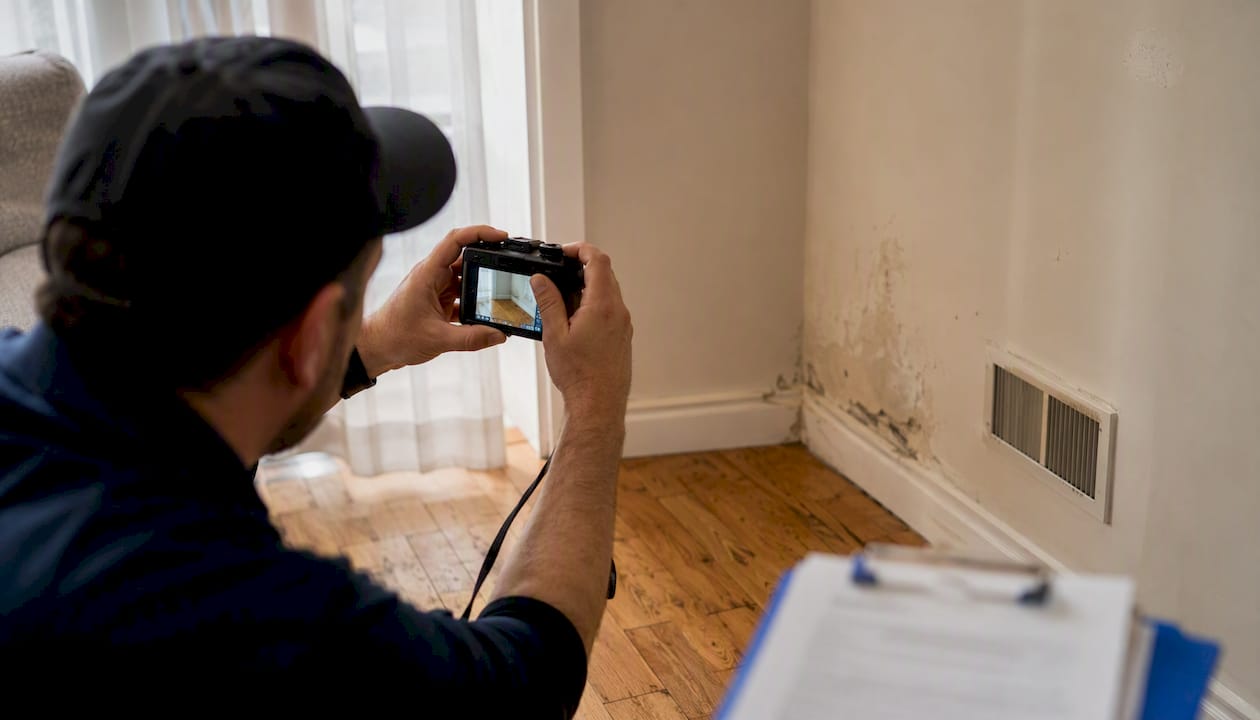
KPI to track: Percentage of turnovers completed with a signed, photo-documented checklist.
6. Standardized vendor procurement
Keep a written vendor list with approved contractors, agreed rates, and response-time expectations. Ad-hoc vendor selection under pressure produces inconsistent quality and inflated invoices.
KPI to track: Average repair cost per incident vs. prior 12-month baseline.
7. Owner reporting cadence
Send a consistent monthly or quarterly report covering income, expenses, occupancy, and maintenance activity. Consistent reporting builds owner trust and surfaces problems before they compound.
KPI to track: Reporting delivered on schedule (yes/no per period).
Pro Tip: Rent collection automation combined with a monthly ledger review gives small landlords the fastest cash-flow visibility. If you fix only one process this quarter, make it this one.
How to build SOPs and simple automations that actually stick
A standard operating procedure (SOP) does not need to be long. The minimum viable structure: scope (what this covers), trigger (what starts it), step sequence (numbered actions), owner (who is responsible), and required documentation (what gets filed).
Step-by-step rollout:
- Audit current practice. Write down what actually happens today for rent collection, maintenance requests, and move-ins, not what should happen.
- Pick three pilot SOPs. Start with rent collection, move-in inspection, and late-notice issuance.
- Map responsibility. Assign one owner per SOP. If you manage alone, you are the owner.
- Add one automation or template per SOP. A rent ledger template, a notice template, and a move-in checklist cover the three pilots.
- Run a 30-day audit. Use a documentation audit checklist to verify each SOP was followed for every transaction in the period.
Quick-start checklist:
- Written rent collection policy (due date, grace period, late fee, notice trigger)
- Move-in and move-out photo checklist (signed by tenant)
- Preventive maintenance calendar (quarterly minimum)
- Approved vendor list with contact details and agreed rates
- Late-notice template for each notice type your state requires
Pro Tip: Record a short screen-share video the first time you complete each SOP. When a vendor or new hire needs training, the video does the work. Version-date every SOP document so you always know which copy is current.
For more on reducing admin hours without sacrificing accuracy, the workflow efficiency guide covers task batching and scheduling tactics that complement the SOP approach.
How to measure the financial impact of better processes
Track these KPIs monthly, then compare 90-day and 180-day periods against your baseline:
- Rent collection rate (payments received on time ÷ payments due)
- Days-to-collect (average days from due date to receipt)
- Vacancy and turnover days (days between tenancies)
- Maintenance cost per unit (total maintenance spend ÷ number of units)
- Lease renewal rate (renewals ÷ leases expiring)
- Average repair cost per incident
Worked valuation example:
| Improvement | Monthly NOI Change | Annual NOI Change | Value Change at 5.5% Cap Rate |
|---|---|---|---|
| Reduce vacancy by 5 days/unit | +$150 | +$1,800 | +$32,727 |
| Cut maintenance cost 10% | +$80 | +$960 | +$17,455 |
| Combined effect | +$230 | +$2,760 | +$50,182 |
Cap-rate formula: Value change = NOI change ÷ cap rate. Example uses 5.5% and illustrative figures.
When estimating ROI, measure both cost reduction and revenue optimization. Industry analysis suggests revenue levers (rent pricing, retention, vacancy reduction) commonly produce 2x–3x the impact of pure cost cuts. Both sides of the equation belong in your tracking.
Common operational mistakes that quietly erode returns
Inconsistency compounds. A single skipped inspection or verbal rent concession rarely feels costly in the moment. Over 12 months, the pattern does.
Red flags and quick fixes:
- Informal verbal policies. Fix: convert to a one-page written policy and reference it in the lease.
- Single-person knowledge silos. Fix: document every process so a substitute can execute it without a briefing.
- Inconsistent vendor follow-up. Fix: require a written work-completion confirmation with photo evidence before closing any work order.
- Irregular inspections. Fix: schedule inspections on a calendar with a 15-minute monthly audit to confirm they happened.
- Ad-hoc rent concessions without documentation. Fix: any concession gets a signed addendum. No addendum, no concession.
A short illustration of compounding: a landlord who skips the move-out inspection to save 30 minutes loses the ability to document damage. Without documentation, the deposit claim fails. The repair comes out of pocket. The unit sits vacant an extra week during the dispute. Three small failures, one avoidable $2,000+ loss.
What I’ve seen change when landlords get consistent
Most landlords who struggle with returns are not making bad investment decisions. They are making good decisions inconsistently. The rent policy exists but gets waived. The inspection checklist exists but gets skipped when the tenant seems trustworthy. The vendor list exists but gets ignored when something breaks at 9 PM.
The research backs this up: the hedonic regression study and the CMMS case study both point to the same conclusion. Management quality, applied consistently, shows up in the numbers. And the time cost of consistency is lower than most landlords expect. Landlordforms reports that automating document workflows saves landlords up to eight hours per week. That is time recovered from paperwork and redirected to the decisions that actually require judgment.
Consistent documentation also changes the dynamic with tenants. When tenants see that policies are applied the same way every time, disputes decrease. Not because tenants become easier, but because the rules are clear and the evidence is there.
Landlordforms puts these processes within reach for small landlords
Most landlords managing fewer than 150 units do not need enterprise software. They need the right forms, generated correctly, every time, without spending an evening on it.
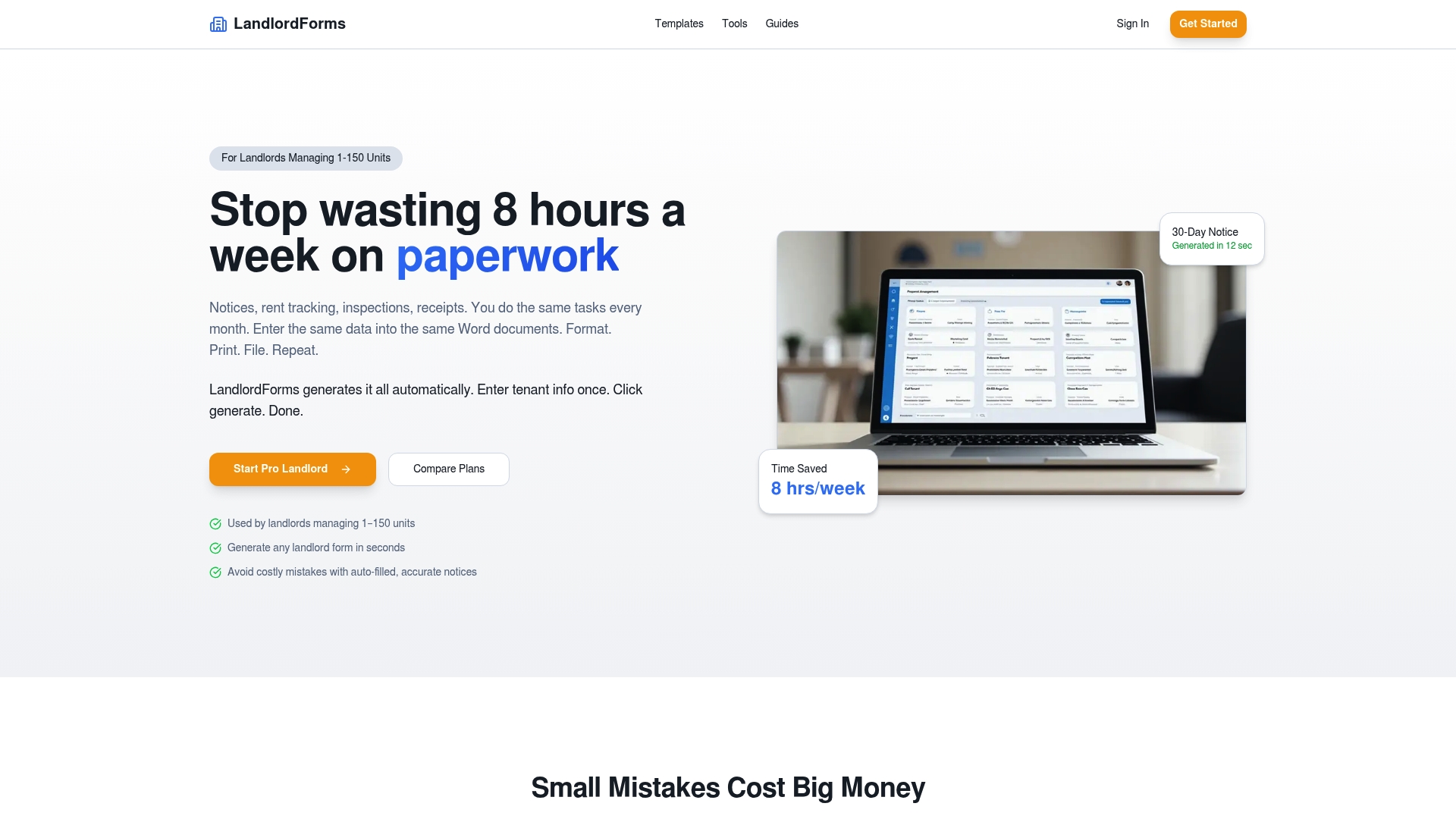
Landlordforms maps directly to the processes in this article: automated 30-, 60-, and 3-day notices replace the informal verbal warning; the rent ledger template replaces the shared spreadsheet; photo documentation tools and move-in/move-out checklists replace the handshake inspection. The late-fee calculator keeps enforcement compliant and consistent across every unit. For landlords managing 1–150 units, the platform covers the full document workflow in a few clicks. Download the free rent ledger template today and start your baseline measurement.
Sources
- Potential impact of property management on the market value of dwellings in multi-owned housing | Journal of Housing and the Built Environment
- AI Property Management ROI: Payback by Portfolio Size
- How Operational Consistency Protects Asset Value - Metric Property Management
FAQ
How do consistent processes protect investor returns in rental properties?
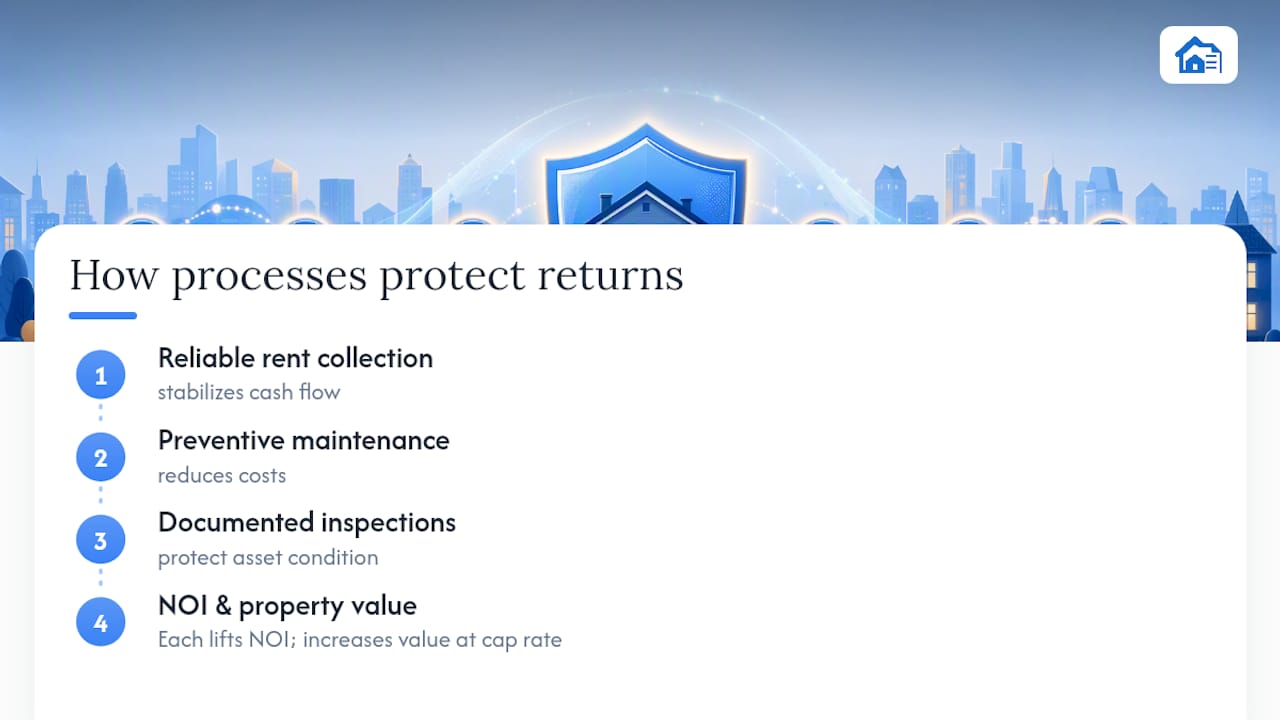
Consistent processes stabilize cash flow through reliable rent collection, reduce costs through preventive maintenance, and protect asset condition through documented inspections. Each improvement lifts NOI, which directly increases property value at your cap rate.
Which property-management process has the biggest impact on returns?
Rent collection and tracking typically deliver the fastest impact because arrears and inconsistent enforcement directly reduce monthly income. Preventive maintenance produces the largest long-term cost savings, with one documented case study reporting a 28% reduction in per-property maintenance costs.
How do I measure whether my processes are actually improving returns?
Track rent collection rate, days-to-collect, vacancy days, maintenance cost per unit, and lease renewal rate monthly. Compare 90-day periods against your pre-change baseline, then convert NOI changes to estimated value using your local cap rate.
What is the minimum viable SOP for a small landlord?
A one-page document covering scope, trigger, numbered steps, owner, and required documentation is enough to start. Prioritize rent collection, move-in inspection, and late-notice issuance as your first three.
How does Landlordforms help with process consistency?
Landlordforms automates the creation of notices, rent receipts, and inspection checklists, and provides a rent ledger for real-time payment tracking. The platform is built for landlords managing 1–150 units and can save up to eight hours per week in document-related tasks.