Audit-Proof Rental Property Documents for Landlords

TL;DR:
- An audit-proof rental file contains specific documents organized into per-event PDFs that can be produced within 48 hours. Maintaining organized, timestamped, linked, and signed records for each property and event helps protect deductions and supports quick responses during audits. Consistently following best practices in documentation, storage, and record retention minimizes the risk of denial and reduces audit time.
An audit-proof rental file contains six categories of documents — lease, rent ledger, receipts/invoices, closing disclosure, depreciation worksheet, and timestamped inspection photos — organized so you can produce any one of them within 48 hours of a request. The single action to take today: create one PDF event packet for your next move-in or repair, drop it in a property-specific folder, and you will have built the habit that protects every deduction you claim on Schedule E.
Here is the minimum set an IRS agent or opposing attorney will ask for, per property and per event:
- Lease and all amendments — fully executed, with tenant initials on every page
- Rent ledger — a running record of charges, payments, and balances tied to bank deposits
- Invoices and receipts — every expense claimed on Schedule E, matched to a bank statement line
- Closing disclosure or HUD-1 — establishes your cost basis for depreciation under IRS Publication 527
- Form 4562 depreciation worksheet — the backup behind every depreciation deduction
- Move-in/move-out inspection with timestamped photos — signed by the tenant, dated within 24 hours
- Tenant notices — written, dated, and delivered with proof of service
IRS Publication 527 governs residential rental property taxation, and Form 4562 drives every depreciation deduction you take. Landlordforms maps directly to these requirements with ready-made templates for rent ledgers, inspection forms, and notices — so you produce compliant documents at the moment of the event, not weeks later when memory fades.
Table of Contents
- What do audit-proof rental property documents actually include?
- How long should you keep each type of rental record?
- How do you build an audit-ready file for each property?
- What are the best practices for storing and securing rental records?
- What do IRS agents and attorneys actually look for?
- What should you do immediately when the IRS requests documents?
- Key Takeaways
- Why the “organize later” habit costs landlords more than they realize
- Landlordforms cuts the paperwork time without cutting the paper trail
- Useful sources and references
- FAQ
What do audit-proof rental property documents actually include?
A complete, audit-ready portfolio is organized across four levels: permanent property records, per-tenancy records, per-event packets, and financial/tax documents. Miss any level and you have a gap an auditor will find.
Per-property permanent documents
These stay in the file for as long as you own the property, plus seven years after you sell it:
- Closing disclosure or HUD-1 (establishes purchase price and cost basis)
- Deed and title insurance policy
- Basis worksheet tracking capital improvements over time
- Depreciation schedule (Form 4562 backup, updated annually)
- Mortgage interest statements (Form 1098, each year)
- Property tax statements and payment confirmations
- Insurance declarations pages, each policy year
- Any easements, HOA agreements, or zoning documents affecting the property
Per-tenancy documents
Start a new subfolder for each tenancy. Keep everything from application through move-out:
- Fully executed lease and all signed amendments
- Tenant application and screening records (credit report authorization, background check)
- Security deposit ledger showing receipt, any deductions, and return with itemized statement
- Move-in inspection form signed by the tenant, with timestamped photos attached
- All required disclosures (lead paint, mold, flood zone, local addenda)
- Rent ledger showing every charge and payment
- Rent receipts or payment confirmations
- All notices served (late rent, lease violation, entry, non-renewal, eviction)
- Move-out inspection with photos, signed or documented as refused
A signed, dated move-in inspection with photos is the single most critical document in a tenancy file. Without it, any security deposit deduction is vulnerable in a dispute or audit.
Per-event packets (the event-packet model)
Every maintenance request, violation, or capital project gets its own PDF package. Bundle these four artifacts every time:
- Timestamped maintenance request or work order (date and time visible)
- Photographic evidence — wide shot for context, close-up for the defect or completed work
- Linked vendor invoice and proof of payment (check image, ACH confirmation, credit card statement)
- Signed completion note or tenant acknowledgment
Package those four into one PDF and name it with the date, type, vendor, and property address. That single file answers most auditor questions about an expense without any follow-up.
Pro Tip: Build the packet the same day the work is done. Reconstructed records — assembled weeks or months later — are treated as suspect by courts and auditors alike, while contemporaneous records carry the weight of evidence.
Financial and tax documents
- Bank statements for all rental-dedicated accounts, every month
- Canceled checks or ACH records matching invoice payments
- Receipts for every deductible expense, tagged by property
- Form 1099s issued to vendors paid $600 or more, and 1099s received
- Year-end owner or property management statements
- Schedule E supporting worksheets (income, expense, and depreciation detail)
- Form 4562 depreciation backup for each asset
Entity-level documents (if applicable)
If you hold property in an LLC, partnership, or S-corp:
- Formation documents and EIN confirmation letter
- Operating agreement or partnership agreement
- K-1s issued and received
- Entity tax returns and annual state reports
Pro Tip: Start with your closing disclosure and your most recent move-in packet. Those two documents anchor your basis and your tenancy timeline — the two things auditors check first on a rental property.
For a printable version of this checklist, the property documentation audit checklist at Landlordforms walks through each category with a scoring column so you can see gaps at a glance.
How long should you keep each type of rental record?
The IRS sets a general three-year statute of limitations on tax records, measured from the filing date. But that baseline does not cover the full exposure a landlord faces. The practical rule most tax advisors use: seven years for anything that touched a tax return, and permanent retention for anything that establishes cost basis or depreciation.
| Document type | Minimum retention | Why |
|---|---|---|
| Routine receipts and invoices | 7 years after filing | |
| Rent ledgers and bank statements | 7 years after filing | |
| Lease agreements | Tenancy life plus seven years | |
| Security deposit records | Tenancy life plus seven years | |
| Closing disclosure / HUD-1 | Ownership period plus seven years after sale | |
| Form 4562 depreciation schedules | Ownership period plus seven years after sale | |
| Capital improvement records | Ownership period plus seven years after sale | |
| Entity formation and tax returns | Life of entity plus seven years | |
| Move-in/move-out inspections | Tenancy life plus seven years |
The IRS extends its statute to six years when a return omits more than 25% of gross income, and there is no statute at all for fraudulent returns. Seven years covers both scenarios for most landlords. Basis and depreciation records are a different matter entirely: you need them from the day you bought the property through the day you sell it, because depreciation recapture is calculated on the full history.
State-specific note: Security deposit retention periods are governed by state landlord-tenant law, not the IRS. Some states require return within 14 days; others allow 30 or 45. Keep all deposit documentation for the state-required period plus at least three years beyond that. The tenant rights notice compliance guide at Landlordforms covers state-specific notice requirements that affect how long you need to retain related records.
How do you build an audit-ready file for each property?
Organization is where most landlords fail. Fragmentation across apps, email threads, and physical folders is the most common reason landlords lose deductions or litigation. The fix is a consistent folder structure and a strict naming convention applied at the moment of every event.

Folder structure
Properties/
  123-Main-St/
    Permanent/
      Closing-Disclosure.pdf
      Deed.pdf
      Depreciation-Schedule.xlsx
    2024/
      Tenancy-Smith-2024/
        Lease-Executed.pdf
        Move-In-Packet/
        Notices/
        Rent-Ledger.xlsx
      Maintenance/
        2024-03-15_Repair_HVAC_ABC-Heating_123Main.pdf
      Tax/
        Schedule-E-Backup.xlsx
        Form-4562-Backup.pdf
    2025/
      ...
The naming convention follows a simple pattern: YYYY-MM-DD_type_vendor_property.pdf. A March 15 HVAC repair at 123 Main becomes 2024-03-15_Repair_HVAC_ABC-Heating_123Main.pdf. Every file is sortable by date and searchable by type or vendor without opening a single document.
The event-packet approach
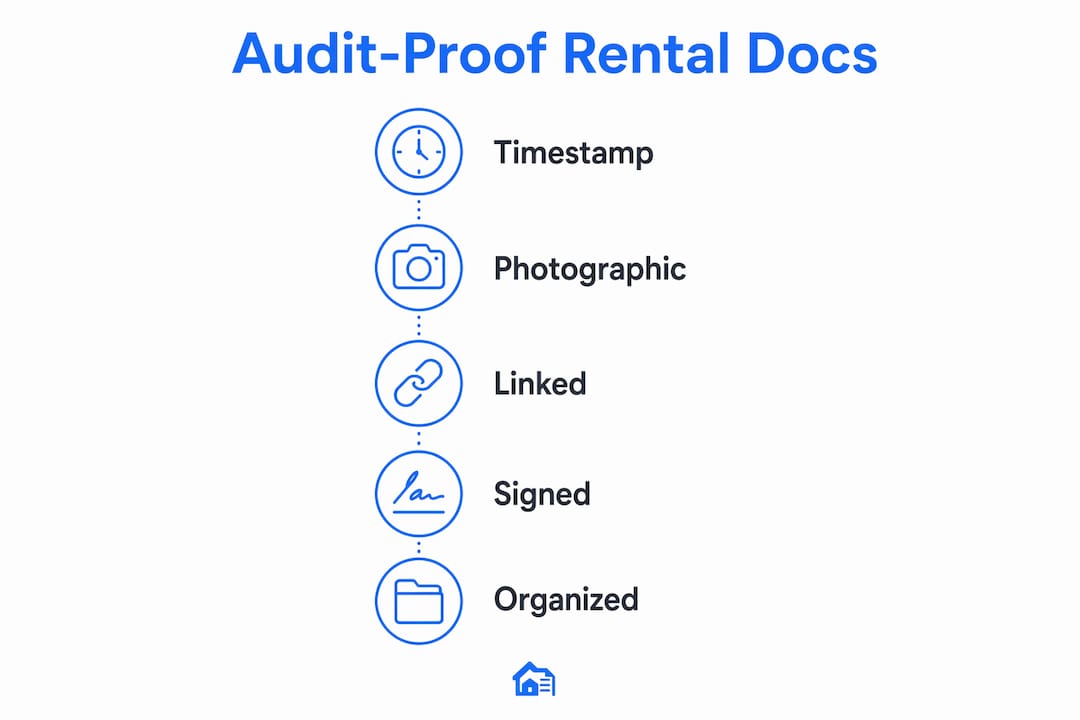
Every event — move-in, move-out, repair, violation, capital project — gets one PDF. The four qualities that make a packet defensible are: Timestamped, Photographic, Linked, and Signed (TPLS). Produce all four at the moment of the event, not later.
For a maintenance event, the packet contains:
- Tenant’s written request (email, text screenshot, or work-order form) with date/time visible
- Before photos (wide + close-up), EXIF metadata intact
- Vendor invoice referencing the work order number
- Proof of payment (bank ACH, check image, or card statement)
- After photos with the same EXIF standard
- Signed completion note or tenant acknowledgment
For a move-in, follow the documented move-in process that captures a room-by-room inspection with photos, tenant signature, and the date — all in one file attached to the lease.
Linking records to Schedule E and Form 4562
Tag every transaction in your rent ledger with the matching invoice number and event-packet file name. When you prepare Schedule E, each line item on the return traces back to a specific file in the folder. Auditors request exactly this mapping: a ledger total linked to a source document. Without it, poor documentation is the most common cause of denied deductions.
| Organization approach | Strengths | Weaknesses |
|---|---|---|
| Per-property folder + event packets | Full audit trail; fast retrieval; maps to Schedule E | Requires discipline at time of event |
| Property management software upload only | Centralized; searchable | Vendor lock-in; export formats vary; gaps if staff skip uploads |
| Centralized accounting file only | Good for financials | No inspection photos, notices, or tenant correspondence |
Pro Tip: Preserve original EXIF metadata on every photo — do not screenshot or re-save images, which strips the embedded timestamp. Use PDF/A format for archival documents so the file is self-contained and readable without proprietary software. For an audit trail that covers property management operations end-to-end, the audit trail property management guide is worth bookmarking.
What are the best practices for storing and securing rental records?
Digital storage removes the “my files were in the flood” problem, but only if the backup strategy is solid. The 3-2-1 rule applies directly: keep three copies, on two different media types, with one copy offsite or in a separate cloud account.
- Cloud primary: a dedicated folder in Google Drive, Dropbox Business, or a property management platform — with version history enabled so you can recover overwritten files
- Local backup: an external drive or NAS device at your home office, synced weekly
- Offsite or secondary cloud: a separate cloud account or a physical drive stored away from your primary location
The IRS accepts electronic records under Rev. Proc. 98-25, provided the system produces legible, accurate reproductions and maintains an auditable access log. Keep a log of who accessed or modified records, especially for multi-owner LLCs.
Authentication steps that matter:
- Use PDF/A for all archival documents (self-contained, no external font dependencies)
- Preserve original EXIF metadata on photos — never re-save or screenshot
- Use certificate-based electronic signatures (DocuSign, Adobe Sign) for leases and inspection forms; keep the signed PDF and the certificate together
- Note that some local eviction courts still require wet-ink originals — check your jurisdiction before relying solely on e-signatures for notices
Pro Tip: Run a restore test every six months. Most landlords discover their backup is broken only when they need it. Download a random file from each backup location and confirm it opens correctly. A backup you cannot restore is not a backup.
Security basics: encrypt files at rest (most cloud platforms do this by default, but verify), use role-based access so a property manager can see their properties but not others, and enable two-factor authentication on every account that holds rental records.

What do IRS agents and attorneys actually look for?
IRS auditors focus on four areas when examining a rental return: gross rental income, major expense deductions, cost basis, and the depreciation calculation. Travel deductions require contemporaneous mileage logs — a spreadsheet reconstructed at tax time carries almost no weight.
The red flags that trigger deeper scrutiny or outright disallowance:
- Capital improvements deducted as repairs. A new roof is a capital improvement; patching three shingles is a repair. Separate folders for “Repairs” and “Capital Improvements,” with distinct invoices and photos from the moment of payment, are the clearest defense.
- Missing receipts. A bank statement alone does not substantiate a deduction. The IRS wants the invoice showing what was purchased and for which property.
- Commingled personal and business expenses. Running rental expenses through a personal credit card or account makes it nearly impossible to prove the expense was business-related. A dedicated account and card for each property (or at minimum for all rentals) eliminates this problem.
- No timestamped move-in/move-out photos. Without a baseline, any deposit deduction is contested. Weak documentation on a security deposit dispute can lead to substantial contested write-offs; habitability claim exposure can be significant in some cases; and statutory deposit penalties may reach multiples of the deposit amount in states with strict landlord-tenant laws.
- Reconstructed records. Records assembled after the fact — even accurate ones — are treated as suspect. Contemporaneous records, built at the time of the event, carry evidentiary weight.
| Red flag | Consequence | Mitigation |
|---|---|---|
| Capital improvement deducted as repair | Deduction disallowed; potential penalty | Separate Repairs vs. Capex folders; photos at time of work |
| Missing receipt for claimed expense | Deduction denied | Scan receipts same day; attach to invoice in event packet |
| Commingled personal/business expenses | Entire category questioned | Dedicated bank account and card for rental activity |
| No move-in inspection baseline | Deposit deduction vulnerable; $800–$2,400 exposure | Signed inspection with timestamped photos within 24 hours |
| Reconstructed mileage log | Travel deduction disallowed | Contemporaneous log (app or spreadsheet updated same day) |
A defensible event packet does not just preserve the deduction — it speeds the auditor’s review and reduces follow-up requests, which shortens the entire audit timeline.
What should you do immediately when the IRS requests documents?
Speed and organization matter more than volume when an audit notice arrives. Here is the ordered response:
- Note the request date and response deadline. IRS correspondence deadlines are firm. Mark the date on your calendar and set a reminder seven days before.
- Copy the entire request letter. Do not annotate the original. Work from a copy so the original is preserved exactly as received.
- Notify your CPA and any co-owners immediately. Do not respond to the IRS directly without your tax advisor’s input, especially if the audit involves depreciation or basis questions.
- Preserve a read-only copy of the requested records. Lock the relevant year’s folder so nothing is modified, deleted, or overwritten during the audit period.
- Assemble the priority documents first: Schedule E backup, rent ledger, receipts and invoices tied to questioned amounts, Form 4562 depreciation worksheets, and the closing disclosure if basis is in question.
- Build a year-specific audit binder PDF per property. Include a one-page index at the front listing each document, its page number, and the Schedule E line it supports. Number every page of the binder.
- Write a short narrative. One page per issue, linking ledger totals to the attached receipts and invoices. Auditors review faster when the logic is spelled out; it also reduces follow-up questions.
- Deliver organized, not overwhelming. Send exactly what was requested, organized by the auditor’s question list. Sending unsolicited documents can expand the audit scope.
- Communicate in writing. Confirm every phone conversation with a follow-up email summarizing what was discussed and agreed. Keep copies of all correspondence.
- Request an extension in writing if you need more time. Explain the reason briefly and professionally. Most IRS agents grant reasonable extensions for well-organized responses.
The tenant communication records guide at Landlordforms covers how to maintain a written log of tenant interactions — the same discipline applies to auditor correspondence.
Key Takeaways
Audit-proof rental records require four qualities at creation — timestamped, photographic, linked, and signed — organized into per-event PDF packets and a per-property Permanent folder that maps directly to Schedule E and Form 4562.
| Point | Details |
|---|---|
| TPLS at creation | Every document must be timestamped, photographic, linked, and signed at the moment of the event. |
| Retention defaults | Keep tax-influencing records 7 years; keep basis and depreciation records for ownership life plus 7 years after sale. |
| Event-packet discipline | Bundle maintenance request, photos, invoice, payment proof, and signed completion note into one PDF per event. |
| Red-flag mitigation | Separate Repairs and Capex folders; dedicated rental bank account; contemporaneous mileage log. |
| Landlordforms templates | Landlordforms provides rent ledger, inspection, and notice templates that produce TPLS-compliant documents at the point of creation. |
Why the “organize later” habit costs landlords more than they realize
Most landlords know they should keep better records. The gap is not knowledge — it is timing. The instinct to file documents “later” is where audit exposure actually lives, and it is worth being direct about why.
An auditor does not care that you paid for the repair. They care that you can prove it, link it to a specific property, and show it was not a capital improvement disguised as a routine expense. A receipt scanned the same day the work is done, attached to the invoice and the before/after photos in one PDF, answers all three questions instantly. The same receipt found in a shoebox six months later answers none of them convincingly.
The event-packet method described here is not extra work. It is the same work done in the right order. You are already paying the vendor, taking the photos, and filing the invoice somewhere. The only change is packaging them together before you close the laptop. That habit, applied consistently, is what separates a landlord who breezes through an audit from one who spends three months reconstructing records and still loses deductions.
Scale matters too. If you manage one to five units, a manual folder system works fine. At 20 or more units, the volume of events makes manual packaging unsustainable without a consistent naming convention and a weekly ingestion routine. The rental inspection documentation guide at Landlordforms covers how to build that routine into your move-in and move-out workflow regardless of portfolio size.
One more thing worth saying plainly: the documents that protect you most are the ones tenants sign. A lease is only as strong as the signature on it. An inspection report without a tenant signature carries little weight in court or in an audit. Get the signature at the time of the event, attach it to the packet, and you have a document that holds up.
Landlordforms cuts the paperwork time without cutting the paper trail
Eight hours a week is what manual landlord paperwork typically consumes — drafting notices, building ledgers, formatting inspection forms from scratch. Landlordforms was built specifically for landlords managing 1 to 150 units, and it eliminates most of that overhead by generating the documents the audit-proof checklist requires: rent ledgers, move-in/move-out inspection forms, 30-day notices, rent receipts, and more.
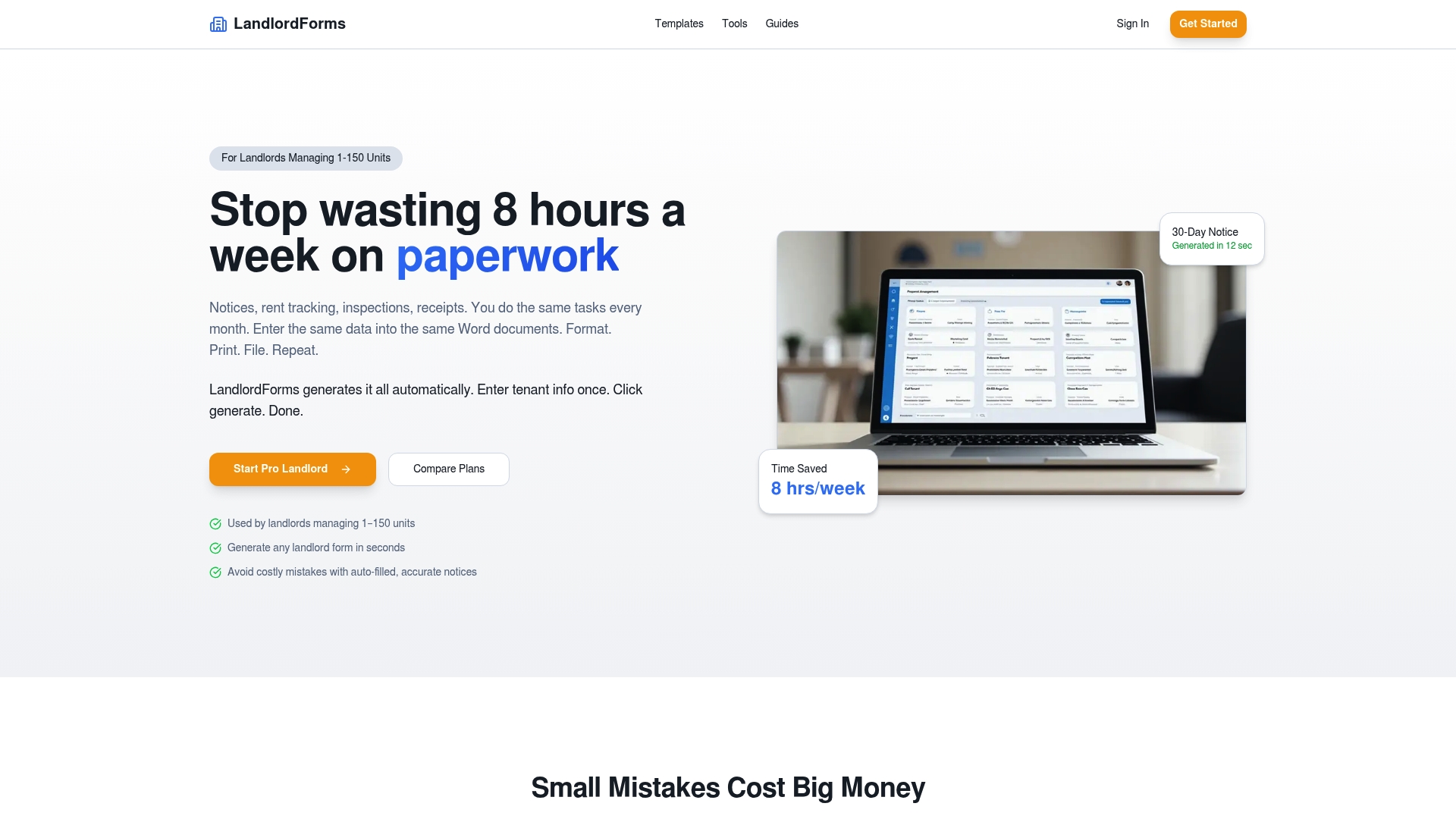
The templates are pre-formatted to produce signed PDFs with consistent naming, which means every document you generate already meets the TPLS standard without extra steps. The rent ledger template tracks charges, payments, and balances in a format that maps directly to Schedule E — so your year-end audit binder is mostly assembled before tax season starts. The free rent ledger template is the fastest place to start: download it, enter your property and tenant details, and you have a compliant income record from day one. If you need to calculate accurate proration entries for a mid-month move-in, the rent proration calculator produces the figures your ledger needs. Start with the rent ledger template today and build your first audit-ready property file before the next rent cycle closes.
Useful sources and references
The guidance in this article draws on the following authoritative sources. Consult them directly for legal and tax questions specific to your situation:
- IRS Publication 527, Residential Rental Property — the primary IRS reference for rental income, deductions, depreciation rules, and recordkeeping requirements. Start here for any tax question about your rental.
- IRS Tips on Rental Real Estate Income, Deductions, and Recordkeeping — a concise IRS summary of what to report, what to deduct, and what records to keep.
- IRS: How Long Should I Keep Records? — the official IRS retention guidance, including the three-year general rule and the six-year rule for omitted income.
- Form 4562, Depreciation and Amortization — required for every depreciation deduction; keep the backup worksheets for the life of the property plus seven years after sale.
- Landlordforms Rent Ledger Template — free download; the fastest way to start building a Schedule E-ready income record.
- Landlordforms Property Documentation Audit Checklist — a scored checklist for investors assembling or auditing their existing records.
- Landlordforms Move-Out Documentation Checklist — practical move-out checklist with statutory deadline reminders by state.
- FinHelp: Audit-Ready Recordkeeping for Rental Properties — practical retention advice and per-document guidance on building a compliant recordkeeping system.
This article is general information, not legal or tax advice. Confirm current IRS rules, retention requirements, and state-specific landlord-tenant obligations with a qualified CPA or attorney for your specific situation.
FAQ
Do landlords get audited by the IRS?
Yes. Rental real estate is one of the IRS’s audit focus areas because of the volume of deductions involved — depreciation, repairs, travel, and management fees are all common targets. Landlords who report consistent losses or large deductions relative to income draw more scrutiny.
What documents do I need for an IRS rental audit?
Auditors typically request your rent ledger, bank statements, all receipts and invoices for claimed expenses, your Form 4562 depreciation backup, Schedule E worksheets, and the closing disclosure establishing your cost basis. Move-in/move-out inspections and tenant notices may also be requested if income or deposit amounts are questioned.
What documents verify rental history for a property?
A signed lease, a rent ledger showing every charge and payment, bank statements confirming deposits, and rent receipts together constitute a complete rental history. For disputes involving condition, a signed move-in inspection with timestamped photos is the strongest supporting document.
How do I perform a financial audit of a rental property myself?
Pull your rent ledger and reconcile every line to a bank deposit. Then match every expense on Schedule E to an invoice and a bank debit. Flag any transaction without a receipt, any expense that could be classified as a capital improvement, and any deposit without a matching ledger entry. Resolve those gaps before filing — the audit-ready recordkeeping guidance recommends reconciling monthly and resolving unmatched transactions within 7–10 days. Landlordforms’s rent ledger template makes that monthly reconciliation straightforward.
How long should landlords keep rental property records?
Keep tax-influencing records such as receipts, ledgers, and bank statements for seven years after filing. Retain any records that establish cost basis or depreciation — including closing disclosures, Form 4562 worksheets, and capital improvement receipts — for as long as you own the property plus seven years after it is sold, per IRS guidance.