Fix an NSF Rent Check in 48 Hours: U.S. Playbook

Yes. In most states, a landlord can charge a fee for a bounced rent check if the lease says so or state law allows it, though the amount is often capped or must be “reasonable.” If your check bounces, verify the bank’s reason code today, tell the other party the same day, and save every document. Skip either step and a fixable problem turns into an eviction filing or an unenforceable charge.
TL;DR:
- State laws vary widely, capping landlord NSF rent check fees from as low as $20 in New York to up to $35 in California, with some states relying on reasonableness.
- A bounced rent check is considered unpaid immediately upon bank notification, activating eviction notices faster if landlords act promptly within 1 to 5 days.
- Tenants should verify the bank’s return reason, notify landlords in writing the same day, and pay with certified funds to prevent further legal or financial issues.
- Landlords must ensure their lease clearly discloses NSF fee amounts, notification methods, and adheres to state caps to avoid unenforceable charges.
- A single NSF check typically does not impact credit scores but can result in eviction filings or damage future rental references if unresolved or repeated.
Table of Contents
- What Is an NSF Rent Check and How Is It Different From a Late Fee?
- How Do State Laws Limit NSF Fees on Rent Checks?
- What Happens Legally After a Rent Check Bounces?
- What Should Tenants and Landlords Do Right After a Check Bounces?
- How Should Leases Handle NSF Fees and Payment Policies?
- Does a Bounced Rent Check Affect Your Credit or Rental History?
- How Do You Negotiate an NSF Fee With Your Landlord?
- What Alternatives Help Tenants Avoid NSF Rent Problems?
- An Editorial Take: Why Documentation Beats Disputes Every Time
- Where to Find Official NSF and Rent Fee Rules
- Sources
- FAQ
What Is an NSF Rent Check and How Is It Different From a Late Fee?
An NSF (nonsufficient funds) rent check is a payment your bank refuses to honor because your account didn’t have enough available money when it processed. The term applies to paper checks, but the same problem happens with failed ACH transfers, bounced e-checks through a payment portal, and declined recurring drafts.
Two separate charges can show up after one bounced payment, and mixing them up causes most of the confusion:
- Your bank’s NSF fee comes from your account agreement with the bank, not the lease. Most large banks have scaled back or eliminated these fees following recent CFPB rule changes, but smaller banks and credit unions still charge them in many cases.
- Your landlord’s returned-check fee is a separate charge, allowed only if the lease or state statute permits it, meant to cover the landlord’s administrative cost and bank charges tied to the bounce.
- A late fee is different again. It penalizes you for paying rent after the due date, regardless of why the payment failed.
The NSF fee compensates for a specific bounced transaction. The late fee penalizes overdue rent. A landlord can often charge both, but only if rent actually ends up unpaid past the due date because of the bounce.
How Do State Laws Limit NSF Fees on Rent Checks?
State law, not the lease alone, sets the outer boundary on what a landlord can charge. Some states cap the fee at a fixed dollar figure. Others just require the charge be “reasonable,” which shifts the fight to a judge if it ever gets disputed. A handful of states have no explicit statute on returned-check fees for rent at all, which means ordinary contract law and general consumer protection statutes fill the gap.
The spread across states is wide enough that guessing is a bad strategy:
- New York limits the returned-check fee to whichever is lower: the bank’s actual charge or $20.
- California allows up to $25 for a first bounced check and up to $35 for each additional one from the same tenant.
- Several states set no specific cap, leaving courts to apply a reasonableness test tied to the landlord’s actual costs.
State fee caps vary by tens of dollars. New York limits landlords to the lesser of the bank’s fee or $20, while California permits up to $35 for repeat offenses, according to Rentlatefee. That gap alone can turn a routine charge into a legal dispute if the lease doesn’t match the state’s rule.
A landlord who charges above the statutory cap risks having the whole fee thrown out, not just the excess. If you’re not sure what your state allows, start with your state statutes or check the Usa, which links to consumer protection offices that publish plain-language guidance on rent-related fees.
What Happens Legally After a Rent Check Bounces?
A bounced check almost always counts as nonpayment of rent the moment the bank returns it, not the moment someone notices. That timing matters. Most eviction clocks start running once the landlord learns the payment failed, and waiting to act weakens the landlord’s legal position if the case ends up in court.
Here’s how the sequence typically plays out and what each side can do about it:
- The landlord confirms the return. Once the bank notifies the landlord (often within 1 to 5 business days), the landlord can treat rent as unpaid and start the clock on any required notice.
- A pay-or-quit notice may follow. If rent remains unpaid, most states allow the landlord to serve a notice demanding payment within a set window, often 3 to 14 days depending on the state, before filing for eviction.
- Tenants can raise defenses. A bank error, a landlord’s failure to disclose the NSF fee in advance, or a defective notice (wrong dates, wrong amount, wrong delivery method) can all undercut the landlord’s case.
- State consumer protections may apply. Some states restrict how quickly a landlord can escalate after a first-time bounce, especially for tenants who cure quickly.
Whichever side you’re on, collect the same paper trail: the bank’s return reason code, any bank fee receipt, the written notice from the landlord, and a receipt for whatever replacement payment you make. That documentation decides most disputes long before anyone sees a courtroom, since a complete paper trail, from the bank’s return notice through the ledger adjustment to the replacement receipt, strengthens whoever kept it.
What Should Tenants and Landlords Do Right After a Check Bounces?
Speed matters more than almost anything else here. The first 24 to 48 hours after you learn a check bounced determine whether this becomes a quick fix or a legal headache.
If you’re the tenant, work through this order:
- Call your bank and confirm the exact reason for the return, insufficient funds, a hold, or a processing error are handled very differently.
- Notify your landlord the same day, in writing, even if you’ve already talked by phone.
- Arrange replacement payment in certified funds (cashier’s check or money order) rather than another personal check.
- Get a signed receipt for the replacement payment and keep it with your bank’s return notice.
- If your bank made an error, request a written statement. Banks operate under federal error-resolution procedures that can provisionally credit your account during an investigation, which is strong evidence if the landlord disputes the delay.
If you’re the landlord, follow a parallel checklist:
- Verify the bank’s return notice before updating your records, don’t rely on a tenant’s verbal explanation alone.
- Update your rent ledger immediately to reflect the unpaid balance and any fee assessed.
- Send formal written notice if your state or lease requires it before charging a fee or starting the pay-or-quit clock.
- Confirm the fee amount against your state’s cap before charging it. Charging an unauthorized or uncapped amount can void the entire fee in a dispute.
Pro Tip: If a tenant claims bank error, don’t dismiss it. Ask for the bank’s written communication and any provisional credit notice before you assess a fee or send a notice. That single document often resolves the dispute without an argument.
How Should Leases Handle NSF Fees and Payment Policies?
A lease clause that never gets read is worthless the day a check bounces. Enforceability hinges on whether the tenant actually saw the fee terms before signing, not on whether the landlord meant to charge them fairly.
A solid clause needs a few specific pieces: a dollar amount or clear formula (not “a reasonable fee,” which invites disputes), the method used to notify tenants of the fee, and a requirement that future payments come as certified funds once a check has bounced. Every part needs to sit inside whatever cap the state sets, because a clause that exceeds the statutory limit typically gets struck rather than reduced to the legal maximum.

Advance disclosure is the linchpin. Legal guidance is consistent that clear notice before the fact is the single biggest factor in enforceability. A landlord who tries to charge an NSF fee that was never mentioned in the lease or disclosed some other way is likely to lose that fee if the tenant pushes back.
Prevention beats enforcement every time:
- Offer an online ACH portal so rent moves electronically instead of by paper check.
- Set up autopay with a low-balance alert a few days before rent is due.
- Require certified funds for a set period, often several months, after any bounced payment; this is enforceable when written into the lease or permitted by state statute.
Tenants can help themselves too. Checking your available balance, not just your ledger balance, before sending rent avoids one of the most common causes of accidental bounces, since pending holds and uncleared deposits can make your account look flush when it isn’t.
Does a Bounced Rent Check Affect Your Credit or Rental History?
A single NSF rent check does not, by itself, get reported to the three major consumer credit bureaus the way a missed credit card payment does. Landlords generally don’t report routine payment activity to Equifax, Experian, or TransUnion unless they use a specialized rent-reporting service, and most small landlords don’t subscribe to one.
The real risk isn’t the credit bureaus. It’s what happens next. If the bounced check leads to a formal eviction filing, that filing becomes part of the public court record almost immediately, and tenant-screening companies pull court records routinely. An eviction filing, even one that gets dismissed after you cure the rent, can show up on screening reports for years and cost you your next apartment application.
There’s a second, quieter consequence: your relationship with your current landlord. A returned check that gets resolved calmly with certified funds and a clear explanation tends to be forgotten. A bounced check that turns into an argument, or a second bounce from the same tenant, often shows up in a landlord reference when you apply elsewhere. Property managers ask past landlords about payment reliability more often than tenants expect, and “paid late, bounced a check once” reads very differently from “had to be threatened with eviction twice.”
The practical takeaway: treat the first bounce as a reputational event, not just a financial one. Resolving it fast, in writing, with certified funds protects your rental history even when it can’t touch your credit score.
How Do You Negotiate an NSF Fee With Your Landlord?
Start by checking whether the fee is even enforceable before you negotiate anything. If your lease never mentioned an NSF charge, or the amount exceeds your state’s cap, you have real leverage, not just a request for mercy.
If the bounce was your bank’s fault, a processing delay, a hold that cleared late, or an outright bank error, lead with documentation, not apology. Producing bank error communications and any provisional credit notice tends to persuade landlords to waive the fee entirely, since it shifts the fault away from you. Keep every email and timestamp; a landlord weighing a $25 fee against a tenant who clearly did nothing wrong usually waives it rather than risk a dispute.
If the fee is legitimate but this is a first-time issue, ask directly for a one-time courtesy waiver and offer something in return: enrolling in autopay, switching to certified funds going forward, or paying the fee split over your next two rent payments instead of all at once. Landlords who manage a handful of units often care more about predictable future payments than collecting a small fee once.
Timing matters more than tone. Reach out the same day you learn about the bounce, before the landlord has spent time on a notice or a ledger correction. A tenant who calls within hours looks responsible. A tenant who goes silent for a week looks like a collection problem, and negotiating leverage evaporates fast once a pay-or-quit notice is already in the mail.
What Alternatives Help Tenants Avoid NSF Rent Problems?
The cheapest fix is never letting the check bounce in the first place, and several low-effort changes cut that risk close to zero.
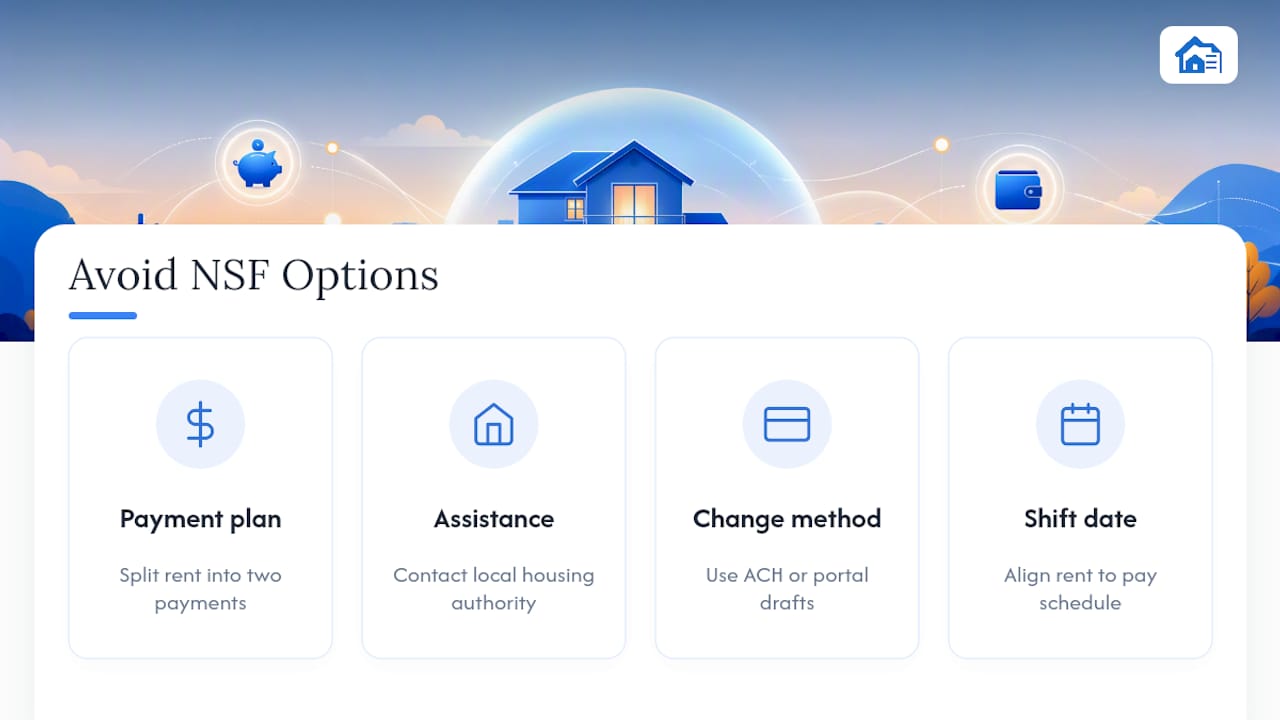
Ask your landlord about a short-term payment plan if you know in advance that rent is going to be tight. Most landlords, especially smaller owners managing a handful of units, would rather split one month’s rent into two payments than deal with a bounced check, a notice, and a possible vacancy. This works far better as a proactive request than as a response to a bounce that already happened.
Rental assistance programs exist in most counties and cities, often run through local housing authorities or nonprofit partners, and they can cover a shortfall before it turns into a missed payment. Availability and funding levels shift throughout the year, so check with your local housing authority directly rather than assuming a program is open.
Switching payment methods also removes the problem at the source. An ACH transfer or a payment portal draft fails for the same reason a check bounces, insufficient funds, but it fails before the money leaves your account rather than after the landlord has already deposited a check that gets reversed days later. That timing difference alone prevents a lot of the panic and fee stacking that comes with a returned paper check.
If bounces have happened more than once, treat it as a signal to renegotiate your due date. Aligning rent with your pay schedule, even shifting it by a few days, resolves more chronic NSF problems than any fee negotiation ever will.
An Editorial Take: Why Documentation Beats Disputes Every Time
Most NSF disputes don’t get resolved by who’s right on the law. They get resolved by who kept better records. A landlord with a dated bank return notice, a ledger entry, and a mailed notice wins arguments that a landlord relying on memory loses, even when the underlying law is on their side.
That’s the part both tenants and landlords underestimate. The legal framework, state caps, disclosure rules, pay-or-quit timing, matters, but it only matters once someone can prove what actually happened and when. A landlord who charges a fee that was never disclosed in the lease has no case regardless of how reasonable the amount is. A tenant who claims bank error but has no bank statement to show for it has no defense regardless of how sympathetic the story sounds.
This is where consistent process quietly does more work than clever arguments. Landlords using document tracking systems to log every returned payment, every notice sent, and every ledger correction end up with a defensible file almost by accident, just by doing the paperwork the same way every time. LandlordForms builds toward exactly that habit: automated notice generation, a running rent ledger, and free calculators for late fees and proration that keep the numbers consistent across every unit a landlord manages. None of that replaces knowing your state’s cap. It just makes sure that when you do know it, you can prove you followed it.
— Igor
Where to Find Official NSF and Rent Fee Rules
For the fee rules that actually apply to you, start with your state attorney general’s office, which publishes consumer protection guidance state by state. The Consumer Financial Protection Bureau tracks the broader shift in bank overdraft and NSF fee practices. Nolo’s legal encyclopedia and local legal aid organizations can help interpret how your specific lease clause holds up under state law.
This article is general information, not a substitute for advice from a qualified lawyer. Consult a qualified legal professional about your own circumstances before acting on anything here.
Sources
FAQ
What Is an NSF Charge on My Rent?
An NSF charge is a fee your landlord assesses after your rent check or electronic payment bounces due to insufficient funds. It’s separate from your bank’s own NSF fee and is only enforceable if your lease discloses it or your state law authorizes it.
How Much Can a Landlord Charge for a Bounced Check?
It depends entirely on your state. New York caps the fee at the lesser of the bank’s actual charge or $20, while California allows up to $25 for a first bounce and $35 for repeat offenses, according to state-by-state fee data. Some states set no fixed cap and instead require the fee be “reasonable.”
Can a Bank Refuse to Pay an NSF Check?
Yes. When your account lacks sufficient available funds, the bank returns the check unpaid rather than covering the shortfall, which is exactly what makes it an NSF (nonsufficient funds) event. This is different from a bank error, where the funds were actually available but a hold or processing glitch caused the return anyway.
How Can I Check if I Have an NSF Fee?
Log into your bank account and review recent transactions for a returned-item or NSF fee line, or call your bank directly for the specific reason code on any bounced payment. If you also owe a landlord’s separate NSF fee, that charge should appear on your rent ledger or in a written notice, since advance disclosure is required for the landlord’s fee to be enforceable.