Hawaii Rental Agreement: Free Template and Legal Checklist

Use a written, Hawaii-specific rental agreement that includes the state-mandated disclosures and a signed move-in inventory. That combination is what actually holds up when a dispute lands in front of a judge.
You can customize a Hawaii lease template through Landlordforms right now and fill in the details as you read. The reason a written lease matters so much: the Hawaii Judiciary notes that agreements can be oral or written, but only a written lease documents the promises both sides made and gives you something to point to later.
- A written lease beats a verbal one in almost every landlord-tenant dispute.
- Hawaii requires specific disclosures and an inventory report before move-in.
- Templates save hours, but only if they’re built around Hawaii’s Landlord-Tenant Code.
Quick fact: Hawaii caps late fees at a legally established rate for agreements signed or renewed after November 1, 2017, according to the 2024 Handbook for the Hawaii Residential Landlord-Tenant Code.
Key Takeaways
A legally sound Hawaii rental agreement is written, includes the state’s mandatory disclosures, and pairs with a signed move-in inventory to protect both landlord and tenant.
Table of Contents
- What Is a Hawaii Rental Agreement and Which Type Fits You?
- What Disclosures Does Hawaii Law Require in a Lease?
- How Should You Set Rent, Late Fees, and Increase Notices?
- What Are Hawaii’s Security Deposit Rules?
- What Are a Hawaii Landlord’s Entry and Repair Obligations?
- What Belongs in a Move-In and Move-Out Inventory?
- How Do You End a Hawaii Tenancy Legally?
- How Do You Turn a Template Into a Signed, Legal Lease?
- How Have Emergency Rules Affected Hawaii Rental Agreements?
- What Are Your Options if a Lease Dispute Comes Up?
- Why Precision in Lease Drafting Actually Matters
- Skip the Guesswork: Build Your Hawaii Lease With Landlordforms
- Where to Verify the Exact Legal Language
- Sources
- FAQ
What Is a Hawaii Rental Agreement and Which Type Fits You?
A Hawaii rental agreement is a contract between landlord and tenant that operates under the state’s Residential Landlord-Tenant Code, not generic contract law. That distinction matters because the code sets rules a private agreement can’t override, no matter what the lease says.
Most Hawaii landlords choose from four structures:
- Fixed-term lease. Runs for a set period, usually one year, with rent locked in and no automatic renewal unless the lease says otherwise.
- Month-to-month agreement. Renews automatically each month; either party can end it with proper notice, and rent increases follow their own notice rule.
- Week-to-week or short-term rental. Common for vacation properties, with much shorter notice windows and different tax and licensing considerations.
- Sublease or roommate agreement. A secondary contract layered onto the primary lease, requiring the original landlord’s written consent in most cases.
Fixed-term leases give you rent stability and a built-in end date. Month-to-month gives flexibility but less predictability, since a tenant can leave on short notice, too.
Pro Tip: If you’re worried about frequent turnover, a fixed-term lease with a renewal clause locks in rent and gives you more control over eviction timing than a month-to-month deal.
What Disclosures Does Hawaii Law Require in a Lease?
A rental contract Hawaii courts will actually enforce needs more than a rent amount and two signatures. The Landlord-Tenant Code and federal law both require specific language, and skipping it can weaken your position in a dispute.
Core clauses every lease should include:
- Full legal names of all tenants and the landlord or managing agent.
- Property address and a description of what’s included (parking, storage, furnishings).
- Lease term, rent amount, due date, accepted payment methods, and late-fee terms.
- Security deposit amount and conditions for its return.
- Utility responsibilities, occupancy limits, and maintenance duties.
- Signature blocks for every adult tenant and the landlord or agent.
Required disclosures go further. You need contact information for the landlord or property manager, and if the building predates 1978, a federal lead-based paint disclosure with the EPA pamphlet attached, per 40 CFR § 745.113. You also need a signed move-in inventory before the tenant takes possession.
Hawaii’s landlord-tenant statute establishes rights that can’t be waived by contract. Never write a clause that tries to strip a tenant’s statutory protections. Courts will simply ignore it, and it can undercut your credibility on the rest of the lease.
Pro Tip: Where the handbook or statute gives exact wording for a notice, copy it closely instead of paraphrasing. Verbatim language is harder to challenge in disclosure disputes than your own summary of it.
How Should You Set Rent, Late Fees, and Increase Notices?
Rent terms need to be specific enough that no one can argue about them later. State the rent amount, the exact due date, which payment methods you accept, and where payment goes, whether that’s a mailing address, a portal, or in person.
Late fees need their own clause. Hawaii limits late charges to a legally established rate for leases signed or renewed after November 1, 2017, according to the Hawaii handbook. Anything higher on a covered lease won’t survive a challenge.
For returned checks, spell out the NSF fee in the lease itself rather than relying on a verbal understanding at move-in.
Rent increases follow a strict timeline: month-to-month tenants get 45 days’ written notice before any increase takes effect. Shorter tenancies have their own notice windows, so check the term length before you draft the clause.
- State the rent, due date, and payment method in one clear paragraph.
- Cap late fees at 8% and name the grace period, if any.
- Spell out the NSF fee amount in dollars, not a vague reference to “bank fees.”
- Give 45 days’ notice for any month-to-month rent increase.
- Keep a receipts policy. A rent ledger settles almost any “I paid on time” argument before it starts.
What Are Hawaii’s Security Deposit Rules?
Hawaii guidance caps security deposits at roughly one month’s rent, with an additional pet deposit allowed separately, according to the Hawaii Residential Landlord-Tenant Handbook. Collect it alongside first month’s rent before handing over keys, and put both amounts in writing on the lease itself.

When the tenancy ends, you owe the tenant an itemized statement for any deductions, returned within the statutory deadline. Vague deductions (“cleaning,” “damage”) without receipts or photos are exactly what tenants successfully dispute.
A workable clause might read: “Tenant shall pay a security deposit of [amount], not exceeding one month’s rent, due at lease signing. Landlord shall return the deposit, less itemized deductions with supporting documentation, within the timeframe required by the Hawaii Residential Landlord-Tenant Code.”
- Cap the deposit at one month’s rent; add a separate pet deposit only if it’s clearly labeled.
- Collect the full deposit and first month’s rent before move-in, never partial amounts on a promise.
- Provide an itemized, documented statement for every deduction, on time.
What Are a Hawaii Landlord’s Entry and Repair Obligations?
You can’t just show up. Draft your entry clause to require reasonable advance notice for routine visits and repairs, with a carved-out exception for genuine emergencies like a burst pipe or fire.
Repair obligations split into two buckets: routine maintenance the tenant handles day to day, and habitability repairs, which are yours. State a reasonable response window in the lease so a tenant can’t claim you ignored a request, and so you have a record if they never sent one.
Where a landlord fails to make a required repair, Hawaii law allows tenants certain remedies, including limited repair-and-deduct rights under specific conditions. Review habitability notice requirements before you finalize this clause, since the timelines matter more than the general language.
- Require 24 to 48 hours’ notice for non-emergency entry; state emergency exceptions plainly.
- Define what counts as a habitability issue versus routine tenant upkeep.
- Set a response window for repair requests, in writing.
Pro Tip: Require repair requests in writing, even a text message, and save every reply. A verbal “I’ll get to it” is worthless if the dispute ends up in front of a judge months later.
What Belongs in a Move-In and Move-Out Inventory?
Hawaii requires an inventory or condition report before a tenant moves in, and you need to give the tenant a copy. This single document prevents more deposit disputes than any clause in the lease itself.
A solid move-in inspection report covers room-by-room condition notes, appliance and furnishing status, existing damage with photos, and meter readings where relevant.
- Note condition of walls, floors, and fixtures in every room, not just “good” or “fair.”
- Photograph existing damage and timestamp the images.
- Get signatures and initials from every tenant and the landlord on each page.
Pro Tip: Use a templated checklist with dedicated photo slots. It forces consistency across units and turns a five-minute walkthrough into evidence you can actually use.
How Do You End a Hawaii Tenancy Legally?
Fixed-term leases simply expire on their end date. No notice is required unless the lease says otherwise, which makes them predictable for both sides.
Month-to-month tenancies work differently. Either party can end the arrangement with proper notice, and rent increases on these tenancies need 45 days’ written notice. Shorter tenancy types carry their own, tighter notice windows, so match the notice period to the actual lease term rather than assuming one rule fits all.
Breaking a fixed-term lease early carries consequences. The departing tenant may owe damages, but Hawaii law generally expects landlords to make reasonable efforts to re-rent the unit rather than simply collecting the remaining months’ rent as a windfall.
Eviction itself is a court process, not a landlord decision made alone. It starts with proper statutory notice, followed by a formal complaint if the tenant doesn’t comply, and it ends with a judge’s order, not a locksmith.
Two things to never do:
- Never attempt a self-help eviction: changing locks, shutting off utilities, or removing belongings without a court order is illegal and exposes you to real liability.
- Never write a lease clause that waives a tenant’s statutory rights. Courts will strike it, and it can taint the rest of your agreement’s credibility.
How Do You Turn a Template Into a Signed, Legal Lease?
Downloading a template is the easy part. Here’s the workflow that actually produces an enforceable lease:
- Pick the right structure. Decide between fixed-term and month-to-month, then confirm the template includes Hawaii-specific clauses, not generic boilerplate.
- Fill in every field precisely. Names, unit address, rent amount and due date, deposit terms, utility responsibilities, and house rules. Skip any clause that tries to waive statutory tenant rights.
- Document the move-in. Complete the inventory and photo log before handing over keys, and collect signatures from every named tenant and the landlord or agent.
- Store copies properly. Give the tenant a signed original, keep your own, and back up a digital copy with a timestamp.
A sample fill might look like: “Rent: $2,200/month, due the 1st. Security deposit: $2,200, due at signing. Landlord may enter with 24 hours’ notice except in emergencies.”
Pro Tip: Require a signed addendum for any later change to rent, occupants, or rules. A verbal “that’s fine” from six months ago is impossible to prove and even harder to enforce.
How Have Emergency Rules Affected Hawaii Rental Agreements?
COVID-era emergency orders temporarily changed how evictions worked in Hawaii, including extended notice periods and, at various points, moratoriums tied to specific relief programs. Those specific pandemic-era protections have expired, but the episode changed how landlords should think about lease drafting going forward.
The practical lesson: build flexibility into your lease where the law allows it, rather than relying on rules staying static. A lease that only references “current law” without naming specific statutes ages better than one that hardcodes now-expired notice periods as permanent fact.
Emergency housing rules can also resurface around natural disasters, which matter more in Hawaii than in most states. Hurricane damage, volcanic activity, or flooding can trigger county or state emergency declarations that temporarily affect notice timelines, habitability standards, or eviction proceedings. A lease with a force majeure or emergency clause, describing how rent, repairs, and notice periods get handled during a declared disaster, puts you ahead of a problem most landlords only think about after it happens.
None of this changes the baseline rule: your lease still has to comply with the standing Landlord-Tenant Code day to day. Emergency provisions are an overlay, not a replacement, and they only apply while a declaration is active. Check the Hawaii Judiciary’s self-help pages periodically, since guidance shifts faster during active emergencies than most landlords expect.
What Are Your Options if a Lease Dispute Comes Up?
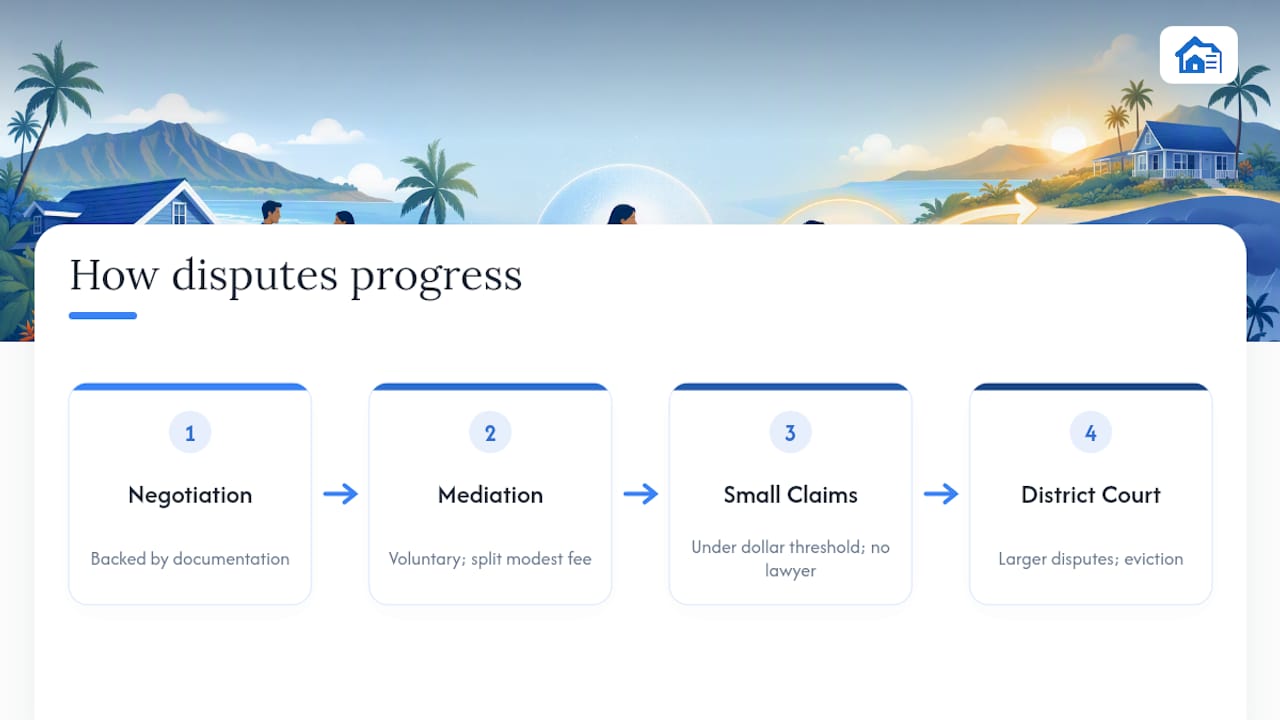
Most Hawaii landlord-tenant disputes never need a courtroom. Security deposit disagreements, repair complaints, and notice disputes usually get resolved faster and cheaper through direct negotiation, backed by your documentation.
That’s where your inventory report and rent ledger earn their keep. A dispute over “the carpet was already stained” collapses fast when you have a signed, photographed move-in report showing otherwise. A dispute over “I paid on time” collapses just as fast against a dated payment record.
When direct negotiation stalls, Hawaii tenants and landlords can turn to community mediation programs available through several county-level and nonprofit mediation centers across the islands. Mediation is voluntary, faster than litigation, and considerably cheaper, since both sides split a modest fee instead of paying attorneys by the hour.
If mediation fails or one side won’t participate, small claims court handles most deposit and rent disputes under a set dollar threshold, without requiring either party to hire a lawyer. Larger disputes, or ones involving eviction, generally move through district court, following the notice and filing procedures set out in the Landlord-Tenant Code.
The pattern holds across nearly every dispute type: the landlord who documented everything, from the signed inventory to every rent payment, walks into mediation or court with a stronger position than the one relying on memory and good faith. Move-out inspections structured the same way every time make that documentation consistent instead of accidental.
Why Precision in Lease Drafting Actually Matters
A vague clause costs you nothing until the day you need it, then it costs you everything: a lost deposit dispute, a botched eviction notice, months of delay. Clear, statute-matched language and documented inventories aren’t paperwork for its own sake. They’re what actually holds up when a disagreement lands in front of a mediator or a judge.
Skip the Guesswork: Build Your Hawaii Lease With Landlordforms
Writing a compliant lease from scratch means tracking rent-increase notice rules, deposit caps, lead-paint disclosures, and inventory requirements all at once, and getting even one wrong can cost you a dispute later. Landlordforms builds those Hawaii-specific requirements directly into the document generator, so the clauses, notice language, and disclosures are already aligned with the Landlord-Tenant Code before you fill in a single field.

Beyond the lease itself, Landlordforms automates the paperwork that actually prevents disputes: move-in checklists with photo documentation, automated rent receipts, and real-time payment tracking so you’re never reconstructing a payment history from memory. Instead of juggling a template, a spreadsheet, and a folder of phone photos, everything lives in one place tied to the specific unit and tenant.
Start by generating a rent ledger for your property to see how automated tracking compares to whatever system you’re using now. It takes a few minutes, and it’s the same tool landlords use to settle payment disputes before they become mediation cases.
Where to Verify the Exact Legal Language
For the statutory text itself, start with the Hawaii Judiciary’s landlord self-help page, which walks through rental agreement basics in plain language. The 2024 Handbook for the Hawaii Residential Landlord-Tenant Code from the Department of Commerce and Consumer Affairs covers deposits, notices, and disclosures in detail.
For the underlying statute, the Hawaii Revised Statutes landlord-tenant code has the exact legal language courts rely on. Federal lead-paint rules are covered in the EPA’s disclosure rule fact sheet and 40 CFR § 745.113.
Use these for exact deadlines and wording, and talk to an attorney for anything unusual, like a mixed-use property or a tenant with a disability accommodation request.
This article is general information, not a substitute for advice from a qualified lawyer. Consult a qualified legal professional about your own circumstances before acting on anything here.
Sources
- Judiciary | Rental Agreement
- 2024 Handbook For the Hawaii Residential Landlord-Tenant Code
- Capitol
- EPA — Lead Disclosure Rule fact sheet
- 40 CFR § 745.113 — Disclosure of known lead-based paint hazards
FAQ
What is the required format for a rental agreement in Hawaii?
Hawaii doesn’t mandate a single official form, but a compliant lease must be in writing and include rent terms, deposit terms, required disclosures, and a signed move-in inventory to meet Landlord-Tenant Code standards.
Can I download a free lease agreement for Hawaii?
Yes. Landlordforms offers customizable, state-compliant lease templates you can fill in and download, along with a free move-in checklist to pair with it.
What are the basic rental rules in Hawaii?
Key rules include an 8% cap on late fees for leases signed after November 1, 2017, a security deposit limit around one month’s rent, and a required move-in inventory report, all detailed in the Hawaii Landlord-Tenant Handbook.
What are the requirements for a month-to-month lease in Hawaii?
A month-to-month agreement renews automatically each month, and landlords must give 45 days’ written notice before raising the rent. Either party can typically end the tenancy with proper statutory notice.
Do I need a lead paint disclosure for my Hawaii rental?
Yes, if the property was built before 1978. Federal law requires landlords to provide a lead hazard disclosure and the EPA pamphlet under 40 CFR § 745.113.