Landlord Time Management: A Practical Guide for Property Owners

TL;DR:
- Landlord time management involves creating systems that reduce repetitive admin work and focus on growing or maintaining properties. Automating communication, scheduling preventive maintenance, and using templates can save landlords hours monthly while improving tenant relationships. Building routines and leveraging tools like Landlordforms enhances efficiency and minimizes costly reactive tasks.
Landlord time management is the set of routines, tools, and decisions that let you spend less time on repetitive admin and more time on work that actually grows your portfolio or improves tenant relationships.
TL;DR:
- Industry estimates put maintenance and repairs alone at roughly four hours per property per month — before you count leasing, bookkeeping, or tenant communication.
- Batching messages, automating documents, and pre-authorizing contractors can reclaim multiple hours every week for a solo landlord.
- This guide includes copy-ready templates, daily/weekly/monthly routines, and tool recommendations you can put to work today.
Table of Contents
- Why time management matters more than most landlords realize
- What is landlord time management in practice?
- Which tools and automations save landlords the most time?
- When should you delegate, and what should you hand off first?
- Copy-ready daily, weekly, and monthly routines you can start today
- How long do common landlord tasks actually take?
- Common time-management mistakes landlords make
- A simple prioritization method you can run in five minutes
- Key Takeaways
- The mindset shift that actually changes how you work
- Landlordforms cuts the paperwork that eats your week
- Useful sources and further reading
- FAQ
Why time management matters more than most landlords realize
Poor time habits don’t just feel stressful. They carry a real financial cost. A missed lease renewal deadline can trigger a month-to-month rollover that costs you a rent increase. A slow maintenance response pushes good tenants toward the exit. Reactive landlord scheduling — handling problems as they explode rather than preventing them — creates compounding cleanup work at every turnover and renewal cycle.
The upside flips that picture. Faster responses reduce vacancy. Cleaner books reduce disputes. Predictable maintenance schedules reduce emergency call-out costs. None of that requires working more hours. It requires working on the right things at the right time.
Benchmark: Industry data estimates landlords spend roughly four hours per month per property on maintenance and repairs alone. Multiply that across five properties and you’re looking at a part-time job before you’ve answered a single email.
Common risks of poor time habits:
- Missed deadlines on notices, renewals, or inspections
- Emergency repair costs that planned maintenance would have prevented
- Higher tenant turnover from slow communication
- Bookkeeping errors that create legal exposure
What is landlord time management in practice?
Time management for property owners isn’t a personality trait. It’s a system. The landlords who handle ten units without burning out aren’t faster or smarter — they’ve built repeatable processes that handle the predictable 80% of their work automatically, leaving their attention for the 20% that genuinely needs judgment.
The core techniques below are ordered by impact. Start with the first two this week.
1. Batch your tenant communication
Stop replying to messages the moment they arrive. Set two fixed reply windows per day — say, 9:00 AM and 4:00 PM — and let everything else queue. This single habit reduces task-switching and can reclaim multiple hours per week for a small-portfolio landlord. Tenants adapt quickly when you communicate your response window upfront in the lease or a welcome message.

2. Put everything on a calendar
If it isn’t on the calendar, it doesn’t exist. Lease expiration dates, inspection windows, filter change reminders, rent due dates — all of it. Use Google Calendar or a similar tool with recurring events and 48-hour reminders. A well-structured calendar turns “I need to remember that” into an automated nudge.

3. Build a template library
Rewriting the same move-in instructions, late-payment notice, or maintenance acknowledgment from scratch every time is pure waste. Create a folder of plain-text templates for your ten most common messages. Paste, personalize two lines, send. A template library also protects you in disputes — consistent written communication is far easier to defend than improvised replies.
4. Time-block maintenance windows
Reserve one morning per week for maintenance coordination — scheduling contractors, following up on open tickets, ordering supplies. Keeping this work in a single block prevents it from bleeding into every other day. Pair it with a simple spreadsheet or app that logs open requests so nothing falls through.
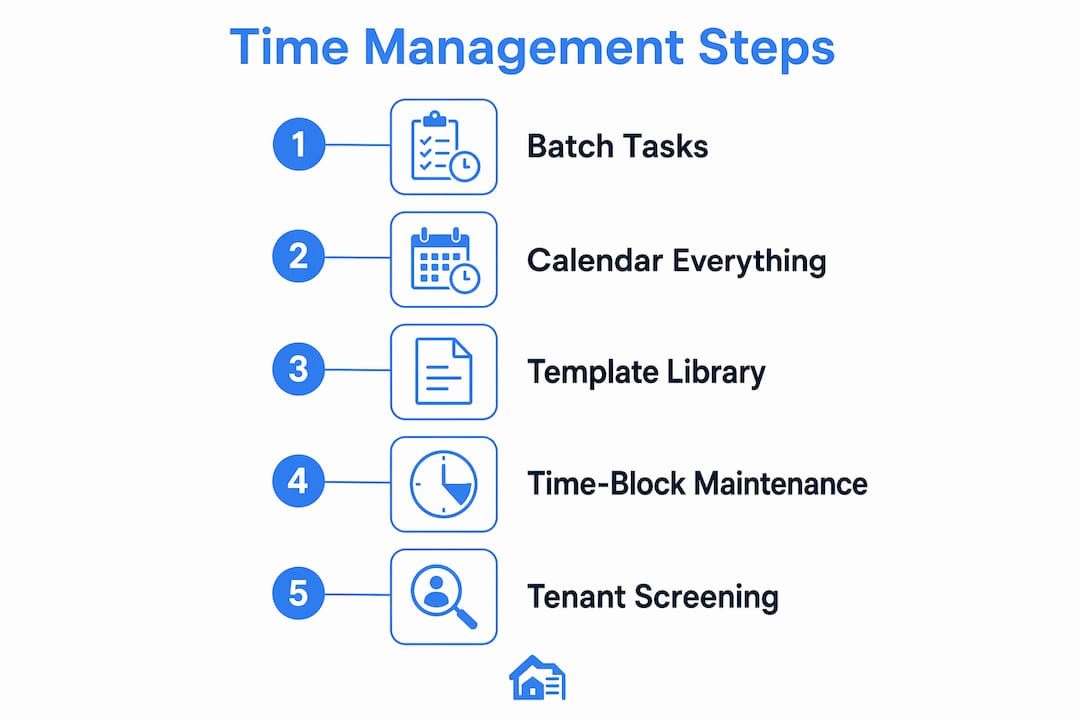
5. Screen tenants to prevent future time drains
A difficult tenant costs far more time than a vacancy. Thorough upfront screening — credit check, rental history, income verification — is one of the highest-ROI time investments a landlord makes. The National Apartment Association and NARPM both recommend standardized screening criteria applied consistently to every applicant.
Pro Tip: Set a written policy for your default response time (e.g., “non-emergency requests answered within 24 business hours”) and include it in your lease. This sets tenant expectations and gives you a defensible standard if a dispute arises.
Which tools and automations save landlords the most time?
The goal isn’t to use every tool available. It’s to automate the tasks you repeat most often. Start with one category, get it running smoothly, then add the next.
High-impact tool categories:
- Calendar + reminders: Google Calendar, Apple Calendar, or any property management app with recurring event support. Set reminders for lease renewals 90, 60, and 30 days out.
- Online rent collection: Platforms that send automatic payment reminders and generate receipts eliminate the most common landlord-tenant friction point.
- Digital tenant files: A central folder per tenant (cloud-based) holding the signed lease, move-in photos, maintenance history, and payment records. A digital tenant file cuts repeated verification time and is invaluable if a dispute reaches small claims court.
- Templated forms and documents: Rent receipts, 30-day notices, move-in checklists, and maintenance request forms. Generating these from a template rather than typing from scratch eliminates errors and saves 15–30 minutes per document.
- Maintenance ticketing: Even a shared Google Form that tenants submit requests through creates a paper trail and prevents verbal-only requests from getting lost.
Landlordforms automates the document side of this list. It generates rent receipts, ledgers, and notices in a few clicks, with real-time payment tracking and photo documentation built in — the kind of paperwork system that replaces an hour of manual entry with two minutes of form completion.
Pro Tip: Before rolling out a new template or form, test it on one property for a full rental cycle. You’ll catch missing fields and awkward phrasing before they become a problem across your whole portfolio.
When should you delegate, and what should you hand off first?
The decision rule is simple: if a task takes your physical presence or specialized skill, keep it or hire a specialist. If it’s administrative and repeatable, it’s a delegation candidate.
What to delegate first:
- Routine maintenance coordination (scheduling, follow-up calls)
- Bookkeeping and receipt organization
- Tenant inquiry responses during business hours
- Move-in/move-out walkthrough scheduling
Hiring checklist for contractors:
- Verify current license and liability insurance before the first job.
- Get at least two references from other landlords, not homeowners.
- Sign a written scope-of-work agreement for every job over $500.
- Pre-authorize them for repairs under a set dollar threshold (e.g., $200) so small fixes don’t require your approval every time.
- Confirm they can schedule service during business hours to avoid overtime rates and tenant disruption.
When to hire a property manager:
The math usually tips toward hiring a property manager when your portfolio crosses several units and you are spending a substantial amount of time per week on management tasks. A typical property management fee runs 8–12% of monthly rent. If your time is worth more than that fee — or if you’re losing sleep over missed tasks — the trade is worth it. Virtual assistants are a lower-cost middle option for landlords who need administrative help but not full management.
Copy-ready daily, weekly, and monthly routines you can start today
The fastest way to reduce decision fatigue is to stop deciding when to do recurring tasks. Schedule them once, then follow the schedule.
Sample weekly schedule:
- Monday morning (30 min): Check rent payment status; send automated reminders for any outstanding balances; review open maintenance tickets.
- Tuesday/Thursday 9 AM and 4 PM: Tenant communication windows. Reply to all queued messages in batch.
- Wednesday morning (1 hour): Maintenance coordination block. Schedule contractors, order supplies, close completed tickets.
- Friday afternoon (20 min): Admin wrap-up. File any new documents, update the rent ledger, note anything that needs follow-up next week.
Monthly tasks (schedule on the first of each month):
- Review lease expiration dates for the next 90 days.
- Confirm upcoming inspections are scheduled.
- Reconcile rent payments against the ledger.
- Check HVAC filters, smoke detectors, and any preventive maintenance items on your property checklist.
Template library to build this month:
- Late payment notice (first and second)
- Maintenance request acknowledgment
- Lease renewal offer letter
- Move-in welcome message
- Move-out instructions and walkthrough checklist
Start with one property. Run the schedule for a full month, note what doesn’t fit, adjust, then roll it out to the rest of your portfolio.
How long do common landlord tasks actually take?
Knowing where your time goes is the first step to reclaiming it. Maintenance time serves as a useful anchor, but total management time is higher once you add leasing, communication, and bookkeeping.
A rough estimate for a solo landlord managing a single unit without automation:
| Task | Estimated time per month |
|---|---|
| Maintenance coordination | 4 hours |
| Tenant communication | 2–3 hours |
| Rent collection and bookkeeping | 1–2 hours |
| Inspections and documentation | 1 hour |
| Leasing (averaged across vacancy cycles) | 1–2 hours |
| Total | 9–12 hours |
With batched communication, automated rent reminders, and templated documents, that same landlord can realistically cut the total to 4–6 hours per month per unit. Across multiple properties, that amounts to a difference of many hours per month — enough to matter.
The workflow efficiency gains compound as you add properties. A landlord with no system sees time grow linearly with each new unit. A landlord with repeatable processes sees much smaller marginal time increases per additional property.
Common time-management mistakes landlords make
Most landlord time problems trace back to a handful of recurring habits. Recognizing them is faster than diagnosing them from scratch.
Red-flag behaviors and quick fixes:
- Replying to every message immediately. Fix: set and communicate two daily reply windows; use an auto-reply that confirms your response time.
- Handling the same admin task repeatedly from scratch. Fix: build one template, use it every time, update it when the situation changes.
- Approving every contractor visit personally. Fix: pre-authorize trusted contractors for repairs under a set dollar amount.
- Keeping tenant records in email threads. Fix: move to a central digital file per tenant — signed lease, photos, payment history, correspondence.
- Skipping preventive maintenance until something breaks. Fix: add a quarterly maintenance checklist to your calendar as a recurring event.
Pro Tip: Write a one-page standard operating procedure for your three most common tasks — late payment, maintenance request, and lease renewal. When a situation arises, you follow the SOP instead of improvising. This alone prevents most repeat mistakes.
A simple prioritization method you can run in five minutes
The Eisenhower Matrix — sorting tasks by urgency and importance — adapts well to landlord work. Here’s a version you can run every morning in under ten minutes.
Step 1: Write down everything on your plate today (tenant requests, maintenance, admin, calls). Don’t filter yet — just list.
Step 2: Sort each item into one of four buckets:
- Urgent + Important: Do it today. Examples: a broken heater in winter, a lease expiring this week, a legal notice deadline.
- Important, not urgent: Schedule it. Examples: preventive inspections, lease renewal outreach 60 days out, bookkeeping catch-up.
- Urgent, not important: Delegate or batch it. Examples: routine maintenance scheduling, tenant questions that have template answers.
- Neither urgent nor important: Drop it or defer it indefinitely. Examples: researching a new app when your current one works fine.
Step 3: Move your “Important, not urgent” items directly into your weekly schedule before you close the list. If they don’t get a time slot now, they’ll become urgent next week.
Step 4: Handle your “Urgent + Important” items first, in the morning when focus is highest. Research from Kellogg Insight suggests that tackling harder tasks earlier tends to produce better outcomes — a useful nudge when you’re tempted to clear easy emails first.
Step 5: At the end of the week, move any unfinished “Important, not urgent” items forward. Don’t let them disappear from the list.
Key Takeaways
Effective landlord time management comes down to three moves: batch your repeatable tasks, automate your documents, and schedule your maintenance before it becomes an emergency.
| Point | Details |
|---|---|
| Batch communication | Set two daily reply windows to cut task-switching and reclaim hours each week. |
| Automate documents | Use templates or tools like Landlordforms to generate receipts, notices, and ledgers in minutes, not hours. |
| Schedule preventive maintenance | Maintenance time per property is a significant baseline; planned work helps prevent increases. |
| Pre-authorize contractors | Allow trusted contractors to handle repairs under a set threshold without requiring your approval each time. |
| Use Landlordforms for paperwork | Landlordforms replaces manual document creation with automated forms, real-time rent tracking, and photo documentation. |
The mindset shift that actually changes how you work
Most landlords who struggle with time aren’t disorganized. They’re operating as firefighters — responding to whatever is loudest. The shift that changes everything is moving from reactive to predictive: building systems that handle the predictable work before it becomes a crisis.
That means accepting that a tenant message at 7 PM doesn’t need a 7 PM reply. It means investing 30 minutes this week to build a template that saves 20 minutes every month for the next five years. It means scheduling the HVAC inspection in March instead of paying emergency rates in August.
Three habits worth committing to:
- Treat your calendar as a contract. If a task isn’t scheduled, it isn’t real.
- Build before you need it. Create the template, the SOP, the contractor list before the situation arises.
- Measure your time once. Spend one week logging where your landlord hours actually go. The result is usually surprising — and clarifying.
The landlords who scale past ten units without hiring a full management company aren’t exceptional. They’ve just systematized the ordinary.
Landlordforms cuts the paperwork that eats your week
Eight hours a week on admin is the ceiling Landlordforms is built to break through. For landlords managing 1 to 150 units, it replaces the manual creation of rent receipts, 30-day notices, ledgers, and inspection forms with a few clicks — no blank-document hunting, no copy-paste errors, no missed fields.
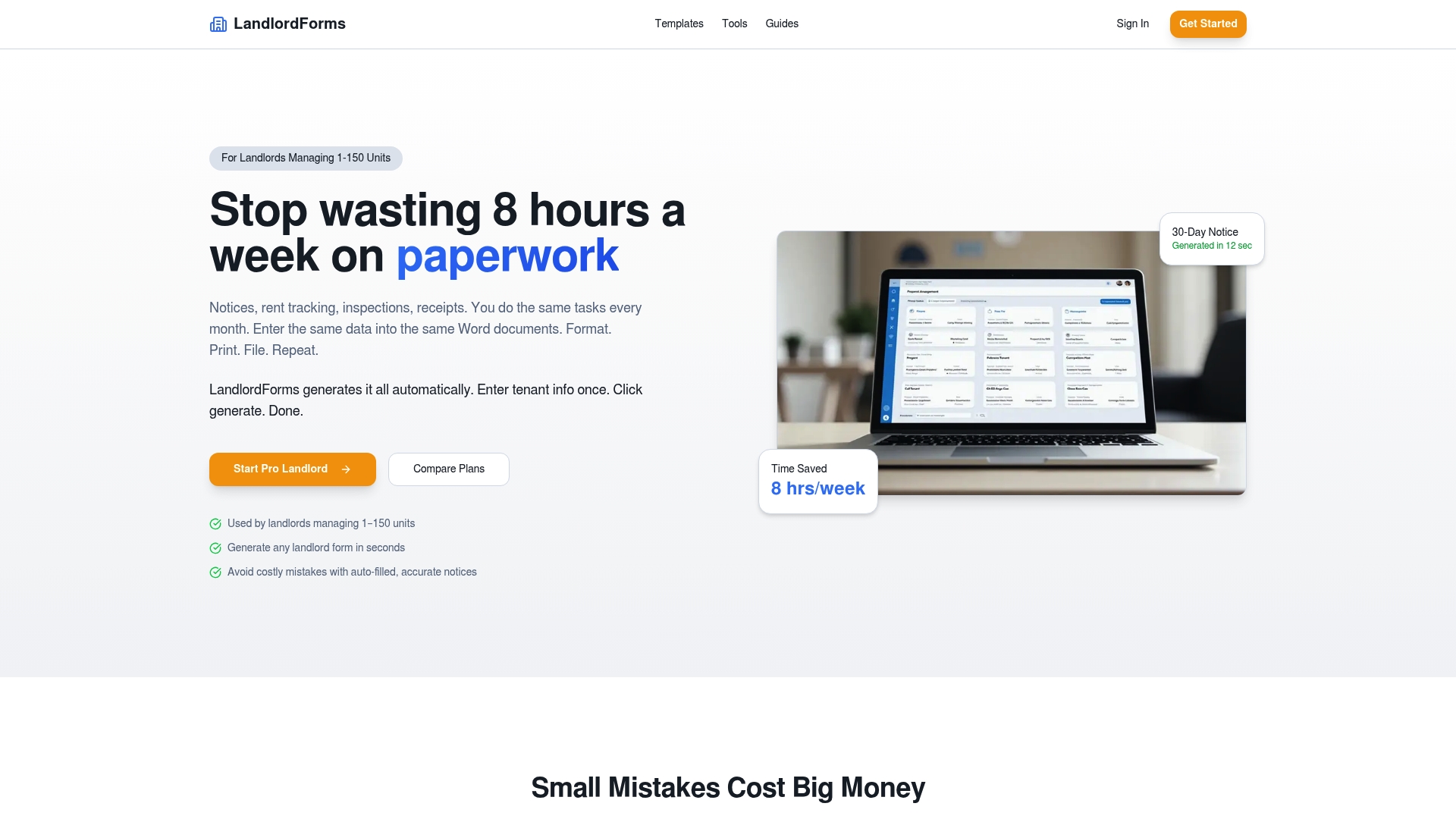
The practical difference: instead of typing a rent receipt from scratch each month, you generate an accurate, professional document in under two minutes. Instead of a spreadsheet you update by hand, you get real-time rent tracking with a payment history that’s ready if a dispute ever reaches court. Photo documentation for inspections is built in, so your move-in and move-out records are always complete.
Start with the free rent receipt template — it’s the fastest single swap you can make today. If you want a fuller picture of what Landlordforms handles, visit landlordforms.io to see the full template and tool library.
Useful sources and further reading
- The Ten Basic Time Management Skills Every Landlord and Property Manager Should Practice — Calendar.com; source of the four-hours-per-property maintenance benchmark.
- How to Manage Your Time as a Busy Landlord — Home Rental Property 101; practical batching and scheduling tactics.
- Accidental Landlord Time Management — PortfolioRental; covers the long-term cost of ad-hoc approaches.
- Time-Saving Workflows and Systems for Landlords — Sarah PA Solutions; admin automation and templated communication examples.
- Time Management Tips for Busy Property Managers — American Apartment Owners Association.
- NARPM — National Association of Residential Property Managers — professional standards and screening guidance.
- Kellogg Insight: Easy or Hard Tasks First? — Northwestern University; task-ordering research cited in the prioritization section.
- Property Management Workflow Efficiency Tips — Landlordforms blog.
- How Digital Tenant File Management Works for Landlords — Landlordforms blog.
- How to Document the Tenant Move-In Process Right — Landlordforms blog.
FAQ
What is landlord time management?
Landlord time management is the practice of organizing property-related tasks — maintenance, communication, bookkeeping, and leasing — into repeatable routines and systems so you spend less time on admin and more on higher-value decisions.
How much time should a landlord spend per property each month?
Industry estimates put maintenance and repairs alone at roughly four hours per property per month; total management time for a solo landlord without automation typically runs 9–12 hours per unit per month.
What are the signs of poor time management for landlords?
Common signs include replying to tenant messages at all hours, recreating the same documents from scratch repeatedly, missing lease renewal deadlines, and handling every contractor visit personally instead of pre-authorizing trusted tradespeople.
What is the Eisenhower Matrix and how does it apply to landlords?
The Eisenhower Matrix sorts tasks into four buckets by urgency and importance: do it today, schedule it, delegate it, or drop it. For landlords, it’s a five-minute morning exercise that separates a broken heater (urgent and important) from routine maintenance scheduling (delegate or batch).
How can landlords save time on paperwork?
Using templated forms for rent receipts, notices, and move-in checklists eliminates repetitive manual entry. Tools like Landlordforms automate document generation and track rent payments in real time, replacing hours of manual work each week.