Multi-Unit Landlord Administrative Tasks Checklist

Running multiple rental units without a system doesn’t just cost time — it costs money. Use this one-page administrative checklist to cover daily, monthly, and annual tasks across every unit you manage, then download the templates below to start executing today.
Core checklist categories (print or save this):
- Tenant lifecycle: Screening consent, application intake, lease execution, move-in condition report, key handoff, renewal notice, move-out walkthrough, deposit reconciliation
- Maintenance: HVAC filter log, work order intake, vendor assignment, inspection records, emergency repair protocol
- Finance: Daily rent posting, rent ledger update, late fee tracking, monthly bank reconciliation, quarterly owner report, annual tax packet
- Compliance & recordkeeping: Lease storage by unit, notice log, photo documentation with timestamps, insurance renewal calendar
- Vendor management: Preferred vendor list, active work orders, contract renewal dates, preventive service schedule
- Emergency preparedness: Tenant notification tree, utility shutoff locations, evacuation plan per building, 24-hour contact list
Landlordforms templates slot directly into the tenant lifecycle and finance categories. The move-in/move-out checklist creates a timestamped photo record, and the rent ledger template tracks receipts and balances in Excel without manual math. Both are free downloads. For a quick audit of your current records, the property documentation audit checklist shows exactly where gaps exist before they become disputes.
Centralizing records across four discrete layers — portfolio, property, unit, and tenancy — keeps every file retrievable as your portfolio grows. Standards and templates live at the portfolio level; permits and warranties at the property level; inspection photos and appliance serials at the unit level; leases and payment history at the tenancy level.

Table of Contents
- What does a multi-unit landlord administrative tasks checklist look like by frequency?
- How do you build a repeatable tenant lifecycle workflow?
- Which maintenance tasks actually move the needle on cost and risk?
- What fields does a clean rent ledger actually need?
- What compliance and recordkeeping rules apply to U.S. multi-unit landlords?
- How do you implement these checklists without starting from scratch?
- How should you log tenant communications and handle disputes?
- What does an emergency preparedness plan look like for a multi-unit building?
- Key Takeaways
- The process gap most landlords don’t see until it’s too late
- Landlordforms cuts the paperwork that slows multi-unit operations
- Useful sources and downloadable templates
- FAQ
What does a multi-unit landlord administrative tasks checklist look like by frequency?
The most common failure in multi-family property management isn’t missing a task once. It’s having no schedule at all, so tasks pile up until something breaks. The table below maps every major administrative duty to a frequency, an estimated time window, and the person or tool responsible.

| Frequency | Task | Est. Time per Property | Owner |
|---|---|---|---|
| Daily | Rent payment posting, urgent maintenance intake | 30 min | Manager / software |
| Weekly | Common-area inspection, vendor follow-up, open work order review | 60 min | Manager |
| Monthly | HVAC filter check, rent reconciliation, late fee review, tenant communication log review | 30–60 min | Manager |
| Quarterly | Full unit exterior inspection, owner distribution report, lease renewal pipeline review | 2–4 hours | Manager + owner |
| Semi-annual | Smoke/CO detector test, water heater flush, gutter cleaning | 3–5 hours | Contractor |
| Annual | HVAC service, roof inspection, insurance renewal, tax packet assembly | Full day | Contractor + accountant |
Daily and weekly checklists prevent small issues from compounding into emergencies. A leaking common-area faucet caught on a Tuesday walkthrough is a $40 washer; the same leak ignored for three weeks is a mold remediation claim.
Pro Tip: Batch same-frequency tasks across all properties on the same day. Run every monthly HVAC check on the first Monday of the month, every quarterly inspection on the first week of January, April, July, and October. Batching cuts context-switching and makes it easier to delegate a full day’s work to one person rather than scattering tasks across the calendar.
Mapping tasks to financial outcomes sharpens prioritization. Operational checklists tied to financial impact help landlords identify which process changes deliver the highest return on time — tenant screening lowers bad debt and turnover costs; preventive maintenance reduces capital repair outlays; lease management tightens vacancy loss.
How do you build a repeatable tenant lifecycle workflow?
Every tenancy follows the same arc. The goal is to document each step so thoroughly that any team member can execute it without asking questions.
- Pre-screening: Post a written rental criteria document before accepting applications. This protects against Fair Housing complaints and sets expectations. Include income requirements, credit thresholds, and pet policy.
- Application intake: Collect a completed application and signed screening authorization from every adult applicant. The FTC’s guidance on tenant background checks requires written consent before running a consumer report.
- Screening and decision: Run credit, criminal, and eviction checks through a compliant screening service. Document the decision criteria and keep the denial reason on file for at least three years.
- Lease execution: Use a state-specific lease with all required addenda (lead paint disclosure, mold addendum, move-in condition report). Countersign and deliver a copy to the tenant within 24 hours.
- Move-in documentation: Walk every unit with the tenant before handing over keys. Photograph every wall, appliance, and fixture with a timestamp. In 17 states, missing documented baselines can legally prevent deposit deductions for damage — a move-in condition report is not optional paperwork.
- Routine tenancy touchpoints: Schedule a 90-day check-in call, an annual inspection notice (per state law), and a lease renewal offer 90–60 days before expiration.
- Renewal or notice to vacate: If renewing, issue a written renewal offer with any rent adjustment. If the tenant is leaving, confirm the move-out date in writing and send the move-out procedure checklist.
- Move-out walkthrough and turnover: Walk the unit within 24 hours of key return. Compare condition against the move-in photos. Document every charge with a photo, invoice, and itemized list. Turnover files should include pre- and post-cleaning photos, vendor invoices, and itemized charge support linked to dated condition records.
- Security deposit reconciliation: Issue the itemized statement and any refund within your state’s statutory deadline (typically 14–30 days). Keep copies of every supporting document.
Standardized templates enforce consistency across properties. When a failed safety check triggers an emergency repair task automatically, that’s conditional workflow branching — a step that only fires when a prior step produces a specific result. Build these into your checklists so nothing falls through the cracks between units.
For detailed guidance on documenting the move-in process and the move-out documentation checklist, Landlordforms has step-by-step guides for both.
Which maintenance tasks actually move the needle on cost and risk?
Not all preventive maintenance delivers equal value. Prioritize by consequence: what fails expensively, what fails suddenly, and what tenants notice immediately.
HVAC filter replacement is the single most impactful monthly task. Practitioners consistently identify it as the top monthly preventive item because neglected filters raise energy consumption, shorten equipment life, and generate repair costs that dwarf the price of a filter. For a landlord paying utilities on common areas or all-inclusive units, this is a direct line to the income statement.
A maintenance log should capture at minimum:
| Field | What to Record |
|---|---|
| Date | Date task was completed |
| Property | Building address or ID |
| Unit | Unit number (or “common area”) |
| Task | Description of work performed |
| Vendor / Staff | Who completed the work |
| Invoice # | Reference number for payment |
| Cost | Amount paid |
| Photo proof | File name or link to photo |
| Next due date | When this task recurs |
Keep this log at the unit level for repairs and at the property level for building systems. That separation makes it easy to pull a full repair history for a single unit during a dispute, or a full HVAC service history for an insurance claim.
Pro Tip: Schedule high-consequence items — HVAC annual service, water heater inspection, roof check — in September, before heating season. Contractors are easier to book, and you catch problems before the first cold snap. Split the work: in-house staff handle filter swaps and detector tests; licensed contractors handle anything involving gas, electrical, or structural systems.
Preventive plumbing contracts are worth the annual cost for buildings with more than four units. Scheduled line clearing and slow-leak identification prevent the kind of emergency callout that runs $800 at 11 PM on a Saturday.
What fields does a clean rent ledger actually need?
Financial administration for multiple units breaks down when landlords track rent in spreadsheets that weren’t built for the job. A proper rent ledger has a fixed schema so every unit’s history looks the same and reconciliation takes minutes, not hours.
Essential rent ledger fields:
- Tenant name and unit number
- Lease start and end dates
- Monthly rent amount
- Payment received date
- Payment method (check, ACH, portal)
- Reference number (check number or transaction ID)
- Late fee charged (if any)
- Late fee received date
- Running ledger balance
Monthly reconciliation follows four steps: post all payments received, match against bank deposits, calculate any outstanding balances, and prepare the owner distribution. Quarterly, generate a per-property income and expense summary. Annually, compile the tax packet — rent received, repair invoices, depreciation schedule, and any 1099s for contractors paid over $600 (see IRS Publication 527 for rental income and expense rules).
| Cadence | Financial Task |
|---|---|
| Daily | Post rent payments; flag NSF returns |
| Monthly | Bank reconciliation; late fee review; owner distribution |
| Quarterly | Owner income/expense report; vacancy cost summary |
| Annual | Tax packet assembly; 1099 filing; depreciation review |
The Landlordforms rent ledger template is a free Excel download pre-built with these fields. It handles running balances automatically, so you’re not manually calculating what a tenant owes after a partial payment.
What compliance and recordkeeping rules apply to U.S. multi-unit landlords?
Document retention isn’t just good practice — in a dispute, it’s the difference between winning and losing. The table below covers the core document types and how long to keep them.
| Document Type | Recommended Retention |
|---|---|
| Signed lease and all addenda | Duration of tenancy + 7 years |
| Move-in / move-out condition reports | Duration of tenancy + 7 years |
| Inspection photos (timestamped) | Duration of tenancy + 7 years |
| Rent payment records | 7 years (IRS audit window) |
| Notices served (entry, non-renewal, late rent) | Duration of tenancy + 7 years |
| Security deposit accounting | Duration of tenancy + 7 years |
| Repair invoices and work orders | 7 years |
| Screening records (applications, denials) | 3 years minimum |
| Insurance policies | Duration of policy + 3 years |
Move-in condition reports with dated photos are the most critical document in any deposit dispute. Courts frequently rule against landlords who cannot produce a documented baseline — and in many states, the absence of that baseline legally bars any deduction at all.
Store records in the four-layer structure described earlier: portfolio-level templates, property-level permits and warranties, unit-level inspection photos and appliance records, tenancy-level leases and payment history. That structure makes any document retrievable in under two minutes, which matters when a tenant files a complaint or an attorney sends a demand letter.
For a full list of essential landlord documents and what belongs in each file, Landlordforms has a dedicated guide. Best practices for photo documentation — naming conventions, timestamp settings, and storage — are covered separately.
How do you implement these checklists without starting from scratch?
A checklist that lives in a Google Doc gets ignored. One with assigned owners, due dates, and recurring triggers gets followed. Here’s a practical sequence for rolling out a system across multiple properties.
- Choose a central repository. Pick one place where all checklists, templates, and records live. This can be property management software, a shared drive with a strict folder structure, or a dedicated platform like Landlordforms. The key requirement: every team member accesses the same version.
- Import your templates. Load the move-in/move-out checklist, rent ledger, maintenance log, and notice templates. Don’t customize yet — get the defaults working first.
- Map owners and due dates. Assign every recurring task to a named person or role. “Manager” is not specific enough; “Maria — Unit 1–8 monthly HVAC check, first Monday” is.
- Create recurring triggers. Set up automatic reminders for monthly, quarterly, and annual tasks. For event-driven tasks (move-in triggers a move-in checklist; lease expiration triggers a renewal workflow), build the trigger into your system so it fires without manual intervention. Recurring triggers with task assignment and audit trails are what convert a good process into a repeatable operation.
- Integrate photo and signature capture. Move-in walkthroughs and inspection reports need photo proof and tenant sign-off. Landlordforms handles both — the move-in checklist captures photos and generates a signed record that becomes part of the tenancy file.
- Run a 30-day pilot on two properties. Don’t roll out to the full portfolio on day one. Run the system on two properties for 30 days, identify what breaks or gets skipped, and fix the process before scaling.
Landlordforms templates — move-in checklists, rent ledger, 30-day notices, rent receipts — are designed to drop into step 2 of this sequence. The platform generates accurate, professional documents in a few clicks and organizes tenant information in one place, which cuts the manual entry that causes missed deadlines and costly errors. For a deeper look at workflow efficiency, the Landlordforms blog covers batching, delegation, and system design for growing portfolios.
How should you log tenant communications and handle disputes?
Every conversation with a tenant is a potential exhibit. That’s not paranoia — it’s the practical reality of managing multiple units where disputes over repairs, deposits, or lease terms are inevitable.
Log every substantive communication: date, time, method (phone, email, text, in-person), summary of what was discussed, and any commitments made. For phone calls, follow up with a brief email confirming what was agreed. That email creates a written record even when the original conversation was verbal.
When a dispute arises, the resolution protocol matters as much as the underlying facts. Respond in writing within 24–48 hours of any formal complaint. Acknowledge the issue, state what you’re doing about it, and give a timeline. If the dispute involves a deposit deduction, pull the move-in photos, the move-out photos, and the itemized charge list before responding. A landlord who can attach three timestamped photos to a reply email resolves most disputes before they escalate.
For habitability complaints or repair requests, document the date received, the date you responded, the date work was completed, and the vendor invoice. That four-point record defeats most retaliatory claims. Automated letter tools — such as HOA Letter AI for routine notices — can handle templated communications at scale, freeing up time for the disputes that actually need personal attention.
Keep communication logs in the tenancy layer of your records, linked to the relevant lease period. When a tenancy ends, the full communication history moves to the archived tenancy file and stays there for the retention period.
What does an emergency preparedness plan look like for a multi-unit building?
A single-family rental emergency plan is simple. A 20-unit building is a different problem: multiple households, shared systems, and a single point of failure (you) if there’s no documented protocol.
Every multi-unit property needs four things in writing before an emergency happens:
Tenant notification tree. Know how you’ll reach every tenant within 30 minutes. Maintain a current contact list with cell numbers and email addresses. For larger buildings, a group text channel or a building-specific notification app works better than individual calls.
Utility shutoff locations. Document the location of every main water shutoff, gas shutoff, and electrical panel for each building. Post laminated copies in the maintenance room and keep digital copies accessible on your phone. A burst pipe at 2 AM is not the time to search for the shutoff.
Evacuation plan per building. Post floor plans with exit routes in common areas. Identify a designated assembly point. For buildings with elevators, note the stairwell locations and any units with mobility-limited tenants who may need assistance.
24-hour emergency contact list. Maintain a list of licensed contractors for plumbing, electrical, HVAC, and structural emergencies — not just your preferred vendors, but backup contacts for when the first call goes to voicemail. Include your insurance carrier’s claims line.
After any emergency, document what happened, what was done, and what it cost. That record supports insurance claims, informs future capital planning, and demonstrates due diligence if a tenant later claims the building was unsafe.
Key Takeaways
A multi-unit landlord administrative tasks checklist only works when it’s organized by frequency, tied to named owners, and backed by centralized records at the portfolio, property, unit, and tenancy layers.
| Point | Details |
|---|---|
| Start with the one-page checklist | Group tasks by category (tenant lifecycle, maintenance, finance, compliance) and assign a frequency to each. |
| Centralize records in four layers | Store templates at portfolio level; permits at property level; photos at unit level; leases at tenancy level. |
| Prioritize move-in documentation | In 17 states, missing dated photo baselines can legally bar deposit deductions — this is non-negotiable. |
| Automate recurring triggers | Monthly HVAC checks, rent posting, and lease renewal workflows should fire automatically, not from memory. |
| Landlordforms for paperwork | Landlordforms converts checklist steps into fillable forms, automated notices, and a free rent ledger template. |
The process gap most landlords don’t see until it’s too late
Most multi-unit operations don’t fail because landlords are careless. They fail because data lives in too many places. One landlord keeps leases in a filing cabinet, photos on a personal phone, rent records in a spreadsheet, and maintenance notes in text messages. That setup works fine until a tenant disputes a $1,200 deposit deduction and the landlord spends three days reconstructing a paper trail that should have taken three minutes to pull.
The single process change that pays back fastest isn’t a new software platform or a better spreadsheet. It’s committing to one location per document type and enforcing it from the first day of every tenancy. Unit-level files — move-in photos, appliance serials, repair history — are where gaps first appear and where disputes are won or lost. A landlord who can open a folder and produce a timestamped photo from move-in day, a signed condition report, and every repair invoice for the past two years has already won most disputes before they start.
The paperwork system matters more than the tools you use to run it. Build the structure first, then automate what repeats.
Landlordforms cuts the paperwork that slows multi-unit operations
Eight hours a week is what landlords managing multiple units typically spend on administrative paperwork — generating notices, updating rent records, chasing down signed forms. Landlordforms is built specifically for portfolios of 1–150 units, and it converts the checklist steps in this article into fillable forms, automated notices, and audit-ready records in a few clicks.
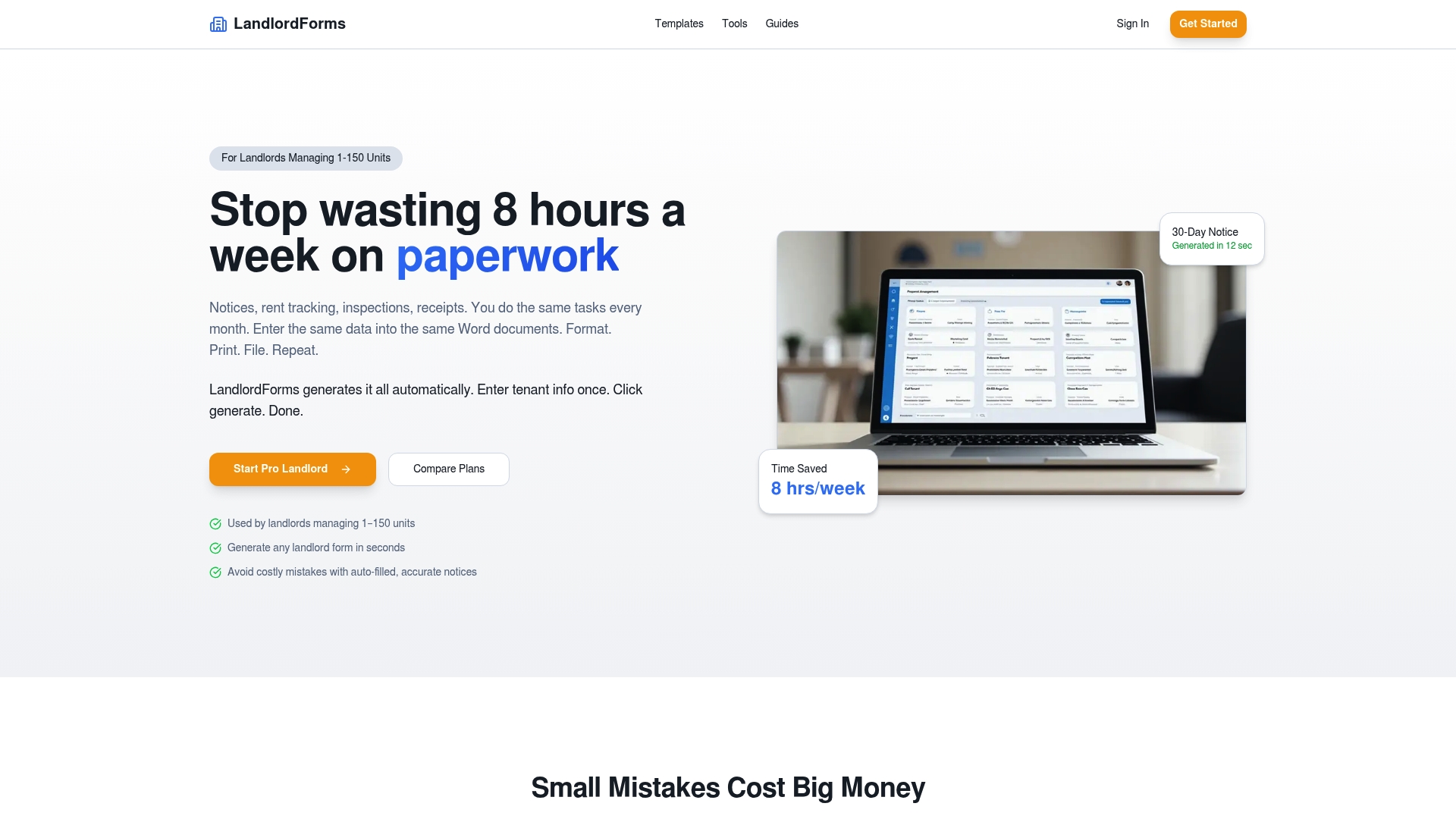
The rent ledger template is a free Excel download pre-built with every field covered in the financial administration section — tenant name, unit, payment date, method, reference number, late fees, and running balance. The rent proration calculator handles partial-month calculations automatically, so move-in and move-out math doesn’t require a spreadsheet formula. For notices, Landlordforms generates state-specific 30-day notices and rent receipts that create a timestamped audit trail — the kind of documentation that resolves deposit disputes before they reach small claims court.
Download the rent ledger template or try the proration calculator at landlordforms.io to start reducing admin time today.
Useful sources and downloadable templates
The following resources were referenced in this article and are worth bookmarking for ongoing use:
- Move-In/Move-Out Checklist Template — Free PDF generator from Landlordforms; creates a timestamped condition record for every unit turnover.
- Rent Ledger Template (Free Excel Download) — Pre-built schema covering all essential ledger fields; handles running balances automatically.
- Property Documentation Audit Checklist — A compact checklist to test record completeness across your portfolio before a dispute surfaces.
- Essential Landlord Documents Guide — Full list of documents every landlord should maintain, organized by document type.
- Photo Documentation Best Practices — Naming conventions, timestamp settings, and storage guidance for defensible inspection records.
- Multi-Unit Building Plumbing Management — Partner guide on preventive plumbing contracts and maintenance scheduling for multi-unit properties.
- IRS Publication 527 — Official IRS guidance on rental income and expenses, depreciation, and record requirements for landlords.
- FTC Tenant Background Check Rights — Federal guidance on written consent requirements before running consumer reports on applicants.
FAQ
What tasks should a multi-unit landlord do every day?
Daily tasks for multi-unit landlords include posting rent payments, flagging NSF returns, and logging any urgent maintenance requests. Keeping a daily rent posting habit prevents ledger errors from compounding across multiple units.
How many states require a move-in condition report?
In 17 states, missing a documented move-in baseline can legally prevent a landlord from making deposit deductions for damage. Even in states without a statutory requirement, dated photos and a signed condition report are the strongest defense in any deposit dispute.
What fields does a rent ledger need for multiple units?
A rent ledger for multiple units should include tenant name, unit number, lease dates, monthly rent amount, payment received date, payment method, reference number, late fees charged and received, and a running ledger balance. The Landlordforms rent ledger template includes all of these fields in a free Excel download.
How long should landlords keep rental records?
The standard recommendation is to retain signed leases, condition reports, inspection photos, rent records, and notices for the duration of the tenancy plus seven years. Screening records should be kept for at least three years. IRS Publication 527 governs the tax record requirements for rental income and expenses.
What is the most impactful monthly maintenance task for multi-unit properties?
HVAC filter replacement is consistently identified as the highest-impact monthly preventive task because neglected filters raise energy costs, shorten equipment life, and generate repair bills that far exceed the cost of a filter. For landlords paying utilities on any units, it has a direct effect on operating expenses.