How to Reduce Human Error in Tenant Notices: 2026 Guide

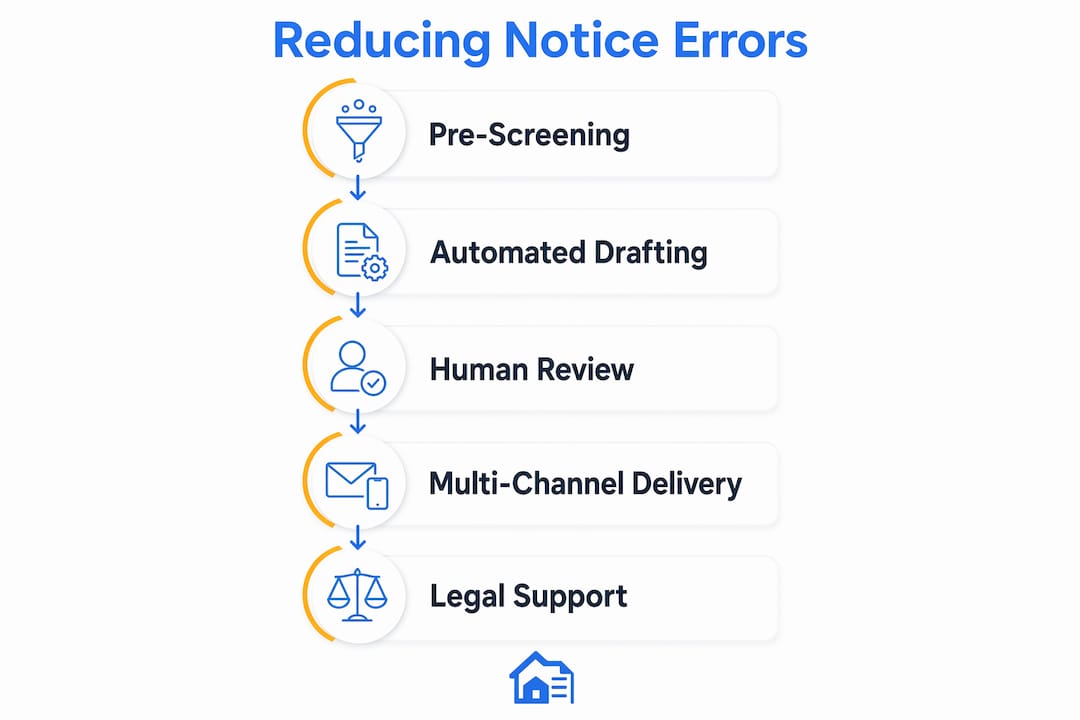
The fastest way to reduce human error in tenant notices is to stop relying on memory and manual entry. Use jurisdiction-aware templates, multi-channel delivery, and documented workflows instead. A single clerical mistake, wrong tenant name, missing statutory language, or a notice served by email when the law requires certified mail can get your eviction case dismissed entirely, forcing you to restart the clock while a non-paying tenant stays put.
Here is what actually works:
- Use automated tools that generate jurisdiction-specific notices with correct statutory language
- Deliver notices through multiple channels (email, SMS, portal) to maximize confirmed receipt
- Document every delivery attempt with certified mail receipts or digital acknowledgments
- Outsource legal review for non-routine notices, especially evictions
- Pre-screen tenants to reduce the volume of notices you need to issue
- Build a standardized eviction workflow with checklists and defined roles
- Train staff on notice deadlines, correct notice types, and delivery requirements
- Run quarterly audits to catch errors before they become dismissed cases
- Use document templates with built-in error checks, updated for current law
Table of Contents
- How automation improves tenant notice accuracy
- Why outsourcing legal support reduces costly notice errors
- Pre-screening tenants and building a standardized eviction workflow
- How Landlordforms helps you generate accurate notices faster
- Landlordforms cuts paperwork so you can focus on compliance
- Key Takeaways
- FAQ
How automation improves tenant notice accuracy
Automated tools solve the most common source of notice errors: manual data entry against rules no one person can reliably track. Jurisdiction-aware notice generation eliminates the leading cause of eviction-case dismissals by pulling the correct statutory language, cure periods, and delivery requirements for each property’s location automatically.
Multi-channel delivery is the other half of the equation. Properties using automated multi-channel communication achieve significantly higher confirmed delivery rates than those relying on a single manual channel. That gap matters in court, where a notice that cannot be proven delivered is treated as if it was never sent.
Pro Tip: Build a “proof loop” into every notice workflow. Capture certified mail receipts, portal acknowledgments, or SMS delivery confirmations and log them against the tenant record immediately. Without that artifact, proof of delivery is just your word.
Key automation features worth having:
- Rule-based notice generation tied to property jurisdiction and notice type
- Deadline tracking with back-calculated send dates and delivery buffers
- Multi-channel delivery across email, SMS, and tenant portal simultaneously
- Proof-of-service logging with timestamped delivery confirmations
- Escalation alerts when delivery fails or a deadline is approaching
One important caveat: AI-drafted notices require human review before sending. AI can produce plausible-sounding statutory citations that do not exist or have been repealed. The automation handles structure and scheduling; you verify the notice type and legal references.
Why outsourcing legal support reduces costly notice errors
Legal experts catch what templates miss. Notice requirements differ not just by state but by city, notice type, and sometimes the size of a rent increase. An attorney who specializes in evictions knows, for example, that Florida’s three-day notice under Statute 83.56 requires exact dollar amounts, specific statutory language, and the landlord’s physical address for payment delivery. A generic online template often gets at least one of those wrong.
Improperly formed or served notices result in total case dismissal, meaning you restart the eviction timeline from day one, often months later. The cost of attorney-prepared notices is consistently lower than the rent lost during that delay.
Outsourcing advantages at a glance:
- Compliance assurance on jurisdiction-specific formatting and statutory language
- Proper service documentation including process server affidavits
- Correct notice type selection (cure or quit vs. notice to vacate vs. pay or quit)
- Faster legal escalation when a case needs to move to court
- Reduced case dismissals from technical defects
For the legal handoff itself, push the case packet via API or secure file share rather than emailing PDFs. Manual PDF transfers introduce re-keying errors at exactly the wrong moment. You can find lease violation notice examples from legal compliance specialists to benchmark your own templates against current standards.
Pre-screening tenants and building a standardized eviction workflow
Tenant pre-screening is error prevention at the source. Identifying high-risk applicants before they sign a lease reduces the number of eviction notices you ever need to prepare. Fewer notices means fewer opportunities for mistakes. The role of tenant screening documents in 2026 goes beyond credit checks to include rental history verification and income-to-rent ratio analysis.

Once a notice is necessary, a standardized workflow keeps the process consistent regardless of who handles it. Without documented steps, notice preparation depends on whoever is available that day, and judgment calls under pressure produce errors.
Workflow best practices:
- Defined roles so one person prepares the notice and a second reviews it before delivery
- Checklist usage covering tenant name verification, correct notice type, deadline calculation, and delivery method
- Exception management with escalation paths for unusual cases
- Audit checkpoints at notice preparation, delivery, and confirmation stages
- Regular staff training on legal updates and deadline rules by jurisdiction
A checklist sounds basic, but it is the single most reliable way to catch the errors that cause dismissals: wrong tenant name, incorrect notice period, unauthorized charges in a payment demand, or a delivery method the jurisdiction does not accept.
How Landlordforms helps you generate accurate notices faster
Landlordforms is built specifically for landlords managing 1 to 150 units, and the core value is straightforward: it removes manual entry from the notice creation process. The platform saves up to eight hours a week by automating form generation and organizing tenant information in one place, so you are not hunting through spreadsheets or retyping addresses every time a notice goes out.
The free PDF generators for documents like the Notice of Entry and Lease Renewal Notice include built-in error checks and are updated to reflect legal changes. That means the template itself catches formatting problems before you ever print or send anything.
What Landlordforms covers for notice accuracy:
- Automated form creation for 30-day notices, rent receipts, and other standard documents
- Real-time rent payment tracking to support accurate payment demand amounts
- Photo documentation for inspections, creating a dispute-ready record
- Organized tenant data in one place, reducing copy-paste errors across documents
- Up-to-date templates reflecting current legal requirements
The notice to vacate template and lease violation notice template are particularly useful for landlords who handle evictions without outside counsel, since both include the structural elements courts require. Regular audits of your notice process, combined with Landlordforms’ tracking features, keep your compliance record clean and your cases defensible.
Landlordforms cuts paperwork so you can focus on compliance

Most landlords managing under 150 units do not need enterprise software. They need something that generates the right document, tracks the delivery, and does not require an hour of setup every time a tenant is late. Landlordforms does exactly that, without a steep learning curve or a monthly retainer.
The platform’s free landlord document templates cover the notices you use most, with error checks built in so a missed field or wrong date gets flagged before the document goes out. Pair that with the rent ledger template to keep payment records accurate, and you have the documentation foundation that makes every notice defensible.
Start with the free templates at Landlordforms.io and see how much time you recover in the first week.
Key Takeaways
Automating notice generation and delivery, combined with standardized workflows and legal review, is the most reliable way to keep tenant notices accurate and legally enforceable.
| Point | Details |
|---|---|
| Automation prevents the most common errors | Jurisdiction-aware tools generate correct statutory language and track deadlines automatically. |
| Proof of delivery is legally required | A notice that cannot be proven delivered is treated by courts as if it was never sent. |
| Standardized workflows reduce judgment errors | Checklists with defined roles catch mistakes before a notice goes out, not after dismissal. |
| Legal outsourcing protects complex cases | Attorney-prepared eviction notices eliminate technical defects that cause case dismissals. |
| Landlordforms saves up to eight hours weekly | The platform automates form creation and organizes tenant data, reducing manual entry errors. |
FAQ
What makes a tenant notice legally invalid?
A notice is typically invalid when it contains incorrect tenant identification, wrong statutory language, unauthorized charges, or was delivered by a method the jurisdiction does not accept. Courts must dismiss eviction cases built on defective notices, requiring landlords to restart the process.
How does automated notice delivery reduce errors?
Automated systems generate jurisdiction-specific notices, calculate deadlines with delivery buffers, and deliver through multiple channels simultaneously, capturing proof of receipt at each step. This removes the manual tracking and data entry where most clerical mistakes occur.
What is the five-day notice law in Arizona?
Arizona landlords must give tenants a five-day written notice to pay overdue rent before filing for eviction. If the tenant pays within those five days, the landlord cannot proceed with eviction for that nonpayment.
How many tenant communications can be automated without losing quality?
According to NARPM’s 2025 study, 72–78% of routine tenant communication can be fully automated without any loss in tenant satisfaction. The remaining portion involves disputes, complaints, and sensitive matters that require human judgment.
Should landlords use AI to draft eviction notices?
AI can accelerate drafting, but human review is mandatory before any notice is sent. AI may generate plausible but incorrect statutory citations, and only a person can confirm the correct notice type and verify that timing and delivery requirements match the jurisdiction.