Add Roommates Defensibly: Roommate Addendum Rules for U.S. Landlords

Yes, you need a signed lease addendum (or in some cases a new lease) before a new occupant becomes an enforceable co-tenant. Require a written request naming the person and their move-in date, then run the same independent screening you’d run on any applicant. If you’re also changing rent, the deposit, or the lease term in a meaningful way, skip the addendum and write a new lease instead.
TL;DR:
- A signed lease addendum is appropriate for straightforward changes like adding a roommate without altering lease terms or rent significantly.
- Always follow a written, step-by-step process including tenant request, independent screening, and clear documentation to ensure legal enforceability.
- The addendum must specify occupancy details, rent adjustments, and liability, with signatures from all adults involved, but cannot waive statutory tenant protections.
- Fair housing laws require applying strict, consistent screening criteria and occupancy limits based on local codes to avoid discrimination claims.
- Adding a roommate typically impacts renters insurance, so landlords should remind tenants to update their coverage to prevent uninsured liabilities.
Table of Contents
- When to Use an Addendum vs. a New Lease
- How Do You Add a Roommate to a Lease Correctly?
- Screening Rules and Fair Housing Consistency
- What Should a Roommate Addendum Include?
- What Can a Roommate Addendum Not Legally Do?
- Execution and Recordkeeping: What to Keep on File
- Updating Lease Records With Property Management or a Leasing Office
- Removing a Roommate After the Addendum Is Signed
- Fair Housing Compliance When Adding a Roommate
- Renters Insurance: What Changes When a Roommate Moves In
- What LandlordForms Brings to This Process
- Add a Roommate Without the Paperwork Headache
- Sources
- FAQ
When to Use an Addendum vs. a New Lease
An addendum works when you’re making one clean change to an otherwise intact lease, like adding a name to the tenant list. It’s the right tool when the term, rent structure, and existing conditions all stay the same and you just need to formalize who lives there.
A new lease makes more sense in a few specific situations:
- The current term is close to expiring anyway, so you’re effectively resetting the tenancy.
- You’re materially raising rent or the security deposit to reflect the extra occupant.
- Local rent-control ordinances or a state’s own roommate-consent statute limit what you can change mid-lease without triggering new-lease procedures.
Check your city and state rules before choosing. Some jurisdictions cap how much you can raise a deposit even when adding a paying adult, and a few restrict a landlord’s ability to deny a request tied to certain protected relationships. When in doubt, a fresh lease avoids ambiguity better than an addendum stretched to cover changes it was never built for.
How Do You Add a Roommate to a Lease Correctly?
Following a consistent sequence protects you legally and keeps the paperwork clean if a dispute ever lands in front of a judge. Nolo’s guide on adding a roommate lays out the same core steps courts and tenant attorneys expect landlords to follow.
- Get the request in writing. Ask the current tenant for the proposed occupant’s full legal name and intended move-in date, and keep a timestamped copy of that request.
- Run independent screening. Have the prospective occupant complete a full rental application, then pull your own credit, eviction, criminal, and income verification, using the identical criteria you apply to every other applicant.
- Decide on rent share and deposit. Determine whether the new occupant will pay a rent share directly or through the existing tenant, and check your state’s deposit cap before collecting anything additional.
- Draft the addendum. Reference the original lease by its date and named parties, set a clear effective date, and state explicitly whether the new person is a co-tenant with full joint and several liability or an authorized occupant with narrower obligations.
- Collect signatures and file everything. Every adult tenant and the landlord need to sign, each party gets an executed copy, and your rent ledger and tenant file get updated the same day.
Pro Tip: Never accept a credit report or background check the applicant hands you directly. Pull your own. A second-hand report can be outdated, altered, or missing a recent eviction filing, and if a dispute ever goes to court, “the tenant gave it to me” is a weak defense.
If you manage paperwork by hand right now, this is the exact process a tool like LandlordForms is built to speed up, since the state-specific template and the signature tracking happen in the same place instead of across five separate documents.
Screening Rules and Fair Housing Consistency
Apply the exact same screening bar to the incoming roommate that you’d apply to a stranger walking in off the street. That means identical credit thresholds, identical income multiples, identical criminal and eviction lookback periods, no exceptions because the person is a friend of your existing tenant.
Consistency is the single strongest defense against a fair housing complaint. According to Nolo, a landlord who documents an objective, non-discriminatory reason for every denial, and applies that reason the same way across every applicant, is far better positioned if a rejected occupant later alleges discrimination.
A few practical rules to build into your process:
- Write down the specific reason for any denial (a credit score below your published minimum, an unresolved eviction, insufficient verified income) and keep it in the tenant file.
- Never ask questions tied to protected characteristics under the Fair Housing Act, even informally during the screening conversation.
- Know your state’s exceptions. Some states extend limited protections to certain family members or dependents living with a tenant, which can affect whether you can deny that specific person the way you’d deny an unrelated applicant.
Statistic Callout: Occupancy limits are commonly set around two persons per bedroom plus one, though the exact formula varies by local code, so confirm your city’s standard before approving anyone, not just the state’s baseline.
What Should a Roommate Addendum Include?
A roommate addendum earns its enforceability from precision, not length. The tighter and more specific the language, the harder it is for either side to argue later that a term was ambiguous. Guidance on lease addenda consistently points to the same short list of must-have clauses.
- Reference to the original lease by execution date, named parties, and the property address.
- A stated effective date marking exactly when the addendum takes hold.
- The new occupant’s full legal name, with a clear statement of status: co-tenant (joint and several liability for rent and damages) or authorized occupant only.
- Rent adjustment or rent-share terms, any security deposit contribution respecting your state’s cap, and who handles utility payments.
- Occupancy and guest limits, pet permissions if relevant, a removal or move-out process, and a conflict clause stating the addendum controls wherever it disagrees with the original lease.
- Signature and date lines for the landlord and every adult tenant, not just the incoming occupant.
| Clause | Why it matters |
|---|---|
| Lease reference | Ties the addendum legally to the original agreement’s terms and dates |
| Effective date | Establishes exactly when liability and obligations begin |
| Co-tenant vs. occupant status | Determines whether joint and several liability applies |
| Conflict clause | Settles disputes when the addendum and original lease seem to disagree |
| Signature block | Proves mutual consent from every adult party, not just the landlord |
What Can a Roommate Addendum Not Legally Do?
An addendum cannot waive statutory tenant protections no matter how clearly both parties agree to it in writing. Habitability standards, lawful notice periods before entry or termination, and state security-deposit caps all sit outside what a private agreement can override.
FindLaw’s overview of adding a roommate makes a point that trips up a lot of landlords: mutual consent isn’t optional, it’s the entire basis for enforceability. A landlord who unilaterally hands a tenant an addendum and treats silence as agreement is building a document that a court can toss out entirely.
A few limits worth internalizing:
- If one clause in your addendum violates state law, courts typically sever just that clause and still enforce the rest of the document, but a badly drafted broad waiver can undermine confidence in the whole agreement.
- Avoid sweeping language like “tenant waives all rights related to occupancy changes.” Specific, narrow clauses hold up better than broad disclaimers.
- Every adult tenant needs to sign, not just the person requesting the addition. A roommate added with only the primary tenant’s signature is legally shaky.
Execution and Recordkeeping: What to Keep on File
Once signed, the addendum needs a permanent home next to the original lease, not in a drawer somewhere separate from your other tenant records. ReadYourLease’s guide on adding an occupant recommends treating the executed document with the same care you’d give the original signed lease, because it now carries equal legal weight.
Keep these items together in the tenant file:
- The fully executed addendum, with copies distributed to every signing party the same day.
- Updated entries in your rent ledger reflecting any new rent share or deposit contribution.
- Screening records for the new occupant, including the application, credit and background results, and your documented approval reasoning.
- Deposit receipts and any move-in inspection photos, which matter enormously if a dispute over damages or deposit return comes up later.
A free rent ledger template works fine for tracking these changes manually if you’re not ready to automate the whole file yet.
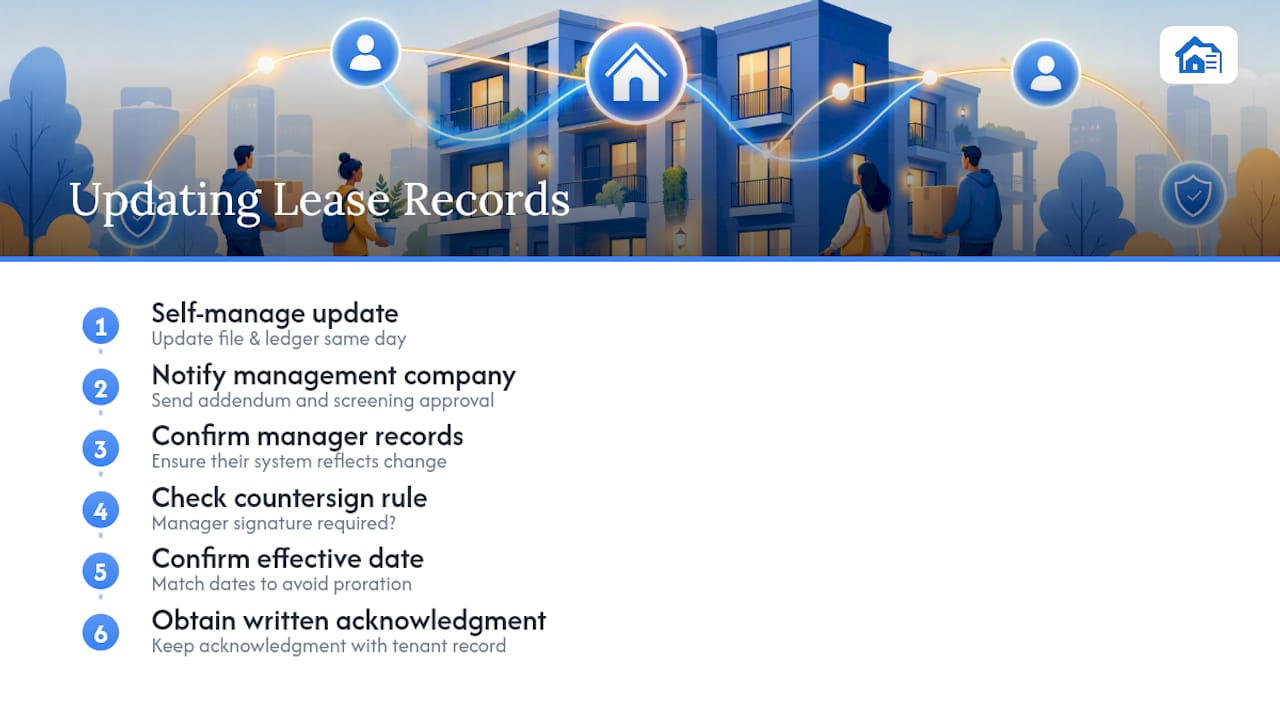
Updating Lease Records With Property Management or a Leasing Office
If you self-manage, updating records means keeping your own tenant file and ledger current the day the addendum is signed, no separate approval loop needed. If you work with a property management company or a leasing office handles day-to-day tenant relations on your behalf, the process needs one more step: formal notification.
Send the leasing office a copy of the signed addendum along with the new occupant’s screening approval, and confirm in writing that their internal system reflects the change, not just your own file. Property managers typically maintain their own tenant roster, rent-collection software, and emergency contact list, and a mismatch between your records and theirs is exactly the kind of gap that surfaces during a maintenance emergency or a dispute over who’s liable for a repair bill.
Ask specifically whether the management company needs its own signature line on the addendum, or whether landlord and tenant signatures alone satisfy their internal compliance requirements. Some management agreements require the property manager to countersign any lease modification as a condition of their authority to act on the owner’s behalf. Confirm the effective date matches across both your records and theirs, since a one-day discrepancy can complicate rent proration or liability questions if something goes wrong in the first week.
Once the update is confirmed, request written acknowledgment from the leasing office that the new occupant is on file. That acknowledgment becomes part of your permanent tenant record, right alongside the addendum itself.
Removing a Roommate After the Addendum Is Signed
Removing a roommate after they’ve been formally added requires roughly the same rigor as adding one, just running in reverse. The addendum that made them a co-tenant or authorized occupant needs a companion document, or a termination clause built into the original addendum, spelling out how removal actually happens.
If the roommate leaves voluntarily, get a written statement from them acknowledging the move-out date and confirming they’re releasing any claim to the security deposit portion they contributed. Update the lease to reflect that the remaining tenant or tenants are now solely responsible for the full rent, and have everyone who remains sign an acknowledgment of the new liability structure.
If you need to remove someone who won’t leave voluntarily, the process gets more complicated fast, especially considering eviction cleanout costs property managers need to know. A co-tenant with signature-based joint and several liability generally has the same tenancy rights as anyone else named on the lease, which means you likely can’t simply “uninvite” them without going through formal eviction procedures if they refuse to leave and the remaining tenants want them gone. This is one area where the difference between “co-tenant” and “authorized occupant” status, set at the time of the original addendum, matters enormously. An authorized occupant without independent tenancy rights is typically easier to remove than a full co-tenant, which is exactly why getting that classification right at signing is worth the extra five minutes it takes.
Fair Housing Compliance When Adding a Roommate
Every step of the roommate-addition process runs through the same fair housing framework that governs your original tenant screening. That means you cannot deny a proposed roommate, or apply different screening standards to them, based on race, color, national origin, religion, sex, familial status, or disability.
The practical risk shows up in subtle places. If you approve one tenant’s roommate request within a week but stall for a month on another tenant’s nearly identical request, and the two situations differ mainly by a protected characteristic, you’ve built a pattern a fair housing attorney could use against you. The fix is procedural: write down your screening criteria once, apply them identically every time, and time-stamp your decisions so you can show consistent turnaround regardless of who’s asking.
Familial status deserves particular attention. Some landlords instinctively want to limit occupancy when a tenant’s request involves children or a larger household, but blanket restrictions beyond your published, code-compliant occupancy limit can cross into discriminatory territory. Base occupancy decisions on your stated limit (commonly two persons per bedroom plus one, subject to local code) and nothing else. Document that limit in your tenant-facing materials before you ever need to enforce it, so a denial reads as policy application rather than an ad hoc judgment call.
Renters Insurance: What Changes When a Roommate Moves In
Adding a roommate almost always affects renters insurance coverage, and it’s worth flagging to both the existing tenant and the new occupant during the addendum process, even though the policy itself is between the tenant and their insurer, not you.
Most renters insurance policies are written to a single named policyholder or a specific list of household members. When a new adult moves in and becomes a co-tenant, the existing tenant typically needs to notify their insurer and either add the new occupant to the policy or confirm the new occupant is carrying separate coverage. Skipping that step can leave the new occupant’s personal property uninsured, and in some cases it can affect liability coverage if an incident involving the new occupant leads to a claim.
From your side as landlord, this is a good moment to reinforce (in writing, ideally as a line item in the addendum itself) that renters insurance remains the tenant’s responsibility and that any change in household composition should be reported to their carrier. It’s not something you can enforce directly in most states, but documenting that you raised it protects you if a damage dispute later hinges on whether coverage existed. A quick note in the addendum, something like “tenant acknowledges responsibility for updating renters insurance coverage to reflect the added occupant,” costs you nothing and closes a gap that surprises a lot of landlords after the fact.
What LandlordForms Brings to This Process
LandlordForms is built for landlords running 1 to 150 units who don’t have a legal team drafting every document from scratch. The state-aware templates handle date calculations and formatting automatically, which cuts down on the manual errors that turn a routine addendum into a legal headache. Property owners use it to keep tenant information, screening records, and executed documents organized in one place instead of scattered across email threads and file folders, saving time previously spent on paperwork.
— Igor
Add a Roommate Without the Paperwork Headache
Manually drafting an addendum, calculating a prorated rent share, and chasing signatures across email is a process prone to mistakes that can lead to legal exposure. Online software with state-aware templates can handle date logic and deposit math, plus signature tracking for proof that all parties have signed.

Every addendum you generate can be filed alongside the original lease and the updated rent ledger, helping reduce the risk of lost documentation if a dispute arises. If you’re changing rent as part of the addition, the rent proration calculator handles the mid-month math instantly. Start with a free template to see how the process works, or move straight to the Starter Landlord plan at $9 per month if you’re ready to handle the whole tenant file in one place.
Sources
For deeper reading on the legal mechanics behind roommate additions, see Nolo’s roommate addendum guide, FindLaw’s overview of consent requirements, and Justia’s explainer on roommates and guests.
- Adding a Roommate to a Lease or Rental Agreement | Nolo
- Adding a roommate to your lease | FindLaw
- How to Add an Addendum to a Lease: A Landlord’s Step-by-Step Guide (2026)
FAQ
Can a Landlord Refuse to Add a Roommate?
Yes, as long as the denial is based on consistent, objective screening criteria applied equally to every applicant rather than a protected characteristic under fair housing law.
Does a Roommate Addendum Need to Be Notarized?
No, most states only require signatures from the landlord and every adult tenant; notarization isn’t a legal requirement for a lease addendum to be enforceable.
What Happens if a Roommate Never Signs the Addendum?
An unsigned occupant has no formal tenancy rights or joint and several liability, which leaves you without a documented obligation to collect rent or hold that person accountable for damages.
Should Rent Go Up When Adding a Roommate?
That’s your call as landlord, but any increase needs to respect state and local rent-control rules, and a significant change is often cleaner to handle through a new lease rather than an addendum.
Can LandlordForms Generate a State-Specific Roommate Addendum?
Yes, LandlordForms offers state-aware templates that automate date and deposit calculations for lease addenda, with current pricing available on the LandlordForms site.