Virginia Landlord Tenant Handbook: 2026 Official Guide

The official Virginia Landlord & Tenant Handbook is published by the Virginia Department of Housing and Community Development (DHCD) and is available as a free PDF download. It summarizes the Virginia Residential Landlord and Tenant Act (VRLTA), found at Code of Virginia §§55.1-1200 through 55.1-1262, and every Virginia landlord and tenant should read it before signing a lease or filing any notice.
Three actions matter most after you download it:
- Save the handbook PDF and bookmark the DHCD landlord-tenant resources page for future updates.
- Obtain and keep the signed acknowledgment form. The DHCD’s Statement of Tenant Rights and Responsibilities (as of July 1, 2026) must be provided by the landlord and signed by the tenant. Both parties should retain a copy.
- Start a dated documentation folder containing your rent ledger, move-in photos, and all written maintenance requests. Per the Virginia Office of the Attorney General, only courts can enforce VRLTA rights, so your records are your evidence.
Statute callout: The DHCD Statement of Tenant Rights (effective July 1, 2026) caps nonrefundable application fees at a specific amount (excluding third-party background-check costs) and requires landlords to deliver a written lease within 10 business days of the lease’s effective date.
Key Takeaways
The Virginia Landlord & Tenant Handbook (DHCD) and the VRLTA together set enforceable rights and obligations for every covered tenancy, and only courts can enforce them — which means documentation is not optional.
| Point | Details |
|---|---|
| Official handbook source | Download the free DHCD handbook PDF and the Statement of Tenant Rights (July 1, 2026) from the DHCD landlord-tenant resources page. |
| Application fee cap | Nonrefundable application fees are capped at a specific amount (excluding third-party screening costs) under the DHCD Statement effective July 1, 2026. |
| Lease delivery deadline | Landlords must deliver a signed written lease within 10 business days of the effective date or risk the statutory 12-month default lease rule. |
| Deposit return window | Security deposits must be returned or itemized in writing within 45 days of lease termination; missing this deadline is one of the most common landlord violations. |
| Eviction prerequisites | A landlord cannot file an unlawful detainer action until required notices are served and the Statement of Tenant Rights has been delivered and acknowledged. |
| Landlordforms | Automates timestamped delivery of required forms, rent ledger tracking, and move-in photo documentation to reduce VRLTA compliance risk. |
Table of Contents
- What is the Virginia landlord tenant handbook and how does it relate to state law?
- Key tenant rights under the VRLTA you should know
- What landlords are required to do under Virginia law
- Application fees, deposits, and security deposit rules in Virginia
- How rent, late fees, and rent increases work under Virginia law
- How to request repairs and handle habitability issues
- When can a landlord enter your rental unit?
- How eviction works in Virginia: notices, filings, and common mistakes
- Where to download official Virginia landlord-tenant forms
- How software tools help landlords meet VRLTA compliance requirements
- Step-by-step checklists for tenants and landlords after reading the handbook
- What most landlords get wrong about VRLTA compliance
- Landlordforms makes VRLTA compliance faster and less error-prone
- Sources
- FAQ
What is the Virginia landlord tenant handbook and how does it relate to state law?
The handbook is an official DHCD publication that translates the VRLTA into plain English. It is not a standalone legal document and does not replace the statute, but it is the most practical starting point for understanding Virginia rental laws.
The VRLTA (Code of Virginia §§55.1-1200–55.1-1262) governs most residential rental housing in Virginia. The handbook covers the same ground in accessible language, including required disclosures, lease requirements, deposit rules, repair duties, and eviction procedures.
What the VRLTA covers:
- Standard residential rental units (apartments, single-family homes, townhouses)
- Manufactured home lot rentals (with some separate provisions)
- Landlords who own more than four rental units (smaller landlords may be exempt from certain provisions — check §55.1-1200 for the current threshold)
Common exemptions from the VRLTA:
- Transient occupancy (hotels, motels, short-term rentals under 90 days)
- Occupancy under a contract of sale
- Residence at a nonprofit facility or institution
- Single-family residences where the landlord owns four or fewer units and does not use a licensed property manager (partial exemptions apply)
The VRLTA supersedes conflicting local ordinances. A city or county cannot give landlords fewer protections than the statute requires, though some localities publish their own supplemental handbooks. Alexandria, for example, publishes a local landlord-tenant handbook that mirrors state guidance with locally tailored procedural tips. Those local documents are useful companions but carry no independent legal authority over the VRLTA.
The DHCD handbook reflects amendments effective as of July 1, 2022. Legislative changes after that date appear in the Code of Virginia directly. Before relying on any specific provision, check the current statute text at law.lis.virginia.gov to confirm no subsequent amendment applies.
Key tenant rights under the VRLTA you should know
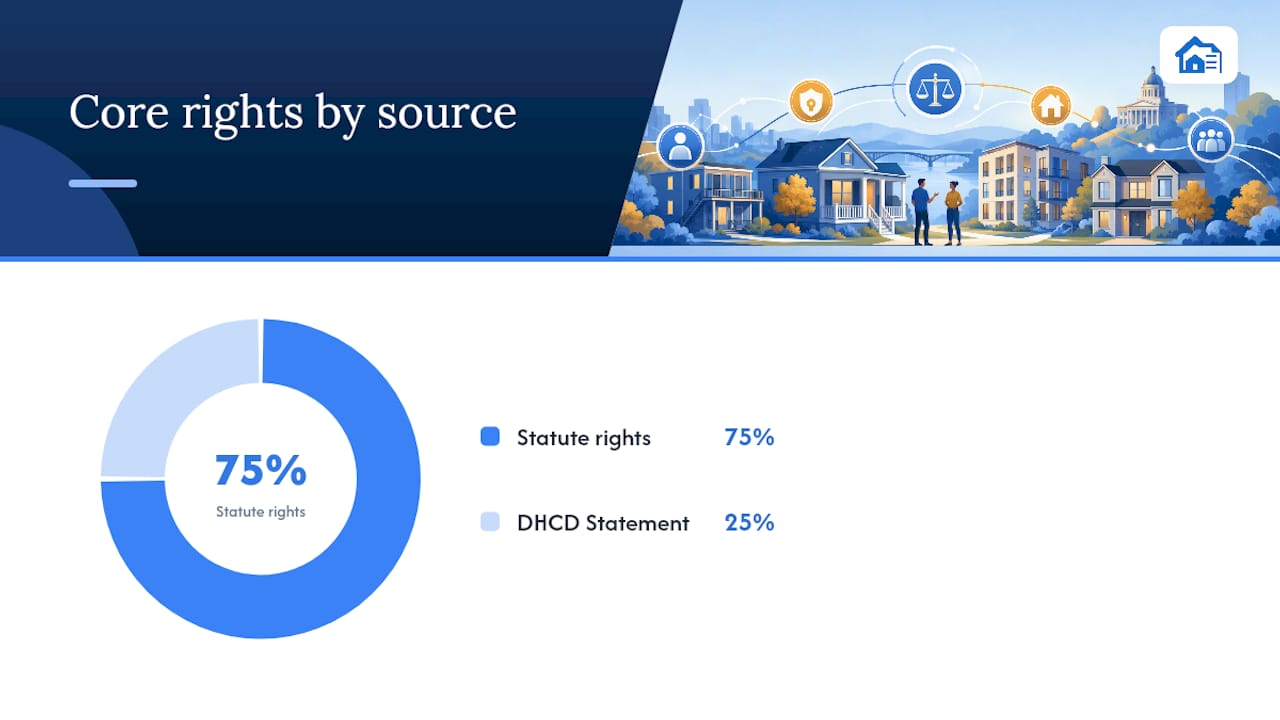
Under Virginia rental laws, tenants have the right to a written lease copy, a habitable unit, proper security deposit accounting, disclosure of the property owner’s identity, and protection from unlawful eviction. Those are the rights that come up in nearly every dispute.
Core tenant rights with statute references:
- Written lease copy (§55.1-1204): The landlord must provide a copy of the signed rental agreement within 10 business days of the effective date.
- Statement of Tenant Rights (DHCD, effective July 1, 2026): The landlord must provide the DHCD Statement of Tenant Rights and Responsibilities before or at lease signing; the tenant must sign an acknowledgment.
- Habitable unit (§55.1-1234): The landlord must maintain the premises in a fit and habitable condition, including working heat, plumbing, and structural safety.
- Security deposit accounting (§55.1-1226): The landlord must return the deposit (or provide an itemized written statement of deductions) within 45 days of lease termination.
- Owner/manager disclosure (§55.1-1217): The landlord must disclose the name and address of the property owner and any managing agent.
- Notice of sale or foreclosure (§55.1-1219): Tenants must receive advance written notice if the property is sold or enters foreclosure.
- Application fee cap (DHCD Statement, July 1, 2026): Nonrefundable application fees cannot exceed $50, excluding the actual cost of a third-party background or credit check.
- Late fee limits (§55.1-1204): Late fees are only enforceable if the lease permits them and must comply with statutory caps.
- Privacy and entry protections (§55.1-1229): Landlords must give advance notice before entering except in emergencies.
- Retaliation protection (§55.1-1247): A landlord cannot retaliate against a tenant for exercising a legal right (such as requesting repairs or contacting a housing authority).
Statistic callout: The DHCD Statement of Tenant Rights (July 1, 2026) sets the application fee cap at $50 (excluding third-party screening costs) — a specific, enforceable ceiling that applies statewide regardless of what the lease says.
Documenting repair and habitability issues:
Put every repair request in writing. Email or a written letter with delivery confirmation creates a timestamp that matters in court. Photograph the problem the same day you notice it, and keep a log with dates. If the issue involves mold or a pest infestation, note the specific location and take multiple photos from different angles. That contemporaneous record is what separates a winnable habitability claim from an unverifiable complaint.
Where to get legal help:
If your landlord does not act, Virginia Law Help provides free guidance and referrals. Virginia Legal Aid offers direct legal assistance for qualifying low-income tenants. The OAG Consumer Protection office provides general guidance but does not arbitrate individual disputes.
What landlords are required to do under Virginia law
Landlord responsibilities under the VRLTA are not optional and not negotiable by lease language. A lease clause that waives a tenant’s statutory right is void under §55.1-1204.
Core landlord obligations:
- Provide the written rental agreement (§55.1-1204): Offer a written lease before occupancy begins and deliver a signed copy within 10 business days of the effective date.
- Deliver the Statement of Tenant Rights (DHCD, July 1, 2026): Provide the current DHCD Statement of Tenant Rights and Responsibilities at or before lease signing and obtain a signed acknowledgment.
- Disclose owner identity and managing agent (§55.1-1217): Provide the name and address of the property owner and any agent authorized to manage the property.
- Maintain habitable conditions (§55.1-1234): Keep the unit in a fit and habitable condition throughout the tenancy, including structural, mechanical, and utility systems.
- Handle security deposits properly (§55.1-1226): Collect no more than the statutory maximum, hold deposits in a separate account, and return funds (or an itemized statement) within 45 days of lease termination.
- Maintain confidentiality of tenant records (§55.1-1246): Tenant personal information may not be disclosed except as permitted by statute.
- Provide notice before entry (§55.1-1229): Give advance notice before entering the unit except in genuine emergencies.
Pro Tip: Automate delivery of the Statement of Tenant Rights and the lease copy using a platform that generates a timestamped receipt. Failing to deliver these documents within the statutory window can trigger the VRLTA’s 12-month default lease rule, potentially binding you to terms and renewal conditions you did not intend. A signed, dated acknowledgment is your proof of compliance — and your first line of defense if a tenant later claims they never received required disclosures. Read more about the legal role of tenant acknowledgment signatures before your next lease signing.
Practical onboarding checklist for landlords:
- Provide the DHCD Statement of Tenant Rights before or at lease signing
- Collect the signed acknowledgment form and retain a copy
- Deliver the signed written lease within 10 business days
- Complete a move-in inspection with photos and have the tenant sign the inspection record
- Collect the security deposit and document receipt
- Set up a rent ledger from day one
Application fees, deposits, and security deposit rules in Virginia
Virginia law sets specific limits on what landlords can charge at the application and move-in stage. Knowing these caps protects tenants from overcharging and protects landlords from statutory violations that can complicate later proceedings.
Application fees and deposits:
- Nonrefundable application fee cap: Per the DHCD Statement of Tenant Rights (July 1, 2026), a landlord may charge a nonrefundable application fee of up to $50, not counting the actual cost of a third-party background or credit check passed through at cost.
- Refundable application deposit: A landlord may also collect a refundable application deposit. If the applicant is rejected or withdraws before occupancy, the deposit must be returned. If the applicant is accepted and takes occupancy, the deposit is typically applied to the first month’s rent or security deposit.
- Return of application deposit: If the landlord fails to rent the unit to the applicant, the refundable deposit must be returned promptly. The VRLTA (§55.1-1203) governs the specific mechanics.
Statistic callout: The $50 application fee cap (excluding third-party screening costs) is set by the DHCD Statement of Tenant Rights effective July 1, 2026. Any fee above that ceiling is a statutory violation regardless of what the lease or application form says.
Security deposit rules:
- The VRLTA limits the security deposit to a specified multiple of the monthly rent (§55.1-1226).
- The landlord must provide a written receipt for the deposit.
- The tenant has the right to be present at the move-out inspection. The landlord must notify the tenant of the inspection date and time.
- Within a specified number of days of lease termination, the landlord must either return the full deposit or provide an itemized written statement of deductions along with any remaining balance.
- Deductions are limited to unpaid rent, damages beyond normal wear and tear, and other charges permitted by the lease and statute.
Documentation tip: Create a written itemized receipt at move-in that lists the deposit amount, the date received, and the account where it is held. At move-out, photograph every room before and after cleaning, and compare against the move-in inspection record. Landlords who lack a contemporaneous move-in record typically lose deposit disputes on credibility alone. A move-in documentation workflow makes this process repeatable.
How rent, late fees, and rent increases work under Virginia law
Rent is due on the date specified in the lease. Virginia law does not set a universal grace period, so the lease terms control when rent is considered late and whether a late fee applies.
Late fees:
- Late fees are only enforceable if the lease explicitly permits them (§55.1-1204).
- The DHCD Statement of Tenant Rights (July 1, 2026) references a cap on late fees. Under the VRLTA, a late fee cannot exceed 10% of the monthly rent or 10% of the unpaid balance, whichever is less.
- A late fee cannot be charged until rent is past due by a statutory grace period.
If the tenant pays $1,200 and owes $300, the maximum late fee on the unpaid balance is $30.
Statistic callout: Under the VRLTA, late fees are capped at 10% of the monthly rent or 10% of the unpaid balance — whichever is less — and cannot be charged until rent is at least five days overdue.
Rent increases:
Virginia has no statewide rent control law. A landlord may increase rent at lease renewal or, for month-to-month tenancies, with proper written notice. For a month-to-month tenancy, the landlord must give at least 30 days’ written notice before the rent increase takes effect. The notice period for fixed-term leases is governed by the lease itself; typically, the landlord notifies the tenant before the renewal date.
Practical steps for both parties:
- Landlords: Use a rent ledger template to track every payment, including the date received, amount, and any balance. A complete ledger is your best evidence in a nonpayment dispute.
- Tenants: Keep every rent receipt and bank record. If you pay by check or electronic transfer, the transaction record itself serves as proof of payment.
- Both parties: When rent is disputed, communicate in writing. A text message or email with a date stamp is far more useful in court than a verbal conversation.
How to request repairs and handle habitability issues
Tenants have a statutory right to a fit and habitable unit under §55.1-1234 of the VRLTA. That right includes working heat, plumbing, structural safety, and freedom from conditions that materially affect health or safety. Visible mold that is caused by a landlord’s failure to maintain the property falls within that standard.
How tenants should request repairs:
- Submit every repair request in writing. Email is acceptable; a letter sent by certified mail with return receipt creates the strongest record.
- Describe the problem specifically: location, date first noticed, and any health or safety risk.
- Keep a copy of every request with the date sent.
- Follow up in writing if you do not receive a response within a reasonable time.
What landlords must do:
- Respond to repair requests within a reasonable time. For non-emergency repairs, the DHCD handbook references a general expectation that landlords act within 21 days of written notice, though the statute does not set a single universal deadline for every repair type.
- For emergency conditions (no heat in winter, sewage backup, structural hazard), the landlord must act promptly, typically within 24–72 hours.
- The landlord may request reasonable access to inspect and make repairs, with proper advance notice.
Pro Tip: Keep a repair request log with three columns: date sent, method of delivery, and landlord response. Attach photos to each entry. If the matter goes to court, a judge can see at a glance that you documented the problem, notified the landlord, and received no response. That log, combined with timestamped photos, is worth more than any verbal testimony. See the habitability notice legal requirements guide for a ready-made template.
Mold and health hazards:
Virginia Code §55.1-1234 addresses visible mold. If a landlord receives written notice of visible mold, they must respond within five days to either remediate the condition or provide a written plan for remediation. Tenants should photograph mold, note its location and approximate size, and deliver written notice by a method that creates a timestamp.

Remedies if repairs are not made:
If a landlord fails to make required repairs after proper written notice, tenants may have the right to terminate the lease, seek rent escrow, or pursue other remedies under §55.1-1234 and §55.1-1236. Virginia Law Help and Virginia Legal Aid can help tenants understand which remedy applies to their situation. The DPOR Fair Housing office handles discrimination-related habitability concerns.
When can a landlord enter your rental unit?
A landlord may enter a rental unit for maintenance, inspection, showing the unit to prospective tenants or buyers, or emergencies. Outside of genuine emergencies, the landlord must give advance notice.
Notice requirements under the VRLTA (§55.1-1229):
- For routine maintenance or inspections, the DHCD handbook references a 72-hour advance notice expectation as a general standard.
- For non-emergency repairs that the landlord has been asked to perform, entry is typically expected within 14 days of the tenant’s written repair request.
- In a genuine emergency (fire, flooding, gas leak), the landlord may enter without prior notice.
- Entry must occur at a reasonable time unless the tenant agrees otherwise.
Valid reasons for entry:
- Routine maintenance or inspection
- Making agreed-upon repairs
- Showing the unit to prospective tenants, buyers, or lenders
- Emergency situations affecting health or safety
- Court-ordered entry
What tenants should do if access is abused:
If a landlord enters repeatedly without notice or for reasons not permitted by the statute, document each incident with the date, time, and circumstances. Notify the landlord in writing that the entries violate §55.1-1229 and that you expect compliance. If the pattern continues, consult Virginia Law Help or a local legal aid office. The VRLTA provides remedies for abuse of access, including the right to terminate the lease in egregious cases.
How eviction works in Virginia: notices, filings, and common mistakes
Eviction in Virginia is a court process called an unlawful detainer action. A landlord cannot remove a tenant, change the locks, or shut off utilities to force a tenant out. Every eviction requires proper statutory notice followed by a court filing, and a landlord cannot file until all statutory prerequisites are satisfied.
Common notice types and timing:
- Pay or quit (nonpayment of rent): The landlord must serve a written notice giving the tenant at least five days to pay the overdue rent or vacate. Under current VRLTA provisions, the landlord must also provide the tenant with the DHCD Statement of Tenant Rights before filing an unlawful detainer action if it has not already been provided.
- Cure or quit (lease violation): For a curable lease violation, the landlord must give written notice specifying the violation and allowing the tenant at least 21 days to remedy it (§55.1-1248).
- Unconditional termination: For repeat violations or certain serious breaches, the landlord may serve a notice requiring the tenant to vacate without an opportunity to cure. The specific grounds and notice periods are set by §55.1-1247 and §55.1-1248.
- Month-to-month termination: Either party may terminate a month-to-month tenancy with at least 30 days’ written notice before the next rent due date.
Filing before statutory prerequisites are met can result in dismissal of the unlawful detainer action. Courts have dismissed cases where the landlord could not prove delivery of the Statement of Tenant Rights or failed to give the required notice period. Keep the signed acknowledgment form and a delivery record for every tenancy — those two documents are your proof that you met the statutory threshold before filing.
Warning for landlords:
Filing an unlawful detainer action before delivering required forms or before the notice period expires is one of the most common procedural mistakes in Virginia housing court. It does not just delay the case; it can give the tenant a defense that survives the merits. Review the DHCD handbook and the Code of Virginia Chapter 12 before serving any eviction notice.
Where to get help:
- Tenants facing eviction: Virginia Law Help and Virginia Legal Aid provide free guidance and representation for qualifying individuals.
- Landlords: The DHCD handbook includes sample termination notices. For contested cases, consult a licensed Virginia attorney.
Where to download official Virginia landlord-tenant forms
All essential official forms are available through the DHCD’s centralized landlord-tenant resources page. You do not need to search elsewhere for the authoritative versions.
Essential official downloads:
- Statement of Tenant Rights and Responsibilities (PDF): DHCD Statement (July 1, 2026) — the required disclosure document with the acknowledgment form.
- Sample termination notices: Available through the DHCD resources page and the DHCD handbook appendix.
- Manufactured home park forms: Separate forms for manufactured home lot tenancies are also available on the DHCD page.
- Spanish-language versions: DHCD provides Spanish translations of the Statement of Tenant Rights on the same resources page.
Completing the acknowledgment form:
The acknowledgment form is the page at the end of the Statement of Tenant Rights where the tenant signs to confirm receipt. Both parties should sign it. The landlord retains the original; the tenant keeps a copy. Signing does not mean the tenant agrees with every provision — it confirms receipt of the required disclosure. Courts treat a missing or unsigned acknowledgment as evidence that the required disclosure was not properly delivered.
Storing signed forms:
Scan every signed form immediately and store the digital copy in a folder labeled with the tenant’s name and lease start date. Keep the physical original in a separate file. Date-stamp your scans. If you ever need to prove delivery in court, a scanned copy with a file creation date is far more persuasive than a verbal claim that you “always” provide the form.
If you need help completing forms:
Virginia Law Help and Virginia Legal Aid offer free assistance for tenants who are unsure how to interpret or complete official forms.
How software tools help landlords meet VRLTA compliance requirements
For landlords managing multiple units, the biggest compliance risk is not ignorance of the law — it is missed deadlines and incomplete paper trails. Automation addresses both.
Core software features that reduce VRLTA legal risk:
- Timestamped delivery and signed acknowledgments: Electronic delivery of the Statement of Tenant Rights with a signed receipt creates a court-ready record of compliance. This directly addresses the most common procedural defense in unlawful detainer actions.
- Rent ledger templates: A complete, date-stamped payment history is the primary evidence in nonpayment disputes. A free rent ledger template gives landlords a ready-made format that holds up in court.
- Move-in/move-out photo inspection logs: Photo documentation tied to a specific date and unit is the strongest defense against deposit disputes. Landlords who document move-in condition with photos rarely lose on the “normal wear and tear” question.
- Tenant record portals: Centralizing lease copies, signed acknowledgments, deposit receipts, and maintenance requests in one place means you can produce any document on short notice.
- Dated receipts for deposits and fees: Generating a receipt at the moment of collection, with the amount and date, satisfies the VRLTA’s written receipt requirement and removes ambiguity.
Pro Tip: One practical example: if a landlord fails to deliver the written lease within 10 business days of the effective date, the VRLTA can impose a 12-month default lease term, potentially locking in renewal conditions the landlord did not intend. Automating lease delivery with a timestamped electronic portal eliminates that risk entirely. See how a property management workflow system can build this into your standard onboarding process.
Software organizes evidence and automates delivery, but it is not a substitute for legal advice in contested matters. When a dispute reaches Virginia housing court, consult a licensed Virginia attorney.
Step-by-step checklists for tenants and landlords after reading the handbook
Turn the handbook into tasks with deadlines. The checklists below cover the most time-sensitive obligations under the VRLTA.
Tenant checklist
- Download and save the handbook PDF from the DHCD resources page immediately after signing your lease.
- Request your signed acknowledgment copy from the landlord. You are entitled to a copy of the signed Statement of Tenant Rights acknowledgment.
- Confirm you received the written lease within 10 business days of the lease’s effective date (per the DHCD Statement of Tenant Rights, July 1, 2026).
- Document the unit’s condition at move-in. Photograph every room, note any pre-existing damage in writing, and deliver a copy to the landlord. Date-stamp everything.
- Set up a rent payment record. Keep every receipt, bank transfer confirmation, or money order stub in a dedicated folder.
- Submit all repair requests in writing. Email with a date stamp is the minimum; certified mail is stronger for serious issues.
- Contact legal aid if the landlord does not respond. Virginia Law Help and Virginia Legal Aid provide free guidance.
Landlord checklist
- Provide the DHCD Statement of Tenant Rights at or before lease signing. Use the current July 1, 2026 version from the DHCD resources page.
- Collect the signed acknowledgment form and retain the original. Scan and date-stamp a digital copy immediately.
- Deliver the signed written lease within 10 business days of the effective date (DHCD Statement, July 1, 2026).
- Complete a move-in inspection with photos before or on the day the tenant takes possession. Have the tenant sign the inspection record.
- Document the security deposit receipt in writing, including the amount, date, and account where it is held.
- Set up a rent ledger from day one. Track every payment with the date received and any balance. A rent ledger template makes this straightforward.
- Calendar the 45-day deposit return deadline from the expected lease end date. Missing this window is one of the most common and costly landlord errors in Virginia.
- Review the 72-hour entry notice rule before scheduling any routine inspections or maintenance visits.
What most landlords get wrong about VRLTA compliance
The compliance failures that actually cost landlords money in Virginia housing court are almost never about the big, obvious rules. Nobody forgets that eviction requires a court order. What trips landlords up is the paperwork timing.
The Statement of Tenant Rights is not a formality. It is a statutory prerequisite. A landlord who cannot produce a signed acknowledgment at the unlawful detainer hearing has handed the tenant a procedural defense before the merits are even argued. The same is true for the written lease delivery deadline. Ten business days sounds like plenty of time, and then a landlord gets busy, the tenant moves in on a Friday, and suddenly it is three weeks later with no signed copy in the file.
The fix is not complicated. Automate the delivery. Use a platform that generates a timestamped receipt the moment the tenant opens and signs the document. That single change eliminates the most common procedural vulnerability in Virginia eviction cases. Landlordforms is built specifically for this workflow — state-specific forms, electronic delivery with signed receipts, and a rent ledger that produces court-ready payment history without manual entry.
Landlordforms makes VRLTA compliance faster and less error-prone
Virginia landlords managing even a handful of units face a specific paperwork problem: the VRLTA requires precise delivery timing, signed acknowledgments, itemized deposit accounting, and a complete rent history — all of which need to be producible on short notice if a dispute reaches court.

Landlordforms gives you state-specific forms, automated delivery with timestamped receipts, and a free rent ledger template that tracks every payment in a format courts can read. The late fee calculator keeps your fee calculations within the VRLTA’s 10% cap, and the rent proration calculator handles partial-month move-ins cleanly. Move-in photo documentation is built into the inspection workflow, so your deposit defense is ready before the tenant even unpacks.
Landlordforms is not a law firm and does not provide legal advice. For contested matters, consult a licensed Virginia attorney. For everything else — the forms, the ledgers, the delivery receipts, the inspection logs — Landlordforms and get your compliance workflow running before your next lease signing.
Sources
The following official sources contain the authoritative text and forms for Virginia landlord-tenant law. Bookmark them and check for updates at the start of each new lease year.
- Virginia Statement of Tenant Rights and Responsibilities under the Virginia Residential Landlord and Tenant Act as of July 1, 2026
- Code of Virginia Code - Chapter 12. Virginia Residential Landlord and Tenant Act
- Landlord/Tenant — Office of the Attorney General of Virginia, Consumer Protection
- Housing | Virginia Law Help
FAQ
What can landlords not do in Virginia?
Under the VRLTA, landlords cannot include lease provisions that waive a tenant’s statutory rights, charge application fees above $50 (excluding third-party screening costs), enter a unit without proper advance notice except in emergencies, withhold a security deposit without an itemized written statement, or retaliate against a tenant for exercising a legal right such as requesting repairs.
How much notice does a landlord have to give a tenant to move out in Virginia?
For a month-to-month tenancy, the landlord must give at least 30 days’ written notice before the next rent due date. For nonpayment of rent, the landlord must first serve a written five-day pay-or-quit notice before filing an unlawful detainer action in Virginia housing court.
What is the current rent law in Virginia?
Virginia has no statewide rent control law. Landlords may increase rent at renewal or, for month-to-month tenancies, with at least 30 days’ written notice.
Where can I download the official Virginia landlord-tenant handbook?
The official handbook is a free PDF published by the Virginia Department of Housing and Community Development (DHCD). Download it directly from the DHCD landlord-tenant resources page or from the direct handbook PDF link.
What happens if a landlord does not return a security deposit in Virginia?
If a landlord fails to return the security deposit or provide an itemized written statement of deductions within 45 days of lease termination, the tenant may be entitled to recover the full deposit plus damages under §55.1-1226 of the VRLTA. Tenants in this situation should contact Virginia Legal Aid or Virginia Law Help for guidance on filing a claim.