5 Phase Lease Compliance Checklist to Keep U.S. Landlords Court Ready

Confirm five things today: lead disclosures are signed and filed, your screening policy is written down, records go back at least three years, smoke and CO detectors have logged inspection dates, and you have an audit scheduled. If any bucket is empty, stop and fill it before signing a new lease. Run a 10-minute file pull right now for your newest tenant’s lead pamphlet and last inspection photos. That single check tells you more about your exposure than anything else on this list.
TL;DR:
- Landlords must retain lead disclosure records for at least three years, with some states requiring longer retention depending on local regulations.
- Conducting an operational compliance audit monthly and a full legal review annually helps prevent disputes related to expenses, notices, and documentation gaps.
- Proper proof of notice delivery, including dates and methods, outweighs the mere existence of signed documents in legal disputes.
- State-specific lease addenda are crucial, as most templates require local disclosures such as mold, bedbugs, or flood zone notices, and should be updated regularly.
- LandlordForms streamlines compliance by providing automated document generation, automatic deadline calculations, and organized record-keeping tailored to local regulations.
Table of Contents
- A Phase-by-Phase Lease Compliance Checklist
- What to Keep, How Long, and How to Prove Delivery
- Safety Disclosures and Inspection Records That Protect You
- Fair Housing Rules and Screening You Can Defend
- How to Run a Lease Compliance Audit
- State Addenda: Where Your Lease Needs More Than the Federal Minimum
- Lead Hazard Disclosures Beyond the Federal Minimum
- Serving Late Rent and Violation Notices the Right Way
- Rent Control and Rent Increase Notice Rules
- The Compliance Gap Most Landlords Don’t See Coming
- How LandlordForms Keeps Every Checklist Item on Track
- Sources
- FAQ
A Phase-by-Phase Lease Compliance Checklist
Compliance isn’t a one-time form you file and forget. It moves through four phases of a tenancy, plus an ongoing review layer that catches what the first four miss. Here’s the order that actually works, based on how leases progress in practice.
1. Pre-lease. Disclose known lead-based paint hazards if the unit was built before the late 1970s, and hand over the EPA pamphlet before the lease is signed. Publish a written screening policy so applicants know exactly what criteria you use and why. If you plan to send notices electronically, get signed e-consent up front, not after a dispute starts.
2. Move-in. Have the tenant sign the lease and every required addendum, including the Lead Warning Statement where applicable. Walk the unit with a move-in inspection checklist and photograph every room, not just problem areas. Issue a signed receipt for the security deposit, stating the amount and where it’s held.
3. During tenancy. Log every maintenance request with a date and resolution note, not just a mental tally. If a tenant requests a reasonable accommodation, document the request, your response, and the timeline in writing. Keep rent ledger entries current, and file every notice you serve with proof of delivery attached.
4. Move-out. Conduct a final inspection using the same checklist format as move-in so you can compare condition side by side. Provide an itemized deposit statement within your state’s required window. Hold onto the signed lease, all notices, and inspection photos even after the tenant leaves.
5. Ongoing. Set calendar reminders for lease renewals, inspection cycles, and disclosure deadlines so nothing depends on memory. Run a monthly operational check on open maintenance items and rent status. Schedule an annual legal review of your lease templates and addenda, since state rules shift more often than most landlords expect.
Each phase feeds the next. A sloppy move-in inspection makes move-out disputes nearly impossible to win, and a missing e-consent record can undercut a notice you served months later.
What to Keep, How Long, and How to Prove Delivery
The federal floor for lead disclosure records is three years: signed acknowledgments of the Lead Warning Statement need to survive that long at minimum. Security deposit records, maintenance logs, and screening decisions often carry longer retention expectations depending on your state, so treat three years as a baseline, not a ceiling.
Where you store records matters as much as how long you keep them. A binder in a filing cabinet doesn’t hold up when a dispute lands in small claims court six months after a tenant moves out.
- Keep every document tied to a specific unit and tenant, not scattered across email threads and paper files.
- Use one searchable system so a signed lease, a notice, and an inspection photo can be pulled together in minutes.
- If you deliver notices electronically, follow E-SIGN consent rules: get affirmative consent, offer a paper option, and store the electronic version in a format the tenant could actually access later.
- Attach a delivery method and date to every notice, whether it’s certified mail, a signed acknowledgment, or an e-sign log.
Pro Tip: Courts care less about whether a document exists and more about whether you can prove when and how it reached the tenant. A dated delivery log beats a stack of unsigned copies every time.
Safety Disclosures and Inspection Records That Protect You
Federal law sets a clear floor here, and most landlords hit it on paper but fall short on documentation. For housing built before 1978, disclosure of known lead hazards, delivery of the EPA pamphlet, and a 10-day inspection opportunity are all required before the lease is signed, with signed acknowledgments kept for at least three years.
Smoke and carbon monoxide detectors get less federal attention but cause just as many disputes. Document every check and battery or unit replacement with a date, not a vague “checked recently” note in your head.
- Log detector test dates at move-in and at each inspection cycle.
- Photograph detector placement and function during routine and move-out inspections.
- Note the difference between disclosure (telling the tenant what you know) and abatement (fixing a hazard), since the second often requires a certified contractor.
The three-year retention window for signed lead disclosures isn’t a suggestion. It’s the number the EPA’s own disclosure rule sets, and it’s the first thing an inspector or attorney will ask about if a dispute goes anywhere near a hazard claim. Pair that record with inspection photo logs so detector maintenance and lead disclosure sit in the same defensible file.
Fair Housing Rules and Screening You Can Defend
Reasonable accommodation and reasonable modification are not the same request, and mixing them up is a common compliance failure. An accommodation changes a policy or practice, like allowing a service animal despite a no-pets rule. A modification changes the physical space, like adding a grab bar. Both require you to engage in what HUD and DOJ guidance calls the interactive process: respond promptly, ask clarifying questions if needed, and document the exchange.
Screening carries its own exposure if you’re not consistent. HUD’s screening guidance points to a few habits that separate defensible landlords from vulnerable ones:
- Use criteria that are actually relevant to tenancy, like income and rental history, not proxies that disproportionately screen out protected classes.
- Verify report accuracy before acting on it, and give applicants a path to correct errors under FCRA.
- Publish your screening policy so every applicant is measured against the same written standard.
- Provide a specific, documented reason for any denial rather than a vague rejection.
Every accommodation request and screening decision should get a timestamp and a written outcome. If a discrimination claim ever surfaces, that timeline is your best evidence that you acted consistently and in good faith.
How to Run a Lease Compliance Audit
An audit doesn’t need to be a quarterly production. It needs to be consistent, and it needs to compare what you’re actually doing against what your lease says you’re doing.
- Pull together the signed lease, every notice served, the full rent ledger, inspection logs, and vendor invoices for the unit.
- Compare billed expenses, like utility pass-throughs or maintenance charges, against what the lease actually authorizes.
- Check every notice for a delivery date and proof of receipt, not just a copy of the notice itself.
- Flag vague clauses, especially maintenance responsibility language, since audit reviews consistently find this is where disputes start.
- Note any expense allocation that doesn’t match the lease’s stated formula, a common and costly audit finding.
Run this operational check monthly, a full legal review of your lease templates annually, and an extra audit any time a property changes ownership or management. Misapplied expenses and undocumented notices are the two findings that show up most often, and both are cheap to fix before a tenant’s attorney finds them first.
State Addenda: Where Your Lease Needs More Than the Federal Minimum
Federal rules set the floor, but your state sets most of the actual requirements you’ll be judged on. A lease that only covers EPA and HUD basics is missing the layer that varies most from state to state: local addenda.
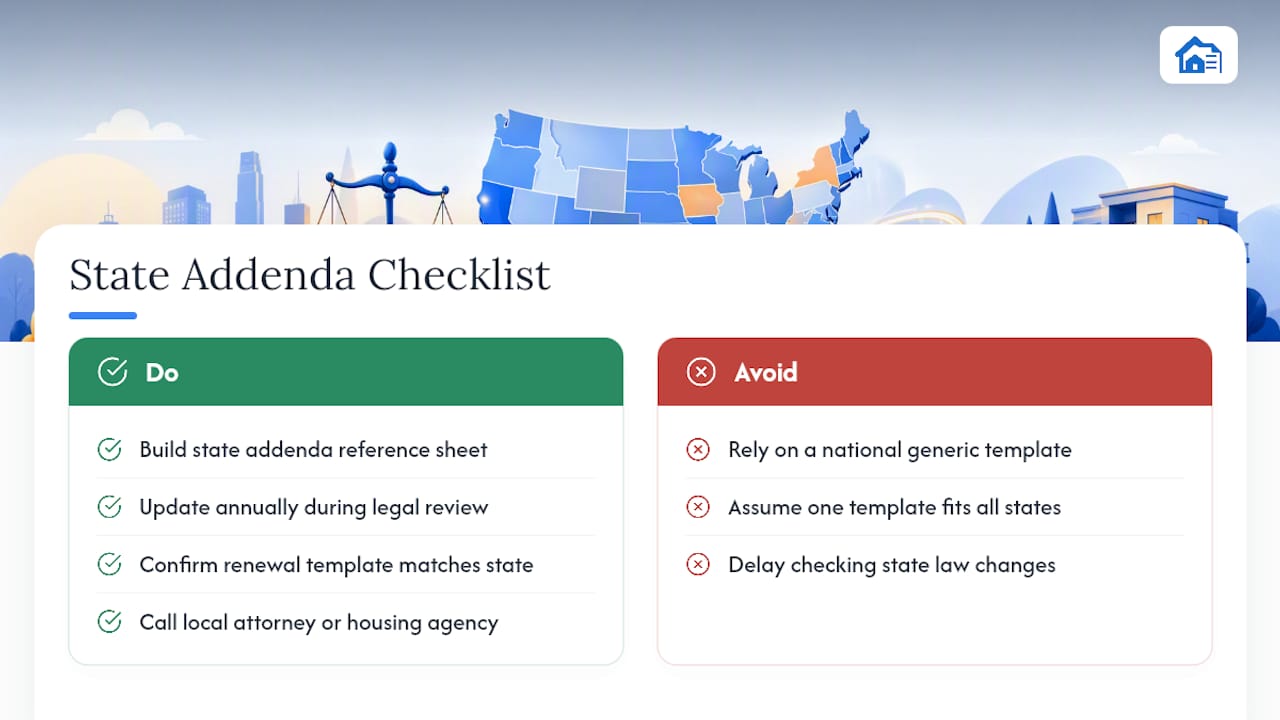
Some states require a specific mold disclosure addendum. Others mandate bedbug disclosure, flood zone notices, or a separate rider explaining tenant rights during foreclosure. A handful require lease language spelling out utility responsibility down to the meter, especially in units with shared systems. None of these show up in a generic template pulled from a national forms site.
The practical problem is that a lease drafted for one state rarely survives a move to another without revision. Landlords who manage properties across state lines often assume a single template will work everywhere, then discover during a dispute that a required addendum was missing the whole time.
Build a short reference sheet for each state where you own property, listing the addenda required beyond the federal baseline. Update it during your annual legal review, since state legislatures adjust these requirements more often than landlords expect. If you’re using lease renewal templates, confirm the version matches your state’s current addenda list before you send it, not after.
When in doubt, a quick call to a local landlord-tenant attorney or your state’s housing agency website settles the question faster than guessing based on what worked in a different state last year.
Lead Hazard Disclosures Beyond the Federal Minimum
The federal rule is a floor, not a ceiling, and a growing number of states and cities have built taller requirements on top of it. Some jurisdictions require lead hazard disclosure for housing built after 1978 if the property has a documented hazard history. Others mandate a certified lead risk assessment before a certificate of occupancy is issued for a rental, regardless of when the building was constructed.
A few cities require landlords to register lead-safe certification with a local housing department, separate from anything the EPA requires. Miss that local filing, and you can be in full compliance with federal law while still facing a municipal citation.
The safest approach is treating the federal disclosure rule as the minimum floor for every applicable unit, then checking your state housing agency and local health department for anything layered on top. This is especially important in older housing stock cities, where lead poisoning prevention programs often carry their own disclosure and inspection mandates.
Document which version of the disclosure form you used for each property and when, since a form that satisfies federal requirements but skips a local addendum won’t protect you if a city inspector shows up. Pair every lead disclosure with the right landlord disclosure paperwork for your specific jurisdiction rather than relying on a single national template.
Serving Late Rent and Violation Notices the Right Way
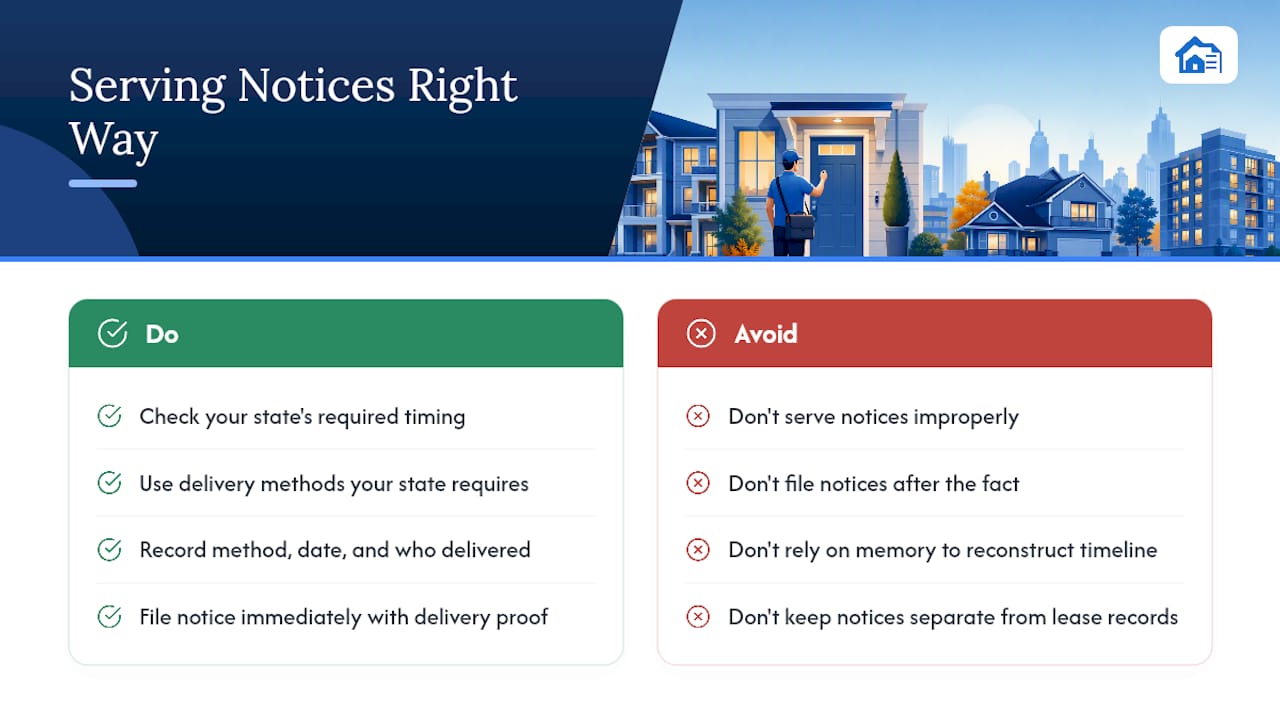
Timing and delivery method are where most notice-related disputes actually get decided, not the wording of the notice itself. A perfectly worded late rent notice served the wrong way can still fail to hold up.
Most states require a specific number of days between a late rent notice and the point where you can file for eviction, and that window varies widely by jurisdiction. Lease violation notices for issues like unauthorized occupants or property damage typically require a separate cure period before you can escalate, and some states require a different notice period depending on whether the violation is curable.
Delivery method matters just as much as timing. Personal delivery, certified mail, and posting on the door are treated differently depending on your state, and some jurisdictions require more than one method for a notice to be considered properly served. Document exactly which method you used, the date, and who delivered it.
Once a notice goes out, file it immediately with a delivery record attached, not after the fact when you’re trying to reconstruct a timeline from memory. A notice without proof of delivery is close to worthless if a tenant later claims they never received it.
Keep every late rent and violation notice in the same file as the lease and rent ledger for that unit. When timelines get contested, a single connected record beats a folder full of unrelated documents.
Rent Control and Rent Increase Notice Rules
Rent control doesn’t apply everywhere, but where it does, the notice requirements are stricter and less forgiving than a standard lease renewal. Some jurisdictions cap annual rent increases at a fixed percentage or tie them to a local cost-of-living index. Others simply extend the notice period required before any increase takes effect, sometimes to 60 or 90 days for longer-term tenants.
The mistake that trips up landlords moving between markets is assuming rent increase rules are the same everywhere. A 30-day notice that satisfies one state’s standard lease terms can fall well short of what a rent-controlled jurisdiction requires, and serving a noncompliant increase notice can delay or invalidate the increase entirely.
Check your local rent control ordinance, if one exists, before calculating any increase, and confirm the required notice period matches your tenant’s length of tenancy, since some rent control rules scale the notice period up the longer someone has lived in the unit. Keep a copy of the increase notice, the calculation method used, and proof of delivery in the same file as the lease.
If you operate in a market without rent control, standard lease terms govern notice periods, but it’s still worth confirming your state’s general rent increase notice requirement, since even non-controlled markets often mandate 30 to 60 days depending on lease length.
The Compliance Gap Most Landlords Don’t See Coming
The conventional advice on lease compliance treats it like a paperwork problem: get the right forms, get them signed, file them away. That’s necessary, but it’s not sufficient. The bigger gap is operational. Landlords lose disputes not because they lacked a document, but because they couldn’t prove when and how it reached the tenant.
Federal frameworks from the EPA, HUD, and DOJ set the floor: disclose known lead hazards, run fair screening, engage honestly with accommodation requests. Most landlords clear that floor. What separates the ones who win disputes from the ones who don’t is whether every document ties back to a dated, provable chain of custody for that specific unit and tenant.
Start by fixing the weakest link first, whether that’s proof of delivery, screening documentation, or inspection photos. Don’t try to overhaul everything at once. A small portfolio with one clean, connected system will outperform a large one with scattered records every time a dispute actually lands in front of a judge.
— Igor
How LandlordForms Keeps Every Checklist Item on Track
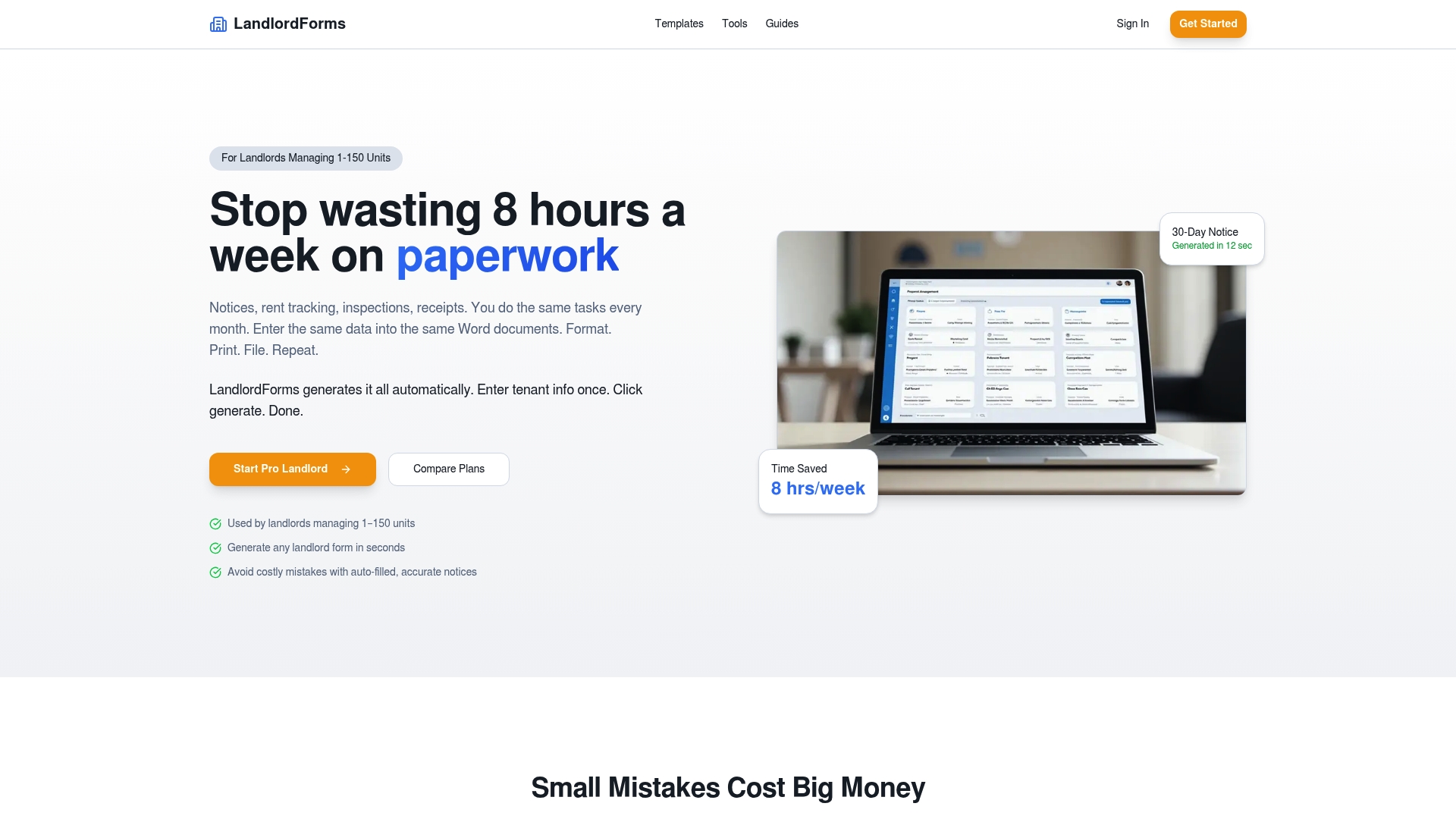
LandlordForms exists for the exact gap most landlords hit: knowing what compliance requires but running out of hours to document it consistently. Instead of drafting notices from scratch or tracking deadlines in a notebook, you generate state-specific lease forms, 30-, 60-, and 3-day notices, and rent ledger entries in a few clicks, with date calculations handled automatically so a notice period never runs short by accident.
Inspection photo logs attach directly to the tenant and unit record, which solves the proof-of-delivery and chain-of-custody problem this checklist keeps circling back to. Every plan, from Starter Landlord to Small PM Suite, is built around the same idea: fewer manual steps, fewer missed deadlines, and one searchable file per tenancy instead of folders scattered across email and paper.
Grab the free rent ledger template to start organizing payment records today, or check the Starter Landlord and Pro Landlord plans to see which tier fits a 1 to 150 unit portfolio. None of this replaces a conversation with a landlord-tenant attorney for jurisdiction-specific questions, but it does mean the paperwork side of compliance stops depending on memory.
This article is general information, not a substitute for advice from a qualified lawyer. Consult a qualified legal professional about your own circumstances before acting on anything here.
Sources
- EPA — Lead-based paint disclosure rule (Section 1018, Title X)
- HUD — Guidance on screening of applicants for rental housing
- Baker Tilly — Lease audit FAQ
FAQ
What Belongs on a Basic Lease Compliance Checklist?
At minimum, confirm lead disclosure for pre-1978 housing, a written screening policy, signed lease and addenda, inspection photos at move-in and move-out, and a document retention system going back at least three years for lead records. Add a recurring audit cadence so gaps get caught before they become disputes.
How Long Must Landlords Keep Lead Disclosure Records?
Federal rules require landlords to retain signed Lead Warning Statements for three years after signing. Some states extend retention expectations for other lease-related records, so check your state’s rules for anything beyond lead disclosures.
How Often Should I Audit My Leases for Compliance?
Run an operational check monthly for active issues like open maintenance requests and rent status, and a full legal review annually to catch state and local rule changes. Add an extra audit whenever a property changes ownership or management, since lease audits most often catch misapplied expenses and undocumented notices during transitions.
What’s the Difference Between a Reasonable Accommodation and a Modification?
An accommodation changes a policy, like waiving a no-pets rule for a service animal. A modification changes the physical unit, like installing grab bars. Both require engaging in the interactive process outlined in HUD and DOJ fair housing guidance and documenting the request and response.
Does LandlordForms Help With Lease Compliance Tasks?
Yes. LandlordForms generates state-specific notices and lease documents, calculates notice deadlines automatically, and logs inspection photos against each tenant record, covering several of the checklist tasks landlords otherwise track manually. Pricing starts with the Starter Landlord plan at $9 per month, with Pro Landlord and Small PM Suite tiers available on the LandlordForms site for larger portfolios.