How to Standardize Your Rental Agreement Process

The fastest way to standardize your rental agreement process is this: adopt one attorney-reviewed base lease, attach short modular addenda for each jurisdiction’s local requirements, and lock in a documented approval and version-control workflow. That three-part structure keeps your core legal language consistent across every unit while letting you swap in city-specific rent-control disclosures or lead-paint notices without rebuilding a full lease from scratch.
Here is where to start today:
- Pick your base lease. Choose or commission one attorney-reviewed template that covers your state’s core obligations. Name one person as the owner responsible for all future updates.
- Build your addenda categories. List every local rule that varies by city or county across your portfolio (rent control, local disclosures, utility billing ordinances) and create a short, single-topic addendum for each.
- Set the approval owner and storage location. Decide who signs off on legal changes and where the current version lives. One shared folder or document vault, one source of truth.
That is the whole model. The sections below show you how to execute each step, what clauses belong where, how to make e-signed leases defensible in court, and how to run a low-risk pilot before rolling out to your full portfolio.
Table of Contents
- How do you build a standardized lease workflow from scratch?
- What clauses belong in your base lease vs. addenda?
- How do jurisdictional addenda keep your portfolio legally compliant?
- What makes an e-signed lease legally enforceable?
- How do you pilot and measure a lease standardization rollout?
- What does standardization actually cost and how long does it take?
- Key Takeaways
- Why standardization is about more than saving time
- Landlordforms puts this process within reach for small landlords
- Useful sources
- FAQ
How do you build a standardized lease workflow from scratch?
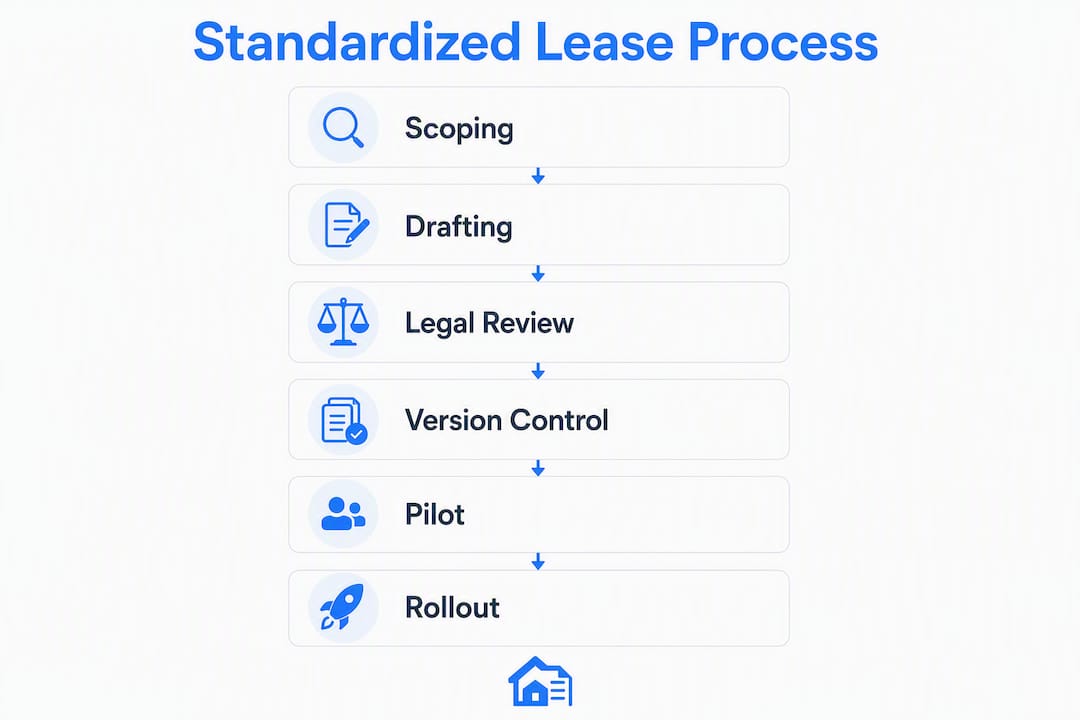
A repeatable lease process has six stages. Each one has a clear owner and a defined output. Skip one and you will be back to ad-hoc decisions inside six months.
Stage 1: Scoping
Before you draft anything, inventory what you already have. Pull every lease version currently in use across your portfolio and note where they differ. Flag the clauses that vary by location (deposit limits, notice periods, rent-control language) versus the ones that should be identical everywhere (default remedies, entry rights, subletting rules). This audit tells you exactly how many addenda you need and which local ordinances are already creating compliance gaps.

At the same time, define your non-negotiables: minimum credit score for screening, maximum deposit amount by state, and the exact late-fee policy you want enforced everywhere. Standardizing applicant verification at this stage prevents policy drift later, because it forces you to write down what “approved” actually means before a site manager decides it on their own.
Stage 2: Drafting
Build the base lease first. It should cover every obligation that applies statewide regardless of city. Then identify discrete addenda topics and draft each one as a standalone, single-topic document. Rent control goes in one addendum. Bed-bug disclosure goes in another. Keep them short.
Stage 3: Legal review
Every template, base lease and addendum alike, needs attorney signoff before it touches a tenant. Document the review date, the attorney’s name, and the version number. This record becomes your compliance evidence if a clause is ever challenged.
Stage 4: Version control and storage
Store all current templates in one location, whether a shared drive or a dedicated document management platform. Each file needs a change log with four fields: version number, author, date, and reason for the change. Centralizing templates and enforcing use of approved forms is what separates a real system from a folder full of old Word docs.
Stage 5: Pilot
Run a 4–6 week pilot on a small sample of properties before full rollout. Ten to twenty units across one to three buildings is enough to surface real problems. Track two numbers: lease error rate (clauses missing or wrong) and time from offer to fully executed lease. If systemic errors appear, stop and fix the template before expanding.
Stage 6: Rollout and change control
| Stage | Owner | Output | Timing |
|---|---|---|---|
| Scoping | Property manager / regional lead | Lease audit + local ordinance map | Week 1–2 |
| Drafting | Operations lead + counsel | Base lease draft + addenda drafts | Week 2–4 |
| Legal review | Outside counsel | Signed-off templates with review date | Week 4–5 |
| Version control setup | Operations lead | Document vault + change log template | Week 5 |
| Pilot | Site teams | KPI data: error rate, time-to-sign | Week 6–10 |
| Rollout | All site teams | Policy handbook + trained staff | Week 11+ |

Once the pilot passes, publish a policy handbook that names who approves exceptions, how exceptions get documented, and when the next scheduled legal review occurs. If a policy lives only in a handbook and not in the daily workflow, teams will invent shortcuts. Build the approval step into whatever property management system your staff uses every day.
What clauses belong in your base lease vs. addenda?
Getting this split right saves you from the two most common mistakes: a base lease so long it becomes unmanageable, and addenda so broad they recreate the problem you were trying to solve.
Core clauses for every base lease
Every lease in your portfolio, regardless of state or city, should contain these provisions:
- Late fees: — Dollar amount or percentage, grace period, and how fees are applied
- Security deposit: — Amount, holding account requirements, and return timeline per state law
Consistent, accurate lease documents reduce tenant disputes because every party is reading the same language. Ambiguity in a base clause is the single most common source of security-deposit fights.
What goes in addenda
Keep addenda short, single-topic, and jurisdiction-specific. One addendum per local requirement, not one addendum per city. Examples:
- Rent-control registration and disclosure (city-specific)
- Lead-based paint disclosure (federal, required for pre-1978 units)
- Bed-bug or window-guard notice (required in some cities)
- Local smoke and carbon-monoxide alarm rules
- Utility billing ordinances (sub-metering or RUBS rules)
- Short-term rental restrictions
- Local occupancy limit disclosures
Pro Tip: Keep each addendum to one page when possible. Reference every attached addendum by its exact name and version number in the base lease signature block. That single line of text is what ties the documents together as one executed agreement.
How do jurisdictional addenda keep your portfolio legally compliant?
Using a modular lease — a statewide base lease plus jurisdictional addenda — is the practical answer for portfolios that span multiple cities or counties. It avoids the trap of maintaining dozens of full master templates, each one drifting slightly from the others every time a local law changes.
The legal rationale is straightforward. Core obligations (quiet enjoyment, security deposit handling, default procedures) are governed by state law and belong in the base lease. Local rules (rent-control registration, municipal disclosures, specific notice language) are isolated to short addenda. When a city ordinance changes, you update one addendum, get counsel to sign off, and increment the version number. The base lease stays untouched.
To identify which addenda you need, maintain a jurisdictional checklist that maps each property to its required local disclosures. Update it whenever you acquire a new property or when a local law changes. Require counsel signoff before any new addendum goes live.
Pro Tip: Name addenda files using a consistent convention: jurisdiction_topic_version_date (for example, Chicago_RentControl_v2_2025-09). The file name alone tells you where it applies, what it covers, and whether it is current.
Cross-reference every addendum in the base lease and record the exact addendum version on every executed lease. During an acquisition or audit, that version record is what lets a reviewer confirm which rules applied to a given tenancy without hunting through email threads.
Beyond state law, watch for city and county ordinances that go further than state minimums. Some cities require specific notice language that differs from the state standard. Others impose registration requirements or occupancy-limit disclosures the state does not. A jurisdictional checklist that goes down to the municipal level catches these before they become compliance gaps.
What makes an e-signed lease legally enforceable?
Electronic signatures are enforceable under the federal E-SIGN Act and most state equivalents, but enforceability depends on what you capture alongside the signature. A signature alone is not enough.
To make electronic leases defensible, capture all of the following:
- Explicit consent to electronic delivery: The tenant must affirmatively agree to receive and sign documents electronically before the process begins.
- Identity verification: At minimum, email confirmation. Stronger options include SMS verification or knowledge-based authentication.
- Defined signing order: When a guarantor or co-signer is required, set the signing sequence in the platform so the record shows who signed when.
- Immutable audit trail: Timestamps in ISO format, IP address or device identifier, signing method, and a hash or checksum for the final PDF.
Store the following fields with every executed lease in your document vault:
| Field | What to capture |
|---|---|
| Document version ID | Version number of the base lease and each addendum |
| Signer name and email | As entered at signing |
| Signature timestamp | ISO format (YYYY-MM-DDTHH:MM:SSZ) |
| IP address / device ID | Where available |
| Signing method | Click-to-sign, drawn, or typed |
| File hash / checksum | For the final executed PDF |
Index every executed lease by canonical field names: lease_id, unit_id, tenant_id, lease_start, lease_end, and base_rent. Normalizing these fields prevents hidden concessions and makes rent-roll reconciliation straightforward during acquisitions or audits. Inconsistent rent-roll formats are one of the most common causes of valuation problems when a portfolio changes hands.
For tenant acknowledgment signatures on addenda, the same audit-trail standards apply. Do not treat addenda as informal attachments.
Pro Tip: Require tenants to initial each modular addendum within the same e-sign packet as the base lease. That produces one executed file showing the base lease and all addenda together, with a single audit trail. Separate files for separate documents create gaps a tenant’s attorney can exploit.
A written lease with proper signatures is your primary legal protection. The audit trail is what makes that protection hold up when it is tested.
How do you pilot and measure a lease standardization rollout?
A pilot is not optional. It is the step that tells you whether your templates work in the real world before you commit your entire portfolio to them.
Pilot design
Scope the pilot to 10–20 units across one to three buildings. Run it for 4–6 weeks. Before you start, set acceptance criteria: what error rate is acceptable, what time-to-sign target are you aiming for, and how many audit exceptions will trigger a template revision? Write those numbers down before the pilot begins, not after.
KPIs to track
| KPI | What it measures | Target |
|---|---|---|
| Lease error rate | Clauses missing, wrong, or inconsistent | Below 5% of executed leases |
| Time from offer to executed lease | Process speed | Defined by your current baseline |
| Exceptions and escalations | Deviations from standard templates | Track count and reason |
| Audit findings | Compliance gaps found in review | Zero critical findings |
Training and change management
Site teams need more than a new template folder. Give them a one-page quick-reference card that shows which addenda apply to which properties, who to contact for exceptions, and where the current templates live. Run a short training session before the pilot starts and a follow-up Q&A after the first two weeks. Reducing human error in notices and documents depends as much on training as on template design.
Rollout checklist
- Finalize base lease and all addenda with counsel signoff
- Set version control rules and name the document vault owner
- Train all site staff and publish the policy handbook
- Schedule the first periodic legal review (annually at minimum)
- Define the exception-approval process and document it in the handbook
Operational checklists for multi-unit landlords help keep rollout steps from falling through the cracks when you are managing multiple properties simultaneously.
What does standardization actually cost and how long does it take?
Most small landlords underestimate the time investment and overestimate the cost. Here is a realistic breakdown for a portfolio of 1–50 units.
Timeline: 8–12 weeks from scoping to full rollout
- Weeks 1–2: Lease audit and jurisdictional mapping
- Weeks 2–4: Base lease and addenda drafting
- Weeks 4–5: Attorney review and signoff
- Week 5: Document vault setup and version control configuration
- Weeks 6–10: Pilot (10–20 units)
- Weeks 11–12: Staff training and full rollout
Cost ranges (small portfolio, 1–50 units)
Attorney review of a base lease and a small addenda library typically runs $500–$2,000 depending on complexity and your market. If you are starting from an existing state-approved model lease (the National Apartment Association’s Click & Lease program is one widely used option, reviewed annually by attorneys), attorney time drops significantly because counsel is vetting additions and local modifications rather than drafting from scratch. Software or document management subscriptions for this portfolio size are generally modest. Internal staff time for drafting, training, and pilot management is the largest real cost, typically 20–40 hours spread across the project.
The return shows up quickly. Automating routine property management workflows and eliminating manual document creation recovers hours every week. A paperwork system that removes manual entry also removes the category of errors that generate the most expensive disputes.
Key Takeaways
A standardized rental agreement process built on a single attorney-reviewed base lease, modular jurisdictional addenda, and a documented version-control workflow is the most reliable way to keep a growing portfolio legally consistent and operationally efficient.
| Point | Details |
|---|---|
| Base lease first | One attorney-reviewed template covers statewide obligations; local rules go in short addenda. |
| Modular addenda by jurisdiction | One addendum per local requirement, named with a consistent convention, vetted by counsel before use. |
| E-sign requires more than a signature | Capture explicit consent, signing order, timestamps, and a file hash to make electronic leases defensible. |
| Pilot before full rollout | Run 10–20 units for 4–6 weeks; track lease error rate and time-to-sign before expanding. |
| Landlordforms for implementation | Landlordforms provides attorney-reviewed templates, state-specific addenda, and document automation for landlords managing 1–150 units. |
Why standardization is about more than saving time
The conventional framing for lease standardization is efficiency: fewer errors, faster signing, less paperwork. That is true, but it misses the more important reason to do it.
Institutional discipline is what actually scales a portfolio. When every lease follows the same structure, every rent roll uses the same field names, and every policy deviation requires documented approval, you stop managing by memory and start managing by system. The difference becomes obvious the moment you hire a second property manager, acquire a new building, or try to refinance. Lenders and buyers want clean, consistent data. A portfolio where lease abstracts use different field names, deposit amounts are tracked in three different spreadsheets, and addenda versions are unknown is a portfolio that takes longer to value and longer to close.
Standardization also prevents what I think of as policy drift: the slow accumulation of small, undocumented exceptions that each seem reasonable in the moment but collectively create a portfolio where no two leases are quite the same. One manager waives the late fee for a good tenant. Another allows a pet not covered in the lease. A third uses an old addendum version because the new one was never sent to them. None of these feel like big deals. Over two years and fifty units, they become a compliance audit’s worth of problems.
The landlords who build institutional discipline early, before they feel like they need it, are the ones who can actually sell, refinance, or hand off management without a six-month cleanup project first.
Landlordforms puts this process within reach for small landlords
Eight hours a week is what manual paperwork costs the average landlord managing a small portfolio. Landlordforms was built specifically to recover that time, not by adding complexity, but by replacing manual document creation with a system that generates accurate forms in a few clicks.
For landlords managing 1–150 units, Landlordforms provides attorney-reviewed lease templates, state-specific addenda, and automated form generation for the full document stack: 30-day and 60-day notices, rent receipts, move-in and move-out checklists, violation notices, and lease agreements. Every document populates from your tenant and property data, which means no re-entering the same address and rent amount across five different forms. The rent ledger template gives you a free starting point for standardizing rent tracking across your portfolio, and the rent proration calculator removes the math error risk from mid-month move-ins. If you are ready to see how the full system fits your portfolio, start with a free tool and build from there.
Useful sources
The following resources informed this guide and are worth bookmarking for your own counsel review and template development:
- NAA Click & Lease program: The National Apartment Association’s annually attorney-reviewed lease library, compatible with most property management systems and widely used as a base lease starting point.
- UC Davis Model Lease: A publicly available model lease useful as a structural reference when drafting or reviewing your own base lease.
- How to sign lease agreements electronically: Practical guidance on e-sign controls, consent capture, and audit-trail requirements.
- Standardizing applicant verification across properties: Covers how to define screening standards and document exceptions consistently.
- Multifamily portfolio acquisitions and leasing data migration: Explains canonical field naming and data normalization for rent rolls and lease abstracts.
- Scaling multifamily portfolios with institutional discipline: Covers governance, scorecards, and operational cadence for growing portfolios.
Always have local counsel review your final base lease and every addendum before use. Laws vary by state, county, and city, and this guide is general information, not legal advice.
FAQ
What makes a rental agreement legally binding?
A rental agreement is legally binding when it includes the essential terms (parties, premises, rent, term), is signed by all parties, and complies with state law on required disclosures. Electronic signatures are valid under the federal E-SIGN Act when accompanied by explicit consent to electronic delivery and an immutable audit trail.
What are red flags in a lease agreement?
Missing or vague clauses on security deposit return timelines, late fees without a stated grace period, and undefined maintenance responsibilities are the most common red flags. Any lease that omits the notice requirements for entry or termination creates immediate legal exposure for the landlord.
How do you handle lease amendments after signing?
Amendments should be drafted as a written addendum, signed by all original parties, and stored with the executed lease in the same document vault. Reference the amendment by version and date in the original lease file so the complete agreement is always traceable.
Can a landlord increase rent by a large percentage?
Permissible rent increases depend entirely on state and local law. Many cities with rent-control ordinances cap annual increases at a fixed percentage or CPI-linked amount. Always check your specific jurisdiction’s rules and provide the notice period required by state law before any increase takes effect.
How does Landlordforms support lease standardization?
Landlordforms generates attorney-reviewed, state-specific lease documents and forms from your existing tenant and property data, reducing manual entry and version inconsistency. It covers the full document stack from lease agreements to notices, with centralized storage so your current template is always the one in use.