Landlord Paperwork Bottlenecks: Fix Them Fast

The most common landlord paperwork bottlenecks are missing move-in photos, no rent ledger, scattered repair invoices, outdated lease templates, inconsistent notice tracking, and slow security deposit accounting. Each one has a fix you can start within the hour.
- No rent ledger: Download a rent ledger template and enter the last three months of payments today.
- Missing move-in photos: Create a timestamped photo folder for each unit before the next tenant signs; name it
PROPERTY_UNIT_MOVEIN_YYYY-MM-DD. - Outdated lease template: Pull your current lease and flag any clause that references a fee amount, notice period, or local ordinance, then verify each against your state’s current statutes.
- No notice tracking: Add three recurring calendar reminders: lease expiration minus 60 days, rent increase notice window, and annual inspection date.
- Scattered repair invoices: Create one folder per property labeled
Repairs_YYYYand drop every invoice PDF there the day it arrives. - Inconsistent security deposit accounting: Open a dedicated bank account or sub-ledger for deposits and log the amount, date received, and any deductions in writing at move-out.
- No proof of service on notices: For every notice you serve, attach a photo of the posted notice or a certified mail receipt to the tenant’s digital file the same day.
- Mixed physical and digital files: Spend one weekend scanning the last 12 months of paper documents into a property-centric folder structure (more on that structure below).
Key Takeaways
The most reliable way to stop landlord paperwork bottlenecks is to standardize every recurring document, set deadline reminders before they’re needed, and keep all tenant files in one searchable folder structure.
| Point | Details |
|---|---|
| Standardize templates first | Use one consistent lease, checklist, and ledger template for every tenant, every time. |
| Set three recurring reminders | Lease expiration minus 60 days, deposit return deadline, and annual lease template review prevent the costliest misses. |
| Keep records for 7 years | Rent ledgers, repair invoices, and deposit records should be retained for at least 7 years to cover the IRS audit window. |
| Photo evidence wins disputes | Timestamped move-in photos and a signed condition report are the strongest protection against damage claim disputes. |
| Landlordforms automates the repetitive work | Automated notices, real-time rent tracking, and photo-logged inspections reduce manual errors for landlords managing 1 to 150 units. |
Table of Contents
- What documents do landlords actually need to keep?
- Why do landlord paperwork bottlenecks keep happening?
- How should you organize and store landlord paperwork?
- How do you handle time-sensitive notices without missing deadlines?
- How do you make inspections and move-out claims airtight?
- What financial records do you need for taxes and audits?
- Does automation actually reduce paperwork bottlenecks?
- The single change that matters most
- Landlordforms cuts the time you spend on this
- Sources
- FAQ
What documents do landlords actually need to keep?
Written documentation is among the strongest protections landlords have in disputes, and verbal agreements are nearly impossible to prove in court. The list below covers every document category that matters, along with the minimum fields each one must capture to hold up in an audit or a dispute.
Core documents every landlord must maintain:
- Rental application: Applicant name, contact info, employment and income verification, rental history, consent to background/credit check, and signature with date. Store securely and dispose of declined applications per FTC guidance on consumer report disposal.
- Signed lease agreement: Full legal names of all tenants, property address, lease term, monthly rent amount, due date, late fee terms, security deposit amount, maintenance responsibilities, entry notice requirements, and renewal/termination language. Common lease mistakes include missing disclosures and illegal late fees that expose landlords to legal risk.
- Move-in condition checklist: Room-by-room condition ratings, existing damage notes, appliance serial numbers, and signatures from both landlord and tenant on the same day keys are handed over.
- Inspection reports: Date, inspector name, unit address, findings per room, photos attached (with timestamps), and any required follow-up actions.
- Rent ledger: Tenant name, unit, payment date, amount due, amount received, payment method, running balance, and any late fees applied.
- Security deposit records: Amount collected, date received, bank account or escrow location, itemized deductions at move-out, and date returned with any balance.
- Notices served: Notice type, date served, method of service, recipient name, and proof of service attached.
- Repair invoices and maintenance records: Date of request, description of issue, vendor name, invoice amount, date completed, and payment confirmation.
- Correspondence logs: Date, channel (email, text, letter), sender, recipient, and a one-line summary of the topic.
- Insurance certificates: Policy number, coverage dates, insured property address, and coverage limits.
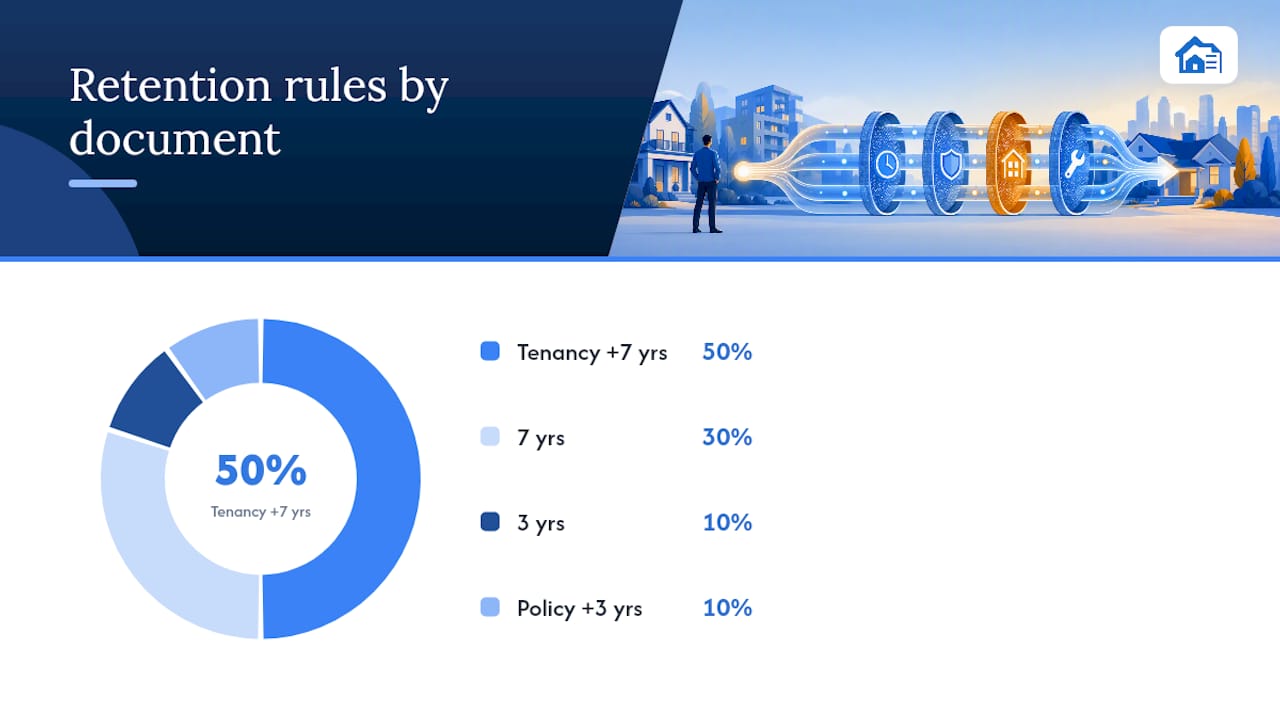
The table below maps each document to its minimum required fields and a practical retention window.
| Document | Minimum Fields | Retention Period |
|---|---|---|
| Rental application | Name, income, consent, signature, date | 3 years after denial or tenancy end |
| Signed lease | All parties, term, rent, fees, signatures | Tenancy term plus 7 years |
| Move-in checklist | Room conditions, photos, dual signatures, date | Duration of tenancy plus 7 years |
| Inspection reports | Date, findings, photos, follow-up actions | Duration of tenancy plus 7 years |
| Rent ledger | Payment dates, amounts, balance, method | 7 years (IRS audit window) |
| Security deposit records | Amount, deductions, return date, balance | 7 years after tenancy end |
| Notices served | Notice type, date, method, proof of service | 7 years or until any dispute resolves |
| Repair invoices | Date, vendor, amount, issue description | 7 years; longer for capital improvements |
| Correspondence logs | Date, channel, parties, summary | Duration of tenancy plus 7 years |
| Insurance certificates | Policy number, dates, coverage limits | Duration of policy plus 3 years |
For state-specific disclosure requirements, check your state attorney general’s website or a resource like essential landlord documents for new property owners before finalizing any template. The Fair Housing Act also governs the language you use in applications and notices, so review protected class requirements before drafting any tenant-facing form.
Why do landlord paperwork bottlenecks keep happening?
Most paperwork problems are not caused by laziness. They come from specific operational gaps that compound over time. Understanding the root cause makes the fix obvious.
Inconsistent templates. When each lease or notice is drafted from scratch or copied from an old version, fields get dropped and clauses go stale. AAOL recommends reviewing and updating lease templates annually to catch clauses that have become illegal or unenforceable under new state law. A landlord who skips this step may be enforcing a late fee that exceeds the local cap, which voids the clause entirely.
Manual data entry across multiple systems. Typing the same tenant name, unit number, and rent amount into a lease, a ledger, a deposit record, and a notice separately is where errors breed. One transposed digit in a rent amount can invalidate a pay-or-quit notice.
Mixed physical and digital filing. Paper leases in a drawer, email receipts in an inbox, and photos on a phone create three separate retrieval problems when a dispute arises. The landlord who can’t produce a signed move-in checklist within five minutes of a tenant’s damage claim is already at a disadvantage.
No file naming conventions. A folder full of files named scan001.pdf, lease_final_FINAL2.docx, and IMG_4892.jpg is functionally unsearchable. Without consistent naming, documents get duplicated, misfiled, or simply lost.
No deadline reminders. Notice periods, deposit return windows, and lease expiration dates are fixed by state law. Missing a deposit return deadline by even one day can cost a landlord double or triple damages in states with strict statutes.
Unclear responsibility when co-managing. Two landlords or a landlord and a property manager who both “handle paperwork” often both assume the other person filed the inspection report. The result is neither did.
Ad hoc communication channels. Maintenance requests that arrive by text, rent receipts sent by Venmo, and lease amendments emailed from a personal account create a scattered paper trail that is hard to reconstruct months later.
Pro Tip: Set up a simple email filter rule that automatically labels any message containing “rent,” “invoice,” or “repair” and moves it to a dedicated folder. Review that folder once a week and transfer the relevant items to the tenant’s digital file. This one rule catches most of the receipts and requests that would otherwise disappear into a general inbox.
The consequences are concrete. AGH Attorneys note that many landlord mistakes come from treating rental management informally, and that strong documentation and timely notices are the most reliable way to reduce expensive disputes. A missed deadline doesn’t just create inconvenience; it can waive your right to retain a security deposit or expose you to a discrimination claim if your screening language isn’t consistent.
How should you organize and store landlord paperwork?
The goal is a system where any document for any tenant can be found in under two minutes, by anyone with access. A property-centric folder structure achieves that.
Recommended folder structure:
/Properties
  /123-Main-St
    /Unit-1A
      /Tenant-Jane-Smith-2024-2026
        /Lease
        /Move-In
        /Inspections
        /Rent-Ledger
        /Notices
        /Repairs
        /Correspondence
        /Move-Out
    /Unit-2B
      ...
  /456-Oak-Ave
    ...
File naming convention: Use the format PROPERTY_UNIT_DOCTYPE_YYYY-MM-DD. Examples:
123Main_1A_Lease_2024-09-01.pdf123Main_1A_MoveInChecklist_2024-09-01.pdf123Main_1A_Notice30Day_2025-08-15.pdf
This naming pattern sorts chronologically by default and makes the document type immediately readable without opening the file.
Steps to convert scattered files into this structure over one weekend:
- Create the top-level folder structure for every active property and unit.
- Gather all physical documents and scan them using a free mobile scanner app (Adobe Scan or Microsoft Lens both produce searchable PDFs).
- Rename every scanned file using the naming convention above before saving.
- Move existing digital files into the correct folders and rename them to match.
- Delete duplicates. Keep only the most recent signed version of any document.
- Set a shared access rule: if a co-manager or property manager needs access, use a cloud folder (Google Drive or Dropbox) with view-only permissions for anyone who doesn’t need to edit.
- Schedule a monthly 15-minute review to file anything that accumulated outside the structure.
For physical originals, keep signed leases and move-in checklists as paper copies in a locked filing cabinet for the duration of the tenancy. Everything else can be digital-only with a cloud backup. Run a backup sync at least weekly.
Digital vs. physical storage at a glance:
Digital tenant file management also simplifies handoffs when you bring on a property manager or sell a property. A well-named folder structure transfers cleanly; a pile of paper does not.
For accounting integration, connect your rent ledger to software like QuickBooks or Wave. Map each income category (rent, late fees, pet fees) and each expense category (repairs, insurance, mortgage interest) to a consistent account name. Manual reconciliation is still necessary at tax time to catch any transaction that didn’t sync correctly, so plan for a quarterly 30-minute review of the ledger against your bank statement.
How do you handle time-sensitive notices without missing deadlines?
Notice errors are among the most expensive documentation mistakes a landlord can make. A notice served one day late, or missing a required field, can restart the entire clock or void the notice entirely.
Common notice types and why they’re served:
- Pay or quit: Tenant has not paid rent; landlord demands payment or vacates within the statutory period (commonly 3 days, but varies by state).
- Cure or quit: Tenant has violated a lease term (unauthorized pet, subletting); landlord demands the violation be corrected.
- Rent increase notice: Landlord is raising rent; must be served within the statutory advance notice window (30, 60, or 90 days depending on state and increase amount).
- Entry notice: Landlord needs to enter the unit for repairs or inspection; most states require 24 hours minimum advance written notice.
- Nonrenewal notice: Landlord will not renew the lease at expiration; advance notice period varies by state and tenancy length.
Proof of service options:
- Certified mail with return receipt: Creates a postal record with a delivery date. Best for formal notices where you need a paper trail.
- Personal delivery with signed receipt: Hand the notice directly to the tenant and have them sign a copy. Fastest and most unambiguous.
- Posting and mailing (substituted service): Post on the front door and mail a copy the same day. Allowed in many states when personal delivery fails; check local rules.
- Email with read receipt: Permitted in some states when the lease includes an electronic notice clause. Confirm your state allows it before relying on it.
Notice periods vary significantly by state. HUD’s tenant rights resources outline federal protections, but state law governs most notice timelines. Check your state statutes annually before serving any notice.
Pro Tip: Log every notice in a simple spreadsheet: notice type, date served, method, recipient, and a file path to the proof of service scan. Sort by date served. This log becomes your first line of defense if a tenant claims they never received a notice.
For eviction-related notice documentation, eviction process documentation guidance covers the specific records you’ll need at each stage. Also review your notice templates against Fair Housing Act requirements to confirm the language doesn’t inadvertently reference a protected class.
This article provides general information only. Notice requirements vary by state and locality. Confirm current rules with your state’s statutes or a licensed attorney before serving any notice.
How do you make inspections and move-out claims airtight?
A signed move-in checklist and a folder of timestamped photos are worth more than any verbal agreement when a tenant disputes a damage deduction. The process below removes ambiguity at every step.
Move-in inspection workflow:
- Complete the inspection before the tenant moves any belongings in.
- Walk every room with the tenant present and note the condition of walls, floors, fixtures, appliances, and any existing damage.
- Photograph every room from the doorway, then close-up shots of any existing damage. Name the folder
PROPERTY_UNIT_MoveIn_YYYY-MM-DD. - Have both the landlord and tenant sign the completed checklist the same day. Give the tenant a copy.
- Upload the signed checklist and photo folder to the tenant’s digital file before end of day.
For ongoing inspections, schedule them annually or at lease renewal. Use the same checklist format so conditions are directly comparable. Rental inspection documentation practices show how consistent formatting makes side-by-side comparison straightforward.
Move-out timeline:
- 30 days before lease end: Send a written move-out instructions notice (cleaning expectations, key return, forwarding address request).
- Day of move-out: Conduct the move-out inspection with the tenant if possible. Use the same checklist format as move-in.
- Within 24 hours of move-out: Complete the itemized deduction list. Attach repair invoices or estimates for any damage beyond normal wear and tear.
- Within the state’s statutory deadline: Return the deposit balance and the itemized deduction statement. Most states require this within 14–30 days; missing this window can cost you the right to retain any portion of the deposit.
The lease agreement checklist from Flat Fee Landlord identifies move-in inspection reports and security deposit handling as two of the most frequent sources of tenant disputes, which tracks with what happens in practice: landlords who skip the signed checklist at move-in have almost no leverage when a tenant denies causing damage.
For repair invoices that support deductions, attach the vendor invoice, the date of repair, and a photo of the completed work to the deduction letter. If you used your own labor, document the time and materials cost.
Pro Tip: Enable location metadata on your phone’s camera before every inspection. The GPS coordinates embedded in the photo file confirm the photo was taken at the property, not somewhere else. For extra tamper-proofing, upload photos to a cloud service with automatic timestamping (Google Photos or iCloud both log upload time) immediately after the inspection.

Move-in documentation practices and the move-out documentation checklist cover the full workflow in detail if you want a ready-to-use template.
What financial records do you need for taxes and audits?
The IRS can audit rental income up to three years after the filing date, and up to six years if income is substantially underreported. That window defines your minimum retention floor for most financial records.
Critical financial records to maintain:
- Rent ledger: The backbone of rental income reporting. Every payment, every month, every unit. Export to PDF at year-end and keep with your tax return.
- Bank deposit records: Match every rent payment in the ledger to a corresponding bank deposit. Discrepancies are the first thing an auditor flags.
- Repair and maintenance invoices: Deductible as ordinary business expenses in the year paid. Keep the invoice, the payment confirmation, and a one-line description of what was repaired.
- Capital improvement documentation: Improvements that extend the useful life of the property (new roof, HVAC replacement, kitchen remodel) are depreciated over time, not deducted in the year paid. Keep these records for as long as you own the property plus at least seven years after sale.
- 1099 forms: If you paid any contractor more than $600 in a calendar year, you’re required to issue a 1099-NEC. Keep copies of all 1099s issued and received.
- Mortgage and insurance statements: Mortgage interest and insurance premiums are deductible. Keep annual statements.
- Mileage and travel logs: If you drive to the property for management purposes, a mileage log supports the deduction.
Retention guide for financial records:
For audit-proof rental property documentation, the key is matching every income entry in the ledger to a bank record and every expense entry to an invoice. Gaps in either direction are what trigger follow-up questions.
Integrate your rent ledger with accounting software (QuickBooks, Wave, or FreshBooks all work for small portfolios) so income and expenses are categorized consistently throughout the year. This cuts the time spent preparing for tax season from days to hours.
Does automation actually reduce paperwork bottlenecks?
The short answer is yes, and the mechanism is straightforward: automation removes the manual steps where errors and delays concentrate.
Landlordforms research shows that automating document creation and reminders reduces time spent on paperwork and lowers common manual errors. For landlords managing multiple units, the time savings compound quickly because the same bottleneck (drafting a notice, updating a ledger, generating a receipt) repeats for every tenant every month.
The table below compares a manual workflow against an automated one across the most common recurring tasks.
| Task | Manual Workflow | Automated Workflow |
|---|---|---|
| Generating a 30-day notice | Draft from template, fill fields manually, print, serve | Auto-populate from tenant record, generate PDF, send |
| Updating rent ledger | Open spreadsheet, type payment date and amount | Payment logged automatically on receipt |
| Creating a rent receipt | Type receipt, email to tenant | Auto-generated and emailed on payment confirmation |
| Scheduling inspection reminder | Add manually to calendar | Recurring reminder set once at lease start |
| Tracking notice deadlines | Manual calendar entry per notice | Deadline auto-calculated from notice date |
A practical example: a landlord managing 12 units previously spent roughly two hours each month generating rent receipts, updating ledgers, and tracking which notices were due. After switching to automated notice generation and a single rent ledger per property, that same work took under 30 minutes, with fewer transcription errors and no missed deadlines. Organized tenant files with photo evidence and timestamps materially improve outcomes in deposit disputes and eviction hearings, which means the time saved on administration also reduces downstream legal costs.
Property management workflow efficiency comes down to removing the steps that require a human to re-enter information that already exists somewhere else. Automation handles that; the landlord handles judgment calls.
The single change that matters most
Most landlords who struggle with paperwork aren’t disorganized people. They’re people who started with one unit, handled it informally, and then added more units without ever formalizing the system. The paperwork didn’t pile up overnight; it accumulated one skipped step at a time.
The single most impactful change isn’t buying software or redesigning your filing system. It’s committing to one consistent template for every recurring document and using it every single time, without exception. A rent ledger you update once a week beats a sophisticated system you never open. A move-in checklist you actually sign beats a detailed template sitting unused on your desktop.
If I were starting this cleanup today, here’s what I’d do this week:
- Standardize the rent ledger first. It’s the document most likely to be requested in a dispute or audit, and it’s the easiest to start from scratch. Download a template, enter the last three months of payments, and commit to updating it within 24 hours of every payment going forward.
- Scan the oldest tenant file. Pick the tenant who has been in place the longest and scan every paper document in their file. Rename each file using the naming convention above. This gives you a working model for every other file.
- Set three calendar reminders. Lease expiration minus 60 days, deposit return deadline at move-out, and an annual lease template review. These three reminders prevent the most expensive deadline misses.
The trap to avoid is waiting until the system is perfect before using it. An imperfect ledger you maintain consistently is worth more than a perfect one you set up and abandon. Progress beats perfection every time.
Landlordforms cuts the time you spend on this
Eight hours a week on paperwork is a number that shows up repeatedly for landlords managing a handful of units manually. Landlordforms is built to cut that number down by handling the repetitive document work automatically, so you spend time on decisions, not data entry.
For landlords managing 1 to 150 units, Landlordforms automates the documents that create the most bottlenecks: state-specific 30-, 60-, and 3-day notices that auto-populate from your tenant records, rent receipts generated on payment confirmation, move-in and move-out checklists with photo logging, and a rent ledger that tracks payments in real time. Every document lives in one place, organized by property and tenant, so you’re never hunting through email or a filing cabinet when a dispute arises.
The fastest way to see the difference is to start with the free rent ledger template, which you can download and populate today. If you’re mid-lease and need to calculate a prorated amount, the rent proration calculator handles that in seconds. Both tools are free, and both give you a working foundation before you commit to anything.
Sources
- FTC — Disposing of Consumer Report Information: Rule tells how
- LeaseLenses — 10 common lease agreement mistakes landlords make (and how to avoid them)
- Flat Fee Landlord — Lease agreement checklist (2026)
- Nolo — Renters’ rights: documentation importance
This article is general information, not a substitute for advice from a qualified lawyer. Consult a qualified legal professional about your own circumstances before acting on anything here.
FAQ
What are the most common landlord-tenant issues?
The most frequent issues involve security deposit disputes, maintenance and habitability complaints, and notice delivery errors. Most of these disputes are easier to resolve, or avoid entirely, when the landlord has signed documentation, timestamped photos, and a complete rent ledger on file.
What paperwork mistakes do first-time landlords most often make?
First-time landlords most often skip the signed move-in condition checklist, use an outdated or generic lease template, and fail to track notice deadlines. Common lease errors include missing required disclosures and fee clauses that exceed state limits, both of which create legal exposure that a current, state-specific template prevents.
How long should landlords keep rental records?
Keep most financial records, including rent ledgers, repair invoices, and deposit records, for at least seven years to cover the standard IRS audit window. Capital improvement documentation should be kept for the life of the property plus at least seven years after sale, since it affects your cost basis and depreciation calculations.
What counts as landlord negligence in a documentation context?
Landlord negligence in a documentation context typically means failing to provide legally required notices, not returning a security deposit within the statutory deadline, or being unable to produce records that show the property was maintained. AGH Attorneys note that many landlord mistakes come from treating rental management informally, and that missing required documentation is one of the most common triggers for tenant legal action.
What are the red flags of poor landlord record-keeping?
The clearest red flags are no signed move-in checklist, a rent ledger with gaps or inconsistent entries, notices that lack proof of service, and repair invoices that can’t be matched to specific work orders. Any one of these gaps weakens your position in a dispute; all of them together make it very difficult to defend a deposit deduction or an eviction.